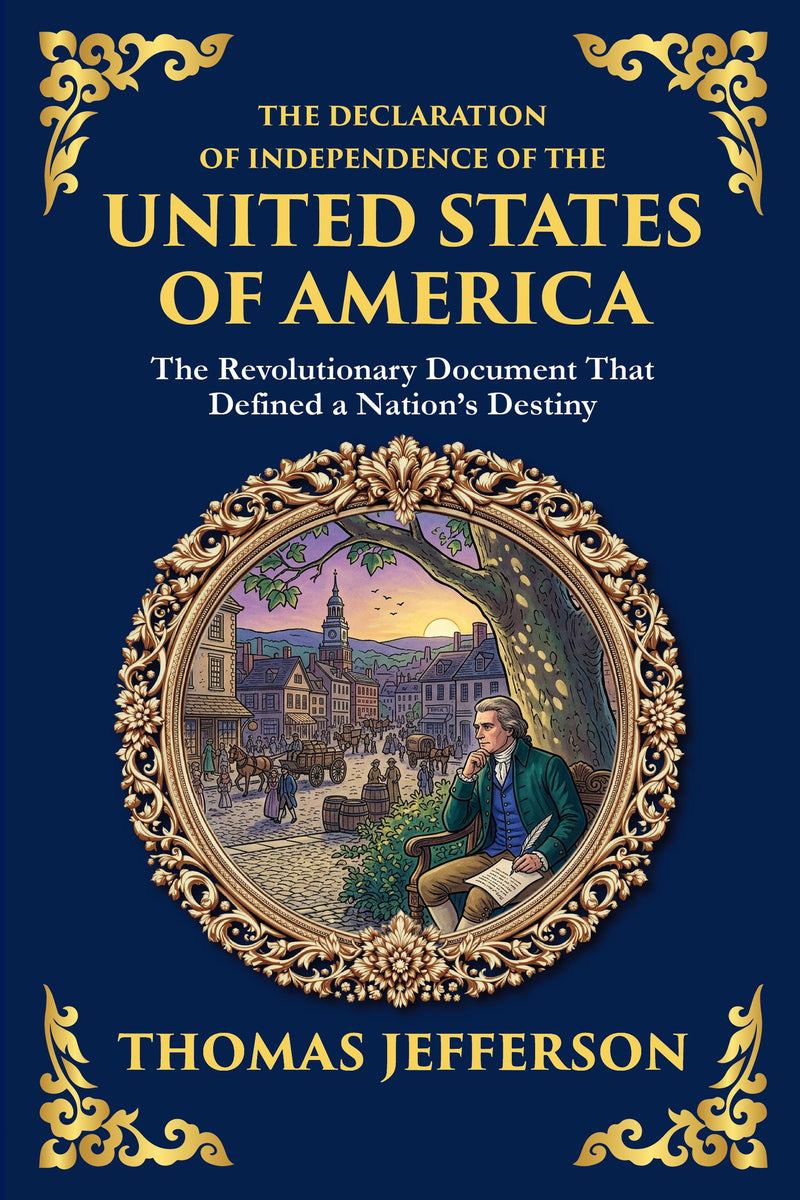
The Declaration of Independence of the United States of America — Large Print
Crafted in the crucible of revolution, The Declaration of Independence is more than a historical artifact—it is a bold manifesto of human freedom, justice, and the right to self-determination.
or free app
10,000+ hrs library
30-day guarantee
The complete The Declaration of Independence of the United States of America appears in modern English through Library of Alexandria Press, available online with audiobook narration included for members.
Have you ever wondered why a single page of writing changed the fate of the modern world? The Declaration of Independence of the United States of America is one of the most consequential and transformative documents in human history. More than a rejection of tyranny, it is a fearless proclamation of human dignity and universal rights.
Written during a time of rebellion and uncertainty, it is a literary triumph, a legal assertion, and a revolutionary act all in one. Authored primarily by Thomas Jefferson, with input from John Adams, Benjamin Franklin, and others, this document not only severed colonial ties with Great Britain but established the ideological foundation of the American republic. This edition offers the full original text, accompanied by a modern introduction and thought- provoking reflection on its enduring relevance in today’s world.
It asks: What does it truly mean to be free? Who gets to decide? And how do we protect those rights?
What you’ll discover in this modern edition
- in This Modern Presentation of America’s Founding Text:
- The Full Original Declaration – Presented in its entirety, preserving the language and spirit of the Revolution.
| Formats | eBook (EPUB + PDF) · Audiobook · Paperback · Hardcover · Large Print |
| Language | English |
| Trim size (print) | 6 × 9 in |
| Binding | Paperback — perfect-bound · Hardcover — casewrap |
| Large Print edition | Same text in a larger, easy-read type — a larger font, not a larger trim |
| Print pricing | Every physical book at our true cost — at-cost, no profit (members) |
| Library | 873 restored titles, always growing |
| Length | 4,980 words · ~20 min reading |
| Reading level | Grade 13 · a demanding, literary read (this modern-English edition) |
| Edition | Modern English translation · 2026 |
Member reviews for this edition are collected as readers finish it — be the first. Across the library: 12,000+ books shipped, every plan covered by a 365-day print guarantee.
About this edition
A faithful, unabridged modern-English edition by The Library of Alexandria — carefully rendered for today's reader and verified paragraph-by-paragraph against the public-domain source. Available as eBook, audiobook, paperback, hardcover, and large print.
- Complete & unabridgedVerified paragraph by paragraph against the source — never a scan, never abridged.
- Modern English, faithfulReadable today, with the author’s meaning kept intact. Readable — not simplified.
- Every format, one membershipRead in your browser or the free app, or listen to the full audiobook.
Included free with your membership
Cancel anytime, one click · 30-day money-back guarantee
Edition last updated July 2026
What’s inside
The Declaration of Independence of the United States of America — Large Print — complete and unabridged, included in full with membership, plus the full audiobook.
Begin reading The Declaration of Independence of the United States of America — Large Print
In clear modern English — the complete text is included with membership.
Introduction
There are documents that record history, and there are documents that make it. The text you are about to read belongs unmistakably to the second category. Composed in the sweltering Philadelphia summer of 1776, debated line by line in a crowded hall, and signed by men who knew that their signatures might one day be read aloud at their own trials for treason, this short composition altered the trajectory of human governance. It is, at once, a legal severance, a philosophical manifesto, a list of grievances, and a promise. And it is, perhaps above all, a piece of persuasive writing of such clarity and force that its central sentences have echoed across more than two centuries, crossing oceans and inspiring revolutions, constitutions, and reform movements far beyond the thirteen colonies that first proclaimed them.
This edition presents the Declaration in a modern translation, adapted carefully for the contemporary reader. That phrase deserves a moment of explanation, because it shapes everything that follows. The eighteenth-century English in which this document was originally written is magnificent, but it can also be daunting. Its sentences run long. Its vocabulary includes words that have shifted in meaning or fallen entirely out of common use. Its legal and rhetorical conventions belong to a world of powdered wigs, royal proclamations, and quill pens. For some readers, that distance is part of the pleasure; for many others, it becomes a barrier that obscures the very ideas the text was designed to communicate as widely and as forcefully as possible. The purpose of this adaptation is to remove that barrier without removing the power. The aim has been to render the meaning faithfully in language that a reader today can absorb at the speed of thought, so that the argument lands with the immediacy its authors intended.
Before you begin, it is worth pausing to consider what kind of reading experience awaits you, and how best to approach it. This is not a long book in terms of word count. The original Declaration can be read aloud in a matter of minutes. Yet it rewards slow reading more richly than almost any text of comparable length. Each clause was contested. Each phrase was weighed. The men who produced it understood that they were not merely announcing a decision but justifying it before “the opinions of mankind,” as the document itself puts it. They were writing for posterity as much as for their contemporaries, and they knew it. To read the Declaration well is to read it as one might read a poem or a piece of scripture: with attention to rhythm, repetition, and the deliberate placement of every word.
To appreciate what you are about to read, it helps to picture the circumstances under which it was written. In the early 1770s, the thirteen British colonies along the eastern seaboard of North America were not seeking to become a new nation. Most colonists thought of themselves as loyal British subjects who happened to live across an ocean from the seat of government. They spoke of “the rights of Englishmen” and expected to enjoy those rights in full. The trouble that eventually erupted into revolution began not as a demand for independence but as a protest against the way they were being governed from afar.
A series of taxes, restrictions, and administrative measures imposed by the British Parliament and Crown provoked mounting resentment. The colonists objected not merely to the burdens themselves but to the principle behind them: that a distant legislature, in which they had no elected representatives, could impose laws and levies upon them at will. The famous slogan “no taxation without representation” captures the heart of the grievance, but the underlying issue was deeper and more philosophical. It concerned the question of consent. By what right does any government govern? On whose authority do laws bind the people who must obey them? These were not new questions in 1776. They had occupied philosophers and political thinkers for generations. But in the American colonies, they ceased to be abstract and became urgent matters of daily life.
For more than a decade, the colonists petitioned, protested, boycotted, and negotiated. They sent representatives to plead their case. They organized assemblies and committees. They hoped, for a long time, that reconciliation was possible — that the British government would recognize their grievances and restore what they regarded as their rightful liberties. The decision to break away entirely came slowly and reluctantly for many. It was, by the standards of the time, an almost unthinkable step. To declare independence was to declare war against the most powerful empire on earth. It was to commit, in the eyes of the law, an act of treason punishable by death. The men who gathered in Philadelphia in the summer of 1776 were not reckless firebrands; many were prosperous, established figures with property, families, and reputations to lose. They acted because they had concluded that no other honorable course remained.
The Declaration, then, was not the opening move of the conflict but a kind of formal threshold. Fighting had already broken out between colonial militias and British forces more than a year before its adoption. What the document accomplished was to transform a rebellion into a revolution — to give the armed struggle a stated purpose and a moral foundation. It announced to the world that the colonies were no longer seeking redress within the British system but were claiming their place as a separate and equal nation among the powers of the earth. This was an extraordinary claim, and the authors knew it required justification. They could not simply assert that they were free; they had to explain why they were entitled to be.
That necessity is the key to understanding the structure of the document. It does not read like a single outpouring of emotion. It is built like an argument, and a remarkably tight one. It begins with a statement of general principles — claims about human nature, about rights, about the proper origin and purpose of government. It then applies those principles to the specific situation of the colonies, presenting a detailed catalogue of the wrongs they had suffered. Finally, it draws the conclusion that the principles and the facts together demand: that the colonies are, and of right ought to be, free and independent. The genius of the document lies partly in this logical architecture. It moves from the universal to the particular and back again, so that by the time you reach its final declaration, the conclusion feels not merely justified but inevitable.
The man whose name appears on this volume served as the document’s principal author, though it is important to understand that he did not work in isolation. He was chosen by a small committee to produce a draft, in part because of his acknowledged gift for clear and elegant prose. He worked quickly, drawing upon a deep well of reading in political philosophy, history, and law. The ideas he expressed were not, by his own admission, original to him. He was not trying to invent a new theory of government but to articulate, in the most compelling possible form, principles that were already widely shared among educated people of his era. His task, as he later described it, was to give voice to the common sense of the matter — to express what many believed in language that would command assent. The draft he produced was then reviewed and revised by his colleagues, who made a number of changes, some of which sharpened the text and some of which, in his own view, weakened it. The result was a collaborative document, but one that bears the unmistakable stamp of a single, brilliant pen.
It is worth dwelling for a moment on the quality of the writing itself, because it is one of the chief reasons the Declaration has endured. Many state papers of comparable importance are forgotten by all but specialists, read only as historical artifacts. This one is read for pleasure, quoted from memory, inscribed on monuments, and recited at public gatherings. The reason is that it is beautifully made. Its most famous sentences achieve a balance between grandeur and simplicity that few writers in any age have matched. They are dignified without being pompous, philosophical without being obscure, passionate without being shrill. They have the cadence of speech meant to be spoken aloud and the precision of language meant to be examined closely. Even in translation and adaptation, that quality survives, because it inheres not only in the particular words but in the shape of the thought itself.
A few words about the experience of reading this particular version will help you get the most from it. Because this is a modern adaptation, you will not encounter the archaic spellings, the elaborate capitalization, and the sometimes labyrinthine sentence structures of the original. Where the eighteenth-century text might use a word that no longer carries its old meaning, this edition substitutes a word that conveys the intended sense to a present-day reader. Where a sentence in the original sprawls across many clauses in a way that taxes modern attention, this edition has, where appropriate, clarified the relationships among those clauses so that the logic remains visible. The goal throughout has been fidelity to meaning rather than slavish reproduction of form.
Some readers, encountering a beloved historical document in adapted form, may wonder whether something essential is lost in the process. This is a fair concern, and it deserves an honest answer. Any translation or adaptation involves choices, and every choice involves a trade-off. What is gained is accessibility: the ability to read the document straight through and grasp its argument without stopping to puzzle over unfamiliar usages. What is risked is the particular flavor of the original’s prose, the texture of its eighteenth-century voice. This edition has tried to minimize that risk by preserving the rhythm and dignity of the original wherever possible, and by treating the most famous and most carefully crafted passages with special reverence. The aim is not to replace the original but to open a door to it — to give the reader a clear and confident first encounter, after which the original, should the reader choose to seek it out, will seem far less forbidding.
There is a particular pleasure in reading a document like this one when you can actually follow its argument. So much of the Declaration’s reputation rests on a handful of phrases that have been quoted and re-quoted until they have almost become detached from their context. We hear them so often that we may cease to hear them at all. One of the rewards of reading the full text, in language that flows easily, is the chance to encounter those famous lines in their proper setting and to see how they function within the larger structure. The ringing opening assertions are not isolated slogans; they are premises in an argument. They are introduced for a reason, and that reason becomes clear only when you read on. Similarly, the long central section — the catalogue of grievances against the British Crown — is often skipped or skimmed by casual readers, who regard it as a tedious list. But it is precisely this section that gives the document its evidentiary force. The opening principles tell us when a people is justified in altering or abolishing its government; the catalogue of grievances supplies the proof that, in this particular case, the conditions for such an action have been met. To skip the list is to read only the conclusion of a syllogism while ignoring its supporting premise.
I would encourage you, therefore, to read the whole thing, and to read it more than once. On a first reading, simply let the argument carry you along. Notice how it builds, how each part prepares for the next, how the tone shifts from the measured calm of the philosophical opening to the mounting indignation of the grievances and finally to the solemn resolve of the conclusion. On a second reading, slow down. Pay attention to individual phrases. Ask yourself what each claim actually means and whether you find it persuasive. Consider how the authors anticipated and answered objections. Notice the careful qualifications — the insistence, for instance, that governments long established should not be changed for light and transient causes, and that people are more disposed to suffer evils than to right themselves by abolishing the forms to which they are accustomed. These are not the words of hotheaded revolutionaries. They are the words of cautious men who wanted to make clear that they had not arrived at their decision lightly.
Cancel anytime, one click · 30-day money-back guarantee
Founding annual rate available now — your price locks for life when you join.
Not ready? Get this free chapter by email — read it anytime.
✓ Sent — check your inbox for The Declaration of Independence of the United States of America — Large Print.
Questions about The Declaration of Independence of the United States of America — Large Print
What is The Declaration of Independence of the United States of America about?
Crafted in the crucible of revolution, The Declaration of Independence is more than a historical artifact—it is a bold manifesto of human freedom, justice, and the right to self-determination. Penned primarily by Thomas Jefferson in 1776, this short but monumental document ignited the birth of a new nation and reshaped the political destiny of the world. This modern edition presents the Declaration with fresh context and accessible commentary— reminding us why its ideals still resonate, inspire, and challenge us to
Who wrote The Declaration of Independence of the United States of America?
The Declaration of Independence of the United States of America was written by Thomas Jefferson. This edition presents the complete work in clear modern English, faithfully rendered from the public-domain original by Library of Alexandria Press.
Is The Declaration of Independence of the United States of America free to read?
The opening chapter is free to read on this page. Members read and listen to the complete work — and the entire library — free, and can order any physical book at our true print cost.
How long is The Declaration of Independence of the United States of America?
2 chapters (~4,980 words) — about 20 min of reading in this modern-English edition.
Is this an abridged version of The Declaration of Independence of the United States of America?
No. This is the complete, unabridged The Declaration of Independence of the United States of America, carefully rendered into clear modern English and verified paragraph-by-paragraph against the public-domain source — nothing is cut or summarised.
What formats does The Declaration of Independence of the United States of America come in?
The Declaration of Independence of the United States of America is available as eBook, paperback, hardcover and large print. eBook and audiobook are included with membership; printed editions ship at our true print cost.
Shipping & returns
Billing & membership
More from the library


Explore History
- The Advancement of Learning · Francis Bacon
- Democracy in America — Volume 2 · Alexis de Tocqueville
- Second Treatise of Government · John Locke
- The Prince · Niccolò Machiavelli
- Society in America, Volume 1 (of 2) · Harriet Martineau
- The Everlasting Man · G. K. Chesterton
- The Book of Tea · Kakuzo Okakura
- The Japanese Spirit · Yoshisaburo Okakura
- Give Me Liberty or Give Me Death · Patrick Henry
- Ion · Plato
- John F. Kennedy’s Inaugural Address · John F. Kennedy
- The Declaration of Independence of the United States of America · Thomas Jefferson
- On Heroes, Hero-Worship, and the Heroic in History · Thomas Carlyle
- The Communist Manifesto
- The Souls of Black Folk · W. E. B. Du Bois
- Letters on the Equality of the Sexes, and the Condition of Woman · Sarah Grimké
- The Romance of Biography (Vol. 1 of 2) · Mrs. Jameson
- The Erotic Motive in Literature · Albert Mordell
The Declaration of Independence of the United States of America — Large Print
The Declaration of Independence of the United States of America — Large Print
The Revolutionary Document That Defined a Nation’s Destiny
Thomas Jefferson
Contents
- Introduction
- The Declaration of Independence of the United States of America
Introduction
There are documents that record history, and there are documents that make it. The text you are about to read belongs unmistakably to the second category. Composed in the sweltering Philadelphia summer of 1776, debated line by line in a crowded hall, and signed by men who knew that their signatures might one day be read aloud at their own trials for treason, this short composition altered the trajectory of human governance. It is, at once, a legal severance, a philosophical manifesto, a list of grievances, and a promise. And it is, perhaps above all, a piece of persuasive writing of such clarity and force that its central sentences have echoed across more than two centuries, crossing oceans and inspiring revolutions, constitutions, and reform movements far beyond the thirteen colonies that first proclaimed them.
This edition presents the Declaration in a modern translation, adapted carefully for the contemporary reader. That phrase deserves a moment of explanation, because it shapes everything that follows. The eighteenth-century English in which this document was originally written is magnificent, but it can also be daunting. Its sentences run long. Its vocabulary includes words that have shifted in meaning or fallen entirely out of common use. Its legal and rhetorical conventions belong to a world of powdered wigs, royal proclamations, and quill pens. For some readers, that distance is part of the pleasure; for many others, it becomes a barrier that obscures the very ideas the text was designed to communicate as widely and as forcefully as possible. The purpose of this adaptation is to remove that barrier without removing the power. The aim has been to render the meaning faithfully in language that a reader today can absorb at the speed of thought, so that the argument lands with the immediacy its authors intended.
Before you begin, it is worth pausing to consider what kind of reading experience awaits you, and how best to approach it. This is not a long book in terms of word count. The original Declaration can be read aloud in a matter of minutes. Yet it rewards slow reading more richly than almost any text of comparable length. Each clause was contested. Each phrase was weighed. The men who produced it understood that they were not merely announcing a decision but justifying it before “the opinions of mankind,” as the document itself puts it. They were writing for posterity as much as for their contemporaries, and they knew it. To read the Declaration well is to read it as one might read a poem or a piece of scripture: with attention to rhythm, repetition, and the deliberate placement of every word.
To appreciate what you are about to read, it helps to picture the circumstances under which it was written. In the early 1770s, the thirteen British colonies along the eastern seaboard of North America were not seeking to become a new nation. Most colonists thought of themselves as loyal British subjects who happened to live across an ocean from the seat of government. They spoke of “the rights of Englishmen” and expected to enjoy those rights in full. The trouble that eventually erupted into revolution began not as a demand for independence but as a protest against the way they were being governed from afar.
A series of taxes, restrictions, and administrative measures imposed by the British Parliament and Crown provoked mounting resentment. The colonists objected not merely to the burdens themselves but to the principle behind them: that a distant legislature, in which they had no elected representatives, could impose laws and levies upon them at will. The famous slogan “no taxation without representation” captures the heart of the grievance, but the underlying issue was deeper and more philosophical. It concerned the question of consent. By what right does any government govern? On whose authority do laws bind the people who must obey them? These were not new questions in 1776. They had occupied philosophers and political thinkers for generations. But in the American colonies, they ceased to be abstract and became urgent matters of daily life.
For more than a decade, the colonists petitioned, protested, boycotted, and negotiated. They sent representatives to plead their case. They organized assemblies and committees. They hoped, for a long time, that reconciliation was possible — that the British government would recognize their grievances and restore what they regarded as their rightful liberties. The decision to break away entirely came slowly and reluctantly for many. It was, by the standards of the time, an almost unthinkable step. To declare independence was to declare war against the most powerful empire on earth. It was to commit, in the eyes of the law, an act of treason punishable by death. The men who gathered in Philadelphia in the summer of 1776 were not reckless firebrands; many were prosperous, established figures with property, families, and reputations to lose. They acted because they had concluded that no other honorable course remained.
The Declaration, then, was not the opening move of the conflict but a kind of formal threshold. Fighting had already broken out between colonial militias and British forces more than a year before its adoption. What the document accomplished was to transform a rebellion into a revolution — to give the armed struggle a stated purpose and a moral foundation. It announced to the world that the colonies were no longer seeking redress within the British system but were claiming their place as a separate and equal nation among the powers of the earth. This was an extraordinary claim, and the authors knew it required justification. They could not simply assert that they were free; they had to explain why they were entitled to be.
That necessity is the key to understanding the structure of the document. It does not read like a single outpouring of emotion. It is built like an argument, and a remarkably tight one. It begins with a statement of general principles — claims about human nature, about rights, about the proper origin and purpose of government. It then applies those principles to the specific situation of the colonies, presenting a detailed catalogue of the wrongs they had suffered. Finally, it draws the conclusion that the principles and the facts together demand: that the colonies are, and of right ought to be, free and independent. The genius of the document lies partly in this logical architecture. It moves from the universal to the particular and back again, so that by the time you reach its final declaration, the conclusion feels not merely justified but inevitable.
The man whose name appears on this volume served as the document’s principal author, though it is important to understand that he did not work in isolation. He was chosen by a small committee to produce a draft, in part because of his acknowledged gift for clear and elegant prose. He worked quickly, drawing upon a deep well of reading in political philosophy, history, and law. The ideas he expressed were not, by his own admission, original to him. He was not trying to invent a new theory of government but to articulate, in the most compelling possible form, principles that were already widely shared among educated people of his era. His task, as he later described it, was to give voice to the common sense of the matter — to express what many believed in language that would command assent. The draft he produced was then reviewed and revised by his colleagues, who made a number of changes, some of which sharpened the text and some of which, in his own view, weakened it. The result was a collaborative document, but one that bears the unmistakable stamp of a single, brilliant pen.
It is worth dwelling for a moment on the quality of the writing itself, because it is one of the chief reasons the Declaration has endured. Many state papers of comparable importance are forgotten by all but specialists, read only as historical artifacts. This one is read for pleasure, quoted from memory, inscribed on monuments, and recited at public gatherings. The reason is that it is beautifully made. Its most famous sentences achieve a balance between grandeur and simplicity that few writers in any age have matched. They are dignified without being pompous, philosophical without being obscure, passionate without being shrill. They have the cadence of speech meant to be spoken aloud and the precision of language meant to be examined closely. Even in translation and adaptation, that quality survives, because it inheres not only in the particular words but in the shape of the thought itself.
A few words about the experience of reading this particular version will help you get the most from it. Because this is a modern adaptation, you will not encounter the archaic spellings, the elaborate capitalization, and the sometimes labyrinthine sentence structures of the original. Where the eighteenth-century text might use a word that no longer carries its old meaning, this edition substitutes a word that conveys the intended sense to a present-day reader. Where a sentence in the original sprawls across many clauses in a way that taxes modern attention, this edition has, where appropriate, clarified the relationships among those clauses so that the logic remains visible. The goal throughout has been fidelity to meaning rather than slavish reproduction of form.
Some readers, encountering a beloved historical document in adapted form, may wonder whether something essential is lost in the process. This is a fair concern, and it deserves an honest answer. Any translation or adaptation involves choices, and every choice involves a trade-off. What is gained is accessibility: the ability to read the document straight through and grasp its argument without stopping to puzzle over unfamiliar usages. What is risked is the particular flavor of the original’s prose, the texture of its eighteenth-century voice. This edition has tried to minimize that risk by preserving the rhythm and dignity of the original wherever possible, and by treating the most famous and most carefully crafted passages with special reverence. The aim is not to replace the original but to open a door to it — to give the reader a clear and confident first encounter, after which the original, should the reader choose to seek it out, will seem far less forbidding.
There is a particular pleasure in reading a document like this one when you can actually follow its argument. So much of the Declaration’s reputation rests on a handful of phrases that have been quoted and re-quoted until they have almost become detached from their context. We hear them so often that we may cease to hear them at all. One of the rewards of reading the full text, in language that flows easily, is the chance to encounter those famous lines in their proper setting and to see how they function within the larger structure. The ringing opening assertions are not isolated slogans; they are premises in an argument. They are introduced for a reason, and that reason becomes clear only when you read on. Similarly, the long central section — the catalogue of grievances against the British Crown — is often skipped or skimmed by casual readers, who regard it as a tedious list. But it is precisely this section that gives the document its evidentiary force. The opening principles tell us when a people is justified in altering or abolishing its government; the catalogue of grievances supplies the proof that, in this particular case, the conditions for such an action have been met. To skip the list is to read only the conclusion of a syllogism while ignoring its supporting premise.
I would encourage you, therefore, to read the whole thing, and to read it more than once. On a first reading, simply let the argument carry you along. Notice how it builds, how each part prepares for the next, how the tone shifts from the measured calm of the philosophical opening to the mounting indignation of the grievances and finally to the solemn resolve of the conclusion. On a second reading, slow down. Pay attention to individual phrases. Ask yourself what each claim actually means and whether you find it persuasive. Consider how the authors anticipated and answered objections. Notice the careful qualifications — the insistence, for instance, that governments long established should not be changed for light and transient causes, and that people are more disposed to suffer evils than to right themselves by abolishing the forms to which they are accustomed. These are not the words of hotheaded revolutionaries. They are the words of cautious men who wanted to make clear that they had not arrived at their decision lightly.
When the course of human events makes it necessary for one group of people to break the political ties that have connected them to another, and to take their place among the nations of the earth as a separate and equal power—a right granted to them by the laws of nature and the God of nature—common decency requires that they explain the reasons why they are separating.
We believe these truths are obvious: that all people are created equal, and that they are given by their Creator certain rights that cannot be taken away, including Life, Liberty, and the pursuit of Happiness. To protect these rights, people establish governments, which get their legal power from the consent of the people they govern. Whenever any form of government stops protecting these goals, the people have the right to change it or get rid of it and start a new government. This new government should be based on principles and organized in a way that the people believe will best ensure their safety and happiness. Common sense tells us that long-standing governments should not be changed for minor or temporary reasons. Experience shows that people are generally more willing to put up with suffering, as long as it is tolerable, than to fix the problem by getting rid of the systems they are used to. But when a long series of abuses and power grabs, all aiming for the same goal, shows a clear plan to put the people under absolute dictatorship, it is their right and their duty to overthrow that government and set up new protections for their future security. This is what these colonies have patiently endured, and this is why they must now change their old system of government. The history of the current King of Great Britain is a history of repeated injuries and power grabs, all intended to establish an absolute tyranny over these states. To prove this, let the facts be presented to the world.
End of the free sample
Keep reading, free
Members read and listen to the complete book — and the entire library. Cancel anytime, one click · 30-day money-back guarantee.