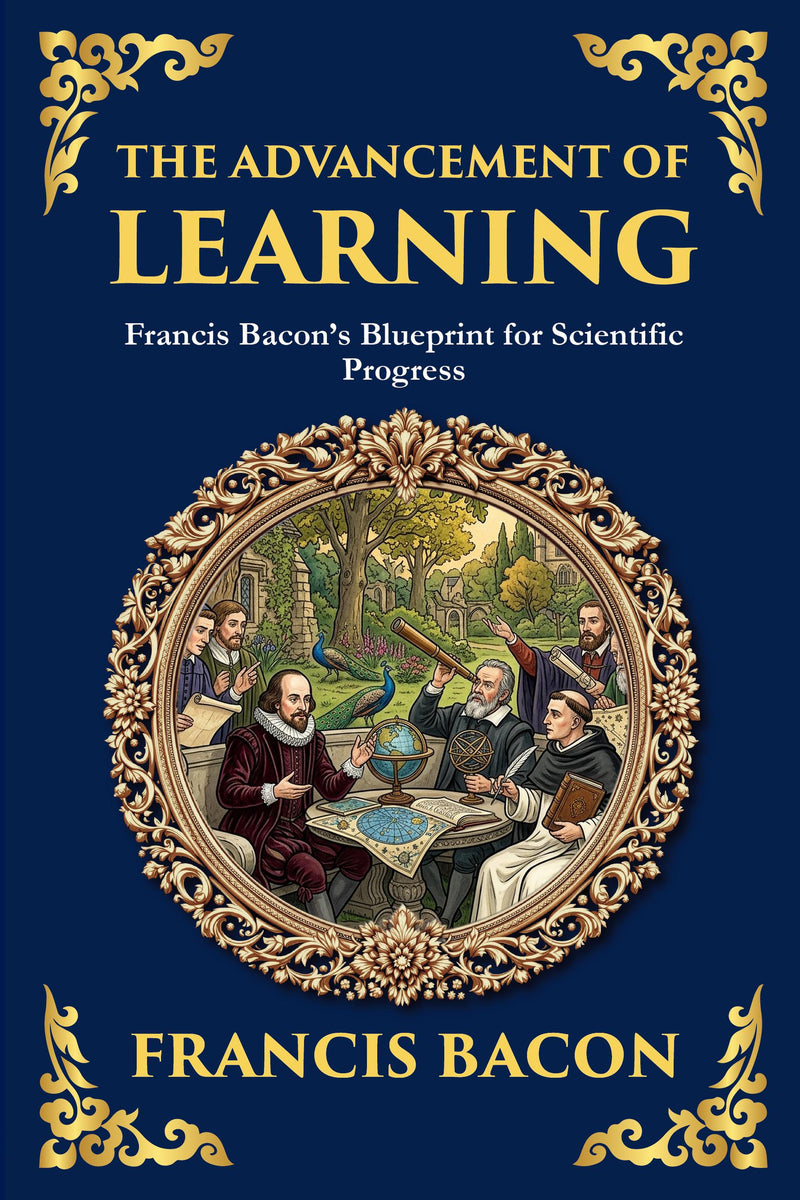
The Advancement of Learning — Large Print
At the dawn of the modern age, one mind dared to redefine how humanity learns, explores, and evolves. The Advancement of Learning is Francis Bacon’s seminal call for the renewal of intellectual inquiry—an impassioned plea to abandon dogma, embrace empirical method, and place knowledge at the center of human progress.
or free app
10,000+ hrs library
30-day guarantee
The complete The Advancement of Learning appears in modern English through Library of Alexandria Press, available online with audiobook narration included for members.
Have you ever wondered why the pursuit of knowledge became the engine of modern civilization? The Advancement of Learning by Francis Bacon is a landmark work that challenged the intellectual status quo of its time and launched a revolution in human thought. Written in 1605, it presents a persuasive and visionary case for empirical reasoning as the foundation for all progress—scientific, societal, and spiritual.
This work is not only a powerful critique of outdated modes of thinking but also a forward- looking manifesto for intellectual reform. Bacon criticizes the medieval obsession with abstract logic and empty rhetoric, urging scholars and institutions to base learning on evidence, observation, and the systematic pursuit of truth. His proposed reorganization of knowledge, structured by method rather than tradition, laid the foundation for modern science.
This modern edition makes Bacon’s 17th-century prose accessible to 21st-century readers while preserving the gravity and brilliance of his insights. It is a must-read for anyone interested in philosophy, science, education, or the history of ideas.
What you’ll discover in this modern edition
- A Bold Call for Intellectual Renewal – Understand how Bacon’s critique of academic stagnation reshaped the Western approach to learning.
- The Foundation of the Scientific Method – Learn how Bacon’s insistence on induction, experimentation, and observation paved the way for the scientific revolution.
- A New Architecture of Knowledge – Explore Bacon’s vision of a restructured system of learning, where disciplines connect and progress together.
- A Rejection of Dogma and Rhetoric – Discover why Bacon demanded truth over tradition and clarity over complexity.
- A Visionary Blueprint for Discovery – See how Bacon’s ideas continue to inform modern research, innovation, and education.
| Formats | eBook (EPUB + PDF) · Audiobook · Paperback · Hardcover · Large Print |
| Language | English |
| Trim size (print) | 6 × 9 in |
| Binding | Paperback — perfect-bound · Hardcover — casewrap |
| Large Print edition | Same text in a larger, easy-read type — a larger font, not a larger trim |
| Print pricing | Every physical book at our true cost — at-cost, no profit (members) |
| Library | 873 restored titles, always growing |
| Length | 81,178 words · ~5 hr 25 min reading |
| Reading level | Grade 3 · an easy, flowing read (this modern-English edition) |
| Edition | Modern English translation · 2026 |
Member reviews for this edition are collected as readers finish it — be the first. Across the library: 12,000+ books shipped, every plan covered by a 365-day print guarantee.
About this edition
A faithful, unabridged modern-English edition by The Library of Alexandria — carefully rendered for today's reader and verified paragraph-by-paragraph against the public-domain source. Available as eBook, audiobook, paperback, hardcover, and large print.
- Complete & unabridgedVerified paragraph by paragraph against the source — never a scan, never abridged.
- Modern English, faithfulReadable today, with the author’s meaning kept intact. Readable — not simplified.
- Every format, one membershipRead in your browser or the free app, or listen to the full audiobook.
Included free with your membership
Cancel anytime, one click · 30-day money-back guarantee
Edition last updated July 2026
What’s inside
The Advancement of Learning — Large Print — complete and unabridged: all 7 sections included with membership, plus the full audiobook.
Begin reading The Advancement of Learning — Large Print
In clear modern English — the complete text is included with membership.
Introduction
When Francis Bacon set down the words that would become The Advancement of Learning, he was not merely writing a book. He was attempting to redraw the boundaries of human possibility. Published in 1605 and addressed to King James I of England, the work arrived at a moment when the very nature of knowledge stood at a crossroads. The medieval inheritance of scholastic philosophy still dominated the universities, and the long shadow of Aristotle stretched across nearly every field of inquiry. Yet a new spirit was stirring in Europe—a restless, questioning energy that would, within a few generations, give birth to what we now call modern science. Bacon stood at the leading edge of that transformation, and in these pages he offered something audacious: a comprehensive survey of all that humanity then knew, a diagnosis of what was wrong with how that knowledge had been pursued, and a visionary blueprint for how it might be pursued better.
To read this work today, even in a modern translation crafted for the contemporary reader, is to encounter a mind that refused to accept the limits of its age. Bacon believed that human understanding had stalled, that scholars spun elaborate webs of argument without ever testing them against the hard surface of reality. He believed, too, that the right method of inquiry could lift the human condition out of ignorance and want, multiplying our power over nature and improving the practical circumstances of ordinary life. These convictions, radical in their time, have since become so woven into our assumptions about progress that we scarcely notice them. We take for granted that knowledge advances, that experiments reveal truth, that science improves the world. Bacon helped invent these expectations. To meet him here is to meet the architect of a mental universe we still inhabit.
Francis Bacon was born in 1561, the youngest son of Sir Nicholas Bacon, Lord Keeper of the Great Seal under Queen Elizabeth I. He grew up amid the intricate machinery of the Elizabethan court, surrounded by statesmen, lawyers, and the ambitious currents of Tudor politics. Educated at Trinity College, Cambridge, he developed early on a deep dissatisfaction with the prevailing system of learning. The young Bacon found the reverence for Aristotle stifling, the endless verbal disputations of the schoolmen sterile, and the prevailing methods of inquiry curiously detached from anything that might actually improve human life. This dissatisfaction never left him. It became, in many ways, the great theme of his intellectual career.
Bacon pursued a long and turbulent public life. He rose through the ranks of law and government, eventually becoming Lord Chancellor of England under James I, before a sudden and dramatic fall from power following accusations of bribery. Yet throughout his career as a statesman, he never abandoned his deeper ambition: the reform of knowledge itself. He envisioned a vast philosophical project, which he called the Instauratio Magna—the “Great Instauration” or great renewal—of human learning. The Advancement of Learning represents an early and crucial installment in this lifelong undertaking. It was, in a sense, the opening movement of a symphony Bacon would never fully complete, a preliminary mapping of the territory he hoped to transform.
What makes Bacon so compelling, and what gives this book its enduring force, is the peculiar position he occupied in history. He stood at a genuine threshold. Behind him lay the medieval and Renaissance worlds, with their reverence for ancient authority, their faith in the perfection of classical wisdom, and their tendency to treat philosophy as a matter of refining and interpreting inherited texts. Ahead of him lay the world of experimental science, of Galileo and Newton, of laboratories and instruments and the patient accumulation of empirical evidence. Bacon faced forward. He sensed, with extraordinary clarity, that the future of human understanding lay not in commentary upon the past but in fresh, direct engagement with the natural world.
Yet he was not a scientist in the modern sense. He performed few experiments of lasting consequence, and some of his specific scientific claims have not survived the test of time. His genius was of a different order. He was a philosopher of method, a theorist of how knowledge ought to be sought, organized, and applied. He saw that the problem was not a lack of intelligence among scholars—there had been brilliant minds in every age—but a flaw in the very approach to learning. People reasoned too quickly from too little evidence. They fell in love with their own theories and bent the facts to fit them. They mistook words for things and elaborate arguments for genuine discoveries. Bacon proposed to clear away these obstacles and to establish learning on firmer, more fruitful foundations.
In The Advancement of Learning, this critical project unfolds in two great movements. The first is a defense of learning itself against those who would disparage it—the skeptics who claimed that knowledge bred pride, distraction, or moral corruption. Bacon answers these objections with eloquence and force, arguing that learning, rightly pursued, is among the noblest of human activities and one of the surest means of human improvement. The second movement is far more ambitious: a sweeping survey of the entire landscape of human knowledge, in which Bacon catalogs what is known, identifies the gaps and deficiencies in each field, and points toward the work that remains to be done. It is an intellectual map of the known world, drawn by a cartographer who is acutely aware of how much of the map remains blank.
This survey is itself an extraordinary achievement. Bacon moves across history, poetry, natural philosophy, medicine, politics, ethics, theology, and much else besides, treating each domain with a discerning eye for both its accomplishments and its failures. He is unfailingly precise about where existing knowledge falls short—where a discipline has been neglected, where it has gone astray, where it has been confused with something else, or where it has simply never been attempted at all. In doing so, he was effectively writing a research agenda for the centuries that followed. Many of the “deficiencies” he identified were eventually addressed by later thinkers, sometimes directly inspired by his words.
It is worth dwelling for a moment on the boldness of this enterprise. To survey all of human knowledge and pronounce judgment upon its strengths and weaknesses requires a confidence that borders on the heroic. Bacon possessed that confidence, but it was tempered by a profound humility about the limits of what humanity had thus far achieved. He believed that the learning of his own age, for all its sophistication, was still in its infancy—that future generations would look back on the knowledge of the early seventeenth century as primitive and incomplete. This is a remarkable stance. It reverses the customary reverence for the ancients, which held that the wisest had already lived and that later ages could only decline from a golden past. Bacon insisted instead that the best was yet to come, that knowledge would grow and compound over time, and that each generation could build upon the work of its predecessors to reach heights the ancients never dreamed of. This idea of progress—so familiar to us, so foundational to the modern outlook—was in Bacon’s day a genuine innovation.
The Method, the Idols, and the Vision of Progress
At the heart of Bacon’s project lies a conviction about how knowledge should be gathered. Though The Advancement of Learning is primarily a survey and a defense rather than a detailed manual of method, it lays the groundwork for the more systematic account Bacon would later give in his Latin masterwork, the Novum Organum, or “New Instrument.” The phrase itself is telling. Aristotle’s logical writings had long been known collectively as the Organon, the “instrument” of reasoning. Bacon proposed to replace this ancient instrument with a new one, better suited to the discovery of truth. The old logic, he argued, was good for winning arguments but useless for making discoveries. It started from accepted premises and drew conclusions from them, but it had no way of arriving at genuinely new knowledge about the world.
What Bacon proposed instead was a method grounded in observation and experiment, in the careful and patient accumulation of facts, followed by a gradual and disciplined ascent toward general principles. Rather than leaping immediately from a few observations to sweeping conclusions, the inquirer should gather evidence methodically, organize it, test it, and only then draw cautious generalizations—generalizations that would themselves be subjected to further testing. This is the seed of what we now call the scientific method, and while later thinkers refined and corrected Bacon’s specific procedures, the basic orientation he championed—toward evidence, experiment, and humility before the facts—became the defining feature of modern science.
But before this new method could take hold, Bacon believed, the mind had to be cleared of certain deep-seated errors. In his later work he would name these errors the “Idols of the Mind,” and the concept is so central to his thought that it is worth introducing here. Bacon identified several categories of mental distortion that systematically lead human beings astray. There are the errors common to all humanity, arising from the very nature of our minds and senses, which tend to impose more order and regularity on the world than actually exists. There are the errors peculiar to each individual, arising from temperament, education, habit, and personal obsession. There are the errors that arise from language itself, from the way words shape and sometimes distort our thinking, leading us to argue about names and definitions as though they were realities. And there are the errors inherited from received philosophical systems and false methods of demonstration, which we accept uncritically because they have the prestige of tradition behind them.
This analysis of the obstacles to clear thinking is one of Bacon’s most enduring contributions. He understood, centuries before the rise of modern psychology, that the human mind is not a neutral mirror passively reflecting the world. It is an active, distorting instrument, prone to wishful thinking, to seeing patterns where none exist, to clinging to beliefs once they are formed, and to being captured by the words we use. To know the truth, we must first become aware of these tendencies and guard against them. This insight remains startlingly relevant. In an age awash in information and misinformation, Bacon’s warnings about the ways our minds deceive us read like a manual for intellectual self-defense.
Yet for all his emphasis on method and on the correction of error, Bacon never lost sight of the larger purpose behind his project. Knowledge, for him, was not an end in itself, to be pursued for the mere pleasure of knowing or the satisfaction of curiosity. Knowledge was power—a phrase associated with Bacon and capturing something essential in his philosophy. He believed that the proper aim of learning was the improvement of the human condition, the relief of suffering, the expansion of human capability, and the dominion of humanity over the forces of nature. In an age of disease, scarcity, and short life expectancy, this was no idle aspiration. Bacon dreamed of a future in which the systematic study of nature would yield practical benefits—new technologies, new medicines, new sources of abundance—that would lift the burden of toil and want from human shoulders.
This vision found its most memorable expression in another of Bacon’s works, the unfinished utopian fable New Atlantis, in which he imagined an ideal society organized around a great research institution dedicated to the discovery and application of natural knowledge. That institution, which Bacon called Salomon’s House, was a fictional anticipation of the modern research university and the scientific academy. Indeed, when the Royal Society of London—one of the world’s oldest scientific institutions—was founded later in the seventeenth century, its members explicitly looked to Bacon as their inspiration and guide. The collaborative, cumulative, institutionally organized pursuit of knowledge that defines modern science owes a profound debt to Bacon’s imagination. He understood that the advancement of learning could not be the work of isolated geniuses alone. It required cooperation, communication, the sharing of findings, the division of labor, and the patient effort of many hands and many generations working toward a common goal.
Cancel anytime, one click · 30-day money-back guarantee
Founding annual rate available now — your price locks for life when you join.
Not ready? Get this free chapter by email — read it anytime.
✓ Sent — check your inbox for The Advancement of Learning — Large Print.
Questions about The Advancement of Learning — Large Print
What is The Advancement of Learning about?
At the dawn of the modern age, one mind dared to redefine how humanity learns, explores, and evolves. The Advancement of Learning is Francis Bacon’s seminal call for the renewal of intellectual inquiry—an impassioned plea to abandon dogma, embrace empirical method, and place knowledge at the center of human progress. This foundational work in the philosophy of science challenges rigid scholasticism and lays the groundwork for a system of discovery rooted in observation, experimentation, and reason.
Who wrote The Advancement of Learning?
The Advancement of Learning was written by Francis Bacon. This edition presents the complete work in clear modern English, faithfully rendered from the public-domain original by Library of Alexandria Press.
Is The Advancement of Learning free to read?
The opening chapter is free to read on this page. Members read and listen to the complete work — and the entire library — free, and can order any physical book at our true print cost.
How long is The Advancement of Learning?
7 chapters (~81,178 words) — about 5 hr 25 min of reading in this modern-English edition.
Is this an abridged version of The Advancement of Learning?
No. This is the complete, unabridged The Advancement of Learning, carefully rendered into clear modern English and verified paragraph-by-paragraph against the public-domain source — nothing is cut or summarised.
What formats does The Advancement of Learning come in?
The Advancement of Learning is available as eBook, paperback, hardcover and large print. eBook and audiobook are included with membership; printed editions ship at our true print cost.
Shipping & returns
Billing & membership
More from the library


Explore History
- The Advancement of Learning · Francis Bacon
- Democracy in America — Volume 2 · Alexis de Tocqueville
- Second Treatise of Government · John Locke
- The Prince · Niccolò Machiavelli
- Society in America, Volume 1 (of 2) · Harriet Martineau
- The Everlasting Man · G. K. Chesterton
- The Book of Tea · Kakuzo Okakura
- The Japanese Spirit · Yoshisaburo Okakura
- Give Me Liberty or Give Me Death · Patrick Henry
- Ion · Plato
- John F. Kennedy’s Inaugural Address · John F. Kennedy
- The Declaration of Independence of the United States of America · Thomas Jefferson
- On Heroes, Hero-Worship, and the Heroic in History · Thomas Carlyle
- The Communist Manifesto
- The Souls of Black Folk · W. E. B. Du Bois
- Letters on the Equality of the Sexes, and the Condition of Woman · Sarah Grimké
- The Romance of Biography (Vol. 1 of 2) · Mrs. Jameson
- The Erotic Motive in Literature · Albert Mordell
The Advancement of Learning — Large Print
The Advancement of Learning — Large Print
Francis Bacon’s Plan for Scientific Progress
Francis Bacon
Contents
- Introduction
- Book 1
- Book 2
- Chapter 1
- Chapter 2
- Chapter 3
- Chapter 4
Introduction
When Francis Bacon set down the words that would become The Advancement of Learning, he was not merely writing a book. He was attempting to redraw the boundaries of human possibility. Published in 1605 and addressed to King James I of England, the work arrived at a moment when the very nature of knowledge stood at a crossroads. The medieval inheritance of scholastic philosophy still dominated the universities, and the long shadow of Aristotle stretched across nearly every field of inquiry. Yet a new spirit was stirring in Europe—a restless, questioning energy that would, within a few generations, give birth to what we now call modern science. Bacon stood at the leading edge of that transformation, and in these pages he offered something audacious: a comprehensive survey of all that humanity then knew, a diagnosis of what was wrong with how that knowledge had been pursued, and a visionary blueprint for how it might be pursued better.
To read this work today, even in a modern translation crafted for the contemporary reader, is to encounter a mind that refused to accept the limits of its age. Bacon believed that human understanding had stalled, that scholars spun elaborate webs of argument without ever testing them against the hard surface of reality. He believed, too, that the right method of inquiry could lift the human condition out of ignorance and want, multiplying our power over nature and improving the practical circumstances of ordinary life. These convictions, radical in their time, have since become so woven into our assumptions about progress that we scarcely notice them. We take for granted that knowledge advances, that experiments reveal truth, that science improves the world. Bacon helped invent these expectations. To meet him here is to meet the architect of a mental universe we still inhabit.
Francis Bacon was born in 1561, the youngest son of Sir Nicholas Bacon, Lord Keeper of the Great Seal under Queen Elizabeth I. He grew up amid the intricate machinery of the Elizabethan court, surrounded by statesmen, lawyers, and the ambitious currents of Tudor politics. Educated at Trinity College, Cambridge, he developed early on a deep dissatisfaction with the prevailing system of learning. The young Bacon found the reverence for Aristotle stifling, the endless verbal disputations of the schoolmen sterile, and the prevailing methods of inquiry curiously detached from anything that might actually improve human life. This dissatisfaction never left him. It became, in many ways, the great theme of his intellectual career.
Bacon pursued a long and turbulent public life. He rose through the ranks of law and government, eventually becoming Lord Chancellor of England under James I, before a sudden and dramatic fall from power following accusations of bribery. Yet throughout his career as a statesman, he never abandoned his deeper ambition: the reform of knowledge itself. He envisioned a vast philosophical project, which he called the Instauratio Magna—the “Great Instauration” or great renewal—of human learning. The Advancement of Learning represents an early and crucial installment in this lifelong undertaking. It was, in a sense, the opening movement of a symphony Bacon would never fully complete, a preliminary mapping of the territory he hoped to transform.
What makes Bacon so compelling, and what gives this book its enduring force, is the peculiar position he occupied in history. He stood at a genuine threshold. Behind him lay the medieval and Renaissance worlds, with their reverence for ancient authority, their faith in the perfection of classical wisdom, and their tendency to treat philosophy as a matter of refining and interpreting inherited texts. Ahead of him lay the world of experimental science, of Galileo and Newton, of laboratories and instruments and the patient accumulation of empirical evidence. Bacon faced forward. He sensed, with extraordinary clarity, that the future of human understanding lay not in commentary upon the past but in fresh, direct engagement with the natural world.
Yet he was not a scientist in the modern sense. He performed few experiments of lasting consequence, and some of his specific scientific claims have not survived the test of time. His genius was of a different order. He was a philosopher of method, a theorist of how knowledge ought to be sought, organized, and applied. He saw that the problem was not a lack of intelligence among scholars—there had been brilliant minds in every age—but a flaw in the very approach to learning. People reasoned too quickly from too little evidence. They fell in love with their own theories and bent the facts to fit them. They mistook words for things and elaborate arguments for genuine discoveries. Bacon proposed to clear away these obstacles and to establish learning on firmer, more fruitful foundations.
In The Advancement of Learning, this critical project unfolds in two great movements. The first is a defense of learning itself against those who would disparage it—the skeptics who claimed that knowledge bred pride, distraction, or moral corruption. Bacon answers these objections with eloquence and force, arguing that learning, rightly pursued, is among the noblest of human activities and one of the surest means of human improvement. The second movement is far more ambitious: a sweeping survey of the entire landscape of human knowledge, in which Bacon catalogs what is known, identifies the gaps and deficiencies in each field, and points toward the work that remains to be done. It is an intellectual map of the known world, drawn by a cartographer who is acutely aware of how much of the map remains blank.
This survey is itself an extraordinary achievement. Bacon moves across history, poetry, natural philosophy, medicine, politics, ethics, theology, and much else besides, treating each domain with a discerning eye for both its accomplishments and its failures. He is unfailingly precise about where existing knowledge falls short—where a discipline has been neglected, where it has gone astray, where it has been confused with something else, or where it has simply never been attempted at all. In doing so, he was effectively writing a research agenda for the centuries that followed. Many of the “deficiencies” he identified were eventually addressed by later thinkers, sometimes directly inspired by his words.
It is worth dwelling for a moment on the boldness of this enterprise. To survey all of human knowledge and pronounce judgment upon its strengths and weaknesses requires a confidence that borders on the heroic. Bacon possessed that confidence, but it was tempered by a profound humility about the limits of what humanity had thus far achieved. He believed that the learning of his own age, for all its sophistication, was still in its infancy—that future generations would look back on the knowledge of the early seventeenth century as primitive and incomplete. This is a remarkable stance. It reverses the customary reverence for the ancients, which held that the wisest had already lived and that later ages could only decline from a golden past. Bacon insisted instead that the best was yet to come, that knowledge would grow and compound over time, and that each generation could build upon the work of its predecessors to reach heights the ancients never dreamed of. This idea of progress—so familiar to us, so foundational to the modern outlook—was in Bacon’s day a genuine innovation.
The Method, the Idols, and the Vision of Progress
At the heart of Bacon’s project lies a conviction about how knowledge should be gathered. Though The Advancement of Learning is primarily a survey and a defense rather than a detailed manual of method, it lays the groundwork for the more systematic account Bacon would later give in his Latin masterwork, the Novum Organum, or “New Instrument.” The phrase itself is telling. Aristotle’s logical writings had long been known collectively as the Organon, the “instrument” of reasoning. Bacon proposed to replace this ancient instrument with a new one, better suited to the discovery of truth. The old logic, he argued, was good for winning arguments but useless for making discoveries. It started from accepted premises and drew conclusions from them, but it had no way of arriving at genuinely new knowledge about the world.
What Bacon proposed instead was a method grounded in observation and experiment, in the careful and patient accumulation of facts, followed by a gradual and disciplined ascent toward general principles. Rather than leaping immediately from a few observations to sweeping conclusions, the inquirer should gather evidence methodically, organize it, test it, and only then draw cautious generalizations—generalizations that would themselves be subjected to further testing. This is the seed of what we now call the scientific method, and while later thinkers refined and corrected Bacon’s specific procedures, the basic orientation he championed—toward evidence, experiment, and humility before the facts—became the defining feature of modern science.
But before this new method could take hold, Bacon believed, the mind had to be cleared of certain deep-seated errors. In his later work he would name these errors the “Idols of the Mind,” and the concept is so central to his thought that it is worth introducing here. Bacon identified several categories of mental distortion that systematically lead human beings astray. There are the errors common to all humanity, arising from the very nature of our minds and senses, which tend to impose more order and regularity on the world than actually exists. There are the errors peculiar to each individual, arising from temperament, education, habit, and personal obsession. There are the errors that arise from language itself, from the way words shape and sometimes distort our thinking, leading us to argue about names and definitions as though they were realities. And there are the errors inherited from received philosophical systems and false methods of demonstration, which we accept uncritically because they have the prestige of tradition behind them.
This analysis of the obstacles to clear thinking is one of Bacon’s most enduring contributions. He understood, centuries before the rise of modern psychology, that the human mind is not a neutral mirror passively reflecting the world. It is an active, distorting instrument, prone to wishful thinking, to seeing patterns where none exist, to clinging to beliefs once they are formed, and to being captured by the words we use. To know the truth, we must first become aware of these tendencies and guard against them. This insight remains startlingly relevant. In an age awash in information and misinformation, Bacon’s warnings about the ways our minds deceive us read like a manual for intellectual self-defense.
Yet for all his emphasis on method and on the correction of error, Bacon never lost sight of the larger purpose behind his project. Knowledge, for him, was not an end in itself, to be pursued for the mere pleasure of knowing or the satisfaction of curiosity. Knowledge was power—a phrase associated with Bacon and capturing something essential in his philosophy. He believed that the proper aim of learning was the improvement of the human condition, the relief of suffering, the expansion of human capability, and the dominion of humanity over the forces of nature. In an age of disease, scarcity, and short life expectancy, this was no idle aspiration. Bacon dreamed of a future in which the systematic study of nature would yield practical benefits—new technologies, new medicines, new sources of abundance—that would lift the burden of toil and want from human shoulders.
This vision found its most memorable expression in another of Bacon’s works, the unfinished utopian fable New Atlantis, in which he imagined an ideal society organized around a great research institution dedicated to the discovery and application of natural knowledge. That institution, which Bacon called Salomon’s House, was a fictional anticipation of the modern research university and the scientific academy. Indeed, when the Royal Society of London—one of the world’s oldest scientific institutions—was founded later in the seventeenth century, its members explicitly looked to Bacon as their inspiration and guide. The collaborative, cumulative, institutionally organized pursuit of knowledge that defines modern science owes a profound debt to Bacon’s imagination. He understood that the advancement of learning could not be the work of isolated geniuses alone. It required cooperation, communication, the sharing of findings, the division of labor, and the patient effort of many hands and many generations working toward a common goal.
On the Proficience and Advancement of Divine and Human Learning.
Under the ancient law, great King, there were both daily sacrifices and voluntary offerings; one was a matter of routine duty, while the other came from a heart of joyful devotion. In the same way, kings receive from their servants both the tribute of duty and gifts of affection. I hope that I will never fail in the first, as I perform my humble duties and serve your Majesty’s wishes. As for the latter, I felt it more appropriate to choose an offering that reflects the unique excellence of your person, rather than the business of your crown and state.
Because of this, I have often thought of your Majesty. I do not look at you with the arrogant curiosity of someone trying to discover things that the Bible says are unknowable, but with the respectful eye of a loyal subject. Setting aside your other virtues and your good luck, I have been deeply struck—even overwhelmed—by your intellectual abilities. I am amazed by the breadth of your capacity, the accuracy of your memory, how quickly you grasp new ideas, the depth of your judgment, and the natural ease and order of your speech. I have frequently thought that of everyone I have known, your Majesty is the best example to prove Plato’s theory that all knowledge is simply a form of remembering. Plato believed that the human mind naturally knows everything, but that its original ideas are hidden by the limitations and darkness of the physical body and must be revived. I have seen this natural light in your Majesty, and a readiness to ignite and shine from the smallest hint or the tiniest spark of someone else’s knowledge. As the Bible says of the wisest king, “his heart was as the sands of the sea.” Although the sea is vast, it is made of the smallest, finest grains; similarly, God has given your Majesty a remarkable mind that can grasp the biggest concepts while still attending to the smallest details. Normally, it would seem impossible for one mind to be perfectly suited for both massive and minute tasks. Regarding your gift of speech, I am reminded of what Cornelius Tacitus said of Augustus Caesar: “Augustus had a flowing eloquence that was befitting of a prince.” If we look closely, speech that is forced and difficult, or speech that sounds like it was learned from a textbook, or speech that mimics a model of eloquence—no matter how great that model is—always feels somewhat robotic and restrictive. But your Majesty’s way of speaking is truly royal; it flows like a fountain, branching out naturally and effortlessly. It is graceful, imitates no one, and cannot be imitated by anyone. In your public life, there seems to be a harmony between your virtue and your luck: a virtuous nature paired with a lucky reign; a virtuous hope for greater fortune followed by the actual achievement of it; a virtuous adherence to the laws of marriage resulting in blessed children; and a virtuous, Christian desire for peace matched by the willingness of neighboring princes to agree to it. In the same way, there is a similar balance between your natural intellectual gifts and the completeness of your education. I am certain that what I am about to say is not an exaggeration, but a factual truth: since the time of Christ, there has not been a single king or secular ruler so well-versed in all forms of knowledge, both divine and human. If a person carefully studies the line of Roman Emperors—of whom Julius Caesar and Marcus Aurelius were the most learned—and then looks at the rulers of Greece, the West, and the dynasties of France, Spain, England, and Scotland, they will find this judgment to be true. It is common for a king to appear learned if he picks up a few superficial ornaments of knowledge from the summaries of other people’s work, or if he supports scholars. But for a king—a king by birth—to actually drink from the true fountains of learning, or even to be a fountain of learning himself, is almost a miracle. Furthermore, your Majesty possesses a rare combination of both sacred and secular knowledge. You embody the “triple power” that was greatly admired in the ancient Hermes: the power and luck of a king, the insight and enlightenment of a priest, and the learning and breadth of a philosopher. This unique quality in your Majesty deserves to be recorded not just in the praise of the present day or in the histories of the future, but in a substantial work—a lasting memorial and an immortal monument—that bears the mark of both a king’s power and the perfection of such a king.
End of the free sample
Keep reading, free
Members read and listen to the complete book — and the entire library. Cancel anytime, one click · 30-day money-back guarantee.