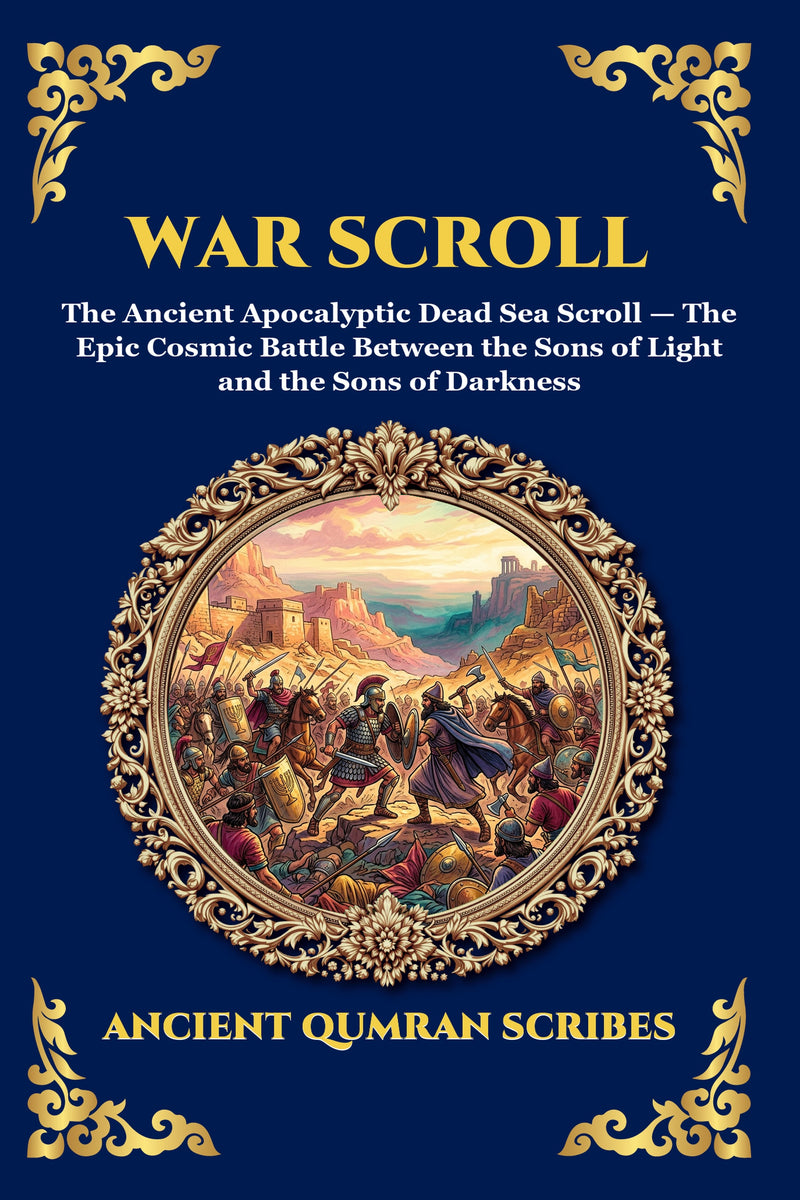
War Scroll — Large Print
The War Scroll lays out a detailed military strategy for the apocalypse, written by the Qumran sect who awaited a cosmic conflict. Excluded from biblical canon, it specifies formations, weapons, and inscriptions, offering a rare glimpse into the ancient vision of the ultimate battle.
or free app
10,000+ hrs library
30-day guarantee
The War Scroll is presented here as a complete modern-English translation of this Dead Sea Scroll military manual, readable online with audiobook narration included through Library of Alexandria Press membership.
Large Print Edition. The complete, unabridged text set in a larger, easy-on-the-eyes typeface for comfortable reading.
Have you ever wondered why ancient desert mystics prepared for an apocalyptic war, or what they believed the end of the world would look like?
In The War Scroll, you will unearth one of the most fascinating and intense apocalyptic documents ever discovered. Written by the secretive sect that lived at Qumran, this ancient Dead Sea Scroll serves as a literal military manual for the end of days. Unlike vague prophecies, this text offers a highly organized, regimented battle plan for the ultimate cosmic conflict.
Far more than a simple prophecy, The War Scroll details the exact formations, weapons, and even the inscriptions written on the banners and trumpets of the holy army. It describes a war that will rage across the earth, where human soldiers fight shoulder-to-shoulder with the Archangel Michael and the heavenly host against the forces of Belial and corrupt earthly empires. By reading this text, you are witnessing the absolute conviction of an ancient community that believed they were living on the very brink of eternity.
What You’ll Discover in This Foundational Text:
The End-Times Military Manual Explore the meticulous rules of holy warfare, from the age and purity required of soldiers to the precise sounding of the battle trumpets.
The Sons of Light and Sons of Darkness Understand the intense cosmic dualism that defined the Qumran sect's worldview and their belief in their own divine election.
Angelic Intervention Read dramatic accounts of the heavenly host joining the earthly battle to tip the scales against the forces of ultimate evil.
Prayers and Hymns of Victory Experience the profound liturgical poetry meant to be chanted on the battlefield to rally the troops and praise the divine warrior.
A Window into Apocalyptic Mysticism Gain a deep understanding of how ancient communities viewed the climax of human history and the dawn of an eternal era of peace.
Whether you are a scholar of ancient religious texts, a history enthusiast, or someone fascinated by eschatology, The War Scroll offers a gripping look at the end of days.
Step into the desert sands and prepare for the ultimate battle. Begin your journey today.
| Formats | eBook (EPUB + PDF) · Audiobook · Paperback · Hardcover · Large Print |
| Language | English |
| Trim size (print) | 6 × 9 in |
| Binding | Paperback — perfect-bound · Hardcover — casewrap |
| Large Print edition | Same text in a larger, easy-read type — a larger font, not a larger trim |
| Print pricing | Every physical book at our true cost — at-cost, no profit (members) |
| Library | 873 restored titles, always growing |
| Composed | 1st century BC to 1st century AD |
| Original language | Hebrew |
| Source tradition | Dead Sea Scroll fragments, primarily 1QM from Qumran Cave 1 |
| Translation basis | Public-domain scholarly translation based on Dead Sea Scrolls research, rendered in clear modern English. |
| Length | 11,577 words · ~46 min reading |
| Reading level | Grade 11 · a confident, adult read (this modern-English edition) |
| Edition | Modern English translation · 2026 |
Member reviews for this edition are collected as readers finish it — be the first. Across the library: 12,000+ books shipped, every plan covered by a 365-day print guarantee.
About this edition
The complete, unabridged text in clear modern English — faithful to the original, never simplified. Every paragraph is checked against the source, so nothing is cut, summarised, or paraphrased away. It reads cleanly for today while keeping the original meaning intact.
This edition derives from Hebrew manuscript fragments discovered at Qumran (1QM and related fragments from caves 4 and 11). It follows the standard scholarly translation tradition established by Dead Sea Scrolls researchers, rendered here in clear modern English.
- Complete & unabridgedVerified paragraph by paragraph against the source — never a scan, never abridged.
- Modern English, faithfulReadable today, with the author’s meaning kept intact. Readable — not simplified.
- Every format, one membershipRead in your browser or the free app, or listen to the full audiobook.
Included free with your membership
Cancel anytime, one click · 30-day money-back guarantee
Edition last updated June 2026
What’s inside
War Scroll — Large Print — complete and unabridged: all 36 sections included with membership, plus the full audiobook.
Begin reading War Scroll — Large Print
In clear modern English — the complete text is included with membership.
The World That Forged the Scroll
To understand the document in your hands, you need to understand the world that produced it — and that world was one of almost unrelenting crisis. The two centuries before the Common Era were, for the Jewish people of Judea, a period of violent disruption, foreign domination, internal conflict, and profound theological ferment. The experience of the Babylonian exile in the sixth century BCE had already transformed Israelite religion in fundamental ways, deepening its monotheism, intensifying its messianic hopes, and producing the rich tradition of apocalyptic literature — texts that claimed to reveal the hidden structure of history and the divine plan for its ultimate resolution. By the time Alexander the Great swept through the Near East in the 330s BCE and his successors began competing for control of Judea, the stage was set for a collision between Hellenistic culture and Jewish religious identity that would prove enormously consequential.
That collision reached its crisis point in the 160s BCE under the Seleucid king Antiochus IV Epiphanes, who attempted to forcibly Hellenize Judea, outlawed the practice of the Torah, and desecrated the Jerusalem Temple by erecting an altar to Zeus within its precincts. The Jewish response was the Maccabean revolt, a guerrilla uprising led by the priestly Hasmonean family that eventually succeeded in driving out the Seleucids, rededicated the Temple — an event still commemorated in the festival of Hanukkah — and established an independent Jewish kingdom for the first time in centuries. For many Jews, this seemed like the beginning of the fulfillment of the ancient prophetic promises: God was acting in history, the enemies were being defeated, and the restoration of Israel was underway.
But the Hasmonean kingdom quickly became a source of deep disillusionment for those who had hoped for something more than a change of rulers. The Hasmonean kings combined the offices of high priest and political monarch in ways that many devout Jews considered illegitimate — the high priesthood was supposed to belong to the Zadokite priestly lineage, not the Hasmoneans. Political intrigue, corruption, and increasing accommodation to Hellenistic culture characterized the Hasmonean court. Various groups within Judaism responded to this disillusionment in different ways. The Pharisees developed a tradition of popular piety centered on Torah observance and oral tradition. The Sadducees aligned themselves with the priestly establishment. And a group that scholars identify with the community at Qumran — often called the Essenes, though the identification is not universally accepted — withdrew from Jerusalem entirely, condemning the Temple establishment as corrupt and illegitimate, and retreating to the desert to await God's direct intervention.
The Qumran community's founding is described obliquely in several of their texts through the figures of the 'Teacher of Righteousness,' a priestly leader of great authority and spiritual insight, and the 'Wicked Priest,' his persecutor, who is generally identified with one of the early Hasmonean high priests. The community saw itself as the true Israel, the faithful remnant that had preserved the authentic covenant while the rest of the nation had gone astray. They maintained a rigorous communal discipline, practiced ritual purity to an extraordinary degree, held property in common, studied the scriptures intensively, and developed a distinctive calendar and theology that set them apart from all other Jewish groups of their time.
Central to their theology was a radical dualism — not the metaphysical dualism of Greek philosophy, which divided reality into matter and spirit, but a moral and cosmic dualism that divided all of creation into two opposing camps. God had created two spirits at the beginning of time: the Prince of Light, also called the Angel of Truth, and the Angel of Darkness, also called Belial or the Prince of Darkness. All human beings were under the dominion of one spirit or the other — indeed, the community believed that even within each individual, these two spirits contended for mastery. The Sons of Light walked in the ways of truth, justice, and holiness. The Sons of Darkness walked in the ways of wickedness, deceit, and impurity. History was the arena of their struggle, and that struggle was approaching its final, decisive phase.
This cosmic dualism was not unique to the Qumran community — it has clear connections to Persian Zoroastrian thought, which had deeply influenced Jewish theology during and after the Babylonian exile. But the community at Qumran developed it with unusual rigor and applied it with unusual urgency to their own historical situation. They believed they were living in the final generation before the end, the last age of wickedness before God's decisive intervention. The Rule of the Community, another of their foundational texts, describes the two spirits and their cosmic struggle in language of extraordinary sophistication. The document you are about to read takes that theological framework and translates it into a detailed operational plan for the final war that will resolve it.
The community's life at Qumran was shaped by this eschatological urgency in every particular. Their daily routines of prayer, study, communal meals, and ritual bathing were understood not merely as religious observances but as preparations for the final battle — ways of maintaining the purity and discipline that would be required when the great day arrived. Their study of the scriptures was intensive and creative, producing a genre of biblical commentary called the pesher, in which ancient prophetic texts were interpreted as coded references to the community's own history and the events of the last days. The prophecies of Isaiah, Habakkuk, Nahum, and others were read as direct addresses to their own situation, their own enemies, their own destiny.
Into this world of intense expectation and meticulous preparation, the scroll fits with perfect coherence. It is not a fantasy or a literary exercise. It is, or was intended to be, a practical document — a genuine battle plan for a war that the community fully expected to fight within their own lifetimes or the lifetimes of their immediate descendants. The fact that this war never came, that the community was instead destroyed by the Romans in 68 CE without any angelic intervention, is one of the great tragic ironies of religious history. But that tragedy does not diminish the document's power. If anything, it deepens it.
The scroll draws heavily on the military traditions of ancient Israel as preserved in the Hebrew Bible, particularly the concept of the 'holy war' or 'herem,' in which God himself fights alongside Israel's armies and the outcome is never in doubt because it has been divinely predetermined. It also draws on the practical military experience of the Hellenistic and Roman periods, incorporating tactical formations and organizational structures that reflect genuine familiarity with the warfare of the author's own time. This combination of ancient sacred tradition and contemporary military reality gives the document a peculiar double quality — it is simultaneously timeless and deeply rooted in a specific historical moment.
The enemies designated as the 'Sons of Darkness' in the scroll include both internal opponents — apostate Jews who have joined the forces of wickedness — and external ones, identified as the 'Kittim,' a term used elsewhere in the scrolls to refer to the Romans. The forty-year war described in the document is structured in a way that reflects deep familiarity with biblical prophecy, particularly the books of Daniel, Ezekiel, and Isaiah, as well as the traditions of the Exodus and the conquest of Canaan. The community understood themselves as the heirs of all these traditions, the generation in which every ancient promise would finally be fulfilled.
Reading an Ancient Vision Anew
When you open the pages that follow, you will encounter a text that operates on multiple registers simultaneously, and it is worth preparing yourself for that complexity. On one level, the scroll is a military manual of remarkable specificity. It prescribes the exact dimensions of trumpets and their inscriptions, the precise arrangement of battle formations, the rotation of divisions through the phases of combat, the roles of priests and Levites in the conduct of battle, and the prayers and exhortations to be delivered at each stage of the fighting. If you read it purely on this level, it is a fascinating artifact of ancient military thinking, comparable in some ways to the Roman military manuals of Vegetius or the strategic writings attributed to Sun Tzu.
But to read it only on this level is to miss almost everything that makes it extraordinary. The military prescriptions are embedded in a theological vision of such scope and intensity that they function less as practical instructions than as liturgical acts — ways of enacting, in the material world, the cosmic drama that is simultaneously unfolding in the heavenly realm. The battle described in the scroll is not merely a human conflict. It is the earthly manifestation of a war that has been raging since the beginning of creation between the forces of light and darkness, truth and falsehood, life and death. When the Sons of Light advance in their formations, they advance alongside the angels of God. When the trumpets sound, they echo the music of the heavenly hosts. When the priests pronounce their blessings and curses, they are channeling the very judgment of the Almighty.
This integration of the human and the divine, the practical and the transcendent, is one of the most distinctive features of the scroll's literary and theological imagination. It reflects a worldview in which the boundary between heaven and earth is not a fixed barrier but a permeable membrane, through which divine power constantly flows into human history. The community at Qumran believed they lived in uniquely close proximity to that membrane — that their purity, their discipline, and their faithfulness had made them a kind of conduit for heavenly reality. The presence of the angels among them was not a metaphor. It was a literal conviction, reflected in their rules about physical purity (those with bodily defects could not participate in the final battle because the angels would be offended by their presence) and in the extraordinary care they took to maintain the holiness of their community.
For the modern reader, this worldview presents both challenges and invitations. The challenges are obvious: we live in a world shaped by scientific rationalism, historical criticism, and a deep suspicion of apocalyptic thinking, which the twentieth century gave us ample reason to distrust. The history of movements convinced of their own cosmic significance and their enemies' absolute wickedness is not an encouraging one. The binary moral universe of the scroll — in which all of humanity is divided into the children of light and the children of darkness, with no middle ground and no possibility of redemption for those on the wrong side — can seem not merely naive but actively dangerous.
These are legitimate concerns, and they deserve to be taken seriously. But they should not prevent us from engaging with the document on its own terms, from trying to understand what it meant to the people who wrote it and why it expressed something they found not merely true but urgently, vitally true. And when we do that, we find that the scroll is grappling with questions that are not peculiar to the second century BCE or to the community at Qumran but are among the most persistent and painful questions of human existence: Why does evil persist in a world created by a good God? How do the righteous maintain their integrity in the face of overwhelming injustice? What does it mean to hope when hope seems irrational? And what would it look like for history to finally, definitively, make sense?
The apocalyptic tradition, of which this scroll is one of the most vivid examples, arose as a response to precisely these questions. It emerged among communities that had experienced catastrophic suffering — exile, persecution, military defeat, the apparent triumph of wickedness — and that refused to accept that suffering as the final word. The apocalyptic imagination insists that appearances are deceiving, that the surface of history conceals a deeper reality in which justice is already assured, that the cosmic ledger is being kept even when human eyes cannot see it, and that the day of reckoning will come. This is not a comfortable or a moderate vision. It is a vision born of extremity, and it has the intensity of extremity.
Understanding this helps explain why apocalyptic texts have continued to resonate across such vastly different historical contexts. The imagery and the framework of the scroll — the cosmic battle, the forces of light against the forces of darkness, the divine warrior fighting alongside the faithful remnant, the final defeat of evil and the vindication of the righteous — have echoed through Jewish and Christian tradition for two thousand years. They appear in the New Testament's Book of Revelation, in the Dead Sea Scrolls' influence on early Christian eschatology, in medieval apocalyptic movements, in the liberation theology of oppressed communities in the modern era, and in the popular culture of our own time, which remains obsessed with narratives of apocalyptic conflict even as it has largely lost the theological framework that originally gave those narratives meaning.
The scroll you are about to read stands near the source of all these later developments. It is not the only apocalyptic text from the Second Temple period — the books of Daniel, 1 Enoch, 4 Ezra, and 2 Baruch, among others, belong to the same tradition — but it is unique in its combination of cosmic scope and operational detail, in its fusion of liturgical beauty and military precision, in its absolute conviction that the end is not merely coming but imminent, and in the haunting specificity with which it imagines a battle that never took place.
Cancel anytime, one click · 30-day money-back guarantee
Founding annual rate available now — your price locks for life when you join.
Not ready? Get this free chapter by email — read it anytime.
✓ Sent — check your inbox for War Scroll — Large Print.
Questions about War Scroll — Large Print
Why isn't the War Scroll in the Bible?
The War Scroll was composed by the Qumran community and was never considered for biblical canon by mainstream Jewish or Christian authorities. It represents sectarian literature specific to the Dead Sea Scrolls community rather than widely accepted scripture.
What does the War Scroll actually contain?
The War Scroll details military formations, weapons, battle standards, and ritual preparations for an anticipated final war between the 'Sons of Light' and 'Sons of Darkness.' It combines apocalyptic theology with practical military organization and ceremonial instructions.
Who wrote the War Scroll?
The War Scroll was composed by members of the Qumran community, likely Essenes, who lived near the Dead Sea. These sectarian Jews developed their own religious texts while awaiting an apocalyptic final battle.
Is War Scroll free to read?
The opening of the text is free to read below. Members read and listen to the complete work — and the entire Lost & Forbidden Library — free.
What is War Scroll?
Have you ever wondered why ancient desert mystics prepared for an apocalyptic war, or what they believed the end of the world would look like? In The War Scroll, you will unearth one of the most fascinating and intense apocalyptic documents ever discovered.
How long is War Scroll?
36 chapters (~8,665 words) in this restored edition.
Shipping & returns
Billing & membership
More from the library


Explore Enoch & Pseudepigrapha
- Apocalypse of Daniel
- Testament of Solomon · Attributed to King Solomon
- Book of Giants · Attributed to Mani
- The Forgotten Books of Eden · Various early Christian and Jew...
- Vision of Esdras · Attributed to the prophet Ezra
- Cave of Treasures · Attributed to Ephrem the Syrian
- Odes of Solomon · Attributed to Solomon
- Testaments of the Twelve Patriarchs · Attributed to the twelve sons o...
- The Book of Jubilees
- Apocalypse of the Virgin
- Apocalypse of Thomas · Attributed to the Apostle Thomas
- Psalms of Solomon · Traditionally Attributed to Kin...
- Apocalypse of Shenoute · Attributed to Shenoute the Arch...
- 2 Enoch · Attributed to Enoch
- Apocalypse of Pseudo-Ephraem · Attributed to Ephraem the Syrian
- Ethiopic Meqabyan I–III
- The Conflict of Adam and Eve with Satan
- Genesis Apocryphon
- Community Rule · Attributed to the Qumran community
- War Scroll · Attributed to the Qumran community
- 2 Esdras · Attributed to the prophet Ezra
- Book of Jasher
- Acts of Barnabas · Attributed to John Mark
- Acts of Paul and Thecla · Attributed to Onesiphorus
- Greek Apocalypse of Daniel
- Sibylline Oracles · Various early Christian and Jew...
- Epistle to the Alexandrians
- Apocalypse of Paul · Attributed to the Apostle Paul
- Apocalypse of Moses · Attributed to early Jewish scribes
- Baruch · Attributed to Baruch
War Scroll — Large Print
War Scroll
The Ancient Apocalyptic Dead Sea Scroll — The Epic Cosmic Battle Between the Sons of Light and the Sons of Darkness
Library of Alexandria Press
War Scroll
© Copyright 2026 Library of Alexandria Press. All rights reserved.
Published by Library of Alexandria Press
Printed in the United States of America
It is not legal to copy, share, or send any part of this document in either digital or printed form without written permission from the publisher, except short quotes in a book review.
Table of Contents
Introduction
The World That Forged the Scroll
Reading an Ancient Vision Anew
Rule of the War Announced
First Attack and Eschatological Battle
Col. 2
Trumpets of Battle Assembly and Retreat
Inscriptions and Rule of the Banners
Banners of Merari and the Thousands
Inscriptions for Battle Advance, Engagement, and Return
Names Inscribed on the Leader's Shield
Battle Line Formation and Arrangement
Infantry Divisions and Battle Dart Rites
Cavalry Deployment and Soldier Recruitment
Age and Role Requirements for Warriors
Priestly and Levitical Battle Ministrations
Col. 8
Battle Formation and Tactical Maneuvers
Address of the Chief Priest
Officers' Exhortation Before Battle
Chief Priest's Prayer to God
Col. 11
Heavenly Hosts and Covenant of the Elect
Battle Hymn and Blessings of War
Col. 13
Leaders' Ritual Before and After Battle
Hymns of Exaltation and Divine Victory
God's Purpose and Battle Array
Chief Priest's Prayer and Exhortation
Opening Battle Against the Kittim
The Final Battle and Second Engagement
Col. 17
Seventh Lot and Fall of Belial's Forces
Prayer of Thanksgiving and Battle Pursuit
Hymn of Derision and Divine Majesty
Battle Exhortation and Morning Gathering
Introduction
In the winter of 1946 to 1947, a Bedouin shepherd boy named Muhammad edh-Dhib was searching for a lost goat along the northwestern shore of the Dead Sea when he stumbled upon a narrow cave opening in the limestone cliffs of Qumran. What he discovered inside would reshape our understanding of ancient religion, apocalyptic thought, and the turbulent world that gave birth to both Rabbinic Judaism and early Christianity. Among the clay jars he found were tightly wrapped scrolls of parchment, preserved for nearly two thousand years by the region's extraordinary aridity and the sealed darkness of the cave. The scrolls he and his companions eventually brought to light — and the dozens of additional manuscripts unearthed in subsequent archaeological campaigns across eleven nearby caves — constitute one of the most significant manuscript discoveries in the history of human civilization.
Among those manuscripts, one stands apart for its sheer dramatic intensity, its theological ambition, and its unnerving relevance to the way human beings have always imagined the ultimate confrontation between good and evil. Scholars call it the War Scroll, or by its Hebrew designation, the Serekh ha-Milhamah — the Rule of the War. It is a document unlike almost anything else that has survived from antiquity: part military manual, part liturgical hymn, part apocalyptic vision, and part theological treatise. It describes, in meticulous and sometimes breathtaking detail, a final, world-ending war between the forces of righteousness and the forces of darkness — a war that is simultaneously human and cosmic, historical and eternal, fought with trumpets and banners and angels and the very presence of God.
To read this text for the first time is to be transported into a mental and spiritual universe that is at once deeply alien and strangely familiar. The men who composed and copied this scroll — almost certainly members of the ascetic Jewish community that lived at Qumran on the Dead Sea's northwestern shore — believed they were living at the edge of time. They believed the final age had arrived, that the cosmic drama was about to reach its climax, and that their community, the 'Sons of Light,' was destined to play the central role in the last great battle against the 'Sons of Darkness.' They prepared for this battle not only spiritually but practically, drafting rules of engagement, designing battle formations, composing the speeches their commanders would deliver, and specifying the precise inscriptions to be engraved on their weapons and standards.
The result is a document of extraordinary psychological and literary power. Whether you approach it as a scholar, as a person of faith, as a student of history, or simply as a reader hungry for one of the most intense and strange texts ever written, the scroll demands your full attention. It will not release you easily. Its imagery — the great trumpets sounding across the desert, the seven-phase battle cycling between victory and defeat, the angels descending alongside human warriors, the final annihilation of Belial and all his hosts — lodges itself in the imagination with the force of myth, because in a very real sense it is myth: the deepest kind of myth, the kind that attempts to give ultimate meaning to human suffering, struggle, and hope.
This introduction is designed to prepare you for that encounter. It will give you the historical and cultural context you need to understand who wrote this document, why they wrote it, and what they believed was at stake. It will explore the remarkable world of the Qumran community — their origins, their theology, their daily life, and their burning sense of eschatological urgency. And it will offer some reflections on why this ancient text continues to speak so powerfully to modern readers, long after the community that produced it has vanished from the earth.
Before we enter that world, however, it is worth pausing for a moment to appreciate the sheer improbability of the scroll's survival. Parchment is a fragile material. Most ancient documents have perished entirely, consumed by moisture, fire, insects, or the simple entropy of centuries. The texts that survived from the ancient world did so almost always because scribes in later generations chose to copy them, edit them, and pass them on. The manuscripts at Qumran survived by a different route entirely: they were hidden, apparently in haste, sometime around 68 CE when the Roman legions of Vespasian were advancing through Judea to crush the great Jewish revolt. The members of the community — or at least those responsible for their library — sealed the scrolls in jars, placed them in the caves, and either fled, were killed, or simply never returned. The scrolls lay undisturbed for roughly nineteen centuries, waiting.
That waiting ended in 1947, and the world has been grappling with the consequences ever since. The initial publication of the scrolls was delayed by academic politics and institutional disputes that became one of the more embarrassing episodes in the history of modern scholarship. Full access to all the manuscripts was not achieved until the early 1990s. But once scholars could examine the complete corpus, the magnitude of the discovery became undeniable. Here were manuscripts dating from the third century BCE to the first century CE — the precise period during which Judaism was diversifying into the many competing sects and movements that would eventually produce both the Talmudic tradition and the New Testament. The scrolls illuminated that world from the inside, in its own words, with an intimacy and immediacy that no amount of later commentary or reconstruction could replicate.
The manuscript you are about to read is the longest and best-preserved of the clearly sectarian texts in the collection. The main copy, found in Cave 1, is written on a single scroll measuring just under three meters in length, comprising nineteen columns of text in a clear, confident hand. Additional fragments from at least five other copies were found in Cave 4, confirming that this was not a marginal or obscure document within the community's library but a central and frequently consulted text. The Cave 1 copy dates paleographically to the late first century BCE or early first century CE, though the composition itself is almost certainly older, with most scholars placing the original drafting somewhere in the second or early first century BCE.
Rule of the War Announced
For the Instructor: the Rule of the War.
First Attack and Eschatological Battle
The first attack of the Sons of Light shall be launched against the forces of the Sons of Darkness, the army of Belial: the troops of Edom, Moab, the sons of Ammon, the Amalekites, Philistia, and the troops of the Kittim of Asshur. Supporting them are those who have violated the covenant. The sons of Levi, the sons of Judah, and the sons of Benjamin — those exiled to the wilderness — shall fight against them and against all their troops when the exiles of the Sons of Light return from the Wilderness of the Peoples to camp in the Wilderness of Jerusalem. Then after the battle they shall go up from that place, and the king of the Kittim shall enter into Egypt. In his time he shall go forth with great wrath to do battle against the kings of the north, and in his anger he shall set out to destroy and eliminate the strength of Israel. Then there shall be a time of salvation for the People of God, and a time of dominion for all the men of His forces, and eternal annihilation for all the forces of Belial. There shall be great panic among the sons of Japheth, Assyria shall fall with no one to come to his aid, and the supremacy of the Kittim shall cease, that wickedness be overcome without a remnant. There shall be no survivors of all the Sons of Darkness.
Then the Sons of Righteousness shall shine to all the ends of the world, continuing to shine forth until the end of the appointed seasons of darkness. Then at the time appointed by God, His great excellence shall shine through all the ages of eternity — for peace and blessing, glory and joy, and long life for all the Sons of Light. On the day when the Kittim fall there shall be battle and horrible carnage before the God of Israel, for it is a day appointed by Him from ancient times as a battle of annihilation for the Sons of Darkness. On that day the congregation of the gods and the congregation of men shall engage one another, resulting in great carnage.
The Sons of Light and the forces of Darkness shall fight together to show the strength of God with the roar of a great multitude and the shout of gods and men — a day of disaster. It is a time of distress for all the people who are redeemed by God. In all their afflictions none has existed that is like it, hastening toward its completion as an eternal redemption. On the day of their battle against the Kittim, they shall go forth for carnage in battle. In three lots the Sons of Light shall stand firm so as to strike a blow at wickedness, and in three lots the army of Belial shall strengthen themselves so as to force the retreat of the forces of Light. But when the banners of the infantry cause their hearts to melt, the strength of God will strengthen the hearts of the Sons of Light. In the seventh lot the great hand of God shall overcome Belial and all the angels of his dominion, and all the men of his forces shall be destroyed forever.
Concerning the annihilation of the Sons of Darkness and the service rendered to God during the war years: the holy ones shall shine forth in support of the truth for the annihilation of the Sons of Darkness. Then with a great roar they took hold of the implements of war — the chiefs of the tribes and the priests, the Levites, the chiefs of the tribes, the fathers of the congregation, the priests, and likewise the Levites, and the divisions of the heads of the clans.
End of the free sample
Keep reading, free
Members read and listen to the complete book — and the entire library. Cancel anytime, one click · 30-day money-back guarantee.