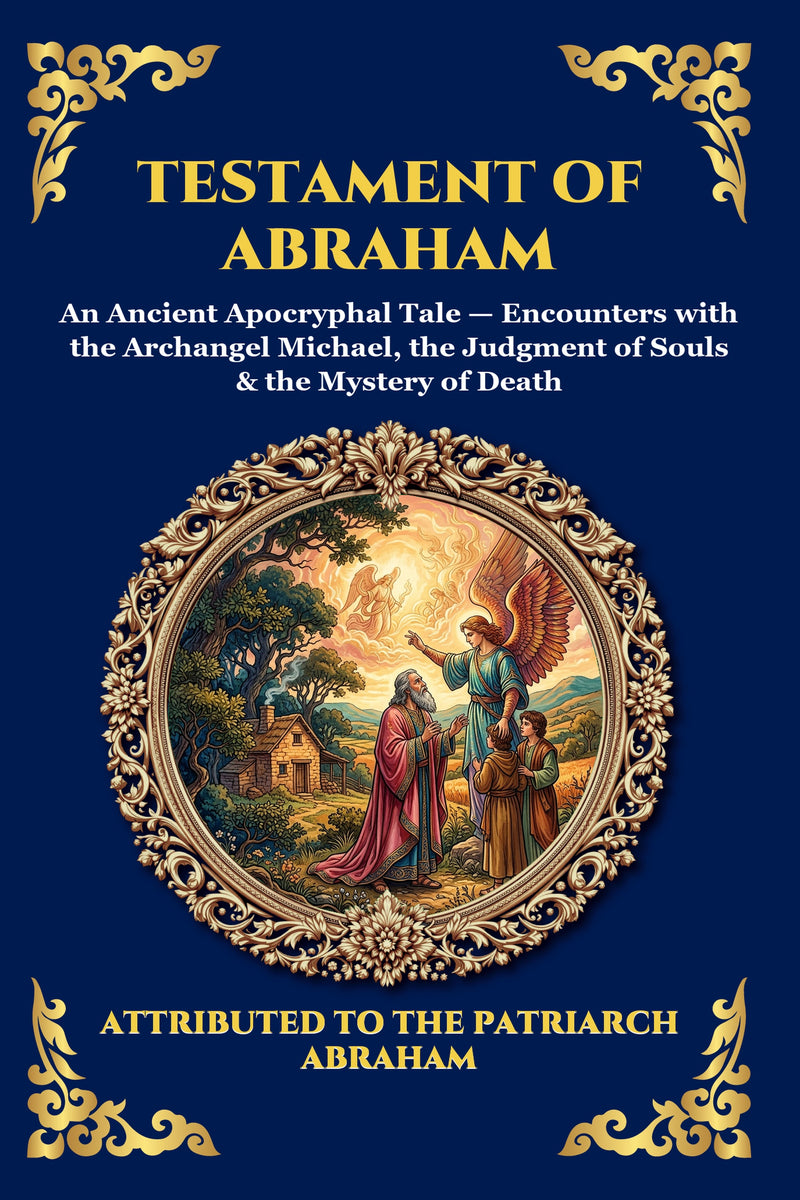
Testament of Abraham — Large Print
Abraham, the revered patriarch, faces the Archangel Michael, sent to guide him from life to the unknown realms beyond. Excluded from the biblical canon, the Testament of Abraham combines theological insight with unexpected humor, exploring humanity's timeless struggle with the inevitability of death.
or free app
10,000+ hrs library
30-day guarantee
The Testament of Abraham presents Library of Alexandria Press's complete modern-English translation of this ancient apocryphal text, readable online with included audiobook narration through our membership platform.
Large Print Edition. The complete, unabridged text set in a larger, easy-on-the-eyes typeface for comfortable reading.
Have you ever wondered why even the most righteous figures in history feared the mystery of death, and what secrets of the afterlife they might have uncovered?
The Testament of Abraham presents a compelling modern translation of one of the most unique, imaginative, and emotionally resonant texts of the ancient apocryphal tradition. Attributed to the biblical patriarch, this fascinating narrative explores the universal human resistance to mortality through a story that seamlessly blends profound theological insight with moments of unexpected, endearing humor.
The story begins when Abraham, having lived a long and righteous life, is visited by the Archangel Michael, the commander-in-chief of heaven. Michael is tasked with a seemingly simple mission: gently prepare Abraham for his physical death. However, Abraham absolutely refuses to surrender his soul. Baffled by this human stubbornness, the great archangel must return to God for further instructions. What follows is a magnificent compromise. Before he dies, Abraham is granted a visionary flight on a celestial chariot to observe the entire inhabited world.
Far more than a tale of a man avoiding his fate, this text plunges the reader into the heart of ancient Jewish and early Christian apocalyptic thought. As Abraham flies over the earth, his strict, unforgiving sense of justice leads him to call down destruction upon sinners. To teach him the boundless mercy of God, Michael brings Abraham to the gates of heaven to witness the grand, cosmic judgment of souls. There, he sees the meticulous weighing of human deeds, the terrifying reality of Death personified, and the profound grace required to save a fragile human soul. Blending moral philosophy with dramatic visionary imagery, The Testament of Abraham challenges readers to reflect on the nature of divine forgiveness, the inevitability of death, and the weight of our earthly actions.
What You’ll Discover in This Modern Translation:
The Refusal of Death Follow Abraham’s incredibly human and relatable struggle against his own mortality, as he actively bargains with the commander of the heavenly hosts.
A Chariot Ride Across the Earth Journey alongside Abraham and the Archangel Michael as they ascend on a chariot of cherubim to look down upon the deeds and sins of humanity.
The Cosmic Scales of Justice Witness the awe-inspiring judgment of souls at the gates of heaven, where an angelic tribunal carefully weighs every human virtue and transgression.
The Personification of Death Explore the terrifying and mesmerizing ancient depictions of Death itself, revealed to possess both a beautiful, radiant face for the righteous and a dark, terrifying visage for the wicked.
A Masterpiece of Apocalyptic Literature Gain a deeper understanding of the visionary traditions, angelic lore, and theological debates concerning mercy and justice that profoundly shaped early religious thought.
Whether you are exploring this work for its immense historical value, its complex theological arguments concerning divine mercy, or its dramatic narrative of spiritual rebellion and acceptance, The Testament of Abraham offers inspiration and insight that endures across millennia.
Step into a narrative of unparalleled prophetic vision and discover the timeless lessons of this ancient apocalyptic journey. Begin your reading today.
| Formats | eBook (EPUB + PDF) · Audiobook · Paperback · Hardcover · Large Print |
| Language | English |
| Trim size (print) | 6 × 9 in |
| Binding | Paperback — perfect-bound · Hardcover — casewrap |
| Large Print edition | Same text in a larger, easy-read type — a larger font, not a larger trim |
| Print pricing | Every physical book at our true cost — at-cost, no profit (members) |
| Library | 873 restored titles, always growing |
| Composed | 1st-2nd century AD |
| Original language | Greek |
| Source tradition | Greek manuscript tradition |
| Translation basis | Public-domain scholarly translation, rendered in clear modern English |
| Length | 11,280 words · ~45 min reading |
| Reading level | Grade 8 · clear and comfortable (this modern-English edition) |
| Edition | Modern English translation · 2026 |
Member reviews for this edition are collected as readers finish it — be the first. Across the library: 12,000+ books shipped, every plan covered by a 365-day print guarantee.
About this edition
The complete, unabridged text in clear modern English — faithful to the original, never simplified. Every paragraph is checked against the source, so nothing is cut, summarised, or paraphrased away. It reads cleanly for today while keeping the original meaning intact.
The Testament of Abraham survives in Greek manuscripts and later translations. This edition derives from the standard public-domain scholarly translation and renders it in clear modern English.
- Complete & unabridgedVerified paragraph by paragraph against the source — never a scan, never abridged.
- Modern English, faithfulReadable today, with the author’s meaning kept intact. Readable — not simplified.
- Every format, one membershipRead in your browser or the free app, or listen to the full audiobook.
Included free with your membership
Cancel anytime, one click · 30-day money-back guarantee
Edition last updated June 2026
What’s inside
Testament of Abraham — Large Print — complete and unabridged: all 36 sections included with membership, plus the full audiobook.
Begin reading Testament of Abraham — Large Print
In clear modern English — the complete text is included with membership.
Chapter 1
Abraham lived out the full measure of his life — nine hundred and ninety-five years — and throughout all those years he had lived in quietness, gentleness, and righteousness. He was an extraordinarily hospitable man. He pitched his tent at the crossroads by the oak of Mamre and welcomed everyone who passed: rich and poor, kings and rulers, the crippled and the helpless, friends and strangers, neighbors and travelers alike. All of them the devout, all-holy, righteous, and hospitable Abraham received and entertained. Yet even upon him there came at last the common, inexorable, bitter lot of death — that uncertain end which awaits every life.
And so the Lord God summoned his archangel Michael and said to him: Go down, Chief-Captain Michael, to Abraham, and speak to him of his death, so that he may set his affairs in order. I have blessed him as the stars of heaven and as the sand upon the seashore; he has enjoyed an abundance of long life and great possessions, and has become exceedingly rich. Beyond all other men he has been righteous in every good thing, hospitable and loving to the very end of his life. Go, therefore, archangel Michael, to Abraham my beloved friend, and announce to him his death. Give him this assurance: that at this appointed time he will depart from this fleeting world, leave the body behind, and go to his own Lord, to dwell among the good.
Chapter 2
And the chief-captain departed from before the face of God and went down to Abraham at the oak of Mamre. He found the righteous Abraham in the field nearby, sitting beside yokes of oxen ready for ploughing, together with the sons of Masek and other servants, twelve in all. And behold, the chief-captain came toward him, and Abraham, seeing the archangel Michael approaching from a distance — like a very handsome warrior — rose and went to meet him, as was his custom whenever he met and welcomed strangers. The chief-captain greeted him and said: Hail, most honored father, righteous soul chosen of God, true son of the Heavenly One. Abraham said to the chief-captain: Hail, most honored warrior, bright as the sun and more beautiful than all the sons of men; you are welcome here. I beg you, therefore, tell me where you have come from; teach me, your humble host, from what place, what army, and what journey your beauty has brought you here. The chief-captain said: I, O righteous Abraham, come from the great city. I have been sent by the great king to summon a good friend of his, for the king has called for him. And Abraham said: Come, my lord, walk with me as far as my field. The chief-captain said: I will come. And they went into the ploughing field and sat down among the company there.
Abraham said to his servants, the sons of Masek: Go to the horse pasture and bring two horses, quiet and gentle and tame, so that this stranger and I may ride. But the chief-captain said: No, my lord Abraham, do not bring horses, for I never sit upon any four-footed beast. Is not my king rich beyond measure, with power over men and every kind of creature? Yet I never sit upon any four-footed beast. Let us go, then, O righteous soul, and walk at an easy pace until we reach your house. And Abraham said: Amen, so be it.
Chapter 3
And as they walked from the field toward his house, a cypress tree stood beside the road, and by the command of the Lord the tree cried out in a human voice, saying, "Holy, holy, holy is the Lord God, who calls to himself those who love him." But Abraham kept the mystery to himself, thinking that the chief captain had not heard the tree speak. When they drew near to the house they sat down in the courtyard, and Isaac, seeing the angel's face, said to his mother Sarah, "My lady mother, look — the man sitting with my father Abraham is not of the race of those who dwell on this earth." Isaac ran and greeted him and fell at the feet of the Incorporeal One, and the Incorporeal One blessed him and said, "The Lord God will grant you the promise he made to your father Abraham and to his seed, and will also grant you the precious prayers of your father and your mother." Abraham said to his son Isaac, "My son Isaac, draw water from the well and bring it to me in the basin, so that we may wash the feet of this stranger, for he is weary from the long journey he has made to reach us." Isaac ran to the well, drew water into the basin, and brought it to them, and Abraham knelt and washed the feet of the chief captain Michael, and his heart was moved and he wept over the stranger. Isaac, seeing his father weep, wept also, and the chief captain, seeing them both weeping, wept with them, and his tears fell into the basin and became precious stones. Abraham saw this wonder and was astonished, and he quietly gathered up the stones and kept the mystery to himself, holding it in his heart.
Chapter 4
Abraham said to his son Isaac: Go, my beloved son, into the inner chamber of the house and make it ready. Spread two couches there, one for me and one for this man who is with us today. Set out a seat, a lamp stand, and a table laden with every good thing. Make the chamber beautiful, my son — spread linen and purple and fine cloth beneath us. Burn every precious and fragrant incense there, and bring sweet-smelling plants from the garden to fill the house with their scent. Light seven lamps full of oil, so that we may rejoice, for this man who is with us today is more glorious than kings or rulers, and his appearance surpasses all the sons of men. Isaac prepared everything well, and Abraham, taking the archangel Michael with him, went into the chamber. They both sat down on the couches, and between them Abraham placed a table laden with every good thing.
Then the chief captain rose and went out, as though compelled by a bodily need, and in the twinkling of an eye he ascended to heaven and stood before the Lord. He said: Lord and Master, let your power know that I am unable to remind that righteous man of his death, for I have not seen upon the earth a man like him — compassionate, hospitable, righteous, truthful, devout, and turning away from every evil deed. Know, Lord, that I cannot bring myself to speak to him of his death. The Lord said: Go back down, chief captain Michael, to my friend Abraham, and do whatever he asks of you, and eat with him whatever he eats. I will send my Holy Spirit upon his son Isaac and put the remembrance of death into Isaac's heart, so that even in a dream he may see his father's death. Isaac will tell the dream, and you shall interpret it, and Abraham himself will come to know his end. The chief captain said: Lord, all the heavenly spirits are without bodies — we neither eat nor drink — and yet this man has set before me a table full of earthly and perishable things. What am I to do, Lord? How am I to manage, sitting at table with him? The Lord said: Go down to him and do not trouble yourself over this, for when you sit down with him I will send upon you a consuming spirit, and it will devour from your hands and through your mouth everything that is on the table. Rejoice with him in all things — only interpret the vision well, so that Abraham may understand the sickle of death and the uncertain end of life, and may set all his affairs in order, for I have blessed him beyond the sand of the sea and the stars of heaven.
Chapter 5
Then the chief captain went down to the house of Abraham and sat with him at the table, and Isaac served them. When supper was over, Abraham prayed as was his custom, and the chief captain prayed with him, and each lay down to sleep on his own couch. Isaac said to his father, Father, I would also like to sleep with you in this chamber, so that I may hear your conversation, for I love to listen to the excellent discourse of this virtuous man. Abraham said, No, my son, go to your own chamber and sleep on your own couch, so that we do not disturb this man. Then Isaac received their blessing and prayers, and went to his own chamber and lay down on his couch.
But the Lord placed the thought of death in Isaac's heart, as though in a dream, and about the third hour of the night Isaac awoke and rose from his couch and came running to the chamber where his father lay sleeping with the archangel. Reaching the door, Isaac cried out, saying, My father Abraham, get up and open the door for me quickly, so that I may come in and throw my arms around your neck and embrace you before they take you away from me.
Abraham got up and opened the door, and Isaac came in and threw himself around his neck and began to weep aloud. Abraham was moved to the heart and wept aloud as well, and the chief captain, seeing them weeping, wept also. Sarah was in her room and heard their weeping, and came running to them, and found them embracing and weeping. Sarah said through her tears, My lord Abraham, what is this weeping? Tell me, my lord — has this brother who was our guest today brought you news that Lot, your brother's son, is dead? Is that why you grieve like this? The chief captain answered and said to her, No, my sister Sarah, it is not as you suppose. Your son Isaac, I believe, had a dream, and came to us weeping, and when we saw him our own hearts were moved and we wept with him.
Chapter 6
Then Sarah, hearing the excellence of the chief-captain's conversation, immediately knew that this was an angel of the Lord who was speaking. She signaled to Abraham to come out to the door and said to him, "My lord Abraham, do you know who this man is?" Abraham said, "I do not know." Sarah said, "You remember, my lord, the three men from heaven whom we entertained in our tent beside the oak of Mamre, when you slaughtered the unblemished kid and set a table before them. After the flesh had been eaten, the kid rose again and suckled its mother with great joy. Do you not remember, my lord Abraham, that by their promise they gave us Isaac as the fruit of the womb? This man is one of those three holy men." Abraham said, "O Sarah, you speak the truth in this. Glory and praise be to our God and Father. For late in the evening, when I washed his feet in the basin, I said in my heart, 'These are the feet of one of the three men whose feet I washed then.' And the tears that fell from his eyes into the basin became precious stones." And shaking them out from his lap, he gave them to Sarah, saying, "If you do not believe me, look at these." Sarah received them and bowed down and gave thanks, saying, "Glory be to God, who shows us wonderful things. And now know, my lord Abraham, that there is among us the revelation of something — whether it be evil or good."
Chapter 7
Abraham left Sarah and went into the chamber. "Come here, my beloved son," he said to Isaac. "Tell me the truth — what did you see, and what happened to you that you came running to us so quickly?"
Isaac began to answer him. "My lord, last night I saw the sun and the moon above my head, surrounding me with their rays and giving me light. As I gazed at this and rejoiced, I saw the heavens open, and a man bearing light descend from them, shining more brightly than seven suns. This radiant man came and took the sun from my head and carried it back up into the heavens from where he had come. I was deeply grieved that he had taken the sun away from me. A little while later, while I was still sorrowful and troubled, I saw this same man come forth from heaven a second time, and he took the moon from my head as well. I wept bitterly and cried out to that man of light, saying, 'Do not take my glory from me, my lord. Have pity on me and hear me — if you must take the sun, at least leave me the moon.' He said, 'Let them be taken up to the king above, for he wishes them there.' And so he took them both away, though he left the rays upon me."
Cancel anytime, one click · 30-day money-back guarantee
Founding annual rate available now — your price locks for life when you join.
Not ready? Get this free chapter by email — read it anytime.
✓ Sent — check your inbox for Testament of Abraham — Large Print.
Questions about Testament of Abraham — Large Print
Why isn't the Testament of Abraham in the Bible?
The Testament of Abraham was excluded from the biblical canon by early church councils. While popular in ancient Jewish and Christian communities, it was considered pseudepigraphic and not apostolic in origin.
Who actually wrote the Testament of Abraham?
The Testament of Abraham was written by an anonymous Jewish or Christian author, not the biblical patriarch Abraham. Ancient writers commonly attributed works to revered figures to convey theological teachings.
What does the Testament of Abraham contain?
The Testament of Abraham narrates Abraham's reluctance to die when the Archangel Michael comes to collect his soul, featuring tours of heaven and judgment scenes with both theological depth and humor.
Is Testament of Abraham free to read?
The opening of the text is free to read below. Members read and listen to the complete work — and the entire Lost & Forbidden Library — free.
What is Testament of Abraham?
Have you ever wondered why even the most righteous figures in history feared the mystery of death, and what secrets of the afterlife they might have uncovered?
How long is Testament of Abraham?
36 chapters (~11,279 words) in this restored edition.
Shipping & returns
Billing & membership
More from the library


Explore Enoch & Pseudepigrapha
- Apocalypse of Daniel
- Testament of Solomon · Attributed to King Solomon
- Book of Giants · Attributed to Mani
- The Forgotten Books of Eden · Various early Christian and Jew...
- Vision of Esdras · Attributed to the prophet Ezra
- Cave of Treasures · Attributed to Ephrem the Syrian
- Odes of Solomon · Attributed to Solomon
- Testaments of the Twelve Patriarchs · Attributed to the twelve sons o...
- The Book of Jubilees
- Apocalypse of the Virgin
- Apocalypse of Thomas · Attributed to the Apostle Thomas
- Psalms of Solomon · Traditionally Attributed to Kin...
- Apocalypse of Shenoute · Attributed to Shenoute the Arch...
- 2 Enoch · Attributed to Enoch
- Apocalypse of Pseudo-Ephraem · Attributed to Ephraem the Syrian
- Ethiopic Meqabyan I–III
- The Conflict of Adam and Eve with Satan
- Genesis Apocryphon
- Community Rule · Attributed to the Qumran community
- War Scroll · Attributed to the Qumran community
- 2 Esdras · Attributed to the prophet Ezra
- Book of Jasher
- Acts of Barnabas · Attributed to John Mark
- Acts of Paul and Thecla · Attributed to Onesiphorus
- Greek Apocalypse of Daniel
- Sibylline Oracles · Various early Christian and Jew...
- Epistle to the Alexandrians
- Apocalypse of Paul · Attributed to the Apostle Paul
- Apocalypse of Moses · Attributed to early Jewish scribes
- Baruch · Attributed to Baruch
Testament of Abraham — Large Print
The Testament of Abraham
Both Ancient Recensions — How the Archangel Michael Was Sent to Take the Soul of the Hospitable Patriarch, Abraham's Tour of the Inhabited World and the Judgement Seat of Abel, the Two Faces of Death, and the Bearing of His Soul to Paradise
Library of Alexandria Press
The Testament of Abraham
© Copyright 2026 Library of Alexandria Press. All rights reserved.
Published by Library of Alexandria Press
Printed in the United States of America
It is not legal to copy, share, or send any part of this document in either digital or printed form without written permission from the publisher, except short quotes in a book review.
Table of Contents
Introduction
Chapter 1
Chapter 2
Chapter 3
Chapter 4
Chapter 5
Chapter 6
Chapter 7
Chapter 8
Chapter 9
Chapter 10
Chapter 11
Chapter 12
Chapter 13
Chapter 14
Chapter 15
Chapter 16
Chapter 17
Chapter 18
Chapter 19
Chapter 20
Chapter 21
Chapter 22
Chapter 23
Chapter 24
Chapter 25
Chapter 26
Chapter 27
Chapter 28
Chapter 29
Chapter 30
Chapter 31
Chapter 32
Chapter 33
Chapter 34
Chapter 35
Introduction
There are stories so old, so layered with meaning, that they resist easy classification. They are not quite scripture, not quite legend, not quite philosophy — and yet they are somehow all three at once. The text you are about to read belongs to that rare and luminous category: a work that has survived the centuries not because it was officially sanctioned by any religious authority, but because it speaks to something so fundamental in the human experience that readers across vastly different cultures and eras have found themselves unable to put it down. It is a story about dying. About the terror of it, the resistance to it, and the strange, almost comic dignity with which even the greatest of souls can meet the end of their earthly life.
The patriarch Abraham — the towering figure of faith revered by Jews, Christians, and Muslims alike — is here portrayed not as an icon of serene spiritual perfection, but as a man. A very old man, admittedly, one who has lived a life of extraordinary righteousness and divine favor, but a man nonetheless, with a man's stubborn attachment to the world he loves, the household he has built, and the simple, irreplaceable pleasure of being alive. When the Archangel Michael descends from heaven to prepare him for death, Abraham does something that no reader entirely expects: he refuses. Not once, but repeatedly, in ways that range from the diplomatically evasive to the outright defiant. And in that refusal — so utterly human, so recognizable across every generation — lies the beating heart of this remarkable narrative.
To understand why this text matters, it helps to understand something of the world in which it was composed and the tradition from which it emerged. The ancient Mediterranean world was awash with texts that we today call apocrypha or pseudepigrapha — writings attributed to famous biblical figures but not included in the canonical scriptures of Judaism or Christianity. These were not forgeries in any cynical modern sense. They were acts of imaginative devotion, attempts by deeply religious communities to fill in the silences of the official record, to explore questions that the canonical texts left tantalizingly open. What happened to the great patriarchs at the moment of death? What does the afterlife actually look like? How are souls judged, and by whom, and according to what precise cosmic mechanism? These were not idle curiosities. For people who organized their entire lives around the hope of divine reward and the fear of divine punishment, they were among the most urgent questions imaginable.
The text itself is believed to have been composed sometime between the first and third centuries of the Common Era, though scholars continue to debate the precise dating and the exact nature of its original language — whether it was first written in Greek, Hebrew, or Coptic, or whether it drew on earlier oral traditions that circulated in multiple linguistic communities simultaneously. What is clear is that it survived in multiple manuscript traditions, in both a longer and a shorter recension, suggesting that it was copied, shared, adapted, and treasured by communities spread across a wide geographical range, from Egypt to the Byzantine world and beyond. It was read by Jewish communities, by early Christians, and possibly by communities that blended elements of both traditions in ways that later orthodoxies would find uncomfortable. Its survival is itself a kind of testament — evidence that a story this alive, this emotionally immediate, is very difficult to suppress.
What strikes the modern reader almost immediately is the tone. This is not a solemn, hieratic text in the manner of, say, the Book of Ezekiel or the Revelation of John. It is, in places, genuinely funny. The humor is never disrespectful — there is no mockery of Abraham's faith or of the divine order — but there is an unmistakable delight in the comedy of the situation. Here is the friend of God, the man to whom the Almighty made his most sweeping promises, the father of nations, and he cannot bring himself to say yes to the one thing that every human being must eventually accept. Michael, the mightiest of archangels, the commander of the heavenly host, finds himself in the awkward position of a divine messenger who cannot deliver his message because the recipient keeps changing the subject, offering hospitality, asking for tours of the cosmos, and generally doing anything he can to avoid the conversation that everyone knows must eventually happen.
This comedy, however, is not mere entertainment. It is the vehicle for some of the most profound theological and philosophical exploration in all of ancient religious literature. The extended tour of the heavens that Abraham is granted — a journey that takes him to the very threshold of judgment itself — confronts the reader with questions about justice, mercy, and the relationship between the two that have lost none of their urgency in the intervening millennia. What does perfect justice actually look like when it is stripped of human bias and applied with absolute consistency? Is it something we would recognize as justice at all, or would it, in its purity, become something terrifying? And if it is terrifying, what is the role of mercy in softening it — and does mercy, by definition, compromise justice? These are not abstract theological puzzles. They are questions that anyone who has ever lost someone, anyone who has ever wondered whether the universe is fair, will recognize as among the most personally urgent questions a human being can ask.
The figure of Abraham himself is rendered with remarkable psychological depth. He is not a simple hero. He is a man of genuine, deep, tested faith — and yet his faith does not make death easy for him. If anything, it makes it harder. He has spent his entire life in relationship with the divine, and that relationship has given his earthly existence a richness and a meaning that he is profoundly reluctant to leave behind. His love for his son Isaac, for his household, for the ordinary daily rhythms of a life well-lived, is portrayed with a tenderness that is almost unbearable. The text does not treat this attachment as a spiritual failing. It treats it as something entirely understandable — perhaps even admirable — in a man who has loved the world as fully as Abraham has loved it. The tension between that love and the inevitability of departure is the emotional engine that drives the entire narrative forward.
Michael, for his part, is a fascinating figure in his own right. He is not the stern, warrior-angel of some other ancient traditions, though his power and authority are never in doubt. Here he is almost gentle — patient, compassionate, genuinely moved by Abraham's distress, and repeatedly returning to heaven to report his failure to God with what can only be described as a kind of embarrassed helplessness. The relationship between the archangel and the patriarch is one of the narrative's great pleasures: two beings of entirely different natures, one immortal and one emphatically not, circling the same difficult truth with a mutual respect and even affection that makes the eventual reckoning all the more poignant.
A World of Hidden Scriptures
To read this text well is to read it in context — and that context is richer and stranger than most modern readers initially expect. The ancient world produced an enormous body of religious literature that existed in the spaces between the official scriptures, in the margins of the canonical record, in the imaginative gaps left by texts that told you what Abraham or Moses or Enoch did but not everything they experienced, felt, saw, or were told. This literature is sometimes called the Pseudepigrapha — writings attributed to famous figures of the ancient past — and it represents one of the most extraordinary outpourings of religious imagination in human history.
These texts were not written by cynics or fraudsters. They were written by deeply devout people who believed that the sacred record was incomplete, that there were truths about the divine order that had been experienced by the great figures of the past and that deserved to be preserved, explored, and transmitted. The attribution of a text to Abraham or Enoch or Moses was not an attempt to deceive readers into thinking they were reading authentic historical documents. It was a literary and theological convention — a way of grounding a speculative, imaginative exploration of divine truth in the authority of a recognized sacred figure. The readers of these texts understood the convention perfectly well. They read these works not as historical reportage but as inspired meditation, as a way of thinking through the great questions of existence by placing them in the mouths and experiences of the most spiritually significant human beings who had ever lived.
The tradition of heavenly journeys and cosmic tours is particularly rich in this literature. The Book of Enoch — perhaps the most famous of all the pseudepigraphical texts — describes in elaborate detail the patriarch Enoch's journey through the heavens, his encounters with angels, his vision of the divine throne, and his glimpse of the mechanisms of cosmic judgment. The Apocalypse of Zephaniah, the Greek Apocalypse of Baruch, the Ascension of Isaiah — all of these texts participate in a shared imaginative universe in which the boundary between the human world and the divine realm is permeable, at least for certain exceptional individuals, and in which those who cross that boundary return with knowledge that transforms both them and the communities that read their accounts.
The text you are holding participates fully in this tradition while simultaneously doing something quite distinctive within it. Most heavenly journey texts are primarily concerned with revelation — with the transmission of cosmic secrets, the disclosure of hidden truths about the structure of the universe and the mechanisms of divine governance. This narrative is certainly interested in those things, and the vision of judgment that Abraham witnesses is one of the most detailed and theologically rich accounts of the afterlife in all of ancient literature. But the primary concern here is not revelation. It is relationship. The drama of the text is not primarily about what Abraham sees. It is about what Abraham feels, how he responds, and what his responses reveal about the nature of the bond between a human being and the God who made him.
This is what makes the text feel so startlingly modern, even to readers who come to it with no background in ancient religious literature. The questions it asks — How do we face death? What do we owe to the people and the world we love? What does it mean to trust a God who asks of us the one thing we most want to refuse? — are questions that have not aged a day. They are the questions that lie beneath every human life, regardless of the specific religious or philosophical framework through which that life is understood. The ancient author who composed this narrative understood that the power of the story lay not in its exotic setting or its supernatural machinery, but in the utterly familiar emotional truth at its center: a person who does not want to die, and a universe that requires it of him anyway.
The manuscript tradition through which this text has come down to us is itself a fascinating story. The work survives in two main versions — a longer recension and a shorter one — and the relationship between them has been the subject of considerable scholarly debate. The longer version is generally considered to be closer to the original, though it may itself be a composite of earlier materials. The shorter version streamlines the narrative considerably, cutting some of the more elaborate cosmic tour material and focusing more tightly on the central drama of Abraham's reluctance and eventual acceptance. Both versions have their advocates, and both repay careful reading, though it is the longer version that has generally been considered the more theologically and literarily rich of the two.
The text was known to early Christian writers and was read by Jewish communities in Egypt and elsewhere in the ancient Mediterranean world. It shows signs of having been edited and adapted by different communities over time — there are passages that seem to reflect specifically Christian theological concerns, and others that seem to belong to a purely Jewish imaginative framework, and still others that are difficult to assign to either tradition with any confidence. This hybridity is not a weakness. It is evidence of the text's vitality — of the fact that it spoke to multiple communities, that it was flexible enough to be claimed and adapted by people with different theological commitments while retaining its essential emotional and narrative power.
Scholars have also noted the text's connections to Egyptian religious traditions, particularly in its treatment of the afterlife judgment. The image of a cosmic scale on which the deeds of the dead are weighed has a long history in Egyptian religion, going back to the Book of the Dead and the weighing of the heart against the feather of Ma'at. The appearance of similar imagery in this text — with its detailed account of souls being judged by the balance of their deeds — suggests that the author or authors were drawing on a rich cross-cultural pool of ideas about death and judgment that circulated throughout the ancient Mediterranean world. This is not surprising. Alexandria, which many scholars believe to have been one of the centers of the text's composition and transmission, was precisely the kind of cosmopolitan intellectual environment in which Jewish, Christian, Greek, and Egyptian religious ideas would have been in constant creative dialogue.
Understanding this background does not diminish the text's power. If anything, it enhances it. To know that the vision of cosmic judgment described here draws on traditions that stretch back thousands of years, that the questions it asks were being asked by Egyptians and Mesopotamians and Greeks long before the author of this narrative was born, is to feel the full weight of the human conversation about death and meaning in which this text participates. It is not an isolated curiosity. It is one voice in a vast, ancient, ongoing conversation — and it is one of the most eloquent and emotionally alive voices in that conversation.
Reading Abraham Across the Ages
There is a particular kind of pleasure that comes from reading a text that has been read by millions of people across two thousand years — people who lived in circumstances almost unimaginably different from our own, who spoke different languages, held different political allegiances, organized their spiritual lives around different ritual practices, and yet found in the same story the same illumination, the same recognition, the same shock of emotional truth. This narrative has been that kind of text for a very long time, and approaching it with an awareness of that history deepens the reading experience in ways that are difficult to fully articulate but impossible to ignore.
Consider what it would have meant to read this story in fourth-century Egypt, in a monastic community where the renunciation of the world was the highest spiritual ideal. The monks and nuns of the Egyptian desert had dedicated their lives to the proposition that attachment to earthly things was the primary obstacle to union with God — that the love of family, comfort, beauty, and ordinary human pleasure was precisely what had to be surrendered in order to achieve the kind of spiritual freedom that made a good death possible. And yet here was Abraham, the friend of God, the model of faith, clinging to his household and his daily life with exactly the kind of attachment that the monastic ideal demanded be overcome. Did those readers find his reluctance scandalous? Comforting? Both at once? The text does not resolve the tension it creates. It simply holds it, with a kind of patient wisdom that suggests the author understood perfectly well that the tension between love of life and acceptance of death is not a problem to be solved but a mystery to be inhabited.
Or consider what it would have meant to read the same story in a medieval Jewish community living under conditions of persecution and precarity — a community for whom the question of divine justice was not an abstract theological puzzle but a daily, agonizing reality. The detailed vision of cosmic judgment that occupies the central portion of the narrative would have resonated very differently in that context. The image of a perfectly just divine tribunal, operating without bias or corruption, weighing every soul with absolute precision — this would have been both a comfort and a challenge. A comfort because it promised that the injustices of the present world would be rectified in the world to come. A challenge because the same perfect justice that would punish the persecutors would also apply, with equal rigor, to the persecuted. No one, the text makes clear, comes to judgment with entirely clean hands.
This universality of moral implication is one of the text's most striking features. The vision of judgment that Abraham witnesses does not divide the world neatly into the righteous and the wicked. It reveals a far more unsettling picture: a vast majority of souls whose accounts are genuinely mixed, whose good deeds and bad deeds are so nearly balanced that the outcome of their judgment is genuinely uncertain. This is not a comfortable vision. It does not offer the reassurance of a simple moral universe in which the good are rewarded and the bad are punished and everyone ends up exactly where they deserve to be. It offers instead a picture of cosmic justice that is both rigorous and, in some deep sense, merciful — or at least open to mercy — precisely because it acknowledges the complexity of human moral life.
The figure of Abraham himself has, of course, been interpreted and reinterpreted across the centuries in ways that reflect the concerns and commitments of successive reading communities. For some readers, his reluctance to die has been a source of gentle comedy — the great patriarch caught in a very human moment of weakness, lovable precisely because of his fallibility. For others, it has been a source of profound theological reflection on the nature of faith itself. If faith is trust in God, and if God is asking Abraham to surrender the life that God gave him, then Abraham's reluctance raises a genuinely difficult question: Is the refusal of death a failure of faith, or is it the last and most honest expression of a faith that has always been grounded in love of the world that God created? The text does not answer this question directly. It dramatizes it, with a subtlety and a compassion that have kept readers returning to it across the centuries.
There is also the matter of the text's humor, which deserves a word of particular attention because it is so easy to miss or to misread. Ancient religious literature is not generally expected to be funny, and readers who come to this narrative with expectations shaped by the solemn dignity of canonical scripture may be caught off guard by its moments of genuine comic delight. But the humor here is never cheap, never disrespectful, never at the expense of the sacred. It is the humor of recognition — the laughter that arises when a universal truth is stated with unexpected directness. Abraham's elaborate evasions of Michael's message are funny because we recognize them. We have all done something similar. We have all found ways to avoid conversations we knew we needed to have, to busy ourselves with hospitality and distraction when the real business of the moment was something we could not yet face. The text's genius is to take that utterly familiar human impulse and place it in the most extreme possible context — the moment of death, in the presence of an archangel, at the end of a life of extraordinary holiness — and thereby reveal how deep and how universal it truly is.
For the modern reader, the text offers something else as well: a window into a world of religious imagination that is both deeply foreign and surprisingly familiar. The ancient people who composed and read this narrative inhabited a universe that was far more densely populated with spiritual beings than the one most modern Westerners take for granted. Angels moved through the world on divine errands. The boundary between the living and the dead was permeable in ways that the living could sometimes glimpse. The cosmos was structured, ordered, governed by principles of justice that operated at a level beyond human comprehension but that could occasionally be glimpsed by those privileged enough to be taken on a tour of the heavenly machinery. This is a very different picture of reality from the one most of us carry around in our heads — and yet the emotional and moral concerns that animate it are entirely recognizable. The desire to understand whether the universe is just. The need to know that the lives we live and the choices we make actually matter. The hope that love — for a son, for a household, for the world itself — is not simply extinguished at death but is somehow preserved, somehow honored, in whatever lies beyond.
These concerns are as alive today as they were when this text was first composed. That is why the narrative has survived. Not because it was officially preserved by any religious institution — it was, in fact, excluded from the canonical scriptures of both Judaism and Christianity — but because it kept being copied, kept being read, kept being passed from hand to hand by people who found in it something they could not find elsewhere. Something honest about death. Something compassionate about the difficulty of acceptance. Something wise about the relationship between justice and mercy. Something funny, in the deepest and most humane sense of that word, about the spectacle of a great man failing, for a little while, to be quite as great as everyone expected.
As you begin reading, it may help to approach the text with a certain openness — a willingness to be surprised, to be moved, to be occasionally amused, and to sit with questions that the narrative raises but does not always resolve. This is not a text that delivers its meanings all at once. It rewards slow reading, rereading, and the kind of reflective attention that allows its layers to reveal themselves gradually. The surface story — an archangel comes to prepare a patriarch for death, the patriarch resists, a cosmic journey ensues — is engaging enough on its own terms. But beneath that surface lies a meditation on mortality, justice, love, and faith that has the depth and the staying power of the greatest religious literature ever produced. The people who treasured this text across two thousand years of copying and reading were not wrong. There is something here that matters — something that reaches across the centuries with a directness and a warmth that feel, even now, almost like a personal address. Almost like a message delivered by a very patient angel who has been waiting, with infinite gentleness, for you to be ready to receive it.
The Testament of Abraham
Chapter 1
Abraham lived out the full measure of his life — nine hundred and ninety-five years — and throughout all those years he had lived in quietness, gentleness, and righteousness. He was an extraordinarily hospitable man. He pitched his tent at the crossroads by the oak of Mamre and welcomed everyone who passed: rich and poor, kings and rulers, the crippled and the helpless, friends and strangers, neighbors and travelers alike. All of them the devout, all-holy, righteous, and hospitable Abraham received and entertained. Yet even upon him there came at last the common, inexorable, bitter lot of death — that uncertain end which awaits every life.
And so the Lord God summoned his archangel Michael and said to him: Go down, Chief-Captain Michael, to Abraham, and speak to him of his death, so that he may set his affairs in order. I have blessed him as the stars of heaven and as the sand upon the seashore; he has enjoyed an abundance of long life and great possessions, and has become exceedingly rich. Beyond all other men he has been righteous in every good thing, hospitable and loving to the very end of his life. Go, therefore, archangel Michael, to Abraham my beloved friend, and announce to him his death. Give him this assurance: that at this appointed time he will depart from this fleeting world, leave the body behind, and go to his own Lord, to dwell among the good.
End of the free sample
Keep reading, free
Members read and listen to the complete book — and the entire library. Cancel anytime, one click · 30-day money-back guarantee.