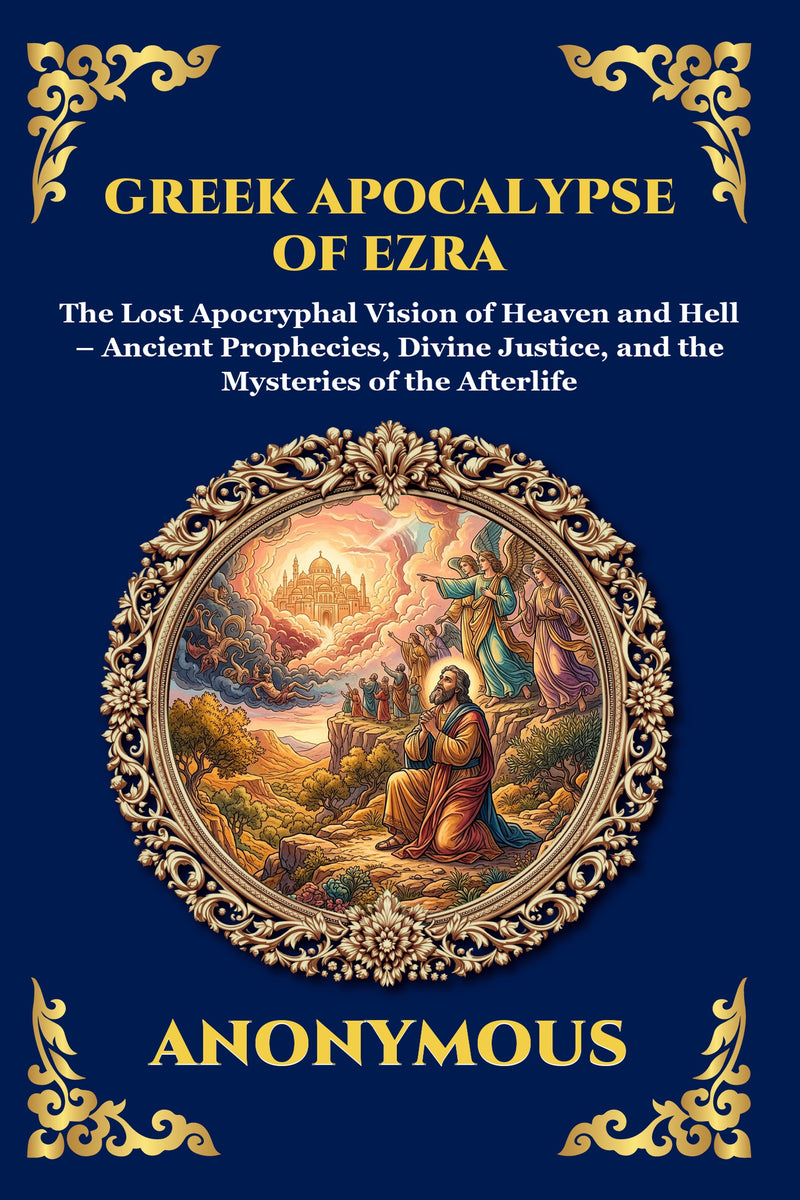
Greek Apocalypse of Ezra — Large Print
The Greek Apocalypse of Ezra offers a stark vision of the afterlife, where sinners face gruesome punishments and the righteous receive eternal rewards. Excluded from the biblical canon, this ancient text attributed to Ezra confronts the age-old question of why the righteous suffer while the wicked prosper.
or free app
10,000+ hrs library
30-day guarantee
This ancient Jewish apocalyptic text from the 2nd-9th century AD, the Greek Apocalypse of Ezra, offers complete modern English translation online with audiobook narration included for Library of Alexandria Press members.
Large Print Edition. The complete, unabridged text set in a larger, easy-on-the-eyes typeface for comfortable reading.
Have you ever wondered why the righteous suffer while the wicked seem to prosper, and what truly awaits the human soul beyond the veil of death?
The Greek Apocalypse of Ezra stands as one of the most vivid and emotionally charged apocryphal texts of the ancient world. Attributed to the revered scribe and prophet Ezra, this visionary narrative takes readers on a harrowing and awe-inspiring journey through the realms of the afterlife. Guided by celestial beings, Ezra is granted a terrifyingly clear view of the cosmic order, witnessing the gruesome punishments meted out to sinners and the eternal rewards bestowed upon the righteous.
But this text is far more than a mere travelogue of heaven and hell. At its core, The Greek Apocalypse of Ezra is a profound philosophical and theological debate about theodicy—the problem of evil and suffering in a world created by a just God. Ezra does not merely observe; he weeps, he argues, and he passionately intercedes for the fate of humanity. He repeatedly challenges the divine emissaries, asking why humans were created with a capacity to sin if their ultimate destiny is eternal torment. His deep compassion for the doomed makes this ancient work incredibly relatable and striking in its emotional depth.
This comprehensive modern translation ensures that the lyrical beauty, striking imagery, and profound philosophical questions of the original text are fully accessible to today's readers. It sheds light on the shifting beliefs surrounding the afterlife, judgment, and mercy during a pivotal era in religious history.
What You’ll Discover in This Modern Translation:
The Visionary Journey of Ezra: Follow the ancient prophet as he is lifted into the heavens and guided through the hidden realms of the cosmos by the archangels.
The Mysteries of Divine Justice: Explore the profound and daring debates between Ezra and the divine regarding the fairness of human suffering and eternal punishment.
Vivid Depictions of the Afterlife: Witness fascinating, ancient conceptualizations of heaven, hell, and the final judgment that shaped early theological thought.
A Plea for Human Mercy: Discover a moving narrative of immense compassion, as one man risks divine wrath to beg for the salvation of humanity.
A Window into Apocryphal Literature: Gain a deeper understanding of the esoteric texts and apocalyptic visions that influenced both Jewish and early Christian traditions.
Prepare to question the nature of eternity and the balance of divine justice. Dive into The Greek Apocalypse of Ezra today and explore a hidden cornerstone of ancient spiritual literature.
| Formats | eBook (EPUB + PDF) · Audiobook · Paperback · Hardcover · Large Print |
| Language | English |
| Trim size (print) | 6 × 9 in |
| Binding | Paperback — perfect-bound · Hardcover — casewrap |
| Large Print edition | Same text in a larger, easy-read type — a larger font, not a larger trim |
| Print pricing | Every physical book at our true cost — at-cost, no profit (members) |
| Library | 873 restored titles, always growing |
| Composed | 2nd-9th century AD |
| Original language | Greek |
| Source tradition | Greek manuscript tradition |
| Translation basis | Public-domain scholarly translation, rendered in clear modern English |
| Length | 3,321 words · ~13 min reading |
| Reading level | Grade 6 · easy, accessible reading (this modern-English edition) |
| Edition | Modern English translation · 2026 |
Member reviews for this edition are collected as readers finish it — be the first. Across the library: 12,000+ books shipped, every plan covered by a 365-day print guarantee.
About this edition
The complete, unabridged text in clear modern English — faithful to the original, never simplified. Every paragraph is checked against the source, so nothing is cut, summarised, or paraphrased away. It reads cleanly for today while keeping the original meaning intact.
This text survives in Greek manuscripts and is translated from the standard public-domain scholarly translation, rendered here in clear modern English for contemporary readers.
- Complete & unabridgedVerified paragraph by paragraph against the source — never a scan, never abridged.
- Modern English, faithfulReadable today, with the author’s meaning kept intact. Readable — not simplified.
- Every format, one membershipRead in your browser or the free app, or listen to the full audiobook.
Included free with your membership
Cancel anytime, one click · 30-day money-back guarantee
Edition last updated June 2026
What’s inside
Greek Apocalypse of Ezra — Large Print — complete and unabridged: all 9 sections included with membership, plus the full audiobook.
Begin reading Greek Apocalypse of Ezra — Large Print
In clear modern English — the complete text is included with membership.
Chapter 1
It came to pass in the thirtieth year, on the twenty-second of the month, that I was in my house. I cried out and said to the Most High: Lord, grant me your glory, that I may see your mysteries. When night came, the angel Michael the archangel appeared to me and said: O Prophet Esdras, abstain from bread for seventy weeks. And I fasted as he commanded me. Then Raphael, the commander of the heavenly host, came and gave me a rod of storax wood.
I fasted for twice sixty weeks. I saw the mysteries of God and his angels. And I said to them: I wish to plead before God on behalf of the race of Christians. It would be better for a man never to have been born than to come into this world. I was then taken up into heaven, and in the first heaven I saw a great army of angels, and they brought me to the place of judgment.
I heard a voice saying to me: Have mercy on us, O chosen one of God, Esdras. Then I began to speak: Woe to sinners when they see one who is just, more glorious than the angels, while they themselves are cast into the Gehenna of fire. And Esdras said: Have mercy on the works of your hands, you who are compassionate and of great mercy. Judge me rather than the souls of sinners, for it is better that one soul should be punished than that the whole world should come to destruction. And God said: I will give rest in paradise to the righteous, for I have shown mercy.
And Esdras said: Lord, why do you bestow your gifts on the righteous? A man who has been hired out and has served his full time goes away and then returns to work again as a servant when he comes back to his masters. In the same way, the righteous have already received their reward in the heavens. Have mercy instead on the sinners, for we know that you are merciful. And God said: I do not see how I can have mercy on them. And Esdras said: They cannot endure your wrath.
And God said: Such is the fate appointed for them. And God said: I wish to honor you as I have honored Paul and John, for you have delivered to me uncorrupted the treasure that cannot be stolen — the treasure of virginity, the stronghold and defense of men.
Chapter 2
And Esdras said: It is better for a man never to have been born. It is better not to exist at all. The irrational animals are better off than man, because they face no punishment. But you have created us and handed us over to judgment. Woe to the sinners in the world to come, for their judgment is without end and the flame cannot be quenched.
While I was still speaking, Michael and Gabriel came, along with all the apostles, and they said: Rejoice, O faithful man of God! And Esdras said: Rise and come with me, O Lord, to judgment. And the Lord said: Behold, I give you my covenant between me and you, that you may receive it. And Esdras said: Let us plead our case before you. And God said: Ask your father Abraham how a son pleads with his father, and then come and plead with us.
And Esdras said: As the Lord lives, I will not stop pleading with you on behalf of the race of Christians. Where are your ancient mercies, O Lord? Where is your patience? And God said: Just as I made night and day, so I made the righteous and the sinner; and the sinner should have lived as the righteous live. And the prophet said: Who made Adam, the first-formed man?
And God said: My own undefiled hands. I placed him in paradise to tend and guard the tree of life, but afterward he became disobedient and fell into transgression. And the prophet said: Was he not protected by an angel? Was not his life guarded by the cherubim for endless ages? How then was he deceived, he who was guarded by angels?
For you commanded all to be present and to attend to what you said. But if you had not given him Eve, the serpent would never have deceived her. You save whom you will, and you destroy whom you will.
Chapter 3
And the prophet said: Let us come, my Lord, to a second judgment. And God said: I cast fire upon Sodom and Gomorrah. And the prophet said: Lord, You dealt with us according to our deserts. And God said: Your sins transcend my clemency. And the prophet said: Call to mind the Scriptures, my Father — those who measured out Jerusalem and set her up again.
Have mercy, O Lord, upon sinners; have mercy upon Your own creatures; have pity upon Your works. Then God remembered those whom He had made, and said to the prophet: How can I have mercy upon them? Vinegar and gall did they give me to drink, and not even then did they repent. And the prophet said: Reveal Your cherubim, and let us go together to judgment; and show me the day of judgment, what it is like. And God said: You have been deceived, Esdras; for the day of judgment is one on which there is no rain upon the earth — and even so, it is a merciful tribunal compared with that day.
And the prophet said: I will not cease to plead with You unless I see the day of the consummation. And God said: Number the stars and the sand of the sea; and if you are able to number these, you are also able to plead with me. And the prophet said: Lord, You know that I wear human flesh; how then can I count the stars of heaven and the sand of the sea? And God said: My chosen prophet, no man will know that great day and the appearing that comes to judge the world. For your sake, my prophet, I have told you the day; but the hour I have not told you.
And the prophet said: Lord, tell me also the years. And God said: If I see that the righteousness of the world has abounded, I will have patience with them; but if not, I will stretch forth my hand and lay hold of the world by its four quarters, and bring them all together into the valley of Jehoshaphat, and I will wipe out the race of men, so that the world shall be no more. And the prophet said: And how then can Your right hand be glorified? And God said: I shall be glorified by my angels. And the prophet said: Lord, if You have resolved to do this, why did You make man?
You said to our father Abraham, I will multiply your seed as the stars of heaven and as the sand that is on the seashore; and where is Your promise? And God said: First I will send an earthquake for the fall of four-footed beasts and of men; and when you see that brother gives up brother to death, and that children rise up against their parents, and that a woman forsakes her own husband, and when nation rises up against nation in war, then you will know that the end is near.
Chapter 4
For then neither brother pities brother, nor husband his wife, nor children their parents, nor friends one another, nor a slave his master; for the adversary of mankind shall rise up from Tartarus and show men many things. What am I to do with you, Esdras? Will you still plead with me? And the prophet said: Lord, I will not stop pleading with you. And God said: Count the flowers of the earth.
If you can count them, then you may plead with me. And the prophet said: Lord, I cannot count them. I wear human flesh; yet I will not stop pleading with you. I wish, Lord, to see also the depths of Tartarus. And God said: Go down and see.
And he gave me Michael and Gabriel and thirty-four other angels; and I went down eighty-five steps, and they brought me down five hundred more, and I saw a fiery throne with an old man sitting upon it, and his judgment was without mercy. And I said to the angels: Who is this, and what was his sin? And they said to me: This is Herod, who was for a time a king, and who ordered the killing of the children two years old and under. And I said: Woe to his soul!
And again they took me down thirty steps, and there I saw fire boiling up, and in it a multitude of sinners; and I heard their voices but could not make out their forms. And they took me down lower still, many steps that I could not count. And there I saw old men with fiery pivots turning in their ears. And I said: Who are these, and what was their sin?
And they said to me: These are they who refused to listen. And they took me down another five hundred steps, and there I saw the worm that never sleeps, and fire consuming the sinners.
Chapter 5
And they took me down to the lowest part of destruction, and I saw there the twelve plagues of the abyss. And they took me away to the south, and I saw there a man hanging by his eyelids, and the angels kept scourging him. And I asked: Who is this, and what is his sin? And Michael, the commander, said to me: This is one who lay with his mother; for having acted on a base desire, he has been condemned to hang there.
And they took me away to the north, and I saw there a man bound with iron chains. And I asked: Who is this? And he said to me: This is he who said, I am the Son of God — who made stones into bread and water into wine. And the prophet said: My lord, let me know what he looks like, so that I may tell the race of men, that they may not believe in him. And he said to me: The form of his face is like that of a wild beast; his right eye is like the star that rises in the morning, and the other eye is motionless; his mouth is a cubit wide; his teeth are a span long; his fingers are like scythes; the print of his feet covers two spans; and on his face is written the word: Antichrist.
He has been exalted to heaven, and he shall go down to Hades. At one time he shall appear as a child, and at another as an old man. And the prophet said: Lord, how do you permit him to go on deceiving the race of men? And God said: Listen, my prophet. He becomes both child and old man, and no one believes that he is my beloved Son.
And after this a trumpet shall sound, and the tombs shall be opened, and the dead shall be raised incorruptible. Then the adversary, hearing that dreadful proclamation, shall be hidden away in outer darkness. Then the heaven and the earth and the sea shall be destroyed. Then I shall burn the heaven down eighty cubits, and the earth eight hundred cubits. And the prophet said: But how has the heaven sinned?
And God said: Because evil dwells within it. And the prophet said: Lord, and the earth — how has it sinned?
Chapter 6
And God said: Since the adversary, having heard the dreadful threat, will go into hiding, I will on that account melt the earth, and with it the enemy of the human race. And the prophet said: Have mercy, Lord, upon the race of Christians. And I saw a woman hanging, and four wild beasts sucking at her breasts. And the angels said to me: She refused to give her milk, and even threw her infants into the rivers. And I saw a dreadful darkness, and a night that had no stars and no moon, where there is neither young nor old, neither brother with brother, nor mother with child, nor wife with husband.
And I wept and said: O Lord God, have mercy upon sinners. And as I said this, a cloud came and caught me up and carried me away again into the heavens. And I saw there many judgments, and I wept bitterly and said: It is better for a man never to have come out of his mother's womb. And those who were in torment cried out, saying: Now that you have come here, O holy one of God, we have found a little relief. And the prophet said: Blessed are those who weep for their sins.
And God said: Hear me, O beloved Esdras. As a farmer casts seed into the ground, so a man casts his seed into the body of a woman. In the first month it gathers together; in the second it grows in size; in the third it grows hair; in the fourth it grows nails; in the fifth it is nourished by milk; in the sixth it is made ready and receives life; in the seventh it is fully formed; in the ninth the barriers of the gate of the woman are opened, and it is born safe and sound into the world. And the prophet said: Lord, it is better for man never to have been born. Woe to the human race when you come to judgment!
Cancel anytime, one click · 30-day money-back guarantee
Founding annual rate available now — your price locks for life when you join.
Not ready? Get this free chapter by email — read it anytime.
✓ Sent — check your inbox for Greek Apocalypse of Ezra — Large Print.
Questions about Greek Apocalypse of Ezra — Large Print
Why was the Greek Apocalypse of Ezra excluded from the biblical canon?
The Greek Apocalypse of Ezra was composed after the biblical canon was largely established and was not accepted by early Christian communities as authentic prophetic literature, despite being attributed to the revered scribe Ezra.
What does the Greek Apocalypse of Ezra actually contain?
The Greek Apocalypse of Ezra presents a visionary journey through the afterlife, depicting detailed punishments for sinners and rewards for the righteous, while addressing theological questions about divine justice and human suffering.
Who actually wrote the Greek Apocalypse of Ezra?
The Greek Apocalypse of Ezra was written by an unknown author who attributed the work to the biblical scribe Ezra, a common practice in ancient religious literature called pseudepigraphy.
Is Greek Apocalypse of Ezra free to read?
The opening of the text is free to read below. Members read and listen to the complete work — and the entire Lost & Forbidden Library — free.
What is Greek Apocalypse of Ezra?
Have you ever wondered why the righteous suffer while the wicked seem to prosper, and what truly awaits the human soul beyond the veil of death?
How long is Greek Apocalypse of Ezra?
9 chapters (~3,328 words) in this restored edition.
Shipping & returns
Billing & membership
More from the library


Explore Enoch & Pseudepigrapha
- Apocalypse of Daniel
- Testament of Solomon · Attributed to King Solomon
- Book of Giants · Attributed to Mani
- The Forgotten Books of Eden · Various early Christian and Jew...
- Vision of Esdras · Attributed to the prophet Ezra
- Cave of Treasures · Attributed to Ephrem the Syrian
- Odes of Solomon · Attributed to Solomon
- Testaments of the Twelve Patriarchs · Attributed to the twelve sons o...
- The Book of Jubilees
- Apocalypse of the Virgin
- Apocalypse of Thomas · Attributed to the Apostle Thomas
- Psalms of Solomon · Traditionally Attributed to Kin...
- Apocalypse of Shenoute · Attributed to Shenoute the Arch...
- 2 Enoch · Attributed to Enoch
- Apocalypse of Pseudo-Ephraem · Attributed to Ephraem the Syrian
- Ethiopic Meqabyan I–III
- The Conflict of Adam and Eve with Satan
- Genesis Apocryphon
- Community Rule · Attributed to the Qumran community
- War Scroll · Attributed to the Qumran community
- 2 Esdras · Attributed to the prophet Ezra
- Book of Jasher
- Acts of Barnabas · Attributed to John Mark
- Acts of Paul and Thecla · Attributed to Onesiphorus
- Greek Apocalypse of Daniel
- Sibylline Oracles · Various early Christian and Jew...
- Epistle to the Alexandrians
- Apocalypse of Paul · Attributed to the Apostle Paul
- Apocalypse of Moses · Attributed to early Jewish scribes
- Baruch · Attributed to Baruch
Greek Apocalypse of Ezra — Large Print
The Greek Apocalypse of Ezra
The Apocalypse of Esdras — The Prophet's Bold Dispute with God Over the Fate of Sinners, His Angel-Guided Tour of the Torments of Tartarus, His Intercession for the Damned, and His Refusal to Surrender His Soul
Library of Alexandria Press
The Greek Apocalypse of Ezra
© Copyright 2026 Library of Alexandria Press. All rights reserved.
Published by Library of Alexandria Press
Printed in the United States of America
It is not legal to copy, share, or send any part of this document in either digital or printed form without written permission from the publisher, except short quotes in a book review.
Table of Contents
Introduction
Chapter 1
Chapter 2
Chapter 3
Chapter 4
Chapter 5
Chapter 6
Chapter 7
Chapter 8
Introduction
There are books that survive because powerful institutions chose to preserve them. And then there are books that survive in spite of everything — despite condemnation, suppression, and the slow erosion of centuries — because something in them refused to be extinguished. The text you are about to encounter belongs firmly to the second category. It is a document that was excluded from the biblical canon, dismissed by church authorities, copied in secret by monks who apparently could not bring themselves to destroy it, and yet passed hand to hand across more than a millennium until it arrived, battered and fragmentary, into the hands of modern scholars. That it exists at all is something close to a miracle. That it reads the way it does — urgent, strange, morally ferocious, and at times breathtakingly beautiful — is something else entirely.
To understand why this text matters, you have to first understand the world that produced it. The centuries surrounding the turn of the Common Era were among the most spiritually turbulent in human history. The Jewish people had endured the destruction of the First Temple, the Babylonian exile, the return under Persian patronage, the Hellenistic conquests of Alexander and his successors, and then the grinding catastrophe of Roman domination. Each of these upheavals forced a reckoning with fundamental questions: Where is God in the midst of suffering? What happens to the righteous who die without seeing justice? Is there any cosmic accounting for the crimes of the powerful against the weak? These were not abstract theological puzzles. They were questions asked by real people in real agony, and the apocalyptic literature of the period was the primary vehicle through which those questions were explored.
Apocalyptic writing — from the Greek apokalypsis, meaning 'unveiling' or 'revelation' — was a genre that emerged with particular force during periods of crisis. Its basic structure involved a visionary, usually a revered figure from Israel's past, being transported beyond the ordinary boundaries of human experience to witness hidden truths: the architecture of the heavens, the fate of souls after death, the ultimate destiny of history. The genre was not escapism. It was, in its own way, a form of protest literature, insisting that the injustices of the present world were not the final word, that there existed a divine order against which human cruelty would ultimately be measured and found wanting. The great canonical examples — Daniel in the Hebrew Bible, Revelation in the Christian New Testament — are merely the most famous survivors of a vast tradition that once encompassed dozens of such texts.
Most of those texts are lost. Some survive only in fragments, in quotations preserved by writers who were arguing against them, in brief mentions that tantalize without satisfying. A precious few have come down to us in more complete form, and it is among these survivors that the visionary account attributed to Ezra holds its peculiar and fascinating place. The text presents itself as the record of a prophet's journey — a journey that takes him through realms that no living human was meant to see, into confrontations with divine beings, and ultimately into the presence of God himself, where questions are asked that even the angels find difficult to answer.
Ezra himself was a figure of enormous significance in Jewish tradition. The historical Ezra, active in the fifth century BCE, was a scribe and priest who played a central role in reconstituting Jewish religious life after the Babylonian exile. He is credited with a massive program of religious reform, with the public reading of the Torah, and in some traditions with the very compilation of the Hebrew scriptures. He was, in short, the ideal candidate for the kind of pseudonymous authorship that apocalyptic literature favored: a figure whose authority was unquestioned, whose connection to scripture was intimate, and whose historical moment — the aftermath of catastrophic destruction — made questions about divine justice feel urgently personal.
The text that bears his name in its Greek form did not, of course, emerge from the fifth century BCE. Scholars who have studied it carefully place its composition considerably later, most likely somewhere in the first few centuries of the Common Era, in a milieu where Jewish and early Christian ideas were in active, sometimes contentious dialogue. The Greek language of the text, the theological concepts it employs, the particular concerns it raises — all of these point toward a world in which the boundaries between traditions were more porous than later orthodoxies would like to admit. This is itself one of the most important things the text can teach us: that the neat divisions we draw between 'Jewish' and 'Christian' thought in the ancient world are largely retrospective constructions, imposed on a reality that was far more complex, fluid, and interesting.
What makes reading this text today such a remarkable experience is precisely its refusal to be neatly categorized. It draws on Jewish traditions of heavenly ascent and divine judgment while incorporating elements that would become central to Christian visions of heaven and hell. It presents a prophet who is not a passive recipient of divine revelation but an active, even argumentative participant — a figure who pushes back against the judgments he witnesses, who demands explanations, who refuses to simply accept the cosmic order as self-evidently just. In this sense, the text participates in a long tradition of what scholars sometimes call 'theodicy from below' — the attempt to hold God accountable to the standards of justice that God himself has proclaimed.
This argumentative quality is one of the features that most distinguishes the text from more sanitized religious literature. The prophet does not arrive in heaven as a humble supplicant. He arrives as something closer to an advocate — for humanity, for the suffering, for those whose earthly lives seemed to offer no evidence of divine care. The dialogues that unfold between the visionary and the divine beings he encounters are not comfortable exchanges. They are, at times, almost painfully direct, raising objections that the text does not always fully resolve, leaving the reader with questions that linger long after the final pages.
A Text Hidden in Plain Sight
The transmission history of this document is itself a story worth telling, because it illuminates both the text's importance and the reasons it remained so long on the margins of scholarly attention. Unlike the canonical books of the Bible, which were copied systematically by institutions with resources and clear motivations, apocryphal and pseudepigraphical texts survived through a much more haphazard process. They were copied when someone found them valuable enough to copy, tucked into manuscript collections alongside other texts, sometimes mislabeled or misattributed, sometimes surviving in a single manuscript that might easily have been lost to fire, flood, or the simple indifference of time.
The manuscripts that preserve this particular text in Greek are relatively late — some of them dating from the medieval period — which initially led some scholars to dismiss the work as a medieval composition. But careful analysis of the text's content, its theological vocabulary, its relationship to other early Jewish and Christian writings, and the traditions it assumes its readers will recognize has convinced the majority of specialists that the core of the work is genuinely ancient, even if the manuscripts we possess represent versions that have passed through multiple hands and undergone various degrees of revision and expansion along the way.
This kind of textual history — ancient core, later transmission, possible interpolations — is actually quite common in the literature of the period, and it need not diminish our appreciation of the text. If anything, it adds a layer of richness. When we read this document, we are not reading a single author's work in pristine form. We are reading the product of a living tradition, a text that mattered enough to successive generations that they continued to copy it, and perhaps to adapt it, keeping it alive across centuries when the official channels of religious authority had no interest in doing so. There is something moving about that kind of underground survival.
The scholarly rediscovery of the text belongs to the broader explosion of interest in Jewish and Christian apocrypha that characterized the nineteenth and twentieth centuries. As researchers began to systematically catalog the manuscript holdings of European libraries and monasteries, they encountered a vast wealth of material that had never been subjected to rigorous critical analysis. The publication of collections like the Apocrypha and Pseudepigrapha of the Old Testament brought many of these texts to a wider audience for the first time, and the discovery of the Dead Sea Scrolls in the mid-twentieth century dramatically expanded our understanding of the diversity of Jewish religious thought in the centuries surrounding the Common Era.
Within this broader context of recovery and reassessment, the Greek Ezra text found its place as a document that illuminated important aspects of ancient thinking about death, judgment, and the afterlife. It shared themes and sometimes specific imagery with other texts — the Apocalypse of Paul, the Testament of Abraham, various Syriac and Ethiopic apocalypses — and studying it in relationship to these parallels has helped scholars understand the common stock of ideas and images from which ancient visionaries drew. At the same time, it has its own distinctive voice and concerns that set it apart from its relatives, and it is that distinctive voice that makes reading it such a rewarding experience.
For the general reader approaching this text for the first time, the transmission history matters for a practical reason: it means that the text as we have it is not perfectly smooth or internally consistent. There are moments of apparent repetition, passages where the narrative logic seems to jump, places where different theological perspectives seem to sit in uneasy proximity to one another. Rather than reading these as flaws, it helps to understand them as evidence of the text's living history — signs that real people, in real communities, found this material important enough to work with, to add to, to adapt for their own circumstances. The text we read today is not a museum piece but the residue of a conversation that stretched across generations.
One of the most striking aspects of the text's content, and one that helps explain both its appeal and its suppression, is its willingness to describe the geography of the afterlife in vivid, concrete detail. Ancient audiences were hungry for exactly this kind of information. The canonical scriptures were, on the whole, remarkably reticent about what happened after death. They spoke of Sheol, the shadowy realm of the dead, in terms that offered little comfort and less detail. The apocalyptic literature of the period rushed in to fill this gap, offering elaborate descriptions of heavenly palaces, angelic hierarchies, and the various regions of punishment and reward that awaited souls after the final separation from their bodies.
These descriptions were not merely satisfying to curiosity. They served a profound moral and theological function. By making the consequences of earthly choices vivid and concrete, by giving names and locations to the punishments that awaited the wicked and the rewards that awaited the righteous, apocalyptic texts reinforced the ethical frameworks of their communities. They made abstract principles of justice feel immediate and real. And they offered something that official theology often struggled to provide: the assurance that the suffering of the innocent and the prosperity of the wicked were not the final chapter of any story, that a cosmic accounting was coming that would set all things right.
The particular vision of that accounting offered in this text is both deeply rooted in ancient tradition and, in certain respects, surprisingly modern in its emotional register. The prophet who undertakes this journey is not a detached observer. He responds to what he sees — with horror, with grief, with anger, with something that reads unmistakably like compassion. And his responses are not dismissed or corrected by the divine beings he encounters. They are, in a sense, taken seriously, engaged with, argued against. This creates a dynamic that feels remarkably contemporary: a dialogue about justice in which no voice, not even the human one, is simply silenced.
Why This Vision Still Speaks
It would be easy, and not entirely wrong, to approach a text like this primarily as a historical artifact — a window into the religious imagination of a distant world, valuable for what it tells us about ancient beliefs and practices but ultimately foreign to modern sensibilities. That approach has its place. The scholarly apparatus that surrounds the text, the careful work of establishing the manuscript tradition, identifying parallels, dating composition, tracing theological influences — all of this is genuinely important, and readers who want to pursue it will find a rich literature waiting for them.
But to read the text only as a historical artifact is to miss something essential about why it survived and why it still rewards careful attention. The questions it raises — about the relationship between divine power and human suffering, about the nature of justice, about what we owe to one another and what we can reasonably demand of the cosmos — are not questions that belong exclusively to the ancient world. They are, in a very real sense, permanent human questions, and the fact that they were asked with such force and sophistication two thousand years ago should give us both humility and a certain kind of companionship.
Consider the central dynamic of the prophetic journey: a human being, confronted with the spectacle of suffering — both in the earthly world and in the realms of punishment he is shown — refuses to simply accept that suffering as the necessary and just outcome of a divine plan. He asks why. He asks whether the scale of human misery is proportionate to human transgression. He asks whether mercy might not be a higher virtue than strict justice. These are questions that every serious engagement with religion, philosophy, and ethics must eventually face, and the text's willingness to raise them without offering easy answers is part of what makes it feel so alive.
There is also something to be said about the text's vision of the afterlife itself — not as a theological proposition to be accepted or rejected, but as a work of moral imagination. The landscapes through which the prophet travels, the beings he encounters, the fates he witnesses — these are the products of a tradition that thought very seriously about what it would mean for the universe to be just, and what the full consequences of human choices might look like if they were ever fully visible. Whether or not one accepts the literal reality of any of this, the imaginative project itself is serious and worth engaging with.
The imagery of heaven and hell that pervades Western culture — much of it traceable not to the canonical scriptures but to exactly this kind of apocryphal visionary literature — has shaped how generations of people have thought about mortality, accountability, and the meaning of their choices. Dante's great poem is unthinkable without this tradition. Milton's Paradise Lost draws deeply from it. The visual art of the medieval period, the sermons of the early church, the devotional literature that shaped ordinary piety across centuries — all of these were nourished by the stream of tradition to which this text belongs. To read the text is, in part, to encounter the source of images and ideas that have been shaping human imagination for two millennia, often without our being fully aware of their origins.
For readers who come to this text from within a religious tradition — whether Jewish, Christian, or another faith shaped by these ancient currents — it offers something particularly valuable: a reminder of the diversity and vitality of the tradition's roots. Official religion has always had an interest in presenting itself as unified, consistent, and authoritative. The apocryphal literature reminds us that the reality was always more complicated, more contested, more humanly messy than official presentations suggest. The questions that the prophet asks in this text were not questions that the authorities of any period were entirely comfortable with. That they were asked anyway, and preserved anyway, is a testament to the persistence of genuine spiritual inquiry.
For readers who approach the text from outside any religious tradition, or with skepticism toward religious claims, there is still much to engage with. The text is, among other things, a sophisticated piece of moral philosophy, working through questions about justice, mercy, free will, and collective responsibility in a dramatic rather than abstract register. It is also a remarkable piece of literature — vivid, emotionally complex, structurally inventive in ways that continue to surprise. And it is a historical document of the first importance for understanding the world that produced both rabbinic Judaism and early Christianity, two traditions that have shaped the modern world more profoundly than almost any others.
Reading ancient texts always involves a degree of translation — not just linguistic translation, though that is part of it, but cultural and conceptual translation as well. The world of the text is not our world. Its assumptions about the cosmos, about the human person, about the relationship between the divine and the earthly — all of these require some adjustment of our modern default settings. But that adjustment is itself one of the rewards of the enterprise. Encountering a genuinely different way of thinking about permanent human questions stretches our imagination and reveals the contingency of assumptions we might otherwise take for granted.
The present edition aims to make that encounter as accessible and rewarding as possible. The translation prioritizes clarity and readability without sacrificing fidelity to the original. The goal is to let the text speak in its own voice — urgent, strange, morally serious, occasionally terrifying, occasionally tender — without the mediation of excessive scholarly apparatus. Notes are provided where they are genuinely necessary for understanding, but the primary aim is to give the reader an experience of the text itself, as directly as possible.
What you will find in the pages that follow is a journey. It begins in a world of grief and unanswered questions, moves through landscapes that no map has ever charted, encounters beings of terrifying power and unexpected compassion, and arrives at confrontations that have no easy resolution. It is a journey that has been making its way through human consciousness for nearly two thousand years, carried by people who found in it something they could not find elsewhere — some combination of honesty, imagination, and moral seriousness that refused to let the hardest questions go unanswered simply because answering them was difficult.
The prophet who undertakes this journey is, in a sense, a stand-in for all of us — for every human being who has looked at the world and found it insufficient, who has demanded more from the cosmos than the cosmos seems inclined to give, who has insisted that suffering must mean something and that justice must, somewhere and somehow, be real. Whether the text ultimately satisfies those demands is something you will have to decide for yourself. But the quality of the questioning, the depth of the engagement, the sheer imaginative courage of the vision — these are not in doubt.
Open the text, then, with the seriousness it deserves and the openness it rewards. You are about to enter a world that is ancient and yet, in its deepest concerns, entirely contemporary. You are about to hear a voice that was almost lost and yet somehow, against all odds, found its way to you. Listen carefully. It has things to say that you will not hear anywhere else, in quite this way, with quite this combination of fury and wonder and grief and hope. That combination is, in the end, what makes a text worth reading across the centuries. And it is what makes this one, discovered or rediscovered in whatever moment you come to it, feel less like history than like a letter written specifically for now.
The Greek Apocalypse of Ezra
Chapter 1
It came to pass in the thirtieth year, on the twenty-second of the month, that I was in my house. I cried out and said to the Most High: Lord, grant me your glory, that I may see your mysteries. When night came, the angel Michael the archangel appeared to me and said: O Prophet Esdras, abstain from bread for seventy weeks. And I fasted as he commanded me. Then Raphael, the commander of the heavenly host, came and gave me a rod of storax wood.
I fasted for twice sixty weeks. I saw the mysteries of God and his angels. And I said to them: I wish to plead before God on behalf of the race of Christians. It would be better for a man never to have been born than to come into this world. I was then taken up into heaven, and in the first heaven I saw a great army of angels, and they brought me to the place of judgment.
I heard a voice saying to me: Have mercy on us, O chosen one of God, Esdras. Then I began to speak: Woe to sinners when they see one who is just, more glorious than the angels, while they themselves are cast into the Gehenna of fire. And Esdras said: Have mercy on the works of your hands, you who are compassionate and of great mercy. Judge me rather than the souls of sinners, for it is better that one soul should be punished than that the whole world should come to destruction. And God said: I will give rest in paradise to the righteous, for I have shown mercy.
And Esdras said: Lord, why do you bestow your gifts on the righteous? A man who has been hired out and has served his full time goes away and then returns to work again as a servant when he comes back to his masters. In the same way, the righteous have already received their reward in the heavens. Have mercy instead on the sinners, for we know that you are merciful. And God said: I do not see how I can have mercy on them. And Esdras said: They cannot endure your wrath.
And God said: Such is the fate appointed for them. And God said: I wish to honor you as I have honored Paul and John, for you have delivered to me uncorrupted the treasure that cannot be stolen — the treasure of virginity, the stronghold and defense of men.
End of the free sample
Keep reading, free
Members read and listen to the complete book — and the entire library. Cancel anytime, one click · 30-day money-back guarantee.