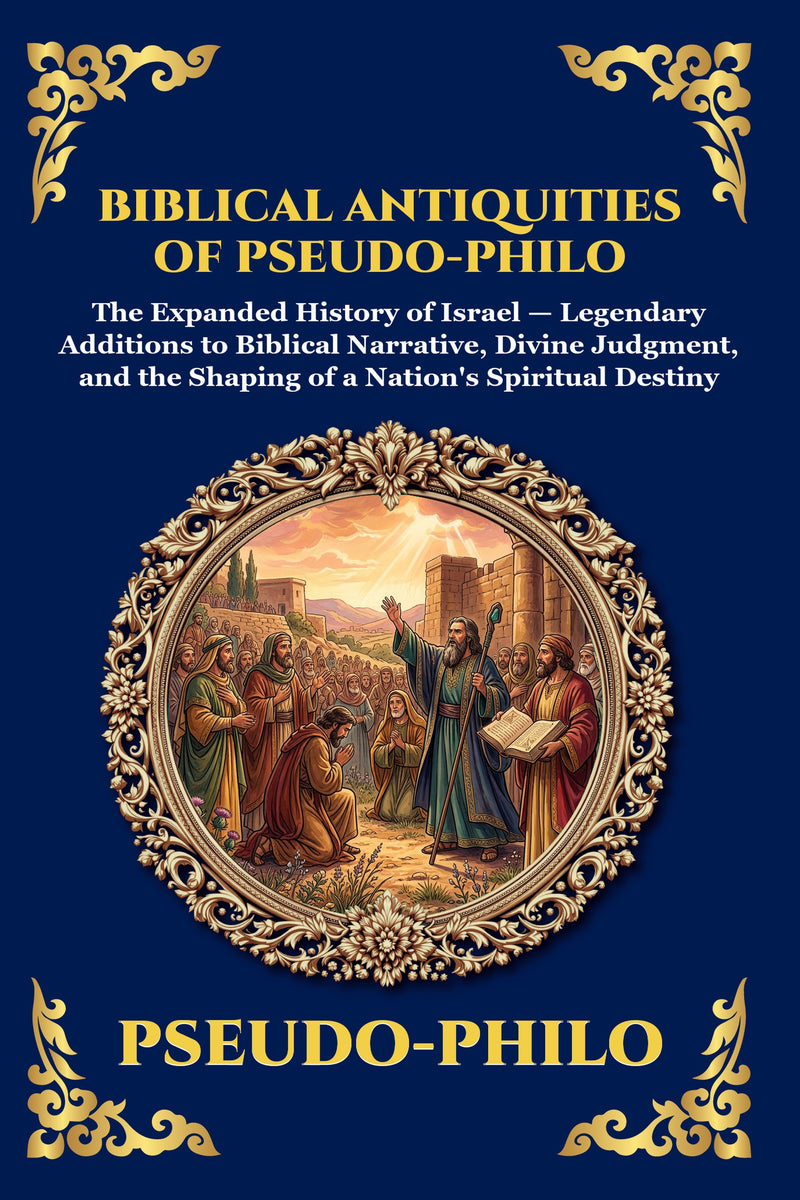
Biblical Antiquities of Pseudo-Philo — Large Print
Written in the first century and misattributed to Philo of Alexandria, the Biblical Antiquities of Pseudo-Philo reimagines Israelite history with vivid legends and speeches omitted from the traditional Bible. This text introduces new heroes and narratives, filling gaps in the Old Testament with creativity and depth.
or free app
10,000+ hrs library
30-day guarantee
This Library of Alexandria edition presents the complete Biblical Antiquities of Pseudo-Philo in modern English translation, readable online with included audiobook narration.
Large Print Edition. The complete, unabridged text set in a larger, easy-on-the-eyes typeface for comfortable reading.
Have you ever wondered why there are missing gaps and untold stories in the Old Testament?
In The Biblical Antiquities of Pseudo-Philo, you will uncover a sweeping, alternative history of the ancient biblical world. Written during the first century, this extraordinary apocryphal text was long attributed to the philosopher Philo of Alexandria before modern scholars realized its true, anonymous origins. Instead of simply repeating the canonical scriptures, this remarkable work boldly reimagines the history of the Israelites, seamlessly weaving together familiar events with a treasure trove of ancient Jewish legends, powerful prayers, and dramatic speeches that were left out of the traditional Bible.
This profound text introduces new heroes, elevates the roles of biblical women, and provides startlingly different accounts of monumental events. You will encounter the epic, unrecorded exploits of Kenaz, the first judge of Israel, read the haunting final lament of Jephthah’s daughter, and explore secret divine covenants. It is a masterpiece of early Jewish literature that bridges the gap between sacred scripture and deeply rooted cultural folklore.
This edition brings the forgotten narratives back to life, offering readers a rare glimpse into the imaginative and spiritual world of ancient Judaism. Whether you are a scholar of religious history, a student of the apocrypha, or someone captivated by biblical mysteries, this book provides a comprehensive look at a text that profoundly shaped early scriptural interpretation.
What You’ll Discover Inside:
- The Expanded Biblical History — Explore a mesmerizing retelling of the Old Testament, from the days of Adam to the death of King Saul.
- Forgotten Heroes and Legends — Read the epic, unrecorded deeds of figures like Kenaz, and discover the expanded roles of prominent biblical women.
- Lost Prayers and Divine Speeches — Uncover moving, apocryphal prayers and prophetic declarations never included in the canonical Bible.
- A Window into Ancient Jewish Folklore — Gain a deeper understanding of how early believers creatively interpreted and expanded upon their sacred traditions.
Whether you are drawn to its historical significance, its rich folklore, or its profound spiritual insights, The Biblical Antiquities of Pseudo-Philo offers an unforgettable journey into the ancient past.
Unearth the missing chapters of biblical history. Begin your journey into these lost narratives today.
| Formats | eBook (EPUB + PDF) · Audiobook · Paperback · Hardcover · Large Print |
| Language | English |
| Trim size (print) | 6 × 9 in |
| Binding | Paperback — perfect-bound · Hardcover — casewrap |
| Large Print edition | Same text in a larger, easy-read type — a larger font, not a larger trim |
| Print pricing | Every physical book at our true cost — at-cost, no profit (members) |
| Library | 873 restored titles, always growing |
| Composed | 1st century AD |
| Original language | Hebrew (surviving in Latin translation) |
| Source tradition | Latin manuscript tradition |
| Translation basis | Public-domain scholarly translation, rendered in clear modern English |
| Length | 47,371 words · ~3 hr 9 min reading |
| Reading level | Grade 9 · clear and comfortable (this modern-English edition) |
| Edition | Modern English translation · 2026 |
Member reviews for this edition are collected as readers finish it — be the first. Across the library: 12,000+ books shipped, every plan covered by a 365-day print guarantee.
About this edition
The complete, unabridged text in clear modern English — faithful to the original, never simplified. Every paragraph is checked against the source, so nothing is cut, summarised, or paraphrased away. It reads cleanly for today while keeping the original meaning intact.
The Biblical Antiquities survives primarily in Latin manuscripts from medieval Europe, though scholars believe it was originally composed in Hebrew. This edition derives from the standard public-domain scholarly translation and renders it in clear modern English.
- Complete & unabridgedVerified paragraph by paragraph against the source — never a scan, never abridged.
- Modern English, faithfulReadable today, with the author’s meaning kept intact. Readable — not simplified.
- Every format, one membershipRead in your browser or the free app, or listen to the full audiobook.
Included free with your membership
Cancel anytime, one click · 30-day money-back guarantee
Edition last updated June 2026
What’s inside
Biblical Antiquities of Pseudo-Philo — Large Print — complete and unabridged: all 27 sections included with membership, plus the full audiobook.
Begin reading Biblical Antiquities of Pseudo-Philo — Large Print
In clear modern English — the complete text is included with membership.
Chapter 1
The beginning of the world. Adam fathered three sons and one daughter: Cain, Noaba, Abel, and Seth.
Adam lived seven hundred years after Seth was born, and fathered twelve sons and eight daughters.
The names of the sons were: Eliseel, Suris, Elamiel, Brabal, Naat, Zarama, Zasam, Maathal, and Anath.
The names of the daughters were: Phua, Iectas, Arebica, Sifa, Tecia, Saba, and Asin.
Seth lived one hundred and five years and fathered Enos. After Enos was born, Seth lived seven hundred and seven more years, and fathered three sons and two daughters.
The names of his sons were: Elidia, Phonna, and Matha. The names of his daughters were: Malida and Thila.
Enos lived one hundred and eighty years and fathered Cainan. After Cainan was born, Enos lived seven hundred and fifteen more years, and fathered two sons and a daughter.
The names of his sons were: Phoë and Thaal. The name of his daughter was Catennath.
Cainan lived five hundred and twenty years and fathered Malalech. After Malalech was born, Cainan lived seven hundred and thirty more years, and fathered three sons and two daughters.
The names of the sons were: Athach, Socer, and Lopha. The names of the daughters were: Ana and Leua.
Malalech lived one hundred and sixty-five years and fathered Jareth. After Jareth was born, Malalech lived seven hundred and thirty more years, and fathered seven sons and five daughters.
The names of the sons were: Leta, Matha, Cethar, Melie, Suriel, Lodo, and Othim. The names of the daughters were: Ada, Noa, Iebal, Mada, and Sella.
Jareth lived one hundred and seventy-two years and fathered Enoch. After Enoch was born, Jareth lived eight hundred more years, and fathered four sons and two daughters.
The names of the sons were: Lead, Anac, Soboac, and Iectar. The names of the daughters were: Tetzeco and Lesse.
Enoch lived one hundred and sixty-five years and fathered Matusalam. After Matusalam was born, Enoch lived two hundred more years, and fathered five sons and three daughters. But Enoch pleased God in his time and was not found, for God took him up.
The names of his sons were: Anaz, Zeum, Achaun, Pheledi, and Elith. The names of his daughters were: Theiz, Lefith, and Leath.
Mathusalam lived one hundred and eighty-seven years and fathered Lamech. After Lamech was born, Mathusalam lived seven hundred and eighty-two more years, and fathered two sons and two daughters.
The names of the sons were: Inab and Rapho. The names of the daughters were: Aluma and Amuga.
Lamech lived one hundred and eighty-two years and fathered a son, and named him according to the meaning of his birth Noe, saying: This child will bring rest to us and to the earth and to all who dwell on it, upon whom a reckoning shall come because of the wickedness of their deeds.
Lamech lived five hundred and eighty-five years after Noe was born.
Noe lived three hundred years and fathered three sons: Sem, Cham, and Japheth.
Now Cain lived out his days on the earth as a wanderer and a fugitive, as God had decreed after he killed his brother Abel. The name of his wife was Themech.
Cain lay with his wife Themech, and she conceived and bore Enoch.
Cain was fifteen years old when he did these things. From that time he began to build cities, until he had founded seven in all. The names of the cities were these: the first he named Enoch, after his son. The second was called Mauli, the third Leeth, the fourth Teze, the fifth Iesca, the sixth Celeth, and the seventh Iebbath.
Chapter 2
Cain lived 715 years after Enoch was born, and in that time he had three sons and two daughters. The names of his sons were Olad, Lizaph, and Fosal; his daughters were named Citha and Maac. Cain lived 730 years in all, and then he died.
Enoch took a wife from among the daughters of Seth, and she bore him Ciram, Cuuth, and Madab. Ciram became the father of Matusael, and Matusael became the father of Lamech.
Lamech took two wives: the name of the first was Ada and the name of the second was Sella.
Ada bore him Iobab, who was the father of all who live in tents and keep flocks. She also bore him Iobal, who was the first to teach the playing of musical instruments.
It was at this time that the people living on the earth had begun to do evil, every man lying with his neighbor's wife and defiling her, and God was angry. Iobal began to play the lute and the harp and every instrument of sweet music, and through this he helped to corrupt the earth.
Sella bore Tubal and Misa and Theffa. It was this Tubal who revealed to men the working of lead and tin and iron and copper and silver and gold; and from that time the inhabitants of the earth began to make graven images and to worship them.
Lamech said to his two wives Ada and Sella: Hear my voice, wives of Lamech, and listen to what I say. I have corrupted men for my own ends and torn infants from their mothers' breasts, so that I might teach my sons and the inhabitants of the earth how to do evil. If vengeance is to be taken seven times over for Cain, then for Lamech it shall be seventy times seven.
In the course of time, when people had begun to multiply on the earth, beautiful daughters were born to them. The sons of God saw that the daughters of men were exceedingly fair, and they took as wives whichever ones they chose.
God said: My spirit shall not contend with these men forever, for they are flesh; their years shall be a hundred and twenty. Upon them he laid the burdens of the world, and in their hands wickedness was never extinguished.
God saw that the works of evil had come to full measure among all who lived on the earth, and since their thoughts were set on wickedness every day of their lives, God said: I will blot out mankind and everything that has sprung up on the earth, for I am sorry that I made him.
But Noah found grace and mercy before the Lord, and these are his generations. Noah was a righteous man, blameless in his generation, and he pleased the Lord. God said to him: The time of all who dwell on the earth has come, for their deeds are very evil. Now build yourself an ark of cedar wood, and build it in this way: three hundred cubits shall be its length, fifty cubits its breadth, and thirty cubits its height. You shall go into the ark, you and your wife and your sons and your sons' wives with you. I will establish my covenant with you, to destroy all who dwell on the earth. Of the clean animals and the clean birds of the sky you shall take seven pairs, male and female, so that their offspring may be kept alive on the earth. Of the unclean animals and birds you shall take two, male and female, and you shall take provisions for yourself and for them as well.
Noah did everything God commanded him and entered the ark, he and all his sons with him. After seven days the floodwaters began to rise over the earth. On that day all the deep springs burst open, and the great fountains of water broke forth, and the windows of heaven were opened, and rain fell on the earth for forty days and forty nights.
This was the sixteen hundred and fifty-second year from the time when God had made the heaven and the earth, on the day when the earth was ruined by its inhabitants because of the wickedness of their deeds.
The flood continued for a hundred and forty days over the earth, and only Noah and those with him in the ark remained alive. Then God remembered Noah and caused the waters to recede.
On the ninetieth day God dried the earth and said to Noah: Come out of the ark, you and all who are with you, and be fruitful and multiply on the earth. Noah came out of the ark, he and his sons and his sons' wives, and he brought out with him all the beasts and creeping things and birds and cattle, as God had commanded him. Then Noah built an altar to the Lord and took some of every clean animal and every clean bird and offered burnt offerings on the altar, and it was accepted by the Lord as a pleasing aroma.
God said: I will not again curse the earth on man's account, for the inclination of the human heart has been evil from youth. Therefore I will not again destroy all living things together as I have done. But when the inhabitants of the earth sin, I will judge them by famine or by the sword or by fire or by pestilence, and there shall be earthquakes, and they shall be scattered into uninhabited places. Yet I will never again ruin the earth with a flood of water, and as long as the earth endures, seedtime and harvest, cold and heat, summer and autumn, day and night shall not cease, until I turn my attention again to those who dwell on the earth and until the appointed times are fulfilled.
But when the years of the world have run their course, the light shall cease and the darkness shall be extinguished. I will give life to the dead and raise up from the earth those who sleep; Hell shall pay its debt and destruction shall give back what was entrusted to it, so that I may render to every person according to their works and according to the fruit of their imaginations, until I have judged between soul and flesh. The world shall rest, and death shall be no more, and Hell shall shut its mouth. The earth shall not be empty or barren for those who dwell in it; no one who has been justified in me shall be defiled. And there shall be another earth and another heaven, an everlasting dwelling place.
And the Lord spoke further to Noah and to his sons, saying: Behold, I will make my covenant with you and with your descendants after you, and I will never again destroy the earth with the waters of a flood. All living creatures that move upon it shall be yours for food. But you shall not eat flesh with its blood, which is its life. For whoever sheds a man's blood, by man shall his blood be shed, for God made man in his own image. As for you, be fruitful and multiply and fill the earth, as the multitude of fish multiply in the waters. And God said: This is the covenant I have made between me and you. When I cover the sky with clouds, my bow shall appear in the cloud, and it shall be a sign of the covenant between me and you and all who dwell upon the earth.
The sons of Noah who came out of the ark were Shem, Ham, and Japheth.
The sons of Japheth: Gomer, Magog, Madai, Nidiazech, Tubal, Mocteras, Cenez, Riphath, Thogorma, Elisa, Dessin, Cethin, and Tudant.
The sons of Gomer: Thelez, Lud, and Deberlet.
The sons of Magog: Cesse, Thipha, Pharuta, Ammiel, Phimei, Goloza, and Samanach.
The sons of Duden: Sallus, Phelucta, and Phallita.
The sons of Tubal: Phanatonova and Eteva.
Chapter 3
The sons of Tyras were Maac, Tabel, Ballana, Samplameac, and Elaz.
The sons of Mellech were Amboradat, Urach, and Bosara.
The sons of Cenez were Jubal, Zaraddana, and Anac.
The sons of Heri were Phuddet, Doad, Dephadzeat, and Enoc.
The sons of Togorma were Abiud, Saphath, Asapli, and Zepthir.
The sons of Elisa were Etzaac, Zenez, Mastisa, and Rira.
The sons of Zepti were Macziel, Temna, Aela, and Phinon.
The sons of Tessis were Meccul, Loon, and Zelataban.
The sons of Duodennin were Itheb, Beath, and Phenech.
These are the peoples who were scattered abroad and settled throughout the earth among the Persians and Medes, and on the islands of the sea. Phenech, the son of Dudeni, went up and gave the order that ships should be built for the sea, and it was then that the third part of the earth was divided.
Domereth and his sons took Ladech; Magog and his sons took Degal; Madam and his sons took Besto; Iuban and his sons took Ceel; Tubal and his sons took Pheed; Misech and his sons took Nepthi; Tiras and his sons took Roo; Duodennut and his sons took Goda; Riphath and his sons took Bosarra; Torgoma and his sons took Fud; Elisa and his sons took Thabola; Thesis and his sons took Marecham; Cethim and his sons took Thaan; Dudennin and his sons took Caruba.
Then they began to till the earth and to sow upon it. When the earth grew thirsty, those who lived on it cried out to the Lord, and he heard them and sent rain in abundance. And when the rain came down upon the earth, the bow appeared in the cloud, and those who dwelt on the earth saw the sign of the covenant and fell on their faces and sacrificed, offering burnt offerings to the Lord.
Cancel anytime, one click · 30-day money-back guarantee
Founding annual rate available now — your price locks for life when you join.
Not ready? Get this free chapter by email — read it anytime.
✓ Sent — check your inbox for Biblical Antiquities of Pseudo-Philo — Large Print.
Questions about Biblical Antiquities of Pseudo-Philo — Large Print
Why was the Biblical Antiquities of Pseudo-Philo excluded from the biblical canon?
The Biblical Antiquities was written after the Hebrew Bible's formation and represents creative retelling rather than original scripture. Early Christian and Jewish authorities recognized it as valuable commentary but not canonical text, leading to its exclusion from official biblical collections.
What stories and characters does the Biblical Antiquities of Pseudo-Philo contain?
The Biblical Antiquities retells biblical history from Adam to King Saul, adding elaborate speeches, new details about familiar figures, and expanded narratives about judges like Deborah and Gideon. It includes vivid accounts of biblical events absent from canonical scripture.
Who actually wrote the Biblical Antiquities of Pseudo-Philo?
The Biblical Antiquities was written by an anonymous Jewish author in first-century Palestine, not by Philo of Alexandria as medieval scholars believed. Modern scholarship has definitively established that Philo did not compose this creative retelling of biblical history.
Is Biblical Antiquities of Pseudo-Philo free to read?
The opening of the text is free to read below. Members read and listen to the complete work — and the entire Lost & Forbidden Library — free.
What is Biblical Antiquities of Pseudo-Philo?
Have you ever wondered why there are missing gaps and untold stories in the Old Testament? In The Biblical Antiquities of Pseudo-Philo, you will uncover a sweeping, alternative history of the ancient biblical world.
How long is Biblical Antiquities of Pseudo-Philo?
27 chapters (~47,441 words) in this restored edition.
Shipping & returns
Billing & membership
More from the library


Explore Enoch & Pseudepigrapha
- Apocalypse of Daniel
- Testament of Solomon · Attributed to King Solomon
- Book of Giants · Attributed to Mani
- The Forgotten Books of Eden · Various early Christian and Jew...
- Vision of Esdras · Attributed to the prophet Ezra
- Cave of Treasures · Attributed to Ephrem the Syrian
- Odes of Solomon · Attributed to Solomon
- Testaments of the Twelve Patriarchs · Attributed to the twelve sons o...
- The Book of Jubilees
- Apocalypse of the Virgin
- Apocalypse of Thomas · Attributed to the Apostle Thomas
- Psalms of Solomon · Traditionally Attributed to Kin...
- Apocalypse of Shenoute · Attributed to Shenoute the Arch...
- 2 Enoch · Attributed to Enoch
- Apocalypse of Pseudo-Ephraem · Attributed to Ephraem the Syrian
- Ethiopic Meqabyan I–III
- The Conflict of Adam and Eve with Satan
- Genesis Apocryphon
- Community Rule · Attributed to the Qumran community
- War Scroll · Attributed to the Qumran community
- 2 Esdras · Attributed to the prophet Ezra
- Book of Jasher
- Acts of Barnabas · Attributed to John Mark
- Acts of Paul and Thecla · Attributed to Onesiphorus
- Greek Apocalypse of Daniel
- Sibylline Oracles · Various early Christian and Jew...
- Epistle to the Alexandrians
- Apocalypse of Paul · Attributed to the Apostle Paul
- Apocalypse of Moses · Attributed to early Jewish scribes
- Baruch · Attributed to Baruch
Biblical Antiquities of Pseudo-Philo — Large Print
The Biblical Antiquities of Pseudo-Philo
The Liber Antiquitatum Biblicarum — A First-Century Retelling of Sacred History from Adam to the Death of Saul: The Generations of the Patriarchs, the Exodus and the Law, the Judges, and the Songs of Deborah and of Jephthah's Daughter
Library of Alexandria Press
The Biblical Antiquities of Pseudo-Philo
© Copyright 2026 Library of Alexandria Press. All rights reserved.
Published by Library of Alexandria Press
Printed in the United States of America
It is not legal to copy, share, or send any part of this document in either digital or printed form without written permission from the publisher, except short quotes in a book review.
Table of Contents
Introduction
Chapter 1
Chapter 2
Chapter 3
Chapter 4
Chapter 5
Chapter 6
Chapter 7
Chapter 8
Chapter 9
Chapter 10
Chapter 11
Chapter 12
Chapter 13
Chapter 14
Chapter 15
Chapter 16
Chapter 17
Chapter 18
Chapter 19
Chapter 20
Chapter 21
Chapter 22
Chapter 23
Chapter 24
Chapter 25
Chapter 26
Introduction
There is a version of the Bible that most people have never read. It tells the same stories, follows the same patriarchs and judges and prophets, moves through the same landscape of covenant and catastrophe — and yet it is unmistakably different. It breathes with a different air. It lingers where the canonical text rushes forward. It speaks where the received scripture falls silent. It names the unnamed, mourns the forgotten, and fills the white spaces between verses with legends, laments, and visions that feel ancient enough to have been there all along. This is the world you are about to enter: the world of the text known to scholars as Liber Antiquitatum Biblicarum, the Book of Biblical Antiquities, attributed for centuries to the Jewish historian Flavius Josephus, and now recognized as the work of an anonymous Jewish author writing sometime around the first century of the Common Era — an author whose identity has been lost to time but whose imagination has not.
The work commonly called Pseudo-Philo — a name that reflects the mistaken attribution to Philo of Alexandria that persisted through much of medieval Europe — is one of the most remarkable and underappreciated documents to survive from the ancient Jewish world. It retells the Hebrew scriptures from the creation of Adam all the way through the death of Saul, covering roughly the same territory as Genesis through First Samuel. But to call it a retelling is to undersell it enormously. What the anonymous author has produced is something closer to a creative theological meditation — an act of interpretive imagination so bold and so deeply rooted in the concerns of its own historical moment that it transforms familiar stories into something new without ever abandoning the framework of the old. Characters speak in extended speeches that do not appear in the Bible. Women who receive barely a sentence in the canonical text become central, tragic, even heroic figures. Entire episodes are invented, or rather, discovered — drawn out of the gaps and silences of scripture with a confidence that suggests the author believed these hidden stories were always there, waiting.
To understand why this text matters, it helps to understand something about the world in which it was written. The first century of the Common Era was a period of extraordinary crisis and creativity for Jewish culture. The Temple in Jerusalem, the physical and spiritual center of Jewish religious life, was destroyed by Roman forces in 70 CE, an event so catastrophic that it reshaped Judaism permanently. In the decades before and after that destruction, Jewish writers and thinkers were engaged in an urgent project: how do you preserve a tradition, a people, an identity, when the institutions that sustained them have been shattered? One answer — perhaps the most important answer — was to tell stories. To return to the foundational narratives of the people and find in them resources for survival, consolation, and hope. The author of this text was doing exactly that. Writing in the shadow of disaster, or perhaps in anticipation of it, this anonymous Jewish sage opened the scroll of scripture and began to read — and then began to write.
The text was composed originally in Hebrew, though the Hebrew original is lost. What survives is a Latin translation, made from a Greek intermediary, and it is from this Latin that modern scholars have worked to reconstruct the text's meaning and significance. The survival of the work in Latin, through Christian manuscript traditions, tells its own interesting story about how Jewish texts traveled through history — often preserved by communities that did not fully understand their origins, copied by monks who may have had little idea they were transmitting a work of Jewish biblical interpretation rather than a Christian one. For centuries it circulated under false names, misidentified, misunderstood, and largely ignored by the mainstream of both Jewish and Christian scholarship. It was not until the twentieth century that serious academic attention began to reveal the full depth and originality of what the text contains.
What does it contain, exactly? At its most basic level, it is a narrative that moves through the biblical story at a brisk pace, sometimes summarizing in a few sentences what the Bible takes chapters to describe, and then suddenly slowing to an almost novelistic attention when a particular episode captures the author's interest. The story of the tower of Babel, for instance, is expanded to include a dramatic confrontation between the builders and a group of righteous men who refuse to participate — a group that includes Abraham, though he is not yet named as such. The account of Jephthah's daughter, one of the most disturbing and enigmatic episodes in the book of Judges, receives an extended treatment in which the daughter herself becomes a figure of extraordinary moral dignity, a young woman who accepts her fate not with passive resignation but with an active, articulate faith that puts her father's impulsive vow in devastating perspective. The story of Deborah, the prophet and judge, is told with a richness and a reverence that makes clear the author regarded her as one of the great figures of Israelite history — a perception not always shared by later interpreters.
Throughout the text, certain themes recur with enough insistence that they begin to feel like the author's deepest preoccupations. The relationship between human sin and divine faithfulness is one. Again and again, the people of Israel fall away from the covenant, and again and again, God remains bound to the promises made to Abraham, Isaac, and Jacob. This is not a passive or sentimental faithfulness — the God of this text is capable of anger, of withdrawal, of allowing terrible things to happen — but it is a faithfulness that ultimately cannot be broken, because it rests not on human merit but on divine commitment. For a community living through the trauma of national disaster, this was not an abstract theological point. It was a lifeline.
Another recurring theme is the role of human leaders — their failures, their moments of genuine greatness, and the complex relationship between individual character and communal destiny. The judges and leaders of Israel in this text are not idealized figures. They are flawed, sometimes catastrophically so. But they are also, at their best, channels through which something larger than themselves moves. The author seems genuinely interested in the psychology of leadership, in what it costs a person to stand between a people and their God, to bear the weight of communal hope and communal sin simultaneously. This interest gives the narrative a human texture that purely theological writing often lacks.
A third theme, perhaps the most surprising to modern readers encountering the text for the first time, is the prominence of women. In a period and a culture in which women's voices were routinely marginalized in both religious and literary contexts, the author of this work makes women central to some of its most powerful moments. Seila, the daughter of Jephthah, speaks some of the most moving lines in the entire text. Deborah is presented as a mother of Israel in the fullest possible sense. Even figures who appear only briefly are given an interiority, a voice, a presence that the canonical text often denies them. Whether this reflects something about the author's own sensibilities, or about the community for which the text was written, or about older traditions that the author was drawing on, is a question that scholars continue to debate. What is not debatable is the effect: the women of this text are among its most memorable and most fully realized characters.
A Text Between Two Worlds
To read this work attentively is to become aware that it occupies a fascinating position in the history of religious literature — situated between two worlds that are more intimately connected than they are often imagined to be. On one side lies the world of the Hebrew Bible itself, the canonical scripture that the author treats as authoritative, sacred, and endlessly generative of meaning. On the other side lies the vast and varied tradition of Jewish interpretive literature — midrash, targum, apocalyptic writing, wisdom literature — that was flourishing in the Second Temple period and its immediate aftermath. This text participates in both worlds simultaneously, and understanding it fully requires some sense of each.
The Hebrew Bible, as most readers know it, is not a single unified document but a collection of texts composed over many centuries, edited and re-edited by many hands, and shaped by many different theological and political concerns. It contains contradictions, gaps, repetitions, and silences that have puzzled and fascinated readers for as long as it has existed. Ancient Jewish interpreters were acutely aware of these features of the text, and they developed sophisticated methods for addressing them — methods that involved not just explanation but creative elaboration, the filling of gaps with stories that felt consonant with the spirit of the original even when they went far beyond its letter. This tradition of creative interpretation is sometimes called rewritten Bible, and the text you are holding is one of its finest examples.
The practice of rewriting scripture was not understood in antiquity as a departure from the sacred text. It was understood as a way of entering more deeply into it. The assumption underlying this kind of writing is that scripture is inexhaustibly rich, that its apparent silences are not absences but invitations, that the stories it tells are not complete in themselves but point toward further stories that a sufficiently attentive and inspired reader can recover. When the author of this text invents a speech for a character who says nothing in the Bible, or expands an episode that the Bible dismisses in a verse or two, the author is not improvising freely but following the text's own internal logic to its furthest conclusions. This is a form of reading that takes the sacred text with absolute seriousness — more seriously, in some ways, than a purely literal approach would.
At the same time, the text is clearly shaped by concerns that go beyond the biblical narrative itself. The author writes in the shadow of specific historical experiences — of persecution, of exile, of the destruction of sacred institutions — and these experiences leave their mark on how the ancient stories are told. When the text dwells on the theme of God's faithfulness to a covenant people even in the darkest times, it is not simply expounding a theological doctrine. It is speaking to a community that needed to hear exactly this message, in exactly these terms, at exactly this moment. The ancient stories become a mirror in which the contemporary situation is reflected and, crucially, transformed — given a framework of meaning that makes survival not just possible but purposeful.
This dual orientation — backward toward the ancient text and forward toward the contemporary community — gives the work a peculiar richness that purely historical or purely theological writing lacks. It is simultaneously an act of scholarship and an act of pastoral care, an exercise in literary imagination and a response to communal crisis. The author moves between these registers so fluidly that it can be difficult to separate them, and perhaps that is the point. In the ancient Jewish world, as in many traditional cultures, the distinction between storytelling and theology, between narrative and doctrine, was not nearly as sharp as modern Western readers tend to assume. A story well told was a theological argument. A theological argument worth making had to take the form of a story.
The question of the text's relationship to early Christianity is one that scholars have found particularly interesting, and for good reason. The text was written at roughly the same time that the earliest Christian communities were taking shape, and it shares with early Christian writing a number of concerns — the interpretation of the Hebrew scriptures, the meaning of sacrifice and covenant, the role of prophetic figures, the nature of divine faithfulness. Some scholars have argued that certain passages in the text show awareness of Christian ideas, or that early Christians may have been among its readers. Others maintain that it is thoroughly and exclusively a product of Jewish interpretive tradition, with no significant Christian influence or audience. The debate has not been definitively resolved, and it probably cannot be, given the nature of the surviving evidence. What it does suggest is that this text occupies a historically crucial moment — a moment when the traditions that would eventually diverge into rabbinic Judaism and Christianity were still deeply intertwined, still drawing on the same scriptural resources and wrestling with many of the same questions.
For modern readers, this historical situation gives the text an additional layer of interest. It is a window into a world that no longer exists — the world of Second Temple Judaism in its final and most creative phase — but it is also a window into the origins of traditions that are very much alive. Reading it carefully, one begins to understand how the stories of the Hebrew Bible were being read and felt and argued over by Jewish communities in the first century, and that understanding illuminates not just the history of Judaism but the history of Western religious thought more broadly. The stories that this anonymous author found so urgent, so inexhaustibly meaningful, so desperately in need of expansion and elaboration, are stories that have continued to shape human culture for two thousand years. To encounter them here, in this unfamiliar but deeply resonant form, is to see them with fresh eyes.
How to Read What Follows
There is a particular kind of pleasure that comes from reading a text that has been lost and found — a pleasure that combines the excitement of discovery with the deeper satisfaction of recognition. When you read this work for the first time, you will almost certainly experience moments of genuine surprise, moments when a story you thought you knew opens up into territory you had no idea was there. You will also experience moments of recognition, moments when something in the expanded narrative feels so right, so consonant with what the canonical text implies but does not say, that it seems less like invention than revelation. Both kinds of moments are worth savoring. They are signs that you are reading attentively, that you are allowing the text to work on you rather than simply processing it for information.
It is worth saying something about how to approach the narrative voice itself. The author writes with a confidence that can initially seem puzzling — a confidence that the elaborations and expansions being offered are not mere speculation but genuine insight into what the ancient stories mean and how they connect to each other. This confidence is not arrogance. It is the confidence of someone who has spent a lifetime immersed in scripture, who has internalized its patterns and rhythms so completely that the move from text to interpretation feels natural, even inevitable. Reading with this in mind will help you appreciate what the author is doing rather than being distracted by questions about historical accuracy or factual invention. The author is not writing history in the modern sense. The author is writing meaning — and meaning, in this tradition, requires the full resources of narrative imagination.
The speeches and prayers that appear throughout the text deserve particular attention. In the ancient world, putting words in the mouths of historical figures was a recognized literary technique, a way of making explicit what the narrative implied about a character's inner life and theological understanding. When a figure in this text delivers a long speech that has no parallel in the Bible, the author is not simply making things up. The author is asking: given everything we know about this person, given the situation they are in, given the theological framework within which they understand their world — what would they say? What would they feel? What would they pray? The answers that the author provides are sometimes startling in their depth and beauty, and they repay careful reading.
The women of this text, as noted earlier, deserve special attention. In a literary and cultural environment in which women's voices were routinely suppressed or ignored, the author has made choices that are remarkable by any standard. Seila, the daughter of Jephthah, is perhaps the most extraordinary example — a young woman facing a death she did not choose, whose response is not despair or bitterness but a kind of fierce, luminous acceptance that transforms her from a victim into something closer to a martyr in the original sense of that word: a witness. Her extended speech before her death is one of the great passages in the entire text, and it raises questions about sacrifice, about the relationship between human vows and divine will, about the cost of piety, that the canonical account of her story leaves entirely unaddressed. Reading her words carefully will reward you with insights that go far beyond the immediate narrative.
Deborah, too, is worth reading with particular care. The author's treatment of her draws on the canonical account in the book of Judges but expands it in ways that reveal a deep appreciation for what her leadership meant — not just militarily or politically, but spiritually and communally. The extended song attributed to her in this text is a meditation on the entire sweep of Israelite history, a panoramic vision that places her own moment within a larger story of covenant and faithfulness. It is writing of considerable literary ambition, and it succeeds.
As you move through the narrative, you will notice that the author has a particular interest in the moment of death — in final speeches, deathbed visions, last words spoken by figures who know they are about to leave the world. This interest is not morbid. It reflects a theological conviction that the moment of death is also a moment of clarity, when the veil between the human and the divine becomes thinner, when figures who have lived their lives in the midst of historical confusion are granted a vision of the larger pattern. Some of the most beautiful writing in the text occurs in these deathbed scenes, and they often serve as moments of theological summary — places where the author pauses the narrative to reflect on what it all means.
The eschatological dimension of the text — its interest in the end of days, in divine judgment, in the ultimate resolution of history — is another feature that rewards attention. The author is not primarily an apocalyptic writer in the technical sense, but there are moments in the text where the horizon of ordinary historical time opens up into something larger, where the immediate story of Israel's struggles and failures and recoveries is placed within a framework of cosmic significance. These moments connect the text to the wider tradition of Jewish apocalyptic literature that was flourishing in the same period, and they give the narrative a depth that purely historical retelling would lack. They suggest that the author understood the stories of Israel not just as the record of a particular people's past but as the unfolding of a divine purpose that encompasses all of human history.
One final thing to keep in mind as you read: this is a text that rewards patience. It is not always easy reading. The Latin translation through which it reaches us is sometimes awkward, sometimes obscure, and the author's style — even at its most expansive — tends toward compression and allusion rather than extended explanation. There will be moments when a passage seems opaque, when a reference is unclear, when the connection between two episodes is not immediately obvious. These moments are not failures of the text. They are invitations to slow down, to read more carefully, to bring to the text the same kind of attentive imagination that the author brought to scripture. The rewards of this kind of reading are considerable. The text opens up gradually, like a landscape seen from a moving vehicle — first the broad outlines, then the details, then the details within the details, until what seemed at first like familiar territory reveals itself to be something stranger and richer and more surprising than you had imagined.
What you are holding is not simply an ancient curiosity or a scholarly artifact. It is a living document — living in the sense that it continues to generate meaning, to raise questions, to challenge assumptions, to illuminate the familiar from unexpected angles. It was written by someone who loved the stories of scripture with a passion fierce enough to drive them to spend a lifetime elaborating and extending those stories, someone who believed that the ancient texts had not said everything they had to say, that there were still depths to be plumbed and heights to be reached. That belief turned out to be correct. The text that resulted from it is one of the great achievements of ancient Jewish literature — profound, moving, surprising, and, in the best possible sense, inexhaustible. Turn the page, and begin.
The Biblical Antiquities of Pseudo-Philo
Chapter 1
The beginning of the world. Adam fathered three sons and one daughter: Cain, Noaba, Abel, and Seth.
Adam lived seven hundred years after Seth was born, and fathered twelve sons and eight daughters.
The names of the sons were: Eliseel, Suris, Elamiel, Brabal, Naat, Zarama, Zasam, Maathal, and Anath.
The names of the daughters were: Phua, Iectas, Arebica, Sifa, Tecia, Saba, and Asin.
Seth lived one hundred and five years and fathered Enos. After Enos was born, Seth lived seven hundred and seven more years, and fathered three sons and two daughters.
The names of his sons were: Elidia, Phonna, and Matha. The names of his daughters were: Malida and Thila.
Enos lived one hundred and eighty years and fathered Cainan. After Cainan was born, Enos lived seven hundred and fifteen more years, and fathered two sons and a daughter.
The names of his sons were: Phoë and Thaal. The name of his daughter was Catennath.
Cainan lived five hundred and twenty years and fathered Malalech. After Malalech was born, Cainan lived seven hundred and thirty more years, and fathered three sons and two daughters.
The names of the sons were: Athach, Socer, and Lopha. The names of the daughters were: Ana and Leua.
Malalech lived one hundred and sixty-five years and fathered Jareth. After Jareth was born, Malalech lived seven hundred and thirty more years, and fathered seven sons and five daughters.
The names of the sons were: Leta, Matha, Cethar, Melie, Suriel, Lodo, and Othim. The names of the daughters were: Ada, Noa, Iebal, Mada, and Sella.
Jareth lived one hundred and seventy-two years and fathered Enoch. After Enoch was born, Jareth lived eight hundred more years, and fathered four sons and two daughters.
The names of the sons were: Lead, Anac, Soboac, and Iectar. The names of the daughters were: Tetzeco and Lesse.
Enoch lived one hundred and sixty-five years and fathered Matusalam. After Matusalam was born, Enoch lived two hundred more years, and fathered five sons and three daughters. But Enoch pleased God in his time and was not found, for God took him up.
The names of his sons were: Anaz, Zeum, Achaun, Pheledi, and Elith. The names of his daughters were: Theiz, Lefith, and Leath.
Mathusalam lived one hundred and eighty-seven years and fathered Lamech. After Lamech was born, Mathusalam lived seven hundred and eighty-two more years, and fathered two sons and two daughters.
The names of the sons were: Inab and Rapho. The names of the daughters were: Aluma and Amuga.
Lamech lived one hundred and eighty-two years and fathered a son, and named him according to the meaning of his birth Noe, saying: This child will bring rest to us and to the earth and to all who dwell on it, upon whom a reckoning shall come because of the wickedness of their deeds.
Lamech lived five hundred and eighty-five years after Noe was born.
Noe lived three hundred years and fathered three sons: Sem, Cham, and Japheth.
Now Cain lived out his days on the earth as a wanderer and a fugitive, as God had decreed after he killed his brother Abel. The name of his wife was Themech.
Cain lay with his wife Themech, and she conceived and bore Enoch.
Cain was fifteen years old when he did these things. From that time he began to build cities, until he had founded seven in all. The names of the cities were these: the first he named Enoch, after his son. The second was called Mauli, the third Leeth, the fourth Teze, the fifth Iesca, the sixth Celeth, and the seventh Iebbath.
End of the free sample
Keep reading, free
Members read and listen to the complete book — and the entire library. Cancel anytime, one click · 30-day money-back guarantee.