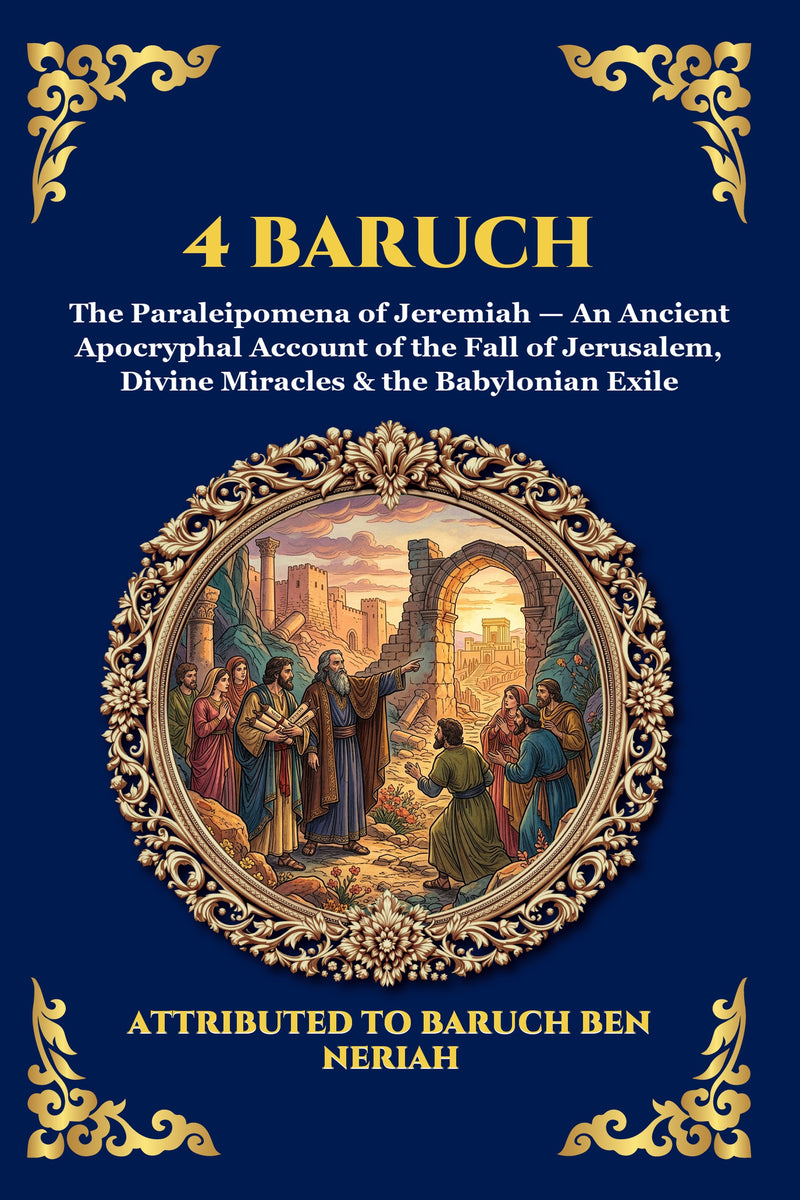
4 Baruch — Large Print
Attributed to Baruch, the loyal scribe of Jeremiah, 4 Baruch fills the gaps in the biblical account of the Babylonian exile with tales of angelic interventions and divine miracles. Excluded from the Bible, it explores themes of unshakable faith and the preservation of the righteous amid Jerusalem's fall.
or free app
10,000+ hrs library
30-day guarantee
4 Baruch (Paraleipomena of Jeremiah), the 1st-2nd century AD text, is available as a complete modern-English translation online with audiobook narration included for members through Library of Alexandria Press.
Large Print Edition. The complete, unabridged text set in a larger, easy-on-the-eyes typeface for comfortable reading.
Have you ever wondered why the fall of Jerusalem sparked not only immense sorrow but also some of the most extraordinary legends of divine miracles in ancient literature?
4 Baruch, also known as the Paraleipomena (Things Omitted) of Jeremiah, presents a compelling modern translation of a deeply fascinating apocryphal text. Attributed to Baruch ben Neriah, the loyal scribe of the prophet Jeremiah, this ancient narrative fills in the gaps of the biblical account of the Babylonian exile, offering a story rich with supernatural wonders, angelic interventions, and unshakable faith.
Far more than a historical chronicle of military defeat, 4 Baruch delves into profound themes of divine protection, the preservation of the righteous, and the dramatic return from captivity. It tells the astonishing story of Abimelech, who miraculously sleeps through the entire sixty-six-year exile under a fig tree, awakening to find his basket of fruit still perfectly fresh—a divine sign that God has not abandoned His people. Blending history, mysticism, and vibrant religious folklore, this book captures the resilience of a displaced people trusting in the ultimate restoration of their home.
What You’ll Discover in This Modern Translation:
The Fall of Jerusalem Follow Jeremiah and Baruch as they navigate the heartbreaking destruction of the holy city and witness the miraculous hiding of the sacred temple vessels by angels.
The Sleep of Abimelech Discover the astonishing tale of the man who slept through the Babylonian exile and awoke as a living symbol of God’s enduring promise and protective grace.
The Eagle’s Journey Read the captivating, mystical account of Baruch sending a resurrected eagle carrying a letter across the harsh desert to comfort Jeremiah and the exiles in Babylon.
The Return of the Exiles Explore the dramatic and mythic retelling of the Israelites' return to the promised land, including the strict tests of their faithfulness and their separation from foreign influences.
A Window into Ancient Jewish Legends Gain a deeper understanding of the vibrant folklore, angelic encounters, and historical reflections that shaped early religious identity and apocalyptic literature.
Whether you are exploring this work for its immense historical value, its miraculous folklore, or its spiritual insight into enduring seasons of exile, 4 Baruch offers inspiration and guidance for all.
Step into a story of unparalleled prophetic vision and discover the timeless lessons of the Paraleipomena of Jeremiah. Begin your journey today.
| Formats | eBook (EPUB + PDF) · Audiobook · Paperback · Hardcover · Large Print |
| Language | English |
| Trim size (print) | 6 × 9 in |
| Binding | Paperback — perfect-bound · Hardcover — casewrap |
| Large Print edition | Same text in a larger, easy-read type — a larger font, not a larger trim |
| Print pricing | Every physical book at our true cost — at-cost, no profit (members) |
| Library | 873 restored titles, always growing |
| Composed | 1st-2nd century AD |
| Original language | Greek |
| Source tradition | Greek manuscript tradition |
| Translation basis | Public-domain scholarly translation, rendered in clear modern English |
| Length | 7,685 words · ~31 min reading |
| Reading level | Grade 12 · rich, literary prose (this modern-English edition) |
| Edition | Modern English translation · 2026 |
Member reviews for this edition are collected as readers finish it — be the first. Across the library: 12,000+ books shipped, every plan covered by a 365-day print guarantee.
About this edition
The complete, unabridged text in clear modern English — faithful to the original, never simplified. Every paragraph is checked against the source, so nothing is cut, summarised, or paraphrased away. It reads cleanly for today while keeping the original meaning intact.
4 Baruch survives primarily in Greek manuscripts, with versions also preserved in Ethiopic, Armenian, and Slavonic traditions. This edition derives from the standard public-domain scholarly translation and renders it in clear modern English.
- Complete & unabridgedVerified paragraph by paragraph against the source — never a scan, never abridged.
- Modern English, faithfulReadable today, with the author’s meaning kept intact. Readable — not simplified.
- Every format, one membershipRead in your browser or the free app, or listen to the full audiobook.
Included free with your membership
Cancel anytime, one click · 30-day money-back guarantee
Edition last updated June 2026
What’s inside
4 Baruch — Large Print — complete and unabridged: all 38 sections included with membership, plus the full audiobook.
Begin reading 4 Baruch — Large Print
In clear modern English — the complete text is included with membership.
A Text Between Two Worlds
One of the most fascinating puzzles surrounding this text is the question of its religious identity — or rather, its religious identities, plural. As noted above, the work as we have it appears to be a composite production, and the seams between its Jewish and Christian layers are visible to careful readers, though scholars continue to debate exactly where those seams lie and how much of the text belongs to each stratum. What is not in serious dispute is that the text enjoyed a particularly warm reception in Ethiopian Christianity, where it was preserved as part of the biblical canon — a remarkable fact that tells us something important about the diversity and flexibility of early Christian communities and their relationship to the Jewish literary heritage.
The Ethiopian Orthodox Church, which traces its origins to the fourth century CE and maintains traditions of extraordinary antiquity, preserved this text as scripture in a way that no other Christian community did. This alone should give us pause and prompt reflection. The Ethiopian church's biblical canon is significantly larger than those of Western Christianity, including texts that other traditions classify as apocryphal or pseudepigraphical, and this breadth reflects a different historical relationship to the rich literary world of Second Temple Judaism. For Ethiopian Christians, the text was not a curiosity or an artifact of dubious status; it was sacred writing, read in liturgy, meditated upon by monks, and woven into the fabric of religious life. This history of reception is itself a kind of argument about the text's power and significance — communities do not preserve and venerate texts across centuries unless those texts are doing real spiritual work.
The christological passages that appear in the text — most strikingly, a remarkable scene involving a messenger and a message about someone called 'the light of the world' who is to come — have been interpreted in radically different ways by different scholars. Some see them as late Christian interpolations that fundamentally alter the character of a Jewish original. Others argue that the boundaries between Jewish and Christian identity in the late first and early second centuries were far more porous than later polemics suggest, and that the text may reflect a community that did not experience these identities as mutually exclusive. Still others suggest that the christological elements are so organically integrated into the narrative's structure that they cannot simply be excised without damaging the whole, which would imply either that the text was always Christian or that the Christian editing was far more thorough and skillful than a simple interpolation model would suggest. The debate is genuinely unresolved, and this is not a weakness of scholarship but a reflection of the text's real complexity.
What this means for the reader is that the work before you operates on multiple registers simultaneously, and different readers will find different things in it depending on their own backgrounds and interests. A reader coming from a Jewish tradition will find here a profound engagement with themes of exile, covenant, and return that resonate with some of the deepest currents in Jewish religious thought. A reader coming from a Christian tradition will find anticipations of themes central to Christian theology, rendered in a narrative idiom that feels both familiar and strange. A reader coming from neither tradition — approaching the text as a work of ancient literature and religious imagination — will find a document that illuminates the extraordinary ferment of the ancient Mediterranean world, where religious identities were being constructed, contested, and negotiated with an energy and creativity that we are only beginning to fully appreciate.
The manuscript tradition of the text is itself a small adventure in textual history. The work survives in Greek, Ethiopic, Romanian, and Armenian versions, each with its own distinctive features and each reflecting the communities that preserved and used it. The Greek text, which most scholars regard as closest to the original composition (or at least to an early stage of it), exists in multiple manuscripts with significant variations, and the task of establishing a reliable critical text has occupied generations of scholars. The Ethiopic version, as one might expect given its canonical status in the Ethiopian church, is the most extensively attested and in some ways the most carefully preserved. The Romanian and Armenian versions are fascinating witnesses to the text's spread through Eastern Christian communities and to the ways in which translators and copyists adapted it to new cultural contexts. Reading about this manuscript tradition — even without reading the manuscripts themselves — gives one a vivid sense of how ancient texts actually lived: not as fixed, stable objects but as dynamic, evolving entities shaped by the communities that used them.
The language of the text, in its Greek form, is what scholars call Jewish Greek or Septuagintal Greek — a variety of the language heavily influenced by Hebrew and Aramaic idiom, full of constructions that feel slightly foreign to a native Greek speaker but that would have been immediately recognizable to anyone familiar with the Septuagint, the Greek translation of the Hebrew Bible that was the scripture of most diaspora Jewish communities and of early Christianity. This linguistic texture is not merely a technical matter; it is part of the text's meaning. By writing in the language of the Septuagint, the author or authors were situating their work within a specific literary and religious tradition, claiming kinship with the great translations and compositions that had shaped Jewish and Christian life for centuries. The text sounds, to an ancient ear, like scripture — and that is almost certainly deliberate.
Geography, too, plays a significant role in the text's imaginative world, and it is worth attending to the spatial dimensions of the narrative. The movement between Jerusalem and Babylon — between the ruined holy city and the place of exile — is not merely a plot device but a theological statement. Jerusalem in this text is not simply a location; it is a theological reality, the place where God's presence was concentrated and from which it has been withdrawn, the place to which all longing is directed and toward which all movement must ultimately tend. Babylon, correspondingly, is not merely a foreign city but a symbol of everything that is not-home, not-holy, not-Jerusalem. The letters that pass between Baruch in Jerusalem and Jeremiah in Babylon are not just narrative conveniences; they are meditations on the possibility of maintaining connection across the void of exile, of keeping alive a relationship with the holy city even when separated from it by vast distances and the crushing weight of foreign domination. For ancient readers who lived in diaspora communities scattered across the Roman Empire, this spatial drama would have been immediately and personally meaningful.
Reading Across the Centuries
To read this text well, it helps to come to it with certain expectations adjusted and certain habits of mind cultivated. Modern readers, trained by centuries of novelistic fiction to expect psychological realism, linear plotting, and narratorial consistency, may initially find the text's movement between registers disconcerting. It shifts without warning from realistic narrative to visionary experience, from intimate domestic scene to cosmic drama, from the specific and historical to the timeless and symbolic. These shifts are not failures of craft; they are features of a literary mode that operates according to different principles than the modern novel, principles that are actually quite sophisticated once one learns to recognize them.
The text belongs to what scholars call the genre of rewritten Bible — a genre that flourished in the Second Temple period and that involves taking a canonical narrative and expanding, embellishing, and reinterpreting it in ways that address the concerns of a new audience. The author or authors of this work knew the book of Jeremiah intimately, and they expected their audience to know it too. The relationship between the canonical text and this expansion is not one of simple addition — it is more like a conversation, in which the later text responds to, questions, and sometimes gently corrects the earlier one. Readers who come to this work already familiar with the biblical Jeremiah will find that familiarity richly rewarded; readers who come to it fresh will find that it stands on its own as a compelling narrative, even if some of the intertextual resonances remain below the surface.
The miraculous elements of the narrative — and there are several, beyond the famous extended sleep — should be approached with neither credulous literalism nor dismissive rationalism. In the world this text inhabits, miracles are not violations of natural law but signs of divine engagement with history, moments when the normally invisible structure of providential care becomes briefly visible. When God speaks directly to characters, when angels carry messages, when the natural world responds to human prayer and divine decree, the text is not making claims that we would today classify as scientific; it is making claims about the nature of reality, about the relationship between the human and the divine, about the responsiveness of the cosmos to moral and spiritual conditions. These are claims that deserve to be taken seriously on their own terms, whatever one's ultimate assessment of their truth.
The figure of Jeremiah as presented in this text is worth particular attention, because it represents a significant and illuminating development of the canonical portrait. The biblical Jeremiah is one of the most psychologically complex figures in all of ancient literature — a man who did not want his prophetic vocation, who raged against God for burdening him with it, who lamented his own birth, who was forbidden to marry or to participate in the normal consolations of social life, who watched helplessly as everything he warned against came to pass. He is, in some ways, the patron saint of reluctant witnesses, of people who see clearly what others refuse to see and who pay a terrible price for that clarity. The Jeremiah of this text inherits all of that complexity but is also given a new dimension: he becomes a figure of pastoral responsibility, a shepherd of his people in their darkest hour, a man whose love for the exiles is as powerful as his grief over the city they have left behind. The tension between these two loyalties — to the holy place and to the living people — gives the narrative much of its emotional energy.
Baruch, too, emerges as a character of unexpected depth. In the canonical tradition, he is primarily a scribe, a faithful servant who writes down what Jeremiah dictates and reads it aloud in the Temple. Here he becomes something more: a keeper of memory, a guardian of hope, a man who stays when others go and who maintains, through the long years of desolation, the possibility of return. His correspondence with Jeremiah across the distance of exile is one of the text's most moving elements — these letters passing between a ruined city and a foreign land, carrying news and grief and encouragement and the stubborn insistence that the separation is not permanent, that the story is not over, that God has not forgotten either the city or its scattered children.
The question of return — of what it means to go back, of whether return is ever truly possible, of what one finds when one arrives at a place one has longed for across years of absence — is perhaps the text's deepest preoccupation. The return from Babylon that the narrative eventually describes is not presented as a simple restoration of what was lost. Something has changed, irrevocably, and the text is honest about this. People who went into exile as one kind of community return as another kind. The city they return to is not the city they left. The relationships that sustained them in exile must be renegotiated in the context of a home that has been transformed by their absence. And yet — and this is crucial — the return is real. The longing is answered, even if not in the form in which it was originally felt. The covenant holds, even if its expression must take new forms. This is not a naive or sentimental message; it is a hard-won and mature theological affirmation, earned through honest engagement with the reality of loss.
For modern readers, the resonances of this ancient meditation on exile and return are not difficult to find. The twentieth and twenty-first centuries have been, among other things, centuries of displacement — of refugees and diasporas, of communities torn from their homes by war and persecution and economic desperation, of people who carry within them the memory of places they may never see again or that no longer exist in the form they remember. The questions this text asks — What do you hold onto when everything familiar has been taken from you? How do you maintain identity across the rupture of displacement? What does it mean to return, and what do you find when you get there? — are not antiquarian questions. They are questions that millions of people are living with right now, and that gives this ancient text an urgency that transcends its historical origins.
There is also, woven through the text, a profound meditation on the nature of faithfulness — divine faithfulness and human faithfulness, and the relationship between the two. The text's God is not a distant, impassive deity indifferent to human suffering. This is a God who grieves over the destruction of Jerusalem, who cannot simply watch unmoved as the city falls, who must, as it were, look away while the worst happens because to witness it directly would be unbearable. This is a striking and theologically daring portrait, one that refuses to resolve the tension between divine sovereignty and divine compassion by sacrificing either one. The God of this text is both the one who has allowed catastrophe to occur — for reasons that are not fully explained and perhaps cannot be fully explained — and the one who remains committed to the ultimate redemption of those who suffer. Holding these two things together without collapsing into either theodicy or despair is one of the text's most impressive achievements.
Cancel anytime, one click · 30-day money-back guarantee
Founding annual rate available now — your price locks for life when you join.
Not ready? Get this free chapter by email — read it anytime.
✓ Sent — check your inbox for 4 Baruch — Large Print.
Questions about 4 Baruch — Large Print
Why was 4 Baruch excluded from the biblical canon?
4 Baruch was composed after the Hebrew Bible's formation and contains legendary expansions of biblical narratives. Early Christian communities preserved it as edifying literature, but it was not included in the official biblical canon due to its later composition and non-apostolic authorship.
What stories does 4 Baruch contain?
4 Baruch narrates events surrounding Jerusalem's destruction and the Babylonian exile, featuring Baruch's preservation of temple vessels, Jeremiah's miraculous experiences, and the eventual return from exile. It includes angelic encounters, supernatural preservation of the righteous, and legendary expansions of biblical accounts.
Who actually wrote 4 Baruch?
4 Baruch was written by an unknown Jewish or Jewish-Christian author in the 1st-2nd century AD, not by the historical Baruch ben Neriah. Ancient texts were commonly attributed to revered figures to convey their spiritual authority and connection to biblical tradition.
Is 4 Baruch free to read?
The opening of the text is free to read below. Members read and listen to the complete work — and the entire Lost & Forbidden Library — free.
What is 4 Baruch?
Have you ever wondered why the fall of Jerusalem sparked not only immense sorrow but also some of the most extraordinary legends of divine miracles in ancient literature?
How long is 4 Baruch?
38 chapters (~4,922 words) in this restored edition.
Shipping & returns
Billing & membership
More from the library


Explore Enoch & Pseudepigrapha
- Apocalypse of Daniel
- Testament of Solomon · Attributed to King Solomon
- Book of Giants · Attributed to Mani
- The Forgotten Books of Eden · Various early Christian and Jew...
- Vision of Esdras · Attributed to the prophet Ezra
- Cave of Treasures · Attributed to Ephrem the Syrian
- Odes of Solomon · Attributed to Solomon
- Testaments of the Twelve Patriarchs · Attributed to the twelve sons o...
- The Book of Jubilees
- Apocalypse of the Virgin
- Apocalypse of Thomas · Attributed to the Apostle Thomas
- Psalms of Solomon · Traditionally Attributed to Kin...
- Apocalypse of Shenoute · Attributed to Shenoute the Arch...
- 2 Enoch · Attributed to Enoch
- Apocalypse of Pseudo-Ephraem · Attributed to Ephraem the Syrian
- Ethiopic Meqabyan I–III
- The Conflict of Adam and Eve with Satan
- Genesis Apocryphon
- Community Rule · Attributed to the Qumran community
- War Scroll · Attributed to the Qumran community
- 2 Esdras · Attributed to the prophet Ezra
- Book of Jasher
- Acts of Barnabas · Attributed to John Mark
- Acts of Paul and Thecla · Attributed to Onesiphorus
- Greek Apocalypse of Daniel
- Sibylline Oracles · Various early Christian and Jew...
- Epistle to the Alexandrians
- Apocalypse of Paul · Attributed to the Apostle Paul
- Apocalypse of Moses · Attributed to early Jewish scribes
- Baruch · Attributed to Baruch
4 Baruch — Large Print
4 Baruch
The Paraleipomena of Jeremiah — An Ancient Apocryphal Account of the Fall of Jerusalem, Divine Miracles & the Babylonian Exile
Library of Alexandria Press
4 Baruch
© Copyright 2026 Library of Alexandria Press. All rights reserved.
Published by Library of Alexandria Press
Printed in the United States of America
It is not legal to copy, share, or send any part of this document in either digital or printed form without written permission from the publisher, except short quotes in a book review.
Table of Contents
Introduction
A Text Between Two Worlds
Reading Across the Centuries
The Word of the Lord Comes to Jeremiah
Jeremiah Weeps and Intercedes
The Hiding of the Sacred Vessels
Divine Command to Protect Abimelech
Jeremiah Dispatches Abimelech for Figs
Angels Guard the Walls Against the Enemy
Captivity of Israel and Lamentation of Jeremiah
Angels Conceal the Sacred Vessels
Jeremiah and Baruch Lament the Captivity
Abimelech Sent to Gather Figs
The Sixty-Six Years of Sleep
Abimelech Wakes and Finds the Figs Fresh
Abimelech Does Not Recognize the City
Abimelech's Identity and Ignorance Established
The Revelation of Jerusalem's Captivity
Abimelech Understands the Sign
Abimelech Arrives at Baruch's Tomb
Baruch and Abimelech Exchange News
Baruch's Exclamation of Praise and Wonder
Baruch Examines the Figs and Prays
Baruch Writes Letter and Prepares Figs
The Eagle Sent Forth to Babylon
Baruch Seals the Letter and Eagle Departs
Eagle Arrives and Raises the Dead in Babylon
Jeremiah Reads and Weeps Over the Letter
People's Lamentation and Preparation to Return
Jeremiah's Command at the Jordan
The People's Response and Division
The Building of Samaria
The Return to Jerusalem and the Sacrifice of Jeremiah
Jeremiah's Death and Resurrection Before the People
The Prophecy of God's Incarnation
Stoning and Death of Jeremiah
Burial and Mourning of Jeremiah
The Preservation of Jeremiah's Words
Introduction
There are books that survive because institutions protect them, because councils canonize them, because scribes copy them faithfully across centuries in the warm shelter of monastery libraries. And then there are books that survive in spite of everything — texts that slip through the cracks of official religion, carried quietly from hand to hand, translated into languages their authors never spoke, cherished by communities who found in them something that the sanctioned scriptures, for all their grandeur, could not quite provide. The work you are about to read belongs emphatically to this second category. It is a text that has lived in the margins of history, and yet it pulses with a vitality that more celebrated works sometimes lack. It is raw, strange, deeply moving, and at moments almost hallucinatory in its imagery. It asks enormous questions about suffering, divine faithfulness, and the possibility of return — and it does so through a story so vividly imagined that readers separated from its composition by nearly two millennia can still feel its emotional weight pressing against the page.
The work known to scholars as the Paraleipomena of Jeremiah — meaning, roughly, 'the things omitted from Jeremiah' — or alternatively as Fourth Baruch, occupies a peculiar and fascinating position in the landscape of ancient Jewish and early Christian literature. It is neither fully Jewish nor fully Christian in its final form, and this ambiguity is not a defect but rather one of the most intellectually interesting things about it. The text appears to have begun as a Jewish composition, probably written in Hebrew or Aramaic sometime in the late first or early second century of the Common Era, in the devastating aftermath of the destruction of the Second Temple in 70 CE. At some point — scholars debate exactly when and how extensively — Christian editors worked over the text, adding or modifying passages that gave the narrative a distinctly christological coloring. What we possess today is therefore a layered document, a palimpsest of religious sensibilities, and reading it with awareness of those layers adds immeasurably to the experience.
To understand why this text was written at all, one must understand the catastrophe that haunted the Jewish world in the decades following 70 CE. The Roman destruction of Jerusalem and the burning of the Temple was not merely a military defeat or a political humiliation. It was a theological earthquake of the first magnitude. The Temple was not simply a building; it was the axis of the cosmos, the place where heaven and earth met, where sacrifice maintained the relationship between God and Israel, where the divine presence — the Shekinah — was believed to dwell in a particular and irreplaceable way. When the Romans under Titus tore it down and carried its sacred vessels away to Rome, the questions that erupted in Jewish communities were not primarily strategic or political. They were agonizingly theological: Where is God? Has the covenant been broken? Is this punishment, and if so, for what? Will God return to us, and if so, how, and when, and under what conditions? These are the questions that breathe through every paragraph of the text you are about to read, even when the narrative appears to be doing something else entirely.
The genius of the work lies in its decision to address these burning contemporary questions not directly but through the lens of an earlier catastrophe — the Babylonian destruction of Jerusalem in 587 BCE, the event that sent the prophet Jeremiah's world crashing down and carried the population of Judah into exile along the rivers of a foreign empire. By writing about that first destruction, the author or authors could speak obliquely but powerfully about the second. The parallels were too obvious to miss for any ancient reader: once again, Jerusalem had fallen; once again, the Temple lay in ruins; once again, the people of Israel found themselves scattered and subject to foreign domination. The earlier catastrophe became a mirror in which the later one could be examined, mourned, and — crucially — placed within a framework of ultimate hope. Because the Babylonian exile had ended. The people had returned. God had not, in the end, abandoned them. The implicit message for readers living in the shadow of Roman destruction was clear: this too shall pass; this too will be redeemed.
The characters through whom this meditation is conducted are among the most compelling in all of ancient literature. Jeremiah himself appears not as the tormented, reluctant prophet of the canonical book that bears his name, but as a figure of almost superhuman dignity and pathos — a man who loves his city so deeply that the prospect of its destruction is physically unbearable, and who must navigate the agonizing tension between obedience to God and loyalty to his people. Baruch, Jeremiah's faithful secretary and companion in the biblical tradition, here becomes something more: a kind of anchor, left behind in the ruins of Jerusalem while Jeremiah accompanies the exiles to Babylon, maintaining a solitary vigil over the holy city and serving as the conduit through which the two separated communities maintain contact across the vast geographical and spiritual distance of exile. And then there is Abimelech — or Ebed-melech, as he is known in the canonical Jeremiah — the Ethiopian servant who rescued the prophet from a cistern and who here becomes the vehicle for one of the text's most astonishing narrative inventions: a miraculous sleep of sixty-six years, a kind of biblical Rip Van Winkle story that allows the text to compress the entire period of the Babylonian exile into a single dreamlike moment and to explore, with great psychological subtlety, what it means to wake up and find that the world you knew has been transformed beyond recognition.
It is worth pausing on that miracle of the extended sleep, because it encapsulates so much of what makes this text distinctive and rewarding. On one level, it is simply a wonderful story — the kind of narrative invention that makes you catch your breath and then immediately want to tell someone else about it. On another level, it is a profound theological statement about the nature of divine mercy: God shields his faithful servant from the full experience of catastrophe, preserving him in a state of suspension while the worst of history unfolds, and then returning him to consciousness in a world where restoration has already begun. On yet another level, it is a meditation on time and its relationship to suffering — the suggestion that what feels, from inside the experience, like an eternity of anguish may, from a larger perspective, be something closer to a night's sleep, a temporary interruption in a story whose ultimate trajectory is toward wholeness. Ancient readers would have found all these levels operating simultaneously, and modern readers who allow themselves to slow down and sit with the text will find them too.
The literary world from which this text emerges was extraordinarily rich and generative. The period between roughly 200 BCE and 200 CE saw an explosion of Jewish literary creativity that scholars have come to call the period of Second Temple literature and its aftermath — a vast outpouring of texts that includes the Dead Sea Scrolls, the books of the Apocrypha and Pseudepigrapha, the writings of Philo and Josephus, the early rabbinic materials, and dozens of other works that circulated in various communities and served various purposes. Many of these texts were apocalyptic in character, meaning that they claimed to reveal hidden truths about the structure of the cosmos, the course of history, and the ultimate destiny of humanity. Others were retellings or expansions of biblical narratives, filling in gaps, answering questions the canonical text left open, and exploring the emotional and psychological dimensions of stories that the Bible often narrates with telegraphic brevity. The work before you belongs to this second category, though it borrows freely from the apocalyptic tradition as well, and reading it alongside other texts from this period — the Second Baruch, the Fourth Ezra, the Lives of the Prophets — illuminates all of them.
What distinguishes this particular text from many of its contemporaries is its emotional directness. Some ancient pseudepigrapha can feel remote and schematic, their human characters reduced to vehicles for theological propositions or cosmic dramas. This text is different. The grief it expresses over the destruction of Jerusalem is palpable and specific. The longing for return that animates its characters is recognizable across all the distances of culture and time. The tenderness with which Baruch cares for the sleeping Abimelech, the anguish with which Jeremiah contemplates the suffering of the exiles, the bewilderment of a man who wakes to find that sixty-six years have passed and everyone he knew is either dead or transformed — these are rendered with a psychological acuity that feels almost novelistic. The author or authors of this text were not merely theologians or scribes; they were storytellers of genuine power.
The Word of the Lord Comes to Jeremiah
It came to pass, when the children of Israel were taken captive by the king of the Babylonians, that God spoke to Jeremiah, saying: Jeremiah, my chosen one, arise and depart from this city, you and Baruch, for I am going to deliver it into the hands of the king of the Babylonians, and he shall take the children of Israel captive and lead them to Babylon. But you, do not weep and do not be distressed, for I have not abandoned them; rather, I am showing them mercy. For just as a father cannot endure seeing his child dishonored, so also I could not endure seeing the works they were doing — the works of evil — and I delivered them to their enemies for a little while, so that they might be disciplined and return to me. For I know that they will return and I will bring them back to this city.
Jeremiah Weeps and Intercedes
And Jeremiah answered and said: I beseech you, Lord, permit me to speak before you. What is it that you wish me to say to the children of Israel? Or what shall I say to them? For they will not listen to me, since they have not listened to you, the Lord their God. And the Lord said to Jeremiah: Say nothing to them at all; only depart from this city, you and Baruch, for I am going to destroy it because of the multitude of the sins of those who dwell in it.
And Jeremiah wept with a great weeping, and he said: Lord, who will judge between you and me? For you have sent me to the fathers of these people, saying: Prophesy to them and call them back from their evil ways. And I prophesied to them, and they did not listen. And now, Lord, they are being led away captive, and I do not know where they are being taken. Do not abandon them, Lord, and do not utterly destroy them. Remember Abraham, Isaac, and Jacob, your servants, to whom you swore that their seed would be as the stars of heaven and as the sand of the sea. And the Lord said to Jeremiah: Arise and depart from this city, you and Baruch, for I will keep you safe.
End of the free sample
Keep reading, free
Members read and listen to the complete book — and the entire library. Cancel anytime, one click · 30-day money-back guarantee.