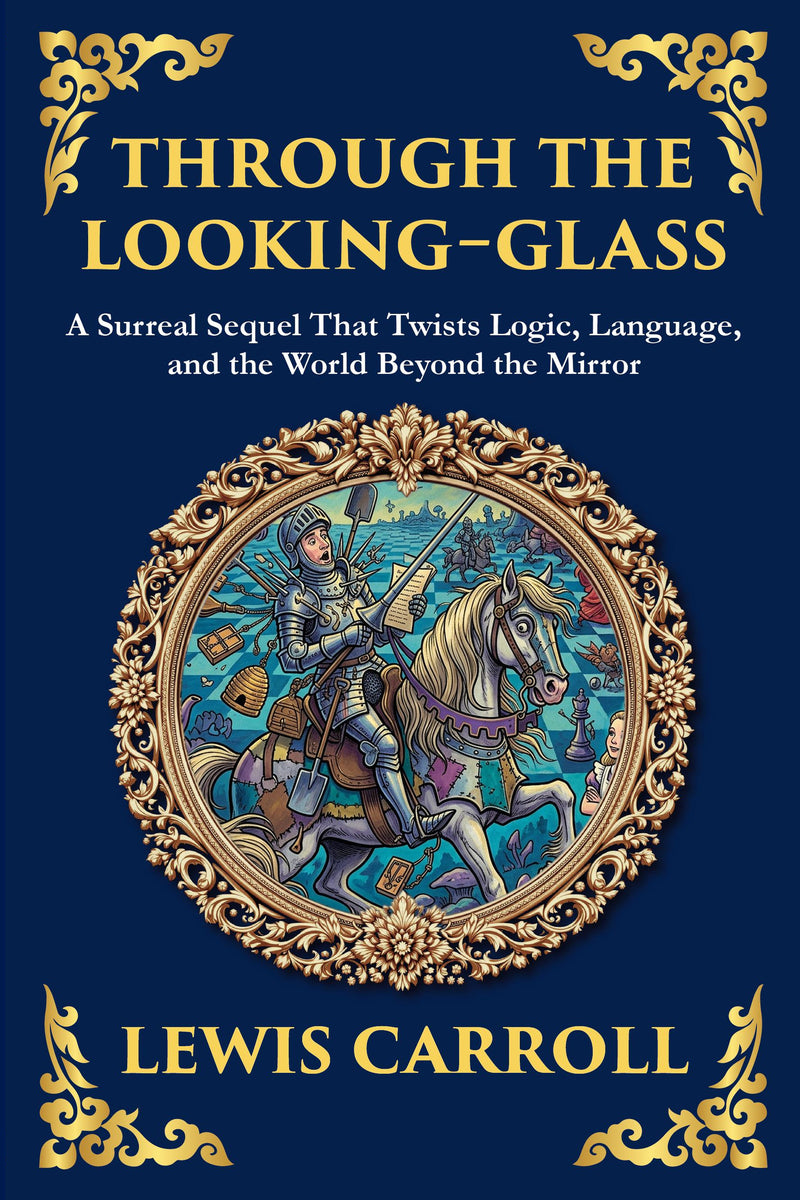
Through the Looking-Glass
Step through the glass and into a world where everything is reversed, reason is riddled with nonsense, and chess pieces argue like kings and queens.
or free app
10,000+ hrs library
30-day guarantee
The complete Through the Looking-Glass appears in modern English through Library of Alexandria Press, available online with audiobook narration included for members.
Have you ever wondered why the world makes more sense when it doesn’t follow any rules? In Through the Looking-Glass, Lewis Carroll continues the whimsical journey of young Alice— not down a rabbit hole, but through a mirror, into a realm that flips reality on its head. This is a land where chess pieces come alive, poems rewrite themselves, and logic becomes an adventure in its own right.
Told with Carroll’s signature wit and brilliant wordplay, this sequel is both a children’s fantasy and a philosophical exploration of meaning, identity, and imagination. As Alice moves square by square across the chessboard of the Looking-Glass world, she meets unforgettable characters like the Red Queen, Tweedledum and Tweedledee, Humpty Dumpty, and the White Knight— each representing not just whimsy, but deeper questions about language, reality, and the self.
What you’ll discover in this modern edition
- A World That Rewrites Itself – Time moves backward, logic flips sideways, and reality dances to the beat of dream-thought.
- Alice as a Pawn and a Queen – Watch Alice’s journey across the literal chessboard of life, where every step is a metaphor.
- Unforgettable Characters and Conversations – Meet icons like the Jabberwock, the White Queen, and Humpty Dumpty, whose riddles and rhymes still puzzle readers today.
- A Masterclass in Wordplay and Paradox – Carroll’s playful manipulation of meaning will delight language lovers and philosophers alike.
- A Book That Speaks to All Ages – Whether you read it for its imagination or its intellect, Through the Looking-Glass is a mirror you’ll never forget.
| Formats | eBook (EPUB + PDF) · Audiobook · Paperback · Hardcover · Large Print |
| Language | English |
| Trim size (print) | 6 × 9 in |
| Binding | Paperback — perfect-bound · Hardcover — casewrap |
| Large Print edition | Same text in a larger, easy-read type — a larger font, not a larger trim |
| Print pricing | Every physical book at our true cost — at-cost, no profit (members) |
| Library | 873 restored titles, always growing |
| Length | 28,921 words · ~1 hr 56 min reading |
| Reading level | Grade 6 · an easy, flowing read (this modern-English edition) |
| Edition | Modern English translation · 2026 |
Member reviews for this edition are collected as readers finish it — be the first. Across the library: 12,000+ books shipped, every plan covered by a 365-day print guarantee.
About this edition
A faithful, unabridged modern-English edition by The Library of Alexandria — carefully rendered for today's reader and verified paragraph-by-paragraph against the public-domain source. Available as eBook, audiobook, paperback, hardcover, and large print.
- Complete & unabridgedVerified paragraph by paragraph against the source — never a scan, never abridged.
- Modern English, faithfulReadable today, with the author’s meaning kept intact. Readable — not simplified.
- Every format, one membershipRead in your browser or the free app, or listen to the full audiobook.
Included free with your membership
Cancel anytime, one click · 30-day money-back guarantee
Edition last updated July 2026
What’s inside
Through the Looking-Glass — complete and unabridged: all 14 sections included with membership, plus the full audiobook.
Begin reading Through the Looking-Glass
In clear modern English — the complete text is included with membership.
Introduction
There are books that we read, and there are books that read us back. Lewis Carroll’s celebrated journey beyond the mirror belongs firmly to the second category. To open it is to step willingly into a world that refuses to behave, where the rules of cause and effect are politely but firmly overturned, where words slip their meanings like coats too loose for their hangers, and where the very ground beneath the heroine’s feet may carry her forward only to deposit her precisely where she began. It is a story that has charmed children for generations and bewildered, delighted, and quietly unsettled adults for just as long. And it is, beneath its glittering nonsense, one of the most intellectually playful works ever composed in the English language.
This modern translation has been prepared with a single, devoted purpose: to deliver the full strangeness and wit of Carroll’s vision to a contemporary reader without the friction of antiquated phrasing or obscure Victorian references standing in the way. The intention is not to flatten the book’s peculiar genius, nor to sand away its sharp edges, but to clear the glass so that the wonders behind it shine through as vividly as they did to their very first readers. What you hold is an invitation to wander, to puzzle, and to laugh — and, perhaps when you least expect it, to pause and recognize something deeply true folded inside the absurdity.
A Mirror World Built on Beautiful Contradictions
To understand why this particular adventure has endured for so long, it helps to appreciate just how audacious its premise truly is. The earlier and more famous tale that introduced this same curious young protagonist sent her tumbling down into an underground realm governed by appetite, chaos, and the logic of dreams. This sequel takes an entirely different architectural approach. Here the organizing principle is the mirror itself — reflection, reversal, and inversion. Everything in the world beyond the glass is the flipped twin of our own, and Carroll, who was a mathematician and logician by training, takes this conceit far more seriously than mere whimsy might suggest. Books must be held up to a mirror to be read. To approach someone, one must first walk directly away from them. To stay in one place, one must run as fast as one possibly can. Memory works backward as well as forward. Cause and effect occasionally trade places entirely.
What makes this so remarkable is that Carroll does not merely decorate his story with these reversals; he constructs the entire narrative upon them, the way a composer might build a symphony around a single repeated motif. The whole landscape is laid out like an enormous chessboard, and the heroine’s progress across it follows the moves of a pawn aspiring to become a queen. Each square she enters introduces a new encounter, a new character, a new test of patience or wit. The journey has a shape, a direction, a destination — and yet that destination is reached by a series of steps so dreamlike and disorienting that the reader, like the protagonist herself, is never entirely certain whether she is advancing or simply being carried along by forces she cannot quite name.
This tension — between the rigid structure of the game and the fluid lawlessness of dream-logic — gives the book its peculiar power. It is, all at once, the most ordered and the most chaotic of stories. Carroll the mathematician imposes a perfect framework; Carroll the dreamer fills it with creatures who weep before they are hurt, who remember the future, who argue passionately about the meanings of words, and who treat the most outrageous impossibilities as ordinary facts of life. The result is a reading experience that constantly tilts beneath you, the way a floor might tilt in a funhouse, leaving you uncertain whether to laugh, to think, or simply to surrender and enjoy the ride.
That surrender, by the way, is part of the point. Readers who try to wrestle this book into submission — to demand that everything mean something, to insist that every riddle resolve neatly — will find themselves frustrated. But readers who relax into its rhythms, who allow the nonsense to wash over them and trust that Carroll knows exactly what he is doing, will be rewarded again and again. For beneath the apparent randomness lies an extraordinary intelligence at play. The chaos is curated. The madness has method. And the deeper you go, the more you begin to suspect that the author is several steps ahead of you at all times, watching with a sly and gentle smile as you stumble through his hall of mirrors.
It is worth pausing here to celebrate Carroll’s astonishing command of language, because language is, in many ways, the true subject of this book. The mirror world is a place where words behave as strangely as everything else. They are pulled apart, stuffed with multiple meanings, treated as objects with weight and texture, made to perform tricks that no ordinary speech could manage. One of the most beloved passages in all of English literature appears in these pages — a poem composed almost entirely of invented words, words that sound as though they ought to mean something, words that conjure vivid images and emotions without ever consenting to be defined. It is a small miracle of linguistic imagination, and it has fascinated poets, linguists, and ordinary delighted readers for well over a century.
This fascination with the slipperiness of language reaches its philosophical peak in the book’s encounters with certain memorably stubborn characters who insist that words mean precisely what they choose them to mean, neither more nor less. These moments are funny, certainly — they are written with a comedian’s perfect timing — but they are also genuinely profound. Carroll, writing in an age that prized clarity, order, and rational meaning, was quietly poking at the foundations of how we communicate at all. Who decides what a word means? Can we simply declare our own definitions? Is logic itself a kind of game we have agreed to play, and what happens when someone refuses to play by the rules? These questions, raised with such featherlight humor, anticipate debates that would occupy serious philosophers for the next hundred years. To read this book attentively is to receive a course in the philosophy of language disguised as a children’s fantasy — and to enjoy every minute of it.
Reading Carroll Today: What This Modern Translation Offers
It is one of the small ironies of literary history that a book so concerned with the instability of language should itself become, over time, partly obscured by the language in which it was written. Carroll composed his masterpiece in the middle of the nineteenth century, in the idiom of his place and era. Much of that idiom remains perfectly clear and delightful. But much of it has drifted — words have shifted in meaning, references that once landed instantly now require footnotes, sentence rhythms that felt natural to a Victorian ear can feel formal or stiff to a modern one. Over the decades, this drift has quietly raised a barrier between Carroll and the very readers who would most love him: the young, the curious, the impatient, the easily distracted, and anyone simply hoping to be swept away rather than slowed down.
This modern translation exists to lower that barrier. The work of adaptation has been guided throughout by a principle of respectful fidelity — the conviction that the best way to honor a great author is not to embalm his words but to keep his spirit alive and accessible. Sentences that once unfolded in long, looping Victorian periods have been gently clarified where clarity was needed. Vocabulary that has fallen into disuse has been thoughtfully refreshed. References whose meaning depended on the daily life of a nineteenth-century reader have been handled with care so that they continue to communicate rather than confuse. Throughout, the aim has been to preserve everything that makes the original irreplaceable — its wit, its rhythm, its surprise, its tenderness, its strangeness — while removing only those obstacles that would otherwise come between you and your enjoyment.
It is important to be clear about what this kind of adaptation does and does not do. The famous poems remain. The invented words remain — they could hardly be otherwise, since they belong to no period and answer to no fashion. The beloved characters, the dialogue, the dream-logic, the chessboard structure, the reversals and riddles and arguments: all of these are intact, faithful to Carroll’s design. What has changed is the texture of the surrounding prose, the connective tissue, the small adjustments that allow a modern reader to move through the story at the pace the story deserves. Think of it as cleaning a beloved old painting — not repainting it, not reimagining it, simply removing the layers of varnish and grime that have dimmed its colors over the years, so that you can finally see it as its creator intended.
Some readers may wonder whether a beloved classic ought to be touched at all. It is a fair question, and one worth answering honestly. There is a powerful argument for reading great books exactly as they were written, and that argument deserves respect; original editions will and should always remain available to those who seek them. But there is an equally powerful argument — perhaps an even more urgent one — for keeping these books alive in the hands of ordinary readers rather than allowing them to retreat into the libraries of specialists. A masterpiece that no one reads is a masterpiece only in name. Carroll did not write for scholars; he wrote, originally, to delight a real child on a real boat trip, and the delight was the whole point. This translation seeks to return that delight to the widest possible audience, to make sure that the laughter and wonder he intended can still ring out clearly across the distance of more than a century and a half.
There is also something fitting, even a little mischievous, about offering a translation of this particular book — because translation, transformation, and the question of whether meaning survives the journey from one form to another are among the story’s own deepest preoccupations. The heroine herself is, in a sense, translated when she passes through the mirror: rendered into a reversed version of herself, transported into a world that operates by foreign grammar. Carroll would likely have appreciated the irony of his book undergoing a similar passage, emerging on the other side recognizably itself yet subtly transformed for a new world of readers. The spirit of the original is not betrayed by such a passage; if anything, it is honored by it.
As you read, you may find it rewarding to notice the layers operating at once. On the surface there is simply a wonderful adventure: a brave and clever young protagonist making her way through a bizarre and beautiful land, meeting one unforgettable character after another, never quite knowing what waits on the next square. This level alone is enough to carry any reader joyfully from the first page to the last. But just beneath it runs a current of sharp comedy aimed at the absurdities of grown-up behavior — the pomposity, the rigid rule-following, the way adults so often insist on nonsense while accusing children of it. And beneath that runs a still-deeper stratum of genuine philosophical inquiry, gentle but persistent, asking questions about memory and time, about identity and dreams, about the relationship between language and reality, about whether the world we take for solid might be no more substantial than a reflection or a dream within someone else’s sleeping mind. You need not chase all these layers to love the book. But they are there, patiently waiting, and they are part of why this slender volume has earned its permanent place among the great works of the imagination.
One particular pleasure awaits the attentive reader: the book’s haunting meditation on dreams and reality, which gathers force quietly throughout and culminates in a question so simple and so destabilizing that it has stayed with readers for generations. Without giving anything away, it is enough to say that Carroll plays a wonderful trick on his audience — a trick that begins as pure whimsy and ends as something close to genuine vertigo. It is the kind of ending that sends you back to the beginning, that makes you reconsider everything you thought you understood, that lingers long after the book is closed. This is not the work of a mere entertainer, charming though Carroll certainly is. It is the work of a deeply original mind delighting in the slipperiness of existence itself.
Cancel anytime, one click · 30-day money-back guarantee
Founding annual rate available now — your price locks for life when you join.
Not ready? Get this free chapter by email — read it anytime.
✓ Sent — check your inbox for Through the Looking-Glass.
Questions about Through the Looking-Glass
What is Through the Looking-Glass about?
Step through the glass and into a world where everything is reversed, reason is riddled with nonsense, and chess pieces argue like kings and queens. In this fantastical sequel to Alice’s Adventures in Wonderland, Lewis Carroll leads us deeper into the absurd, the brilliant, and the beautifully bewildering. Through the Looking-Glass is a surreal, symbolic journey where time flows backward, flowers speak in riddles, and nursery rhymes come to life in unexpected ways.
Who wrote Through the Looking-Glass?
Through the Looking-Glass was written by Lewis Carroll. This edition presents the complete work in clear modern English, faithfully rendered from the public-domain original by Library of Alexandria Press.
Is Through the Looking-Glass free to read?
The opening chapter is free to read on this page. Members read and listen to the complete work — and the entire library — free, and can order any physical book at our true print cost.
How long is Through the Looking-Glass?
14 chapters (~28,921 words) — about 1 hr 56 min of reading in this modern-English edition.
Is this an abridged version of Through the Looking-Glass?
No. This is the complete, unabridged Through the Looking-Glass, carefully rendered into clear modern English and verified paragraph-by-paragraph against the public-domain source — nothing is cut or summarised.
What formats does Through the Looking-Glass come in?
Through the Looking-Glass is available as eBook, paperback, hardcover and large print. eBook and audiobook are included with membership; printed editions ship at our true print cost.
Shipping & returns
Billing & membership
More from the library


Explore Children's Classics
- Peter and Wendy · J. M. Barrie
- Jack and Jill · Louisa May Alcott
- The Wonderful Wizard of Oz · L. Frank Baum
- Anne of Green Gables · L. M. Montgomery
- The Secret Garden · Frances Hodgson Burnett
- The Tale of Peter Rabbit · Beatrix Potter
- Peter Pan · J. M. Barrie
- The Prince and the Pauper · Mark Twain
- The Turquoise Story Book — Large Print · Ada M. Skinner; Eleanor L. Skinner
- The Book of Romance — Large Print · Andrew Lang
- The Days of Chivalry; Or, the Legend of Croquemitaine — Large Print · Quatrelles; Tom Hood (translato...
- The Days of Chivalry; Or, the Legend of Croquemitaine · Quatrelles; Tom Hood (translato...
- The Turquoise Story Book · Ada M. Skinner; Eleanor L. Skinner
- A Book of Myths · Jean Lang
- The Book of Romance · Andrew Lang
- The Yellow Fairy Book · Andrew Lang
- More English Fairy Tales · Joseph Jacobs
- The Black Arrow: A Tale of the Two Roses · Robert Louis Stevenson
- Belgian Fairy Tales · William Elliot Griffis
- The Chinese Fairy Book — Large Print · Richard Wilhelm (editor)
- Foundling Mick — Large Print · Jules Verne
- Adventures of Huckleberry Finn · Mark Twain
- American Fairy Tales — Large Print · L. Frank Baum
- A Grandmother's Tales · George Sand
- A Grandmother's Tales — Large Print · George Sand
- Indian Fairy Tales — Large Print · Joseph Jacobs (compiler)
- Adventures of Huckleberry Finn — Large Print · Mark Twain
- American Fairy Tales · L. Frank Baum
- Europa's Fairy Book · Joseph Jacobs
- The Chinese Fairy Book · Richard Wilhelm (editor)
Through the Looking-Glass
Through the Looking-Glass
A Surreal Sequel That Twists Logic, Language, and the World Beyond the Mirror
Lewis Carroll
Contents
- Introduction
- Cast of Characters
- Chapter 1
- Chapter 2
- Chapter 3
- Chapter 4
- Chapter 5
- Chapter 6
- Chapter 7
- Chapter 8
- Chapter 9
- Chapter 10
- Chapter 11
- Chapter 12
Introduction
There are books that we read, and there are books that read us back. Lewis Carroll’s celebrated journey beyond the mirror belongs firmly to the second category. To open it is to step willingly into a world that refuses to behave, where the rules of cause and effect are politely but firmly overturned, where words slip their meanings like coats too loose for their hangers, and where the very ground beneath the heroine’s feet may carry her forward only to deposit her precisely where she began. It is a story that has charmed children for generations and bewildered, delighted, and quietly unsettled adults for just as long. And it is, beneath its glittering nonsense, one of the most intellectually playful works ever composed in the English language.
This modern translation has been prepared with a single, devoted purpose: to deliver the full strangeness and wit of Carroll’s vision to a contemporary reader without the friction of antiquated phrasing or obscure Victorian references standing in the way. The intention is not to flatten the book’s peculiar genius, nor to sand away its sharp edges, but to clear the glass so that the wonders behind it shine through as vividly as they did to their very first readers. What you hold is an invitation to wander, to puzzle, and to laugh — and, perhaps when you least expect it, to pause and recognize something deeply true folded inside the absurdity.
A Mirror World Built on Beautiful Contradictions
To understand why this particular adventure has endured for so long, it helps to appreciate just how audacious its premise truly is. The earlier and more famous tale that introduced this same curious young protagonist sent her tumbling down into an underground realm governed by appetite, chaos, and the logic of dreams. This sequel takes an entirely different architectural approach. Here the organizing principle is the mirror itself — reflection, reversal, and inversion. Everything in the world beyond the glass is the flipped twin of our own, and Carroll, who was a mathematician and logician by training, takes this conceit far more seriously than mere whimsy might suggest. Books must be held up to a mirror to be read. To approach someone, one must first walk directly away from them. To stay in one place, one must run as fast as one possibly can. Memory works backward as well as forward. Cause and effect occasionally trade places entirely.
What makes this so remarkable is that Carroll does not merely decorate his story with these reversals; he constructs the entire narrative upon them, the way a composer might build a symphony around a single repeated motif. The whole landscape is laid out like an enormous chessboard, and the heroine’s progress across it follows the moves of a pawn aspiring to become a queen. Each square she enters introduces a new encounter, a new character, a new test of patience or wit. The journey has a shape, a direction, a destination — and yet that destination is reached by a series of steps so dreamlike and disorienting that the reader, like the protagonist herself, is never entirely certain whether she is advancing or simply being carried along by forces she cannot quite name.
This tension — between the rigid structure of the game and the fluid lawlessness of dream-logic — gives the book its peculiar power. It is, all at once, the most ordered and the most chaotic of stories. Carroll the mathematician imposes a perfect framework; Carroll the dreamer fills it with creatures who weep before they are hurt, who remember the future, who argue passionately about the meanings of words, and who treat the most outrageous impossibilities as ordinary facts of life. The result is a reading experience that constantly tilts beneath you, the way a floor might tilt in a funhouse, leaving you uncertain whether to laugh, to think, or simply to surrender and enjoy the ride.
That surrender, by the way, is part of the point. Readers who try to wrestle this book into submission — to demand that everything mean something, to insist that every riddle resolve neatly — will find themselves frustrated. But readers who relax into its rhythms, who allow the nonsense to wash over them and trust that Carroll knows exactly what he is doing, will be rewarded again and again. For beneath the apparent randomness lies an extraordinary intelligence at play. The chaos is curated. The madness has method. And the deeper you go, the more you begin to suspect that the author is several steps ahead of you at all times, watching with a sly and gentle smile as you stumble through his hall of mirrors.
It is worth pausing here to celebrate Carroll’s astonishing command of language, because language is, in many ways, the true subject of this book. The mirror world is a place where words behave as strangely as everything else. They are pulled apart, stuffed with multiple meanings, treated as objects with weight and texture, made to perform tricks that no ordinary speech could manage. One of the most beloved passages in all of English literature appears in these pages — a poem composed almost entirely of invented words, words that sound as though they ought to mean something, words that conjure vivid images and emotions without ever consenting to be defined. It is a small miracle of linguistic imagination, and it has fascinated poets, linguists, and ordinary delighted readers for well over a century.
This fascination with the slipperiness of language reaches its philosophical peak in the book’s encounters with certain memorably stubborn characters who insist that words mean precisely what they choose them to mean, neither more nor less. These moments are funny, certainly — they are written with a comedian’s perfect timing — but they are also genuinely profound. Carroll, writing in an age that prized clarity, order, and rational meaning, was quietly poking at the foundations of how we communicate at all. Who decides what a word means? Can we simply declare our own definitions? Is logic itself a kind of game we have agreed to play, and what happens when someone refuses to play by the rules? These questions, raised with such featherlight humor, anticipate debates that would occupy serious philosophers for the next hundred years. To read this book attentively is to receive a course in the philosophy of language disguised as a children’s fantasy — and to enjoy every minute of it.
Reading Carroll Today: What This Modern Translation Offers
It is one of the small ironies of literary history that a book so concerned with the instability of language should itself become, over time, partly obscured by the language in which it was written. Carroll composed his masterpiece in the middle of the nineteenth century, in the idiom of his place and era. Much of that idiom remains perfectly clear and delightful. But much of it has drifted — words have shifted in meaning, references that once landed instantly now require footnotes, sentence rhythms that felt natural to a Victorian ear can feel formal or stiff to a modern one. Over the decades, this drift has quietly raised a barrier between Carroll and the very readers who would most love him: the young, the curious, the impatient, the easily distracted, and anyone simply hoping to be swept away rather than slowed down.
This modern translation exists to lower that barrier. The work of adaptation has been guided throughout by a principle of respectful fidelity — the conviction that the best way to honor a great author is not to embalm his words but to keep his spirit alive and accessible. Sentences that once unfolded in long, looping Victorian periods have been gently clarified where clarity was needed. Vocabulary that has fallen into disuse has been thoughtfully refreshed. References whose meaning depended on the daily life of a nineteenth-century reader have been handled with care so that they continue to communicate rather than confuse. Throughout, the aim has been to preserve everything that makes the original irreplaceable — its wit, its rhythm, its surprise, its tenderness, its strangeness — while removing only those obstacles that would otherwise come between you and your enjoyment.
It is important to be clear about what this kind of adaptation does and does not do. The famous poems remain. The invented words remain — they could hardly be otherwise, since they belong to no period and answer to no fashion. The beloved characters, the dialogue, the dream-logic, the chessboard structure, the reversals and riddles and arguments: all of these are intact, faithful to Carroll’s design. What has changed is the texture of the surrounding prose, the connective tissue, the small adjustments that allow a modern reader to move through the story at the pace the story deserves. Think of it as cleaning a beloved old painting — not repainting it, not reimagining it, simply removing the layers of varnish and grime that have dimmed its colors over the years, so that you can finally see it as its creator intended.
Some readers may wonder whether a beloved classic ought to be touched at all. It is a fair question, and one worth answering honestly. There is a powerful argument for reading great books exactly as they were written, and that argument deserves respect; original editions will and should always remain available to those who seek them. But there is an equally powerful argument — perhaps an even more urgent one — for keeping these books alive in the hands of ordinary readers rather than allowing them to retreat into the libraries of specialists. A masterpiece that no one reads is a masterpiece only in name. Carroll did not write for scholars; he wrote, originally, to delight a real child on a real boat trip, and the delight was the whole point. This translation seeks to return that delight to the widest possible audience, to make sure that the laughter and wonder he intended can still ring out clearly across the distance of more than a century and a half.
There is also something fitting, even a little mischievous, about offering a translation of this particular book — because translation, transformation, and the question of whether meaning survives the journey from one form to another are among the story’s own deepest preoccupations. The heroine herself is, in a sense, translated when she passes through the mirror: rendered into a reversed version of herself, transported into a world that operates by foreign grammar. Carroll would likely have appreciated the irony of his book undergoing a similar passage, emerging on the other side recognizably itself yet subtly transformed for a new world of readers. The spirit of the original is not betrayed by such a passage; if anything, it is honored by it.
As you read, you may find it rewarding to notice the layers operating at once. On the surface there is simply a wonderful adventure: a brave and clever young protagonist making her way through a bizarre and beautiful land, meeting one unforgettable character after another, never quite knowing what waits on the next square. This level alone is enough to carry any reader joyfully from the first page to the last. But just beneath it runs a current of sharp comedy aimed at the absurdities of grown-up behavior — the pomposity, the rigid rule-following, the way adults so often insist on nonsense while accusing children of it. And beneath that runs a still-deeper stratum of genuine philosophical inquiry, gentle but persistent, asking questions about memory and time, about identity and dreams, about the relationship between language and reality, about whether the world we take for solid might be no more substantial than a reflection or a dream within someone else’s sleeping mind. You need not chase all these layers to love the book. But they are there, patiently waiting, and they are part of why this slender volume has earned its permanent place among the great works of the imagination.
One particular pleasure awaits the attentive reader: the book’s haunting meditation on dreams and reality, which gathers force quietly throughout and culminates in a question so simple and so destabilizing that it has stayed with readers for generations. Without giving anything away, it is enough to say that Carroll plays a wonderful trick on his audience — a trick that begins as pure whimsy and ends as something close to genuine vertigo. It is the kind of ending that sends you back to the beginning, that makes you reconsider everything you thought you understood, that lingers long after the book is closed. This is not the work of a mere entertainer, charming though Carroll certainly is. It is the work of a deeply original mind delighting in the slipperiness of existence itself.
One thing was certain: the white kitten had nothing to do with it. It was entirely the black kitten’s fault. The white kitten had been getting its face washed by the old cat for the last fifteen minutes (and taking it pretty well, all things considered), so it clearly couldn’t have been involved in the mischief.
This was how Dinah washed her kittens’ faces: first, she held the poor thing down by its ear with one paw, and then she rubbed its face all over with the other paw, starting at the nose and going the wrong way. Right now, as I mentioned, she was working hard on the white kitten, which lay perfectly still and tried to purr—no doubt believing this was all for its own good.
But the black kitten had finished earlier in the afternoon. While Alice sat curled up in a corner of the big armchair, half-talking to herself and half-asleep, the kitten had been having a great time playing with the ball of wool Alice had been trying to wind up. It had rolled it back and forth until it completely unraveled; now it lay spread across the hearth rug in a mess of knots and tangles, with the kitten chasing its own tail in the middle.
“Oh, you wicked little thing!” Alice cried, picking up the kitten and giving it a small kiss to let it know it was in trouble. “Really, Dinah should have taught you better manners! You should have, Dinah, you know you should!” she added, looking reproachfully at the old cat and speaking in the sternest voice she could manage. Then she scrambled back into the armchair, taking the kitten and the wool with her, and began winding the ball again. She didn’t make much progress, though, because she talked the whole time—sometimes to the kitten and sometimes to herself. The kitten sat very politely on her lap, pretending to watch the progress and occasionally reaching out a paw to gently touch the ball, as if it wanted to help if it could.
End of the free sample
Keep reading, free
Members read and listen to the complete book — and the entire library. Cancel anytime, one click · 30-day money-back guarantee.