Omnilingual
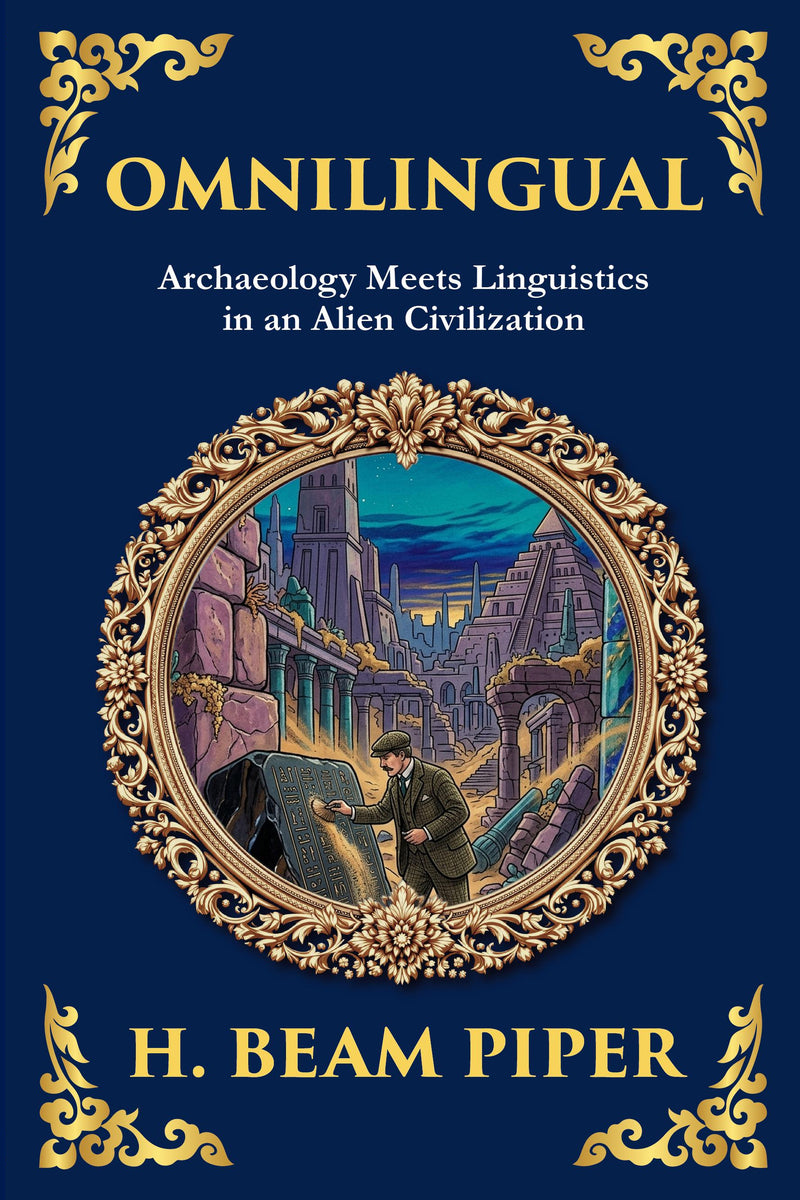
Buried beneath the red sands of Mars lies the secret of a long-extinct civilization. When an interplanetary archaeological team discovers the ruins of an alien city, they are faced with an impossible challenge: decoding a language that no one has ever seen before.
or free app
10,000+ hrs library
30-day guarantee
The complete Omnilingual appears in modern English through Library of Alexandria Press, available online with audiobook narration included for members.
Have you ever wondered why science might be the only key to understanding alien life? In Omnilingual, H. Beam Piper delivers a masterfully written tale of discovery, logic, and intellectual bravery. Set on a future Mars now colonized by humanity, this classic novella follows a team of scientists excavating the remnants of a mysterious Martian civilization that vanished thousands of years ago.
But when the ruins yield nothing but silence, confusion, and undecipherable texts, archaeologist Martha Dane refuses to give up. Driven by determination and insight, she searches for a universal language—a bridge between human minds and alien history. Her quest reveals that beneath the dust and dead cities, truth waits to be translated.
This speculative fiction gem explores themes of gender equality in science, the nature of communication, and the triumph of reason over despair. With a female scientist at the helm— rare for the genre at the time—Omnilingual is as progressive as it is intellectually thrilling.
What you’ll discover in this modern edition
- A First Contact Tale Without the Living Aliens – Explore the remains of an extinct civilization and the mystery they left behind.
| Formats | eBook (EPUB + PDF) · Audiobook · Paperback · Hardcover · Large Print |
| Language | English |
| Trim size (print) | 6 × 9 in |
| Binding | Paperback — perfect-bound · Hardcover — casewrap |
| Large Print edition | Same text in a larger, easy-read type — a larger font, not a larger trim |
| Print pricing | Every physical book at our true cost — at-cost, no profit (members) |
| Library | 873 restored titles, always growing |
| Length | 19,550 words · ~1 hr 18 min reading |
| Reading level | Grade 3 · an easy, flowing read (this modern-English edition) |
| Edition | Modern English translation · 2026 |
Member reviews for this edition are collected as readers finish it — be the first. Across the library: 12,000+ books shipped, every plan covered by a 365-day print guarantee.
About this edition
A faithful, unabridged modern-English edition by The Library of Alexandria — carefully rendered for today's reader and verified paragraph-by-paragraph against the public-domain source. Available as eBook, audiobook, paperback, hardcover, and large print.
- Complete & unabridgedVerified paragraph by paragraph against the source — never a scan, never abridged.
- Modern English, faithfulReadable today, with the author’s meaning kept intact. Readable — not simplified.
- Every format, one membershipRead in your browser or the free app, or listen to the full audiobook.
Included free with your membership
Cancel anytime, one click · 30-day money-back guarantee
Edition last updated July 2026
What’s inside
Omnilingual — complete and unabridged, included in full with membership, plus the full audiobook.
Begin reading Omnilingual
In clear modern English — the complete text is included with membership.
Introduction
There are stories that entertain, and there are stories that linger in the mind long after the final page has been turned, quietly reshaping the way we think about the world and our place in it. H. Beam Piper’s Omnilingual belongs firmly in the latter category. First published in the mid-twentieth century, during the golden age of science fiction when the genre was beginning to demonstrate its capacity for genuine intellectual depth, this remarkable novella endures because it dares to ask a question that is at once impossibly grand and intensely human: when we are confronted with the silent remains of a civilization utterly unlike our own, how do we learn to listen to the voices of the dead? More than that, how do we recover meaning from a language that no living being has ever spoken in our presence, written by hands that crumbled to dust millennia before humanity took its first uncertain steps toward the stars?
This edition has been prepared as a modern translation and adaptation for the contemporary reader, which is to say that careful attention has been given to ensuring that Piper’s brilliant ideas reach a new generation without the friction that sometimes accumulates around mid-century prose. The essential spirit of the original remains entirely intact—the wit, the rigor, the quiet ambition, and above all the deep humanism that pulses beneath the surface of every scene. What you hold is not a watered-down version but a faithful rendering designed to let the story’s strengths shine as brightly for a reader today as they did for the audiences who first encountered it. The aim throughout has been to remove obstacles, not substance, so that you can give yourself fully to the experience of discovery that Piper so masterfully constructs.
A Story Built on the Thrill of Understanding
What distinguishes Omnilingual from so much of the science fiction that surrounds it is the nature of its central drama. Many works in the genre stake their excitement on conflict: battles among the stars, the menace of hostile aliens, the collapse of empires, the desperate scramble for survival against impossible odds. These are reliable engines of narrative tension, and there is nothing wrong with them. But Piper made a far more daring choice. He recognized that there is a kind of suspense more profound than any firefight, a kind of stakes more universal than any war, and he built his entire story around it. The drama here is the drama of comprehension itself—the agonizing, exhilarating process of taking the incomprehensible and, piece by painstaking piece, rendering it intelligible.
Consider for a moment the difficulty of the problem. When archaeologists on Earth decipher ancient scripts, they enjoy advantages they often take for granted. They have continuities of culture, of geography, of biology. The peoples who wrote those ancient texts were human, with human bodies, human needs, human ways of perceiving the world. They ate, they slept, they loved, they feared death. Their languages, however foreign, emerged from minds shaped by the same fundamental experiences that shape our own. And crucially, the great breakthroughs of decipherment have nearly always depended upon some bridge between the known and the unknown—a bilingual inscription, a surviving descendant language, a thread of cultural memory that, however attenuated, still connects the present to the past.
Now strip all of that away. Imagine a written language left behind not by another branch of humanity but by a wholly alien species, one that evolved on another world, under another sun, with a biology and a history and a way of thinking that need bear no resemblance whatsoever to our own. Imagine that this civilization died out so long ago that no living memory of it could possibly survive, that there is no descendant tongue to consult, no Rosetta Stone to provide the saving cross-reference, no human informant who might whisper the meaning of a single word. The texts are there—abundant, tantalizing, clearly the product of intelligence and learning—but they might as well be the patterns of frost on a winter window for all the meaning they readily surrender. This is the wall that Piper’s characters face, and it is a wall that seems, at first, utterly insurmountable.
The genius of the story lies in how it refuses to accept that the wall cannot be climbed. Piper understood something that the best scientists and scholars have always understood: that the universe, for all its strangeness, is governed by regularities, and that wherever there is intelligence, there must be some common ground, however hard it may be to find. The question that animates the narrative is not whether the alien language can be understood—such a question would lead only to despair—but rather how, by what method, through what flash of insight, the impossible might be made possible. And in answering that question, Piper gives us one of the most satisfying intellectual journeys in all of science fiction. There is a moment in this book, which it would be a crime to spoil, when a single realization transforms everything, when a key turns in a lock that had seemed to have no keyhole at all. The pleasure of arriving at that moment alongside the characters, of feeling the dawning comprehension as it breaks over them, is among the purest joys that fiction can offer.
This is what makes Omnilingual so unusual and so enduring. It is a story in which the climax is not an explosion but an idea, in which the hero’s triumph is measured not in enemies defeated but in understanding achieved. It celebrates the life of the mind without ever becoming dry or abstract, because Piper never forgets that ideas are pursued by people, and that the passion for knowledge is one of the most powerful and most human passions of all. The expedition members who labor over these ancient inscriptions are not bloodless intellectuals; they are driven, ambitious, sometimes petty, sometimes generous, fully alive in their hopes and frustrations. Their quest for meaning becomes our quest, and their breakthroughs become our breakthroughs.
It is worth pausing, too, on the title itself, which carries a deeper resonance the more one thinks about it. To be omnilingual—to speak all tongues—is a dream as old as the story of Babel, a longing to overcome the divisions that language imposes upon us. The premise at the heart of this story is that there might exist a language, or a set of concepts, so fundamental that it transcends the accidents of biology and history altogether, a kind of universal grammar written not by any single people but by the structure of reality itself. If such a thing exists, then it would be the key not only to one dead alien civilization but to communication across any gulf, however wide. There is something almost spiritual in this idea, a faith that beneath all our differences there lies a bedrock of shared truth waiting to be uncovered. Piper does not labor this point or preach it, but it hums quietly beneath the surface of the story, lending the technical puzzle a grandeur that lifts it far above mere cleverness.
To understand why Omnilingual succeeds so completely, it helps to know something of the man who wrote it and the qualities he brought to his craft. Henry Beam Piper was, in many respects, an outsider to the literary establishment of his time—a largely self-educated man who worked for years as a night watchman and laborer for a railroad company in Pennsylvania, reading voraciously and writing in his spare hours. He had no university credentials, no privileged entry into the world of letters. What he had instead was an immense and restless curiosity, a deep love of history, and a discipline of self-improvement that filled his mind with knowledge across an extraordinary range of subjects. This combination of intellectual hunger and hard-won learning gives his fiction a distinctive flavor: grounded, knowledgeable, never showing off, yet quietly assured in its command of the ideas it handles.
Piper’s fascination with history runs through nearly all of his work, and it informs Omnilingual in ways both obvious and subtle. He understood that civilizations rise and fall, that the mighty achievements of one age become the ruins and mysteries of another, and that the past is never truly silent if we possess the means to interpret what it has left behind. He approached the imagined archaeology of an alien world with the same seriousness and the same imaginative sympathy that he brought to his reading of Earth’s own history. The dead civilization at the center of this story is not a mere backdrop, a convenient ruin against which to stage human adventures. It is rendered with such care, such attention to the plausible details of how a society might have lived and what it might have valued, that one comes away feeling one has glimpsed a real people, real lives, real losses. This is the mark of a writer who took his world-building seriously, who refused to treat the alien as mere set dressing.
It is also worth noting that Piper was a writer who respected his readers’ intelligence. He did not condescend, did not over-explain, did not hold the reader’s hand through every step of his reasoning. He trusted that the audience could follow a complex line of thought, could appreciate a subtle clue, could feel the weight of a discovery without being told how to feel about it. In an era when much popular fiction was written for quick consumption and instant gratification, Piper aimed higher, and his work has aged all the better for it. There is a clarity and an honesty to his prose that the present adaptation has been careful to preserve. The sentences carry you forward not through cheap thrills but through the steady accumulation of interest, the sense that something genuinely important is at stake and that the people involved are equal to the challenge.
Another aspect of Piper’s vision that deserves mention is his attitude toward science and the scientific enterprise. He was not naive about it. He understood that science is conducted by human beings, with all their flaws—their egos, their rivalries, their thirst for recognition, their occasional willingness to bend the truth to suit their preferences. The world of Omnilingual is not a utopia of selfless seekers after truth. It is a world in which professional jealousy and the politics of reputation are very much alive, in which a breakthrough is valuable not only for what it reveals but for the glory it confers upon whoever achieves it first. Some of the characters are more concerned with their careers than with the truth, and this tension—between the pure pursuit of knowledge and the all-too-human desire for status—gives the story a sharp edge of realism. Piper does not moralize about this. He simply observes it, with a clear-eyed understanding of how science actually gets done, and he lets the reader draw conclusions. This realism makes the eventual triumph all the more satisfying, because it is won not in a vacuum but in the messy, competitive, fully human world that we recognize as our own.
Piper is sometimes remembered chiefly for his sprawling future-history sequence, an interlinked body of stories spanning thousands of years and many worlds, in which humanity spreads across the galaxy and rises and falls through cycles of empire and collapse. Omnilingual belongs to the same broad imaginative universe, set in a future where humanity has reached out beyond Earth and established a presence on neighboring worlds. But one need not have read any of his other work to appreciate this story fully. It stands entirely on its own, a self-contained jewel that requires no prior acquaintance with its author’s larger designs. What it shares with the rest of his output is a certain temperament: optimistic about human capability without being foolishly so, fascinated by the long perspectives of time, and animated by a conviction that intelligence and persistence can solve even the most daunting problems.
Cancel anytime, one click · 30-day money-back guarantee
Founding annual rate available now — your price locks for life when you join.
Not ready? Get this free chapter by email — read it anytime.
✓ Sent — check your inbox for Omnilingual.
Questions about Omnilingual
What is Omnilingual about?
Buried beneath the red sands of Mars lies the secret of a long-extinct civilization. When an interplanetary archaeological team discovers the ruins of an alien city, they are faced with an impossible challenge: decoding a language that no one has ever seen before. Omnilingual is a gripping tale of intellectual curiosity, first contact with a dead culture, and the enduring power of knowledge.
Who wrote Omnilingual?
Omnilingual was written by H. Beam Piper. This edition presents the complete work in clear modern English, faithfully rendered from the public-domain original by Library of Alexandria Press.
Is Omnilingual free to read?
The opening chapter is free to read on this page. Members read and listen to the complete work — and the entire library — free, and can order any physical book at our true print cost.
How long is Omnilingual?
2 chapters (~19,550 words) — about 1 hr 18 min of reading in this modern-English edition.
Is this an abridged version of Omnilingual?
No. This is the complete, unabridged Omnilingual, carefully rendered into clear modern English and verified paragraph-by-paragraph against the public-domain source — nothing is cut or summarised.
What formats does Omnilingual come in?
Omnilingual is available as eBook, paperback, hardcover and large print. eBook and audiobook are included with membership; printed editions ship at our true print cost.
Shipping & returns
Billing & membership
More from the library


Explore Science Fiction
- The Island of Doctor Moreau · H. G. Wells
- A Midsummer Night’s Dream · William Shakespeare
- The Invisible Man: A Grotesque Romance · H. G. Wells
- The War of the Worlds · H. G. Wells
- The Strange Case of Dr. Jekyll and Mr. Hyde · Robert Louis Stevenson
- The Door in the Wall, and Other Stories · H. G. Wells
- Baron Trump's Marvellous Underground Journey — Large Print · Ingersoll Lockwood
- The Napoleon of Notting Hill — Large Print · G. K. Chesterton
- The Napoleon of Notting Hill · G. K. Chesterton
- The Stolen Bacillus and Other Incidents — Large Print · H. G. Wells
- Baron Trump's Marvellous Underground Journey · Ingersoll Lockwood
- Five Weeks in a Balloon — Large Print · Jules Verne
- The People of the Mist — Large Print · H. Rider Haggard
- The Stolen Bacillus and Other Incidents · H. G. Wells
- Queen Sheba's Ring — Large Print · H. Rider Haggard
- Queen Sheba's Ring · H. Rider Haggard
- Five Weeks in a Balloon · Jules Verne
- The Patchwork Girl of Oz — Large Print · L. Frank Baum
- The Patchwork Girl of Oz · L. Frank Baum
- The People of the Mist · H. Rider Haggard
- Erewhon Revisited Twenty Years Later — Large Print · Samuel Butler
- Rinkitink in Oz · L. Frank Baum
- Thirty Strange Stories · H. G. Wells
- The Enchanted Castle · E. Nesbit
- Trips to the Moon · Lucian of Samosata
- She and Allan — Large Print · H. Rider Haggard
- The Magic of Oz — Large Print · L. Frank Baum
- The Old Tobacco Shop — Large Print · William Bowen
- She and Allan · H. Rider Haggard
- The Magic of Oz · L. Frank Baum
Omnilingual
Omnilingual
Archaeology Meets Linguistics in an Alien Civilization
H. Beam Piper
Contents
- Introduction
- Omnilingual
Introduction
There are stories that entertain, and there are stories that linger in the mind long after the final page has been turned, quietly reshaping the way we think about the world and our place in it. H. Beam Piper’s Omnilingual belongs firmly in the latter category. First published in the mid-twentieth century, during the golden age of science fiction when the genre was beginning to demonstrate its capacity for genuine intellectual depth, this remarkable novella endures because it dares to ask a question that is at once impossibly grand and intensely human: when we are confronted with the silent remains of a civilization utterly unlike our own, how do we learn to listen to the voices of the dead? More than that, how do we recover meaning from a language that no living being has ever spoken in our presence, written by hands that crumbled to dust millennia before humanity took its first uncertain steps toward the stars?
This edition has been prepared as a modern translation and adaptation for the contemporary reader, which is to say that careful attention has been given to ensuring that Piper’s brilliant ideas reach a new generation without the friction that sometimes accumulates around mid-century prose. The essential spirit of the original remains entirely intact—the wit, the rigor, the quiet ambition, and above all the deep humanism that pulses beneath the surface of every scene. What you hold is not a watered-down version but a faithful rendering designed to let the story’s strengths shine as brightly for a reader today as they did for the audiences who first encountered it. The aim throughout has been to remove obstacles, not substance, so that you can give yourself fully to the experience of discovery that Piper so masterfully constructs.
A Story Built on the Thrill of Understanding
What distinguishes Omnilingual from so much of the science fiction that surrounds it is the nature of its central drama. Many works in the genre stake their excitement on conflict: battles among the stars, the menace of hostile aliens, the collapse of empires, the desperate scramble for survival against impossible odds. These are reliable engines of narrative tension, and there is nothing wrong with them. But Piper made a far more daring choice. He recognized that there is a kind of suspense more profound than any firefight, a kind of stakes more universal than any war, and he built his entire story around it. The drama here is the drama of comprehension itself—the agonizing, exhilarating process of taking the incomprehensible and, piece by painstaking piece, rendering it intelligible.
Consider for a moment the difficulty of the problem. When archaeologists on Earth decipher ancient scripts, they enjoy advantages they often take for granted. They have continuities of culture, of geography, of biology. The peoples who wrote those ancient texts were human, with human bodies, human needs, human ways of perceiving the world. They ate, they slept, they loved, they feared death. Their languages, however foreign, emerged from minds shaped by the same fundamental experiences that shape our own. And crucially, the great breakthroughs of decipherment have nearly always depended upon some bridge between the known and the unknown—a bilingual inscription, a surviving descendant language, a thread of cultural memory that, however attenuated, still connects the present to the past.
Now strip all of that away. Imagine a written language left behind not by another branch of humanity but by a wholly alien species, one that evolved on another world, under another sun, with a biology and a history and a way of thinking that need bear no resemblance whatsoever to our own. Imagine that this civilization died out so long ago that no living memory of it could possibly survive, that there is no descendant tongue to consult, no Rosetta Stone to provide the saving cross-reference, no human informant who might whisper the meaning of a single word. The texts are there—abundant, tantalizing, clearly the product of intelligence and learning—but they might as well be the patterns of frost on a winter window for all the meaning they readily surrender. This is the wall that Piper’s characters face, and it is a wall that seems, at first, utterly insurmountable.
The genius of the story lies in how it refuses to accept that the wall cannot be climbed. Piper understood something that the best scientists and scholars have always understood: that the universe, for all its strangeness, is governed by regularities, and that wherever there is intelligence, there must be some common ground, however hard it may be to find. The question that animates the narrative is not whether the alien language can be understood—such a question would lead only to despair—but rather how, by what method, through what flash of insight, the impossible might be made possible. And in answering that question, Piper gives us one of the most satisfying intellectual journeys in all of science fiction. There is a moment in this book, which it would be a crime to spoil, when a single realization transforms everything, when a key turns in a lock that had seemed to have no keyhole at all. The pleasure of arriving at that moment alongside the characters, of feeling the dawning comprehension as it breaks over them, is among the purest joys that fiction can offer.
This is what makes Omnilingual so unusual and so enduring. It is a story in which the climax is not an explosion but an idea, in which the hero’s triumph is measured not in enemies defeated but in understanding achieved. It celebrates the life of the mind without ever becoming dry or abstract, because Piper never forgets that ideas are pursued by people, and that the passion for knowledge is one of the most powerful and most human passions of all. The expedition members who labor over these ancient inscriptions are not bloodless intellectuals; they are driven, ambitious, sometimes petty, sometimes generous, fully alive in their hopes and frustrations. Their quest for meaning becomes our quest, and their breakthroughs become our breakthroughs.
It is worth pausing, too, on the title itself, which carries a deeper resonance the more one thinks about it. To be omnilingual—to speak all tongues—is a dream as old as the story of Babel, a longing to overcome the divisions that language imposes upon us. The premise at the heart of this story is that there might exist a language, or a set of concepts, so fundamental that it transcends the accidents of biology and history altogether, a kind of universal grammar written not by any single people but by the structure of reality itself. If such a thing exists, then it would be the key not only to one dead alien civilization but to communication across any gulf, however wide. There is something almost spiritual in this idea, a faith that beneath all our differences there lies a bedrock of shared truth waiting to be uncovered. Piper does not labor this point or preach it, but it hums quietly beneath the surface of the story, lending the technical puzzle a grandeur that lifts it far above mere cleverness.
To understand why Omnilingual succeeds so completely, it helps to know something of the man who wrote it and the qualities he brought to his craft. Henry Beam Piper was, in many respects, an outsider to the literary establishment of his time—a largely self-educated man who worked for years as a night watchman and laborer for a railroad company in Pennsylvania, reading voraciously and writing in his spare hours. He had no university credentials, no privileged entry into the world of letters. What he had instead was an immense and restless curiosity, a deep love of history, and a discipline of self-improvement that filled his mind with knowledge across an extraordinary range of subjects. This combination of intellectual hunger and hard-won learning gives his fiction a distinctive flavor: grounded, knowledgeable, never showing off, yet quietly assured in its command of the ideas it handles.
Piper’s fascination with history runs through nearly all of his work, and it informs Omnilingual in ways both obvious and subtle. He understood that civilizations rise and fall, that the mighty achievements of one age become the ruins and mysteries of another, and that the past is never truly silent if we possess the means to interpret what it has left behind. He approached the imagined archaeology of an alien world with the same seriousness and the same imaginative sympathy that he brought to his reading of Earth’s own history. The dead civilization at the center of this story is not a mere backdrop, a convenient ruin against which to stage human adventures. It is rendered with such care, such attention to the plausible details of how a society might have lived and what it might have valued, that one comes away feeling one has glimpsed a real people, real lives, real losses. This is the mark of a writer who took his world-building seriously, who refused to treat the alien as mere set dressing.
It is also worth noting that Piper was a writer who respected his readers’ intelligence. He did not condescend, did not over-explain, did not hold the reader’s hand through every step of his reasoning. He trusted that the audience could follow a complex line of thought, could appreciate a subtle clue, could feel the weight of a discovery without being told how to feel about it. In an era when much popular fiction was written for quick consumption and instant gratification, Piper aimed higher, and his work has aged all the better for it. There is a clarity and an honesty to his prose that the present adaptation has been careful to preserve. The sentences carry you forward not through cheap thrills but through the steady accumulation of interest, the sense that something genuinely important is at stake and that the people involved are equal to the challenge.
Another aspect of Piper’s vision that deserves mention is his attitude toward science and the scientific enterprise. He was not naive about it. He understood that science is conducted by human beings, with all their flaws—their egos, their rivalries, their thirst for recognition, their occasional willingness to bend the truth to suit their preferences. The world of Omnilingual is not a utopia of selfless seekers after truth. It is a world in which professional jealousy and the politics of reputation are very much alive, in which a breakthrough is valuable not only for what it reveals but for the glory it confers upon whoever achieves it first. Some of the characters are more concerned with their careers than with the truth, and this tension—between the pure pursuit of knowledge and the all-too-human desire for status—gives the story a sharp edge of realism. Piper does not moralize about this. He simply observes it, with a clear-eyed understanding of how science actually gets done, and he lets the reader draw conclusions. This realism makes the eventual triumph all the more satisfying, because it is won not in a vacuum but in the messy, competitive, fully human world that we recognize as our own.
Piper is sometimes remembered chiefly for his sprawling future-history sequence, an interlinked body of stories spanning thousands of years and many worlds, in which humanity spreads across the galaxy and rises and falls through cycles of empire and collapse. Omnilingual belongs to the same broad imaginative universe, set in a future where humanity has reached out beyond Earth and established a presence on neighboring worlds. But one need not have read any of his other work to appreciate this story fully. It stands entirely on its own, a self-contained jewel that requires no prior acquaintance with its author’s larger designs. What it shares with the rest of his output is a certain temperament: optimistic about human capability without being foolishly so, fascinated by the long perspectives of time, and animated by a conviction that intelligence and persistence can solve even the most daunting problems.
Martha Dane stopped and looked up at the copper sky, which had a purple tint. The wind had changed direction since noon while she was indoors, and the dust storm moving across the high eastern deserts was now blowing over Syrtis. The sun looked like a stunning magenta ball, magnified by the haze and appearing as large as the sun of Earth, allowing her to gaze at it directly. Tonight, some of that dust would drift down from the upper atmosphere, adding another layer to the debris that had been burying the city for the past fifty thousand years.
Red dust covered everything, blanketing the streets and the open parks and plazas. It hid the small houses that had been crushed flat and the debris that had fallen from tall buildings when roofs collapsed and walls tumbled outward. Where she stood, the ancient streets were buried a hundred to a hundred and fifty feet deep. The hole they had cut in the wall of the building behind her opened into the sixth floor. From there, she could look down at a cluster of prefabricated huts and sheds, and at the scrubby flat that had once been the waterfront when this place was a seaport on the ocean now known as the Syrtis Depression. The bright metal of the huts was already thinly coated in red dust. She thought again about how much time and effort it would take to clear this city—the sheer amount of people, supplies, and equipment that would have to be shipped across fifty million miles of space. They would have to use heavy machinery; there was no other way. Bulldozers, power shovels, and draglines were fast, but they were clumsy and imprecise. She remembered the excavations at Harappa and Mohenjo-Daro in the Indus Valley, and the careful, patient local workers—the meticulous foremen, the men with picks and spades, and the long lines of workers carrying away earth in baskets. That civilization was as slow and primitive as the ruins they were uncovering, but she could count on one hand the number of times a worker had damaged a valuable artifact in the ground. Without those underpaid and hardworking local laborers, archaeology would still be stuck where Winckelmann had left it. But on Mars, there was no local labor; the last Martian had died five hundred centuries ago.
End of the free sample
Keep reading, free
Members read and listen to the complete book — and the entire library. Cancel anytime, one click · 30-day money-back guarantee.