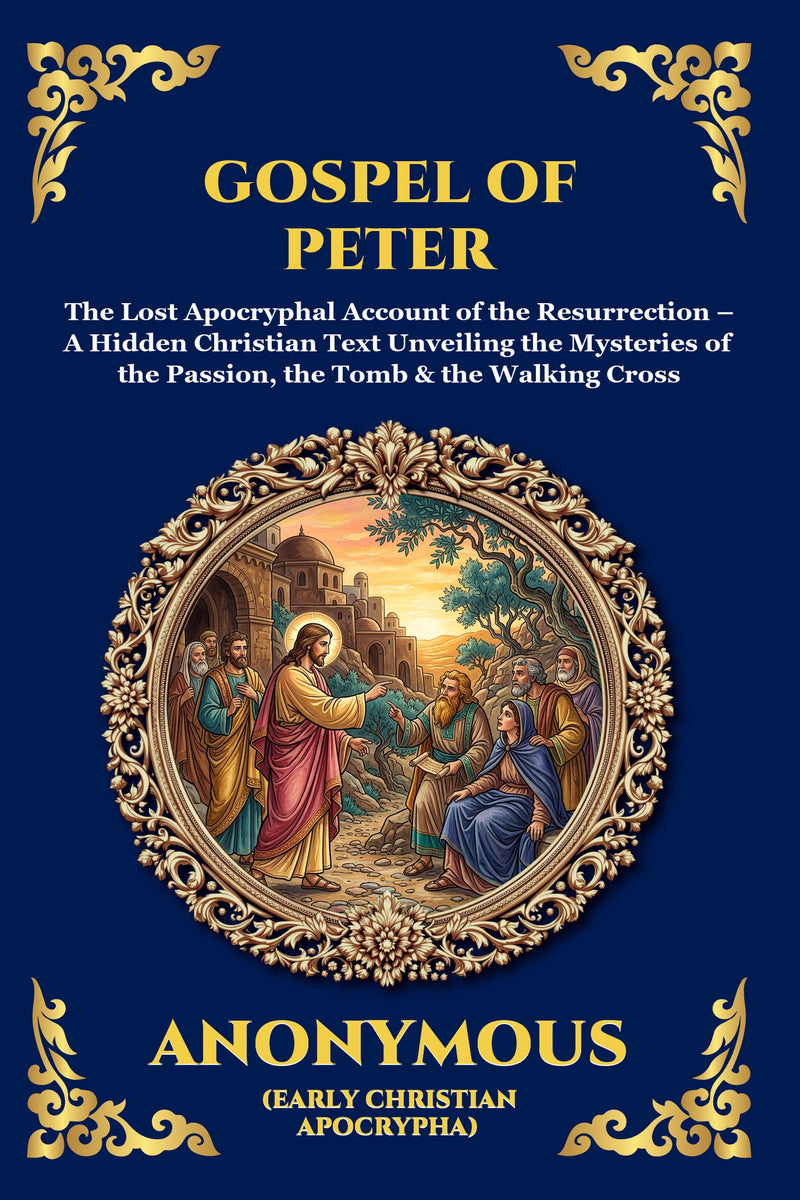
Gospel of Peter — Large Print
The Gospel of Peter offers a first-person narrative of the resurrection, attributed to the apostle Peter himself, and includes the only surviving ancient account of the moment Christ emerged from the tomb. Hidden for centuries, this text was rediscovered in a monk's grave in Egypt, revealing a mystical perspective excluded from the Bible.
or free app
10,000+ hrs library
30-day guarantee
The complete Gospel of Peter—discovered in an Egyptian monk's tomb in 1886—comes with modern English translation, online reading access, and audiobook narration for members.
Large Print Edition. The complete, unabridged text set in a larger, easy-on-the-eyes typeface for comfortable reading.
Have you ever wondered why early Christian communities circulated a vastly different, deeply mystical account of the resurrection that was eventually hidden from history?
The Gospel of Peter is one of the most fascinating and enigmatic texts of the early Christian era. Long rumored to exist by early church fathers who fiercely debated its orthodoxy, a fragment of this lost gospel was finally unearthed in a monk’s grave in Egypt in the late nineteenth century. Unlike the four canonical gospels, this apocryphal text offers a gripping, first-person narrative attributed to the apostle Peter, presenting a strikingly different version of the trial, crucifixion, and resurrection of Jesus.
It is the only surviving ancient gospel that claims to provide an eyewitness account of the actual moment of resurrection. The text describes a scene of awe-inspiring cosmic power: the heavens opening, towering angelic figures descending, and Christ emerging from the tomb accompanied by a miraculous, speaking cross. Furthermore, the narrative distinctly shifts the political and moral responsibility for the crucifixion away from Pontius Pilate and onto Herod and the religious authorities of the time, providing a controversial glimpse into the theological and social tensions of early Christianity.
This text invites readers to explore the rich, diverse landscape of early Christian thought before the biblical canon was strictly finalized. It is a world where history and high mysticism intertwine, offering profound insights into how early believers understood the triumph of the divine over death.
What You’ll Discover in This Translation:
- The Mystical Resurrection — Read the only surviving ancient narrative that explicitly describes the miraculous moment Christ emerged from the tomb in the Gospel of Peter.
- The Walking Cross — Explore the profound and deeply symbolic ancient vision of a cross that follows Christ and speaks to the heavens.
- A Shifted Narrative — Understand the historical and theological implications of a text that exonerates Pilate and places the blame for the Passion entirely on Herod and his allies.
- The Descent to the Dead — Uncover early Christian beliefs about Christ’s triumph over the underworld and his preaching to those who sleep.
- A Window into Early Apocrypha — Gain a deeper appreciation for the diverse theological traditions that shaped the first centuries of the Christian faith.
Whether you are exploring this work for its immense historical significance, its vivid supernatural imagery, or its unique theological perspective, the Gospel of Peter offers a transformative reading experience.
Unearth the hidden mysteries of the empty tomb. Begin your journey today.
| Formats | eBook (EPUB + PDF) · Audiobook · Paperback · Hardcover · Large Print |
| Language | English |
| Trim size (print) | 6 × 9 in |
| Binding | Paperback — perfect-bound · Hardcover — casewrap |
| Large Print edition | Same text in a larger, easy-read type — a larger font, not a larger trim |
| Print pricing | Every physical book at our true cost — at-cost, no profit (members) |
| Library | 873 restored titles, always growing |
| Composed | 2nd century AD |
| Original language | Greek |
| Source tradition | Akhmim fragment (Oxyrhynchus manuscript tradition) |
| Translation basis | Public-domain scholarly translation, rendered in clear modern English |
| Length | 1,610 words · ~6 min reading |
| Reading level | Grade 8 · clear and comfortable (this modern-English edition) |
| Edition | Modern English translation · 2026 |
Member reviews for this edition are collected as readers finish it — be the first. Across the library: 12,000+ books shipped, every plan covered by a 365-day print guarantee.
About this edition
The complete, unabridged text in clear modern English — faithful to the original, never simplified. Every paragraph is checked against the source, so nothing is cut, summarised, or paraphrased away. It reads cleanly for today while keeping the original meaning intact.
Based on the Akhmim fragment discovered in Egypt in 1886-1887, translated from the original Greek manuscript. This edition renders the standard scholarly translation in clear, accessible modern English.
- Complete & unabridgedVerified paragraph by paragraph against the source — never a scan, never abridged.
- Modern English, faithfulReadable today, with the author’s meaning kept intact. Readable — not simplified.
- Every format, one membershipRead in your browser or the free app, or listen to the full audiobook.
Included free with your membership
Cancel anytime, one click · 30-day money-back guarantee
Edition last updated June 2026
What’s inside
Gospel of Peter — Large Print — complete and unabridged: all 15 sections included with membership, plus the full audiobook.
Begin reading Gospel of Peter — Large Print
In clear modern English — the complete text is included with membership.
Chapter 1
But none of the Jews washed their hands — neither Herod nor any of his judges. And since they refused to wash, Pilate stood up and left. Then King Herod commanded that the Lord be taken away, saying to them: Everything I ordered you to do to him, do it.
Chapter 2
Now Joseph, the friend of Pilate and of the Lord, was standing there, and knowing that they were about to crucify him, he came to Pilate and begged for the body of Jesus to bury it. And Pilate sent word to Herod and asked him for the body.
And Herod said: Brother Pilate, even if no one had asked for him, we would have buried him, since the Sabbath is drawing near — for it is written in the law that the sun must not set on one who has been put to death.
Chapter 3
And they took the Lord and pushed him as they ran, saying: Let us drag the Son of God along, now that we have power over him.
And they clothed him in a purple robe and set him on the judgment seat, saying: Judge righteously, O King of Israel. And one of them brought a crown of thorns and placed it on the Lord's head. Others stood and spat in his eyes, others struck his cheeks, others jabbed him with a reed, and some flogged him, saying: With this honor let us honor the Son of God.
Chapter 4
And they brought two criminals and crucified the Lord between them. But he kept silent, as though feeling no pain. And when they had set up the cross, they wrote upon it: This is the King of Israel.
And they laid his garments out before him and divided them among themselves, casting lots for them. But one of the criminals rebuked them, saying: We are suffering like this for the evil things we have done, but this man, who has become the savior of mankind — what wrong has he done you?
And they were angry with him and gave orders that his legs should not be broken, so that he might die in prolonged torment.
Chapter 5
It was midday, and darkness covered all Judea. The people were troubled and anxious, fearing that the sun had already set while he was still alive, for it is written in their law that the sun must not set upon one who has been put to death.
One of them said, "Give him gall mixed with vinegar to drink." They mixed it and gave it to him, and in doing so they fulfilled everything, bringing the full weight of their sins down upon their own heads.
Many people wandered about carrying lamps, thinking it was night, and some fell to the ground. Then the Lord cried out with a loud voice: "My power, my power, you have forsaken me." And when he had said this, he was taken up.
At that same hour, the veil of the temple in Jerusalem was torn in two.
Chapter 6
And then they drew the nails from the hands of the Lord and laid him upon the earth. And the whole earth shook, and a great fear came over everyone.
Then the sun shone out again, and it was found to be the ninth hour. The Jews rejoiced and gave his body to Joseph to bury, because Joseph had witnessed all the good things he had done.
Joseph took the Lord, washed him, wrapped him in linen, and brought him to his own tomb, which is called the Garden of Joseph.
Chapter 7
Then the Jews and the elders and the priests, when they realized how great an evil they had brought upon themselves, began to lament and to say: Woe to us for our sins; the judgment and the end of Jerusalem are drawing near.
But I and my companions were stricken with grief, and our hearts were wounded, and we would have hidden ourselves, for we were being hunted by them as criminals and as men suspected of wanting to burn the temple down.
On top of all this, we were fasting, and we sat in mourning and wept day and night until the Sabbath.
Chapter 8
The scribes, Pharisees, and elders gathered together, for they had heard that all the people were murmuring and beating their breasts, saying: "If such great signs came to pass at his death, see how righteous he was."
The elders were afraid and went to Pilate, pleading with him and saying: "Give us soldiers to guard his tomb for three days, in case his disciples come and steal him away, and the people then suppose that he has risen from the dead and do us harm."
So Pilate gave them Petronius the centurion with soldiers to guard the tomb. The elders and scribes went with them to the tomb, and together with the centurion and the soldiers they rolled a great stone and set it against the door of the tomb. They plastered seven seals upon it, pitched a tent there, and kept watch.
Chapter 9
And early in the morning, as the sabbath dawned, a great crowd came from Jerusalem and the surrounding region to see the sealed tomb.
Then, in the night when the Lord's day began to dawn, while the soldiers were keeping guard two by two in each watch, a great sound rang out from heaven. They saw the heavens open, and two men descend from there, blazing with a great light, and drawing near to the tomb.
The stone that had been set against the door rolled away by itself and moved to one side, the tomb was opened, and both of the young men went in.
Chapter 10
When the soldiers saw this, they woke the centurion and the elders, who were also there keeping watch. While they were still telling them what they had seen, they saw three men come out of the tomb — two of them supporting the third — and a cross following behind them.
The heads of the two reached up to heaven, but the head of the one they were leading by the hand rose beyond the heavens.
And they heard a voice from the heavens asking: "Have you preached to those who sleep?" And a reply came from the cross: "Yes."
Chapter 11
Those men took counsel with one another to go and report these things to Pilate. And while they were still deliberating, the heavens were opened again, and a man descended and entered into the tomb.
When those who were with the centurion saw this, they hastened to go to Pilate in the night, leaving the tomb they had been watching, and told him everything they had seen, in great distress, saying: Truly he was the Son of God.
Pilate answered and said: I am clean from the blood of the Son of God, but this is what you wanted. Then they all came to him and pleaded with him, urging him to order the centurion and the soldiers to say nothing of what they had seen.
For, they said, it is better for us to bear the greatest sin before God than to fall into the hands of the Jewish people and be stoned.
Pilate therefore commanded the centurion and the soldiers to say nothing.
Chapter 12
Now early on the Lord's day, Mary Magdalene — a disciple of the Lord who, out of fear of the Jews, had not gone to the tomb to do for him what women customarily do for those they love who have died, because the Jews were burning with anger — took her women friends with her and went to the tomb where he had been laid.
They were afraid that the Jews might see them, and they said to one another: Even if we could not weep and mourn for him on the day he was crucified, let us at least do so now, at his tomb.
Chapter 13
But who will roll away for us the stone that is set against the door of the tomb, so that we may enter and sit beside him and do what is fitting? For the stone was great, and we are afraid that someone might see us. And if we cannot manage it, then let us at least lay down at the door the things we have brought as a memorial of him, and we will weep and mourn until we return home.
So they went and found the tomb open. They drew near, looked inside, and saw a young man sitting in the middle of the tomb, beautiful in appearance and clothed in brilliantly shining garments, who said to them: Why have you come? Whom are you looking for? Is it the one who was crucified? He has risen and has gone away. But if you do not believe it, look in and see the place where he lay, for he is not here. He has risen and gone away to the place from which he was sent.
Then the women were terrified and fled.
Chapter 14
Now it was the last day of the Feast of Unleavened Bread, and many people were leaving the city and returning to their own homes, for the feast had come to an end.
But we, the twelve disciples of the Lord, were weeping and grieving, and each of us, heavy with sorrow over what had happened, went back to his own home.
But I, Simon Peter, and my brother Andrew, took our nets and went down to the sea. And with us was Levi, the son of Alphaeus, whom the Lord had called from the tax collector's booth. And we went and cast our nets into the sea, and the Lord appeared to us there.
Cancel anytime, one click · 30-day money-back guarantee
Founding annual rate available now — your price locks for life when you join.
Not ready? Get this free chapter by email — read it anytime.
✓ Sent — check your inbox for Gospel of Peter — Large Print.
Questions about Gospel of Peter — Large Print
Why was the Gospel of Peter excluded from the biblical canon?
The Gospel of Peter was excluded from the canon by early church councils due to concerns about its docetic tendencies and late composition. Church fathers like Eusebius questioned its authenticity and theological orthodoxy compared to the four accepted gospels.
What unique content does the Gospel of Peter contain?
The Gospel of Peter uniquely describes Christ's actual emergence from the tomb, supported by two angels, followed by a walking cross. It provides the only surviving ancient narrative claiming to witness the resurrection moment itself.
Who actually wrote the Gospel of Peter?
The Gospel of Peter was written by an anonymous Christian author in the 2nd century AD, not by the apostle Peter himself. Scholars recognize it as pseudepigraphic, written in Peter's name to lend apostolic authority.
Is Gospel of Peter free to read?
The opening of the text is free to read below. Members read and listen to the complete work — and the entire Lost & Forbidden Library — free.
What is Gospel of Peter?
Have you ever wondered why early Christian communities circulated a vastly different, deeply mystical account of the resurrection that was eventually hidden from history?
How long is Gospel of Peter?
15 chapters (~1,617 words) in this restored edition.
Shipping & returns
Billing & membership
More from the library


Explore Enoch & Pseudepigrapha
- Apocalypse of Daniel
- Apocalypse of Shenoute · Attributed to Shenoute the Arch...
- 2 Enoch · Attributed to Enoch
- Apocalypse of Pseudo-Ephraem · Attributed to Ephraem the Syrian
- Ethiopic Meqabyan I–III
- The Conflict of Adam and Eve with Satan
- Genesis Apocryphon
- Community Rule · Attributed to the Qumran community
- War Scroll · Attributed to the Qumran community
- 2 Esdras · Attributed to the prophet Ezra
- Book of Jasher
- Acts of Barnabas · Attributed to John Mark
- Acts of Paul and Thecla · Attributed to Onesiphorus
- Greek Apocalypse of Daniel
- Sibylline Oracles · Various early Christian and Jew...
- Epistle to the Alexandrians
- Apocalypse of Paul · Attributed to the Apostle Paul
- Apocalypse of Moses · Attributed to early Jewish scribes
- Testament of Solomon · Attributed to King Solomon
- Book of Giants · Attributed to Mani
- Baruch · Attributed to Baruch
- The Forgotten Books of Eden · Various early Christian and Jew...
- Fragments of a Zadokite Work · Attributed to the Zadokite comm...
- Chronicles of Jerahmeel · Attributed to Jerahmeel ben Sol...
- Biblical Antiquities of Pseudo-Philo
- Testamentum Domini · Attributed to the early Church ...
- Apocalypse of Bartholomew · Attributed to the Apostle Barth...
- Vision of Esdras · Attributed to the prophet Ezra
- Cave of Treasures · Attributed to Ephrem the Syrian
- Correspondence of Paul and Seneca · Attributed to Paul the Apostle
Gospel of Peter — Large Print
The Gospel of Peter
The Passion and Resurrection of Christ — A Surviving Ancient Fragment
Library of Alexandria Press
The Gospel of Peter
© Copyright 2026 Library of Alexandria Press. All rights reserved.
Published by Library of Alexandria Press
Printed in the United States of America
It is not legal to copy, share, or send any part of this document in either digital or printed form without written permission from the publisher, except short quotes in a book review.
Table of Contents
Introduction
Chapter 1
Chapter 2
Chapter 3
Chapter 4
Chapter 5
Chapter 6
Chapter 7
Chapter 8
Chapter 9
Chapter 10
Chapter 11
Chapter 12
Chapter 13
Chapter 14
Introduction
There is a moment, familiar to anyone who has ever stood before a locked door without a key, when curiosity becomes something more urgent — something almost physical. That feeling, that restless pull toward what lies just beyond reach, is precisely what draws scholars, believers, skeptics, and seekers alike to the fragment of ancient writing you are about to encounter. It is a text that survived by the thinnest of margins, buried in the Egyptian sand for nearly two thousand years, and when it finally surfaced in the winter of 1886, it did not merely add a footnote to the history of early Christianity. It cracked open a window onto a world of competing voices, rival memories, and passionate arguments about the most consequential events in human history.
The document recovered at Akhmim, Egypt, by a French archaeological team working in a monk's grave, was immediately recognized as extraordinary. Written in Greek on parchment leaves tucked inside a codex, the text described the trial, crucifixion, burial, and resurrection of Jesus of Nazareth — but it did so in ways that were startlingly different from the four canonical gospels most readers know. Here was a narrative that named Herod Antipas as the primary authority ordering the execution. Here was a tomb guarded not merely by a few soldiers but by an entire Roman cohort alongside Jewish elders, all of them terrified witnesses to something they could barely describe. And here, most astonishingly of all, was an image that has haunted New Testament scholarship ever since: a walking, talking cross emerging from the sepulcher alongside two luminous angels and a figure whose head reached beyond the clouds. The text broke off mid-sentence, as if the scribe's hand had simply stopped, leaving readers then and now suspended at the edge of revelation.
To understand why this matters — why a damaged, incomplete, and long-suppressed fragment deserves your full attention — it helps to step back and consider the landscape of early Christian literature as a whole. The four gospels enshrined in the New Testament, Matthew, Mark, Luke, and John, were not the only accounts of Jesus's life circulating in the first and second centuries of the common era. They were, rather, the survivors. Around them swirled dozens of other texts: gospels attributed to Thomas, Philip, Mary Magdalene, Nicodemus, James, and many others. Some of these were gnostic in character, exploring esoteric cosmologies and interior spiritual journeys. Others were more narrative in form, filling in gaps that the canonical texts left open — the childhood of Jesus, the inner life of Mary, the fate of Judas, the details of what happened at the tomb. The text you are about to read belongs to this second category, and it belongs there with a particular kind of authority, because it may be among the very oldest of them all.
The question of dating is one of the most fiercely contested in the entire field of biblical studies, and we will return to it in more detail shortly. But it is worth pausing here to note that some of the most respected scholars of the twentieth and twenty-first centuries have argued that the passion narrative embedded in this text preserves traditions that predate the canonical gospels themselves — that it may, in other words, contain memories of the crucifixion and resurrection that are older than anything in Matthew, Mark, Luke, or John. If that argument is correct, even partially, then what you are reading is not a secondary or derivative account. It is a primary source. It is a window onto the earliest stratum of Christian memory, before the councils, before the creeds, before the long process of canonization that decided which voices would be heard and which would be silenced.
That process of silencing is itself part of the story. Bishop Serapion of Antioch, writing around 200 CE, is the first church father to mention this text by name, and his mention is not a recommendation. He had initially allowed a congregation in Rhossus to read it, then changed his mind after examining it more carefully, concluding that it contained docetic tendencies — that is, it seemed to suggest that Jesus did not truly suffer on the cross, that his pain was in some sense illusory or spiritual rather than physical. Whether Serapion's reading was accurate is a question scholars still debate. But the consequence was clear: the text was condemned, suppressed, and eventually lost to the mainstream tradition. For nearly seventeen centuries it existed only as a name in a list of forbidden books, a ghost in the library of early Christianity. Then the sand gave it back.
Reading it now, in the twenty-first century, is a genuinely strange and moving experience. Strange, because the narrative is simultaneously familiar and alien — you recognize the broad outlines of the passion story, the betrayal, the trial, the cross, the tomb, the empty grave, and yet the details keep shifting, surprising you, unsettling your assumptions about what you thought you knew. Moving, because behind the strangeness you can sense real human beings trying to make sense of something that had shattered their world. Whoever wrote this text — and we will consider the question of authorship with appropriate care — was not engaged in abstract theological speculation. They were wrestling with grief, with wonder, with the impossible task of putting into words an experience that seemed to exceed the capacity of language itself.
This introduction aims to prepare you for that experience as fully as possible. It will not spoil the text's most arresting moments — those deserve to be encountered directly, on the page, without forewarning. But it will give you the historical, literary, and theological context you need to read with maximum understanding and appreciation. It will tell you where this document came from, what we know and do not know about who wrote it, how it relates to the texts you may already know, and why it has generated such passionate disagreement among the finest minds in biblical scholarship. Most importantly, it will help you hear the text as it was meant to be heard: not as a curiosity or an anomaly, but as a living voice from the earliest days of a movement that would go on to reshape the world.
A Fragment Rescued from Oblivion
The story of how this text came to light is almost as dramatic as the text itself. In the winter of 1886 to 1887, a French archaeological mission led by Urbain Bouriant was excavating a cemetery at Akhmim, a city in Upper Egypt that the ancient Greeks had called Panopolis. In one of the graves, they found the body of a monk — a Christian monk, buried sometime in the eighth or ninth century CE — and beside the body, tucked inside a small codex, they found a collection of texts written in Greek. Among these was a passion narrative that broke off mid-sentence, a fragment of what appeared to be a larger work. Bouriant recognized its significance immediately and published a preliminary notice. When the full transcription appeared in 1892, the scholarly world erupted.
Within months, dozens of articles and books had been published in French, German, English, and other languages, all of them arguing about the same urgent questions. Was this the text condemned by Serapion? Was it genuinely ancient, or a later composition? Was it dependent on the canonical gospels, or did it preserve independent traditions? Did it support docetism, as Serapion had claimed, or had the bishop misread it? These debates have never fully been resolved, and that is part of what makes the text so endlessly fascinating. It refuses to settle into a comfortable category. It keeps generating new questions just when you think you have answered the old ones.
The physical condition of the manuscript itself contributes to this sense of productive uncertainty. What was recovered at Akhmim is not a complete gospel but a fragment — scholars estimate it covers roughly the passion and resurrection narrative, beginning somewhere in the middle of a trial scene and ending abruptly in the middle of a sentence as the disciples prepare to return to their fishing nets in Galilee. We do not know how much came before. We do not know how much came after. The text as we have it is like a photograph with its edges burned away: vivid and detailed at the center, but tantalizingly incomplete at the margins. This incompleteness is not merely an inconvenience. It is a fundamental feature of the reading experience, one that keeps the imagination perpetually engaged, perpetually reaching toward what cannot quite be seen.
A second, much smaller fragment was identified in the early twentieth century among the Oxyrhynchus papyri, a vast collection of Greek texts recovered from another Egyptian site. This fragment, known as P.Oxy. 2949, appears to overlap with part of the Akhmim text, providing a small but valuable point of comparison and confirming that the text circulated in multiple copies across a wide geographical area. More recently, scholars have proposed that another Oxyrhynchus fragment, P.Oxy. 4009, may also belong to the same work, though this identification remains contested. The picture that emerges from these scattered physical remains is of a text that was genuinely popular in early Egyptian Christianity — read widely, copied carefully, and then, when the winds of orthodoxy shifted, quietly set aside and forgotten.
The question of authorship is one that the text itself raises in a distinctive and provocative way. Unlike the canonical gospels, which are technically anonymous — attributed to Matthew, Mark, Luke, and John by later tradition rather than by their own words — this fragment speaks in the first person. The narrator identifies himself, at the very end of the surviving text, as Simon Peter. This is an astonishing claim. The canonical gospels maintain a kind of studied impersonality, a narrative distance that allows readers to receive them as objective accounts. This text, by contrast, insists on its own eyewitness character. 'I, Simon Peter, and Andrew my brother,' the narrator says, and in those words the entire theological stakes of the document become clear. If this is Peter speaking, then this is the testimony of the man who stood closest to Jesus, the rock on whom the church was built, the first among the apostles. The authority claim could not be more direct or more audacious.
Modern scholars are virtually unanimous in concluding that the text was not actually written by the historical Peter. The linguistic evidence, the theological concerns, and the apparent knowledge of the canonical gospels all point to a composition date somewhere in the second century CE, long after Peter's death. But the question of pseudonymity — of writing in another's name — is more complex than it might first appear. In the ancient world, pseudonymous writing was not necessarily considered fraudulent. It was often understood as a way of channeling a tradition, of speaking in the voice of a revered authority in order to make explicit what that authority had always implicitly stood for. The author of this text, whoever they were, was not simply lying about their identity. They were making a claim about whose tradition they were preserving, whose memory they were honoring, whose vision of the passion and resurrection they believed to be true.
That vision is shaped by a particular community's experience and concerns, and reading the text carefully allows us to glimpse something of that community's life. They appear to have been Christians in tension with Jewish authorities — the text's treatment of Jewish leaders is notably harsh, harsher in some respects than anything in the canonical gospels, and this harshness almost certainly reflects real social conflict between Jews and Christians in the author's own time and place. They appear to have been fascinated by the physical details of the passion — the text lingers over the suffering at the cross with an intensity that is almost uncomfortable to read, and yet it also contains the passage that Serapion found doctically suspicious, in which Jesus on the cross is said to have been 'silent, as though he felt no pain.' Whether this silence represents a theological statement about Christ's divine nature or simply a literary choice emphasizing Jesus's dignity and composure is a question that reasonable readers can answer differently, and have done so for more than a century.
They appear, above all, to have been people for whom the resurrection was not a quiet, private affair but a cosmic, public, overwhelming event. The canonical resurrection accounts are, in their different ways, restrained. The tomb is empty. Angels speak. Jesus appears to individuals and small groups. The risen Christ is recognizable and yet somehow different, able to pass through locked doors, appearing and disappearing without warning. The resurrection in this text is none of these things. It is loud, luminous, and witnessed by an entire Roman military unit and a delegation of Jewish elders — the very people who had conspired to prevent any trickery at the tomb. This is a resurrection that cannot be denied, cannot be explained away, cannot be reduced to a subjective spiritual experience. It is an event in history, witnessed by hostile witnesses, recorded in their own reports to Pilate. The theological agenda is clear, and it is an agenda born of a community that felt its central claim — that Jesus rose from the dead — was under attack and needed the most powerful possible defense.
Reading Across the Centuries
To read this text well, it helps to hold two seemingly contradictory ideas in mind at the same time. The first is that this is an ancient document, shaped by assumptions, concerns, and literary conventions that are very different from our own. The second is that it speaks with a directness and emotional immediacy that can feel startlingly modern — that the experiences it describes, of grief, of fear, of sudden overwhelming wonder, are experiences that have not changed in two thousand years. The best readers of ancient texts are those who can move fluidly between these two registers, honoring the strangeness of the past without losing the thread of human continuity that connects us to it.
The literary world in which this text was composed was one saturated with scripture. The author — or authors, since some scholars believe the text may be composite, drawing on earlier source material — thought in the language of the Hebrew Bible and the emerging Christian writings that would eventually become the New Testament. Allusions and echoes ripple through every paragraph. The details of the passion narrative are shaped by the psalms of lament, particularly Psalm 22, which begins 'My God, my God, why have you forsaken me' and which the canonical gospels also invoke at the crucifixion. The resurrection imagery draws on the apocalyptic traditions of Daniel and Ezekiel, with their visions of heavenly figures descending from the sky and their language of cosmic transformation. Understanding these intertextual layers does not reduce the text to a mere mosaic of quotations — rather, it reveals the depth of the tradition the author was working within, the richness of the symbolic vocabulary they had at their disposal.
At the same time, the text contains details that appear in no other early Christian source and that have no obvious scriptural precedent. The specific description of the guards' experience at the tomb, the particular sequence of events on the morning of the resurrection, the remarkable image of the cross itself as a participant in the divine drama — these elements seem to come from somewhere else, from a tradition or a source or perhaps from the author's own creative imagination working at the edge of what language can contain. Scholars have spilled enormous quantities of ink arguing about whether these unique details preserve genuine historical memories or represent later theological elaboration, and the honest answer is that we do not know, and may never know. What we can say is that they make the text vivid and alive in a way that purely derivative writing rarely achieves.
The relationship between this text and the four canonical gospels is perhaps the most technically complex issue in its study, and also one of the most consequential. For much of the twentieth century, the dominant scholarly view was that the author had read Matthew, Mark, Luke, and John and had woven them together into a new narrative, adding legendary embellishments along the way. On this view, the text is interesting as a witness to how early Christians read and interpreted their scriptures, but it tells us nothing new about the historical events it describes. Then, in 1988, the American scholar John Dominic Crossan published a landmark study arguing that embedded within the text was an earlier source — which he called the Cross Gospel — that predated all four canonical gospels and that had actually been used by Mark as a source for his passion narrative. This argument was controversial when it appeared, and it remains controversial today. But it fundamentally changed the terms of the debate, forcing scholars to take seriously the possibility that the text preserves traditions of genuine historical antiquity.
The debate that followed Crossan's proposal has been enormously productive for the field, generating detailed studies of the text's language, its narrative structure, its theological vocabulary, and its relationship to other early Christian and Jewish sources. Scholars like Raymond Brown, who remained skeptical of Crossan's thesis, and others who found it partially or fully persuasive, have between them produced a body of scholarship that illuminates not just this text but the entire landscape of early Christian passion traditions. Reading this scholarship — and this introduction can only gesture toward it rather than summarize it — gives you a sense of how much is at stake in what might seem like technical philological questions. The date and sources of a two-thousand-year-old fragment are not merely academic puzzles. They touch on questions about historical memory, theological development, and the nature of religious truth that remain urgently alive in our own time.
There is also a dimension of this text that purely historical and literary analysis can sometimes obscure: its power as a spiritual document. Whatever its date, whatever its sources, whatever its relationship to the canonical tradition, this is a text written by someone who believed deeply and passionately in what they were describing. The emotional register shifts throughout the narrative in ways that are carefully crafted and deeply affecting. The disciples are portrayed not as heroic figures but as frightened, grieving, confused human beings — they fast and weep and hide, unable to understand what has happened, unsure what to do next. This portrayal of human vulnerability in the face of the incomprehensible is one of the text's most enduring qualities, and it is one that readers across very different theological commitments have found moving and true.
The resurrection scene itself, when it comes, is rendered with a kind of breathless, almost cinematic intensity. The guards at the tomb are awake and watchful — this is not a story about sleeping soldiers who failed to notice what happened. They see everything. Two figures descend from the sky, the stone rolls away of its own accord, and three figures emerge — two supporting a third, whose head reaches beyond the sky. And then the cross follows them out. And a voice speaks from heaven. And the soldiers run to wake Pilate and the elders, who are already there, already watching, already terrified. The scene accumulates detail upon detail until the reader's imagination is fully engaged, fully inside the moment, experiencing something of the overwhelming quality of what the text is trying to describe. It is, whatever else you want to say about it, extraordinary writing.
The text's abrupt ending adds to this effect rather than diminishing it. We are left with the disciples in Galilee, at the sea, preparing their nets — a scene that evokes the very beginning of their story, the moment before everything changed. The sentence breaks off, and we are left in the silence. It is a silence that invites reflection, that asks us to sit with what we have just read and consider what it means — for the disciples in the story, for the community that first heard it read aloud, and for us, reading it now in circumstances they could never have imagined.
That invitation to reflection is, ultimately, what this text is for. It is not a systematic theology. It is not a historical chronicle in the modern sense. It is an act of witness — passionate, partial, shaped by its moment and its community, but reaching toward something that its author believed to be larger than any single account could contain. Every gospel, canonical or otherwise, is in this sense a fragment: a human attempt to give form to an experience that exceeds the human. What makes this particular fragment so valuable, so worth your time and attention, is precisely its difference from the accounts you already know. It sees the same events from a different angle, hears the same story in a different key, and in doing so it reminds us that the truth about any great event is always larger than any single telling of it.
As you turn the page and enter the text itself, you are doing something that Christians in Rhossus, in Akhmim, in Alexandria, and in dozens of other communities across the ancient Mediterranean world once did: you are listening to a voice that claimed to speak from the very center of the most important story ever told. Whether you approach that story as a believer, a scholar, a skeptic, or simply a curious reader, the voice deserves your full attention. It has waited a very long time to be heard again. It has things to tell you that you will not find anywhere else. And it begins, as all the best stories begin, in the middle of things — in the middle of a trial, in the middle of a crisis, in the middle of a world that is about to be changed forever.
The Gospel of Peter
Chapter 1
But none of the Jews washed their hands — neither Herod nor any of his judges. And since they refused to wash, Pilate stood up and left. Then King Herod commanded that the Lord be taken away, saying to them: Everything I ordered you to do to him, do it.
Chapter 2
Now Joseph, the friend of Pilate and of the Lord, was standing there, and knowing that they were about to crucify him, he came to Pilate and begged for the body of Jesus to bury it. And Pilate sent word to Herod and asked him for the body.
And Herod said: Brother Pilate, even if no one had asked for him, we would have buried him, since the Sabbath is drawing near — for it is written in the law that the sun must not set on one who has been put to death.
Chapter 3
And they took the Lord and pushed him as they ran, saying: Let us drag the Son of God along, now that we have power over him.
And they clothed him in a purple robe and set him on the judgment seat, saying: Judge righteously, O King of Israel. And one of them brought a crown of thorns and placed it on the Lord's head. Others stood and spat in his eyes, others struck his cheeks, others jabbed him with a reed, and some flogged him, saying: With this honor let us honor the Son of God.
End of the free sample
Keep reading, free
Members read and listen to the complete book — and the entire library. Cancel anytime, one click · 30-day money-back guarantee.