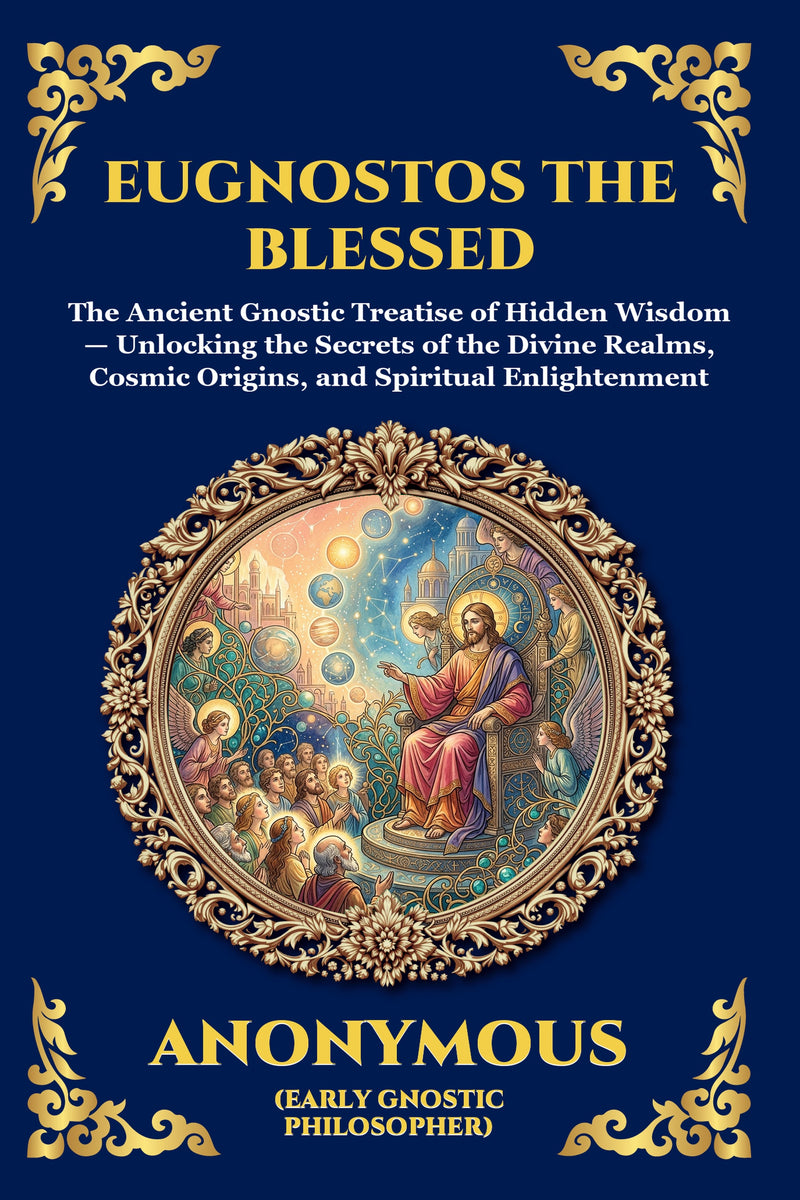
Eugnostos the Blessed
Eugnostos the Blessed delivers a pure philosophical exploration of the divine, bypassing conventional religious narratives. Discovered in the Nag Hammadi library, this Gnostic text offers a cosmological map that challenges mainstream theological doctrines and reveals the esoteric beliefs of ancient mystics.
or free app
10,000+ hrs library
30-day guarantee
This Library of Alexandria edition presents Eugnostos the Blessed as a complete modern-English translation, readable online with audiobook narration included for members.
What lies behind the world, if its highest source cannot be known or named?
Eugnostos the Blessed is a short letter from a teacher to people he calls his own. He begins by challenging thinkers who claim to explain the universe. Then he offers his own account: an unfolding divine order that starts with the Unbegotten One, a God without beginning, name or limit.
According to the letter, this order extends through Immortal Man and Son of Man into crowded heavens. The Savior and his partner Pistis Sophia belong to these celestial realms. Rather than a story or a set of moral lessons, Eugnostos offers a compact map of existence, asking readers to consider what stands behind the world they know.
What you'll discover
- A teacher's searching letter – Meet Eugnostos through his address to a circle of students or followers.
- The limits of explanation – Follow his challenge to thinkers whose accounts of the universe he finds mistaken.
- A God beyond names – Explore how the letter describes its highest source through what cannot be said.
- The unfolding heavenly realms – Trace the letter's divine order through Immortal Man, Son of Man and the Savior.
- Outside the biblical canon – Encounter a different stream of religious thought, later reused in the Sophia of Jesus Christ.
Perfect for readers of ancient philosophy, early Christian history and Gnostic writings, and anyone curious about how people once pictured the divine.
Open the first page and follow Eugnostos from the limits of human explanation into his vision of the heavens.
| Formats | eBook (EPUB + PDF) · Audiobook · Paperback · Hardcover · Large Print |
| Language | English |
| Trim size (print) | 6 × 9 in |
| Binding | Paperback — perfect-bound · Hardcover — casewrap |
| Large Print edition | Same text in a larger, easy-read type — a larger font, not a larger trim |
| Print pricing | Every physical book at our true cost — at-cost, no profit (members) |
| Library | 873 restored titles, always growing |
| Composed | 2nd-3rd century AD |
| Original language | Coptic |
| Source tradition | Nag Hammadi Codex III and V |
| Translation basis | Public-domain scholarly translation, rendered in clear modern English |
| Length | 6,031 words · ~24 min reading |
| Reading level | Grade 9 · clear and comfortable (this modern-English edition) |
| Edition | Modern English translation · 2026 |
Member reviews for this edition are collected as readers finish it — be the first. Across the library: 12,000+ books shipped, every plan covered by a 365-day print guarantee.
About this edition
The complete, unabridged text in clear modern English — faithful to the original, never simplified. Every paragraph is checked against the source, so nothing is cut, summarised, or paraphrased away. It reads cleanly for today while keeping the original meaning intact.
Eugnostos the Blessed survives in the Nag Hammadi Codex III and V, discovered in Egypt in 1945. This edition derives from the standard public-domain scholarly translation and renders it in clear modern English.
- Complete & unabridgedVerified paragraph by paragraph against the source — never a scan, never abridged.
- Modern English, faithfulReadable today, with the author’s meaning kept intact. Readable — not simplified.
- Every format, one membershipRead in your browser or the free app, or listen to the full audiobook.
Included free with your membership
Cancel anytime, one click · 30-day money-back guarantee
Edition last updated June 2026
What’s inside
Eugnostos the Blessed — complete and unabridged: all 13 sections included with membership, plus the full audiobook.
Begin reading Eugnostos the Blessed
In clear modern English — the complete text is included with membership.
Chapter 1
Peace to you. Here is something I want you to understand: every human being formed from the world's earliest days down to this moment has been shaped out of dust. People have searched after God, asking who he is and what his nature might be, yet he has stayed beyond their reach. The wisest among them have reasoned toward truth from the way the cosmos is arranged, but their reasoning fell short of it. Thinkers hold three competing accounts of how the cosmos is governed, and none of them agree with one another. One group claims the world steers its own course. Another holds that a divine plan directs it. A third insists that fate has held the reins. Each of these views is mistaken. Of the three positions I have named, not one stands up as true. A life springing from itself is hollow, being its own maker. Providence shows no wisdom. Fate amounts to nothing. Whoever can step past these three paths I have laid out, arrive at a different way, proclaim the God of truth, and stand in harmony with everyone concerning him — such a person, though dwelling among mortals, will never die.
Chapter 2
No description can capture the One Who Is. From the world's first day until now, no authority, no ruler, no creature, no order of being has ever known the One Who Is. The One Who Is alone possesses knowledge of itself.
The One Who Is endures eternally, abides without end, and never underwent birth, for whatever undergoes birth must also undergo death. It is uncreated, possessing no beginning, for whatever possesses a beginning also reaches an end. It is subject to no rule and bears no name, for whoever bears a name was crafted by another. It is beyond all naming and holds no human form, for whoever wears a human form was brought forth by another.
The One Who Is possesses a form of its own, unlike anything we have been given or laid eyes on, but rather a form of another order entirely, one that surpasses all things and outranks everything within the universe.
It gazes on every side and beholds itself from within itself.
The One is limitless, past all comprehension, and its perfection never falters.
Nothing matches the One. It is good at all times and never changing, free from error, enduring forever, rich in blessing, past all knowing, yet it possesses knowledge of itself.
No measure can contain the One, no trail leads to it. It is wholly perfect and free of every defect.
Sacred is the One, never touched by decay, and it is given the title Father of all.
Chapter 3
Before any visible thing emerged — the majesty and the ruling powers within him — he grasps the whole of everything, while nothing grasps him. He is wholly mind, thought, reflection, deliberation, reason, and power, each of these equal in strength. They are the wellspring from which all things flow. And the entire company, from first to last, was already known to the uncreated one, since at that point nothing visible had yet emerged.
There are distinctions among the perfect worlds. Consider it this way: whatever is perishable will perish, since the perishable is its source. Whatever is imperishable will not perish but will reach perfection, since the imperishable is its source. Many have stumbled into error through ignorance of this distinction, and death has claimed them.
Chapter 4
That will do for now. What I have stated about the holy, perfect, true God stands beyond dispute. Anyone willing to trust the words set down here will pass from the unseen realm to the boundary of the seen. And this very thought will show how faith in unseen things is discovered within things that are seen.
Here is a foundational principle of knowledge. The right title for the Lord of everything is not Father but Forefather, for the Father marks the starting point of what is visible, while the Lord is the Forefather without any beginning. Within his own self the Forefather beholds himself, as one does in a mirror, and the likeness shows itself as self-made Father, self-generating Parent, and a mirrored image, since it mirrors the first uncreated being. Equal in age to the one preceding him, he falls short of him in power. Later he brought to light a host of other beings — self-originating and mirrored likenesses, matching him in both age and power — who are marvelous beyond counting. These bear the name of the company over which no kingship stands, out of all the kingdoms there are. And the whole multitude belonging to that realm where nothing reigns over it are named the offspring of the uncreated Father. Glory beyond perfection and joy past telling fill the unknowable one, and within him all these beings rest, rejoicing endlessly with gladness no tongue can render, over fadeless glory and over limitless praise that no age or its worlds had ever heard of or known.
But let this suffice, lest we never come to a stop.
Chapter 5
A further foundational principle of knowledge exists, seen from the side of created things.
The first to reveal himself before the everlasting universe is the self-growing one, the self-made Father, brimming with radiant light beyond all description. At the beginning he resolved that his likeness should become a mighty power, and instantly the strength of that light stood revealed as an immortal human bearing the qualities of male and female together. The male side of this human carries the name Perfect Mind; the female side, all-wise Mother Sophia. She is also described as resembling her brother and consort. Hers is a truth no one can contest, though down here error dwells alongside truth and contests it. Through the immortal human a first cluster of conceptions emerged: divine reverence and a kingdom. This was disclosed by the Father, who is named the Self-Originate Human Father. For his own majesty he fashioned a lofty age and endowed it with vast power, and it held rule over every created world, bringing forth gods, archangels, and angels in numbers past counting to attend him.
From this Human flowed divine reverence and kingship; for this cause the human was given the titles God of gods and King of kings. For those destined to come afterward, the first Human stands as Faith, Pistis. Within himself he holds a mind of his own, along with thoughts suited to him, plus reflection, deliberation, reason, and power.
Every one of these attributes is flawless and immortal. In perfection they stand equal; in strength they do not. They differ from one another the way a father differs from a son, a son from thought, and thought from all the rest.
Chapter 6
As I noted earlier concerning created things, the one comes first, the two follows, then the three, and so on up to the tens. The tens govern the hundreds, the hundreds govern the thousands, and the thousands govern the ten-thousands. Such is the arrangement among the immortals.
The one and thought are the portion of the immortal human. The tens hold insights; the hundreds stand for teachings; the thousands stand for counsels; and the ten-thousands stand for powers. Those who arise from them dwell with them in every world. At the start, mind gave rise to thought and insights. Insights then yielded teachings, teachings yielded counsels, and counsels yielded power. Following all the attributes, everything that was revealed proceeded out of his powers. What was created gave rise to what was shaped; what was shaped gave rise to what was formed; what was formed gave rise to what was named. Among created things, the distinctions arose through naming, from start to finish, by the power of all the eternal beings. Unfading glory in its fullness and joy beyond words fill the immortal human, while his entire kingdom — together with those whom no later age or its worlds ever heard of or knew — keeps festival with gladness that never ends.
Chapter 7
Afterward a further power issued from the immortal human, the perfect self-creating one. Once his consort, great Sophia, had joined with him, he brought to light the first-created being, male and female in nature, who is called the first-created Child of God. The Child of God's female name is First-Created Sophia, Mother of the universe — love, as some call her. Drawing power from his father, the first-created fashioned for his own majesty a lofty eternal being, along with angels beyond numbering to wait upon him. That entire angelic throng is known as the company of the holy, shadowless beings of light, and whenever they exchange greetings, their embraces bring forth angels of their own kind.
The first-creating father bears the name Adam of Light. Gladness beyond telling and everlasting praise fill the kingdom of the Child of Humanity, where those who dwell there rejoice without ceasing, in a delight words cannot reach, over their flawless glory — a glory no age that has ever arisen, nor any of their worlds, has heard of or been shown.
Chapter 8
Next, the Child — the Son of Humanity — united with Sophia his consort and brought forth a great radiance, male and female in nature. Its male name is Savior, begetter of all things; its female name is Sophia, the all-begetting one, whom some call Pistis, meaning Faith.
Together with his consort Pistis Sophia, the Savior disclosed six spiritual beings, male and female alike, each patterned after those who came before them. Their male names are as follows: first, the Uncreated One; second, the Self-Created; third, the Creating One; fourth, the First Creator; fifth, the All-Creating; sixth, the Chief Creator.
The names of the females are these: first, Sophia the All-Wise; second, Sophia, Mother of All; third, Sophia, Maker of All; fourth, Sophia the First Creator; fifth, Sophia Who Is Love; sixth, Pistis Sophia.
From the union of those just named, thoughts came to light within the eternal realms that had existed from before. Out of thoughts arose ideas; out of ideas, deliberations; out of deliberations, reasoned utterances; out of reasoned utterances, wishes; and out of wishes, words.
Chapter 9
The twelve powers I have described joined together, and each one brought forth six males and six females, giving a total of seventy-two powers. Each of those seventy-two in turn brought forth five spiritual powers, raising the total to three hundred and sixty. A single will bound them all together. In this way, deathless Humanity became the pattern on which our world was modeled. The Begetter, the Son of Immortal Humanity, stands as the image of time. The Savior stands for the year. The twelve powers represent the twelve months. The three hundred and sixty powers that proceed from the Savior correspond to the three hundred and sixty days of the year. And the angels beyond counting who sprang from them correspond to the hours and the moments of each day.
Chapter 10
The moment those I have described came to light, their father, the all-creating one, resolved to fashion 12 eternal realms to attend the 12 angels. Every realm held 6 heavens, yielding 72 heavens for the 72 powers who issued from him. And every heaven held 5 firmaments, yielding 360 firmaments in all from the 360 powers who issued from them.
Once the firmaments were complete, they received the title of the 360 heavens, taking their name from the heavens that preceded them. Every one of them is good and perfect.
In this way the defect of femaleness was made plain. The 1st eternal realm belongs to deathless Humanity. The 2nd eternal realm belongs to Humanity's Child, who is named the first to fashion. The 3rd belongs to the offspring of Humanity's Child, who is named the Savior. Embracing these is the realm over which no king rules, the realm of the everlasting, limitless God — within it the age of ages of the immortals, the age standing above the 8th realm that showed itself in chaos. The deathless Human disclosed realms, powers, and kingdoms, and granted authority to all who issued from him to fashion whatever they wished until the days that stand over chaos. These united with one another and disclosed every kind of majesty, even out of spirit, together with glorious lights beyond counting. At the outset the 1st, 2nd, and 3rd eternal realms received their names: the 1st, the middle, and the perfect. The 1st bore the name unity and rest. Each carries a name of its own; the 3rd realm was titled assembly, after the vast throng that showed itself within the One who is many. For when the many come together into one, assembly is what they are named, drawn from the assembly surpassing heaven. The 8th realm's assembly proved to be male and female together and received names of both kinds: its male side was termed assembly, its female side life, making plain that in every realm life arose from a female.
Chapter 11
Every name descends from the primal source — the one who united with thought, from which powers known as gods came to light. Out of their deliberations the gods disclosed gods of gods; out of their deliberations the gods of gods disclosed lords of lords; out of their words the lords of lords disclosed lords; out of their powers the lords disclosed archangels; the archangels disclosed angels; and from these emerged the conceptions, bearing shape and structure, by which all the ages and their worlds receive their names.
Cancel anytime, one click · 30-day money-back guarantee
Founding annual rate available now — your price locks for life when you join.
Not ready? Get this free chapter by email — read it anytime.
✓ Sent — check your inbox for Eugnostos the Blessed.
Questions about Eugnostos the Blessed
Why was Eugnostos the Blessed excluded from the biblical canon?
Eugnostos the Blessed was never considered for biblical inclusion as it represents Gnostic philosophical teachings that developed alongside but separate from mainstream Christianity, focusing on esoteric cosmological knowledge rather than gospel narratives.
What does Eugnostos the Blessed actually contain?
Eugnostos the Blessed presents a systematic Gnostic cosmology describing the divine realms, the emanation of spiritual beings called aeons, and the structure of the heavenly hierarchy without narrative elements or Christian imagery.
Who wrote Eugnostos the Blessed?
The author of Eugnostos the Blessed remains anonymous. Scholars believe it was composed by an early Gnostic teacher or philosopher in the 2nd-3rd century AD, representing broader Gnostic theological traditions.
Is Eugnostos the Blessed free to read?
The opening of the text is free to read below. Members read and listen to the complete work — and the entire Lost & Forbidden Library — free.
What is Eugnostos the Blessed?
Have you ever wondered why some of the most profound philosophical teachings about the universe were kept hidden from the public eye?
How long is Eugnostos the Blessed?
13 chapters (~2,559 words) in this restored edition.
Shipping & returns
Billing & membership
More from the library


Explore The Lost & Forbidden Library
- 1 Enoch · Attributed to Enoch
- 1–4 Maccabees · Various Jewish authors
- 2 Baruch · Attributed to Baruch
- 2 Enoch · Attributed to Enoch
- 2 Esdras · Attributed to the prophet Ezra
- 4 Baruch · Attributed to Baruch ben Neriah
- A Valentinian Exposition · Attributed to a follower of Val...
- Acta Archelai · Attributed to Hegemonius
- Acts of Andrew and Matthias in the City of the Cannibals · Attributed to early Christian a...
- Acts of Barnabas · Attributed to John Mark
- Acts of Paul and Thecla · Attributed to Onesiphorus
- Acts of Peter and Simon · Attributed to Leucius Charinus
- Acts of Saturninus
- Acts of Titus · Anonymous early Christian writer
- Allogenes the Stranger · Anonymous (Early Gnostic Mystic)
- Antitheses of Marcion · Attributed to Marcion of Sinope
- Apocalypse of Bartholomew · Attributed to the Apostle Barth...
- Apocalypse of Daniel
- Apocalypse of James · Attributed to James the Just
- Apocalypse of Moses · Attributed to early Jewish scribes
- Apocalypse of Paul · Attributed to the Apostle Paul
- Apocalypse of Paul (Visio Pauli, Latin) · Attributed to the Apostle Paul
- Apocalypse of Pseudo- Ephraem · Attributed to Ephraem the Syrian
- Apocalypse of Sedrach
- Apocalypse of Shenoute · Attributed to Shenoute the Arch...
- Apocalypse of Stephen
- Apostolic Canons · Attributed to Clement of Rome
- Apostolic Fathers · Various early Christian authors
- Apostolic Tradition · Attributed to Hippolytus of Rome
- Aristides: Apology · Attributed to Aristides of Athens
Eugnostos the Blessed
Eugnostos the Blessed
A Letter on the Unknowable God and the Unfolding of the Eternal Realms
Library of Alexandria Press
Eugnostos the Blessed
© Copyright 2026 Library of Alexandria Press. All rights reserved.
Published by Library of Alexandria Press
Printed in the United States of America
It is not legal to copy, share, or send any part of this document in either digital or printed form without written permission from the publisher, except short quotes in a book review.
Table of Contents
Introduction
Chapter 1
Chapter 2
Chapter 3
Chapter 4
Chapter 5
Chapter 6
Chapter 7
Chapter 8
Chapter 9
Chapter 10
Chapter 11
Chapter 12
Introduction
There are texts that survive the centuries not merely because scribes were diligent or libraries were fireproof, but because the ideas contained within them possess a kind of gravitational pull — a density of meaning so profound that generation after generation finds itself drawn back, compelled to read, to wrestle, and to wonder. The ancient treatise you are about to encounter is precisely such a text. It has waited in the dark for nearly two thousand years, buried beneath the sands of Upper Egypt, sealed inside a jar alongside a cache of leather-bound codices that would eventually shake the foundations of how we understand early Christianity, ancient philosophy, and the restless human hunger for divine knowledge. When those codices were unearthed near the village of Nag Hammadi in 1945, scholars recognized almost immediately that they were holding something extraordinary. Among the dozens of remarkable documents recovered was this one — a luminous, strange, and deeply ambitious piece of spiritual writing that dared to ask the most fundamental questions a human mind can pose: What is the nature of ultimate reality? Where did the cosmos come from? Who are we, and what is our relationship to the divine source of all existence?
To read this text for the first time is to experience something genuinely disorienting in the best possible sense. The world it describes is not the world most of us were taught to inhabit. There is no single omnipotent creator sitting in solitary majesty above a passive creation. Instead, the reader is invited into a cascading architecture of divine beings, realms within realms, emanations of light and intellect that unfold from a primordial source like the petals of some impossibly complex cosmic flower. The text speaks with the calm authority of someone who has seen these things directly — not through faith alone, but through a form of knowing that the ancient Greeks called gnosis, a word that means not merely intellectual knowledge but lived, experiential, transformative understanding. This distinction is everything. The author is not asking you to believe a set of propositions. The author is inviting you into a mode of perception.
The word 'gnostic' has suffered considerably at the hands of history. For centuries it was used almost exclusively as a term of abuse, deployed by the early church fathers who considered these writings dangerous, heretical, and spiritually poisonous. Irenaeus of Lyon, Tertullian, Hippolytus — these formidable theological polemicists wrote at length about the Gnostics, describing their ideas with a mixture of outrage and barely concealed fascination. But because the actual Gnostic texts themselves had largely disappeared from circulation, suppressed and destroyed as the orthodox Christian church consolidated its authority, readers for over a millennium had to take the heresiologists at their word. The Gnostics were portrayed as confused, arrogant, morally suspect people who had taken the pure gospel and twisted it beyond recognition. It was only with the Nag Hammadi discovery that scholars could finally read the primary sources themselves and discover a far more nuanced, intellectually sophisticated, and spiritually serious tradition than the church fathers had been willing to acknowledge.
What emerged from that reassessment was the recognition that Gnostic thought represented one of the most ambitious and creative intellectual movements of late antiquity — a movement that drew on Platonic philosophy, Jewish mysticism, early Christian revelation, Egyptian religious traditions, and Persian cosmological speculation, weaving them together into systems of breathtaking complexity and occasional breathtaking beauty. The text presented in this volume sits near the heart of that tradition. It is widely regarded by scholars as one of the earliest surviving examples of Gnostic theological writing, possibly predating many of the more familiar Gnostic gospels, and it is remarkable for presenting its cosmological vision without extensive reference to specifically Christian narrative. This has led some researchers to speculate that it may represent a form of Gnostic thought that existed before the movement became deeply intertwined with Christianity — a window, in other words, into the very origins of an entire way of seeing the world.
The title itself deserves a moment's attention. The word 'eugnostos' is Greek, and it means something like 'well-born' or, more pointedly, 'the one who knows well' — the blessed one whose knowing is itself a form of grace. This is not an accidental choice of name. The text is framed as a letter or discourse addressed by this figure to his students, and the framing device is itself theologically significant. Knowledge — real knowledge, transformative knowledge — is presented as something that can be transmitted, that can be shared between a teacher who has achieved genuine understanding and students who are ready to receive it. The blessed knower is not hoarding his wisdom but offering it freely, urgently, as though the stakes of remaining ignorant are simply too high to permit any delay.
It is worth pausing here to say something about why this matters to us now, in the twenty-first century, when we have particle accelerators and space telescopes and neuroscience and all the magnificent apparatus of modern empirical inquiry. One might reasonably ask what a two-thousand-year-old cosmological speculation has to offer a world that has mapped the human genome and detected gravitational waves. The answer, I think, is this: the questions this text is asking are not the same questions that science asks, and they are not answered by scientific methods — not because science is inadequate, but because they are questions of a different order entirely. What is the relationship between consciousness and the cosmos? Is there meaning woven into the fabric of existence, or is meaning something we alone project onto a fundamentally indifferent universe? What does it feel like to know something at the deepest level, not merely to understand it intellectually but to be transformed by understanding it? These are questions that have not become obsolete. If anything, they have become more urgent as the modern world has grown more technologically powerful and, for many people, more spiritually disorienting.
The World That Produced This Vision
To understand the text fully, it helps enormously to understand the world in which it was written. The first and second centuries of the common era were a period of extraordinary intellectual and spiritual ferment across the Mediterranean basin and the Near East. The conquests of Alexander the Great had, centuries earlier, created a vast zone of cultural exchange in which Greek philosophy, Egyptian religion, Jewish scripture, Babylonian astronomy, and Persian dualism were all in constant conversation with one another. By the time the Roman Empire had consolidated its control over this region, the result was a civilization of staggering syncretism — a world in which a single educated person might read Plato in the morning, attend a Jewish synagogue in the afternoon, participate in the mysteries of Isis in the evening, and lie awake at night wondering how all of these different visions of reality could possibly be reconciled.
This was not merely an academic puzzle. It was a deeply felt existential crisis for many people. The traditional gods of Greece and Rome had never been entirely satisfying as explanations of ultimate reality — they were too human, too capricious, too embedded in the political myths of particular city-states to carry the weight of cosmic significance. The philosophical schools — Platonism, Stoicism, Neoplatonism — offered more intellectually rigorous accounts of the universe, but they could feel cold and abstract, insufficiently personal, unable to address the raw human need for a sense of participation in something larger than oneself. Judaism offered a powerful monotheism and a rich scriptural tradition, but it was also a tradition rooted in the particular history of a particular people, and not everyone could or wanted to enter that tradition fully. Into this spiritual vacuum came a proliferation of new religious movements, mystery cults, and revelatory traditions, each offering its own account of the divine, its own path to salvation or enlightenment, its own community of the knowing.
Gnostic thought emerged from this environment not as a single unified religion with a fixed creed and a central authority, but as a loose family of related ideas and spiritual practices that shared certain characteristic emphases. Chief among these was the conviction that the material world as we ordinarily experience it is not the whole of reality — not even close. Behind or above or within the visible cosmos there exists a deeper order of being, a realm of pure light and intellect and divine fullness, and the human soul is in some sense a fragment of that higher realm that has become trapped or lost or forgotten in the density of material existence. The path to liberation, in this view, is not primarily a matter of moral reform or ritual observance, though these might play a role. It is primarily a matter of remembering — of recovering the knowledge of one's true origin and true nature, and through that recovery, beginning the journey back toward the source.
This vision drew heavily on Platonic philosophy, particularly on the Platonic idea that the material world is a kind of shadow or copy of a higher realm of eternal Forms, and that the human soul, being of divine origin, naturally yearns to return to the realm from which it came. But the Gnostic thinkers did something interesting and controversial with this Platonic inheritance: they radicalized it. Where Plato had generally maintained that the material world, though inferior to the realm of Forms, was nonetheless a beautiful and ordered cosmos created by a benevolent divine craftsman, many Gnostic thinkers took a much darker view. The material world, in their account, was the product of ignorance — created not by the highest divine principle but by a lesser being who mistakenly believed himself to be the supreme God. This lesser creator, often called the Demiurge, was not necessarily evil in intent, but he was profoundly limited in understanding, and the world he made reflected those limitations.
This is a startling idea, and it was startling to ancient readers as well. It meant that the God described in much of the Hebrew Bible — the jealous, commanding, sometimes violent deity of the early scriptures — was not, in the Gnostic view, the ultimate source of all being. Above and beyond that God there existed a higher reality, a true divine fullness, utterly transcendent and utterly good, from which the material world had become separated through a kind of cosmic accident or tragedy. The human soul, carrying within itself a spark of that higher light, was therefore in a profoundly paradoxical situation: born into a world made by a limited creator, but bearing within itself the memory and the longing for something infinitely greater.
The text we are presenting here engages with all of these themes, but it does so with a particular elegance and a particular emphasis on the positive dimensions of divine reality rather than dwelling exclusively on the tragedy of the fall into matter. The author is less interested in cataloguing what went wrong than in describing, in loving and meticulous detail, the glorious architecture of what is right — the divine realm in its fullness, the cascading orders of being that flow from the ultimate source, the nature of the divine intellect and its relationship to time, space, and the human capacity for understanding. Reading it, one gets the sense of someone who has genuinely been overwhelmed by a vision of cosmic beauty and is struggling, with great care and great effort, to find words adequate to what they have seen.
The question of authorship is one that scholars have debated with considerable energy and no definitive resolution. The text presents itself as the work of a figure named Eugnostos, but this is almost certainly a pseudonym or a literary device rather than a historical identification. Pseudonymous authorship was entirely common in antiquity — texts were regularly attributed to revered figures, whether historical or legendary, as a way of lending them authority and situating them within a particular tradition. What we can say with some confidence is that the text was composed in Greek, probably sometime in the first or early second century of the common era, and that it was subsequently translated into Coptic, the late form of the ancient Egyptian language, at some point before being included in the Nag Hammadi collection. The Coptic translation is what survived, and it is from that translation that modern scholars have worked to reconstruct the text's meaning.
How to Read What Follows
There is a particular challenge involved in reading ancient spiritual texts that is worth naming directly, because failing to acknowledge it tends to produce frustration and misunderstanding. The challenge is this: these texts were not written for us. They were written for specific communities of readers who shared a set of assumptions, a vocabulary, a set of practices, and a lived context that we do not share and cannot fully recover. When we read them across the distance of two millennia, we are inevitably doing something different from what the original readers did. We are reading as outsiders, as visitors to a world that no longer exists in the form it once took. This is not a reason to despair, but it is a reason for a certain kind of humility and a certain kind of patience.
The cosmological language of this text — the elaborate hierarchies of divine beings, the technical terminology for different orders of existence, the precise distinctions between different modes of knowing and being — can seem at first encounter like an impenetrable thicket of abstractions. Readers accustomed to the narrative drive of a gospel or the argumentative clarity of a philosophical treatise may find themselves initially bewildered by what appears to be an almost obsessive enumeration of divine names and attributes. This is understandable. But it is worth persisting, because beneath and within that elaborate terminology there is a coherent and genuinely profound vision of reality that rewards patient attention.
One useful approach is to read the cosmological descriptions not as literal maps of an external supernatural geography but as a kind of phenomenology of consciousness — an attempt to describe, in the only language available, the different qualities and depths of awareness that a human being can experience as they move from ordinary, surface-level perception toward deeper and deeper levels of understanding and being. The 'divine realms' described in the text can be understood as stages of interior development, as qualities of mind and soul, as modes of relationship between the individual consciousness and the ground of all being. Read in this way, the text becomes not an exercise in speculative mythology but something more like a contemplative manual — a guide to the inner landscape of the awakened human being.
Another approach, equally valid and perhaps more historically grounded, is to take the cosmological descriptions seriously on their own terms — to enter imaginatively into a worldview in which the visible cosmos is genuinely embedded within and sustained by a vast invisible order of being, and to ask what it would mean to live and think and pray from within that worldview. This is the approach of sympathetic historical imagination, and it has its own rewards. It allows us to understand why this text was compelling to the people who read it, why it was worth copying and preserving and hiding in a jar to protect it from destruction. It allows us to feel the force of the vision rather than merely analyzing it from a safe critical distance.
The present volume offers the reader both the text itself and the contextual material necessary to engage with it meaningfully. The translation has been prepared with two goals held in constant tension: fidelity to the original Coptic and Greek sources, and accessibility to the modern reader who comes to this material without specialized training in ancient languages or Gnostic studies. Where the original text is deliberately ambiguous — and it sometimes is, in ways that appear to be intentional rather than accidental — the translation preserves that ambiguity rather than resolving it artificially. Where technical terms have been rendered in English, explanatory notes are provided so that the reader can understand not just what the word means but why it matters, what conceptual work it is doing within the larger argument of the text.
It is also worth saying something about the emotional register of this text, because it is easy to lose sight of this dimension when one is focused on the intellectual and theological content. This is not a cold document. It is written with genuine passion — the passion of someone who believes that the knowledge being transmitted is not merely interesting but urgently necessary, not merely true but liberating. The author writes as someone who has been changed by what they know, and who wants that change for their readers. There is a quality of invitation in the text, a sense that the door to a larger reality is being held open and the reader is being gently but insistently urged to step through it.
The tradition of seeking hidden or deeper knowledge about the nature of reality is, of course, not unique to the ancient Mediterranean world. Across cultures and centuries, human beings have consistently reported experiences of a reality that transcends ordinary perception — experiences of unity, of luminosity, of a profound sense that the surface of things conceals an inexhaustible depth of meaning and being. The mystics of every major religious tradition have described something like this, in their different vocabularies and from within their different cultural frameworks. What makes the Gnostic tradition distinctive is not the experience itself but the elaborate intellectual framework that was built around it — the attempt to translate a direct experience of transcendence into a systematic account of the structure of reality. This is an audacious undertaking, and it does not always succeed. But at its best, as in the text you are about to read, it produces something genuinely remarkable: a vision of the cosmos that is at once intellectually rigorous and spiritually alive, that takes seriously both the power of reason and the reality of direct spiritual experience.
As you turn these pages, you will encounter names and concepts that may be unfamiliar. You will meet divine beings with Greek and Coptic names, arranged in hierarchies of increasing subtlety and power. You will encounter a description of the ultimate divine source that is almost paradoxical in its insistence on what cannot be said about it — a theology of divine transcendence so radical that it anticipates by centuries some of the most sophisticated developments in mystical theology. You will find a vision of the human being that is simultaneously humbling and exalting: humbling because it insists on how far we have fallen from our true origin, exalting because it insists with equal force that our true origin is divine.
What you will not find is easy answers. This text does not offer the comfort of simple certainties or the reassurance of a straightforwardly benevolent universe in which everything is already fine. It takes seriously the reality of ignorance — cosmic ignorance, human ignorance — and it insists that the path out of ignorance requires genuine effort, genuine transformation, genuine willingness to see things differently. But it also offers something that many readers will find unexpectedly moving: a vision of the divine that is not primarily about power or judgment or law, but about light, about knowing, about the irresistible tendency of consciousness to seek its own deepest source. In that vision, the universe is not indifferent. It is, at its deepest level, something very much like awareness — and we, in our capacity for genuine knowing, are participants in that awareness rather than merely observers of it.
The jar that held these texts has long since crumbled. The monks or teachers who hid them — presumably to protect them from the same forces of suppression that destroyed so many other documents of this tradition — are dust. The communities that read these texts and shaped their lives around them have dissolved into history. But the questions remain. They remain because they are not historical questions but human ones, as alive in the twenty-first century as they were in the first, as urgent in a world of smartphones and climate change as they were in a world of Roman legions and Alexandrian libraries. Who are we? Where did we come from? What is the nature of the reality we inhabit? And what would it mean — truly mean, not just intellectually but in every dimension of our being — to know?
Those are the questions this text is asking. They are the questions it has been asking, patiently, for two thousand years, waiting for readers ready to hear them. You are now one of those readers. Turn the page.
Eugnostos the Blessed
Chapter 1
Peace to you. Here is something I want you to understand: every human being formed from the world's earliest days down to this moment has been shaped out of dust. People have searched after God, asking who he is and what his nature might be, yet he has stayed beyond their reach. The wisest among them have reasoned toward truth from the way the cosmos is arranged, but their reasoning fell short of it. Thinkers hold three competing accounts of how the cosmos is governed, and none of them agree with one another. One group claims the world steers its own course. Another holds that a divine plan directs it. A third insists that fate has held the reins. Each of these views is mistaken. Of the three positions I have named, not one stands up as true. A life springing from itself is hollow, being its own maker. Providence shows no wisdom. Fate amounts to nothing. Whoever can step past these three paths I have laid out, arrive at a different way, proclaim the God of truth, and stand in harmony with everyone concerning him — such a person, though dwelling among mortals, will never die.
Chapter 2
No description can capture the One Who Is. From the world's first day until now, no authority, no ruler, no creature, no order of being has ever known the One Who Is. The One Who Is alone possesses knowledge of itself.
The One Who Is endures eternally, abides without end, and never underwent birth, for whatever undergoes birth must also undergo death. It is uncreated, possessing no beginning, for whatever possesses a beginning also reaches an end. It is subject to no rule and bears no name, for whoever bears a name was crafted by another. It is beyond all naming and holds no human form, for whoever wears a human form was brought forth by another.
The One Who Is possesses a form of its own, unlike anything we have been given or laid eyes on, but rather a form of another order entirely, one that surpasses all things and outranks everything within the universe.
It gazes on every side and beholds itself from within itself.
The One is limitless, past all comprehension, and its perfection never falters.
Nothing matches the One. It is good at all times and never changing, free from error, enduring forever, rich in blessing, past all knowing, yet it possesses knowledge of itself.
No measure can contain the One, no trail leads to it. It is wholly perfect and free of every defect.
Sacred is the One, never touched by decay, and it is given the title Father of all.
End of the free sample
Keep reading, free
Members read and listen to the complete book — and the entire library. Cancel anytime, one click · 30-day money-back guarantee.