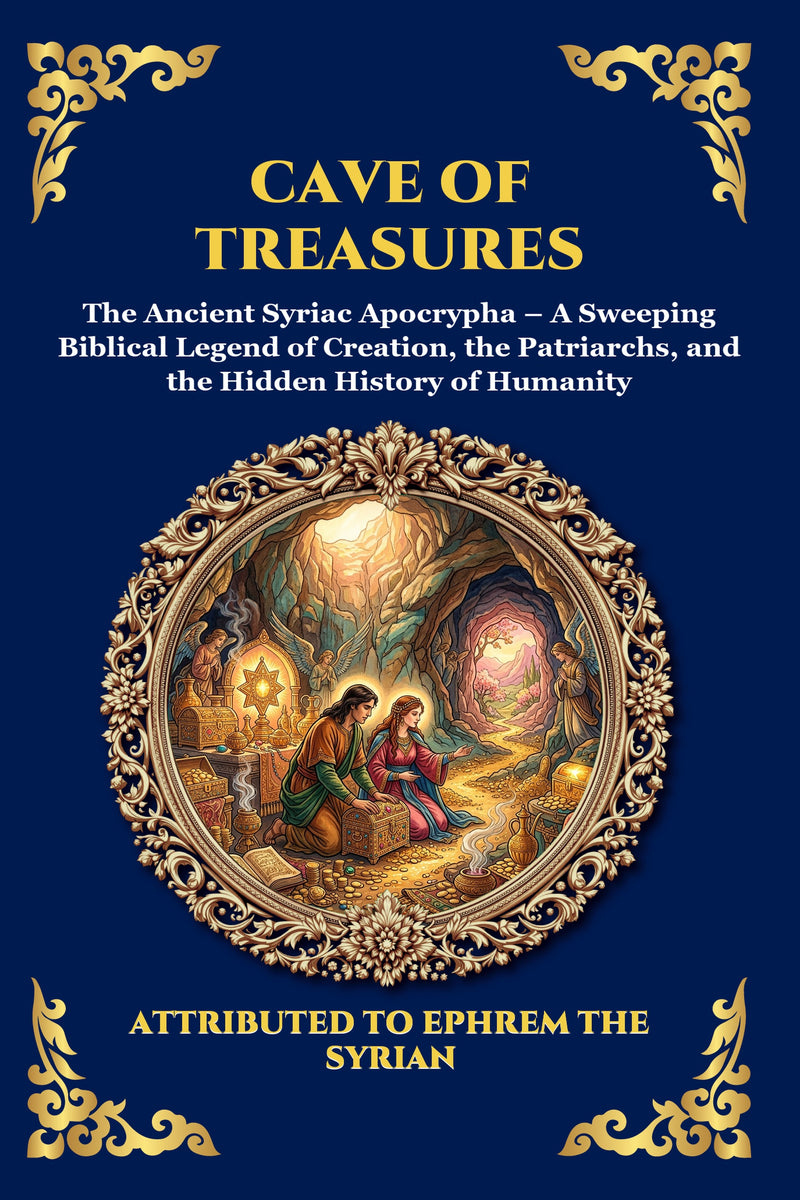
Cave of Treasures — Large Print
Early Christians embraced the Cave of Treasures for its vivid tales that complete the Genesis narrative with angelic lore and profound theological insights. Attributed to Ephrem the Syrian, it connects the creation of Adam and Eve to the crucifixion of Jesus, a sacred continuity excluded from the Bible.
or free app
10,000+ hrs library
30-day guarantee
This complete modern English translation of the 6th-century Cave of Treasures offers online reading with included audiobook narration for Library of Alexandria Press members.
Large Print Edition. The complete, unabridged text set in a larger, easy-on-the-eyes typeface for comfortable reading.
Have you ever wondered why certain ancient biblical stories seem incomplete, and what hidden legends early Christians believed about the dawn of creation?
The Cave of Treasures is a mesmerizing piece of ancient Syriac Christian literature, traditionally attributed to the revered theologian Ephrem the Syrian. This sweeping apocryphal text offers a rich, alternative history of the world, presenting an unbroken, sacred narrative from the creation of Adam and Eve to the birth and crucifixion of Jesus Christ. It fills the silences of the canonical Genesis with vibrant myths, angelic lore, and profound theological meaning, acting as a bridge between the earliest ancestors of humanity and the ultimate redemption of the world.
At the heart of this ancient legend is the "Cave of Treasures"—a sacred, hidden repository carved into the side of a mountain. According to this text, it is here that the physical remains of Adam were laid to rest, alongside the original gold, frankincense, and myrrh that would later be presented to the infant Jesus by the Magi. Through this deeply symbolic narrative, the text traces the exact generations of the patriarchs, exploring their lives, their secret struggles, and their divine visions, demonstrating a perfectly orchestrated cosmic plan.
This modern translation unlocks the esoteric and imaginative world of Eastern Christian mythology, making its sweeping theological history accessible to contemporary readers. Blending ancient traditions with early Christian doctrine, it offers a fascinating glimpse into how ancient believers understood the unfolding of time, the origins of humanity, and the profound, physical connection between the first man and the Savior.
What You’ll Discover in This Modern Translation:
- The Dawn of Creation and the Fall — Explore expanded accounts of the Garden of Eden, the rebellion of Satan, and the early days of Adam and Eve.
- The Legend of the Cave — Discover the hidden sanctuary where the patriarchs were buried and where sacred treasures were kept for generations.
- The Unbroken Patriarchal Bloodline — Trace the detailed, legendary history of humanity's ancestors from Seth and Noah to Abraham and beyond.
- The Connection to the Magi — Read the fascinating apocryphal origins of the gifts of the wise men and their connection to the dawn of time.
Whether you are a scholar of ancient apocrypha, a student of religious history, or someone captivated by early Christian mythology, the Cave of Treasures offers an unforgettable journey into the hidden history of humanity.
Step into the sacred cave and discover the legends that shaped the ancient world. Begin your journey today.
| Formats | eBook (EPUB + PDF) · Audiobook · Paperback · Hardcover · Large Print |
| Language | English |
| Trim size (print) | 6 × 9 in |
| Binding | Paperback — perfect-bound · Hardcover — casewrap |
| Large Print edition | Same text in a larger, easy-read type — a larger font, not a larger trim |
| Print pricing | Every physical book at our true cost — at-cost, no profit (members) |
| Library | 873 restored titles, always growing |
| Composed | 6th century AD |
| Original language | Syriac |
| Source tradition | Syriac manuscript tradition |
| Translation basis | Public-domain scholarly translation, rendered in clear modern English |
| Length | 30,802 words · ~2 hr 3 min reading |
| Reading level | Grade 10 · a confident, adult read (this modern-English edition) |
| Edition | Modern English translation · 2026 |
Member reviews for this edition are collected as readers finish it — be the first. Across the library: 12,000+ books shipped, every plan covered by a 365-day print guarantee.
About this edition
The complete, unabridged text in clear modern English — faithful to the original, never simplified. Every paragraph is checked against the source, so nothing is cut, summarised, or paraphrased away. It reads cleanly for today while keeping the original meaning intact.
The Cave of Treasures survives primarily in Syriac manuscripts, with later Arabic and Ethiopic versions. This edition derives from the standard public-domain scholarly translation and renders it in clear modern English.
- Complete & unabridgedVerified paragraph by paragraph against the source — never a scan, never abridged.
- Modern English, faithfulReadable today, with the author’s meaning kept intact. Readable — not simplified.
- Every format, one membershipRead in your browser or the free app, or listen to the full audiobook.
Included free with your membership
Cancel anytime, one click · 30-day money-back guarantee
Edition last updated June 2026
What’s inside
Cave of Treasures — Large Print — complete and unabridged: all 118 sections included with membership, plus the full audiobook.
Begin reading Cave of Treasures — Large Print
In clear modern English — the complete text is included with membership.
A World of Living Legend
To read this text well, it helps to set aside certain modern assumptions about the relationship between history and story, between fact and meaning. We live in a culture that tends to treat these as opposites: something is either historically accurate or it is fiction, either a document or an invention. The ancient world, and particularly the ancient Near Eastern world in which this text was produced, operated with a fundamentally different set of assumptions. The stories that mattered most — the stories that shaped identity, transmitted wisdom, and made sense of suffering — were understood to be true in a way that went deeper than mere factual accuracy. They were true because they captured something essential about the nature of reality, about the relationship between the human and the divine, about the meaning of time and loss and hope. The author of this text was not writing historical fiction in the modern sense, nor was he writing theology in the academic sense. He was doing something that our culture has largely lost the habit of doing: he was telling sacred story, in the full and serious meaning of that phrase.
The tradition of sacred storytelling into which this text fits is ancient and extraordinarily rich. Jewish midrash — the practice of elaborating on biblical narratives to draw out their hidden meanings — had been developing for centuries before this text was composed, and the author clearly knew and drew on that tradition extensively. Many of the expansions and elaborations found in these pages have close parallels in Jewish sources: the Books of Enoch, the Book of Jubilees, the Life of Adam and Eve, and countless smaller texts and traditions that circulated in the ancient world. The Syriac Christian tradition had its own version of this practice, sometimes called haggadah or simply biblical commentary, and it was deeply intertwined with the liturgical life of the community. The great Syriac theologians wrote in verse as well as prose, and their poetry was full of the kind of imaginative expansion found in this text — the filling in of gaps, the giving of voice to silent figures, the drawing of connections across vast stretches of time.
What makes the author of this text distinctive, within that tradition, is the scale of his ambition and the coherence of his vision. Many parabiblical texts focus on a single episode or a single figure — the fall of the angels, the life of Adam, the story of Enoch. This text encompasses all of them, weaving them together into a single continuous narrative that moves from the very beginning of time to the threshold of the New Testament. The organizational principle is genealogical: the text follows the line of descent from Adam through Seth, through Enosh, Kenan, Mahalalel, Jared, Enoch, Methuselah, Lamech, Noah, and on through the post-Flood patriarchs, eventually arriving at the lineage that will produce the Messiah. But genealogy is only the skeleton. The flesh of the narrative is the stories told about each generation: their lives, their choices, their encounters with the divine, their struggles with the forces of darkness, and their role in preserving and transmitting the sacred knowledge that will ultimately make redemption possible.
One of the most striking features of the text, and one that will immediately capture the attention of any reader coming to it for the first time, is its treatment of the antediluvian world — the long centuries between the Fall and the Flood. In the biblical account, this period is covered in a few verses, mostly a list of names and ages. Here, it becomes a rich and complex drama. The descendants of Adam are divided into two groups: the children of Seth, who are righteous and who dwell on a holy mountain near Eden, and the children of Cain, who are corrupt and who dwell in the valley below. The interaction between these two groups — the gradual corruption of the Sethites by the beauty and seductiveness of the Cainites, the long moral decline that eventually makes the Flood necessary — is told with considerable narrative skill and psychological insight. The author understands that moral corruption is rarely sudden. It happens slowly, through small compromises, through the gradual erosion of boundaries, through the seductive power of what is beautiful but dangerous. The story of the antediluvian world is, among other things, a meditation on how communities lose their integrity, and it is told with a sympathy for human weakness that prevents it from becoming a simple morality tale.
The figure of Enoch deserves special mention, because the author's treatment of this mysterious biblical character is one of the text's most fascinating elements. Enoch appears in Genesis only briefly, but his brief appearance — he 'walked with God, and then he was no more, for God took him' — had generated an enormous body of speculation and elaboration in the ancient world. The Books of Enoch, which survive in various forms, present him as a visionary who was taken up to heaven and shown the secrets of the cosmos. This text draws on that tradition while integrating it into its own theological framework. Enoch becomes a pivotal figure in the transmission of sacred knowledge across the generations, a link between the antediluvian world and everything that comes after. His translation to heaven — his departure from the world without dying — is presented not as an anomaly but as a sign, a prefiguration of the ultimate destiny that awaits those who remain faithful.
The Flood itself, when it comes, is not simply a catastrophe. It is a theological event, a cleansing and a new beginning, and the author treats it as such. Noah is not merely a survivor. He is a second Adam, a new beginning for the human race, and the covenant established with him after the waters recede is understood as a renewal of the original covenant between God and humanity. The narrative of the Flood and its aftermath is handled with considerable dramatic power, and the author's treatment of Noah's family — their dynamics, their fears, their hopes — gives the ancient story a human texture that makes it surprisingly immediate. After the Flood, the text traces the dispersal of Noah's descendants across the world, explaining the origins of the various nations and peoples in a way that was entirely characteristic of ancient ethnographic thinking but that also serves the text's larger theological purpose: the whole world, in all its diversity, is part of the single story that is moving toward redemption.
Running through all of this is a preoccupation with knowledge — sacred, hidden, transmitted knowledge. The patriarchs in this text are not merely ancestors. They are custodians of wisdom, keepers of secrets that must be passed down through the generations without being lost or corrupted. The cave itself is the physical embodiment of this idea: a place where precious things are hidden and preserved against the day when they will be needed. This theme would have resonated deeply with the communities for whom the text was written, communities that understood themselves as preservers of a sacred tradition in a world that was often hostile or indifferent to it. The text is, among other things, a meditation on what it means to be a keeper of sacred memory, on the responsibilities and the burdens of that role, and on the ways in which the past continues to live in the present.
Reading Across the Centuries
There is a question that any thoughtful reader will ask when approaching a text like this: why does it matter now? What does an ancient Syriac legend, composed perhaps sixteen centuries ago for a community of Eastern Christians whose world has long since vanished, have to offer to a reader in the twenty-first century? The question is fair, and it deserves a serious answer.
The most immediate answer is the simplest: this is a great story, told with real skill and genuine imaginative power. Whatever else it is, this text is a work of narrative art, and it rewards reading as such. The characters who populate its pages are not abstractions or theological symbols, though they carry symbolic weight. They are human beings, rendered with a sympathy and a specificity that makes them recognizable across the centuries. Adam's grief at the loss of Paradise is the grief of anyone who has known something precious and lost it. Eve's guilt and her long effort to make amends is the portrait of a conscience at work. The patriarchs who follow them — each one carrying the accumulated weight of the generations before him, each one trying to be faithful to a heritage he has received but cannot fully understand — are recognizable figures, versions of ourselves in our own relationship to the traditions and stories we have inherited.
Beyond the purely literary pleasures, the text offers something that is increasingly rare in our culture: a sense of deep time. We live in a historical moment that is obsessed with the immediate, with the present tense, with the news cycle and the social media feed. This text operates in a completely different temporal register. It thinks in centuries and millennia. It understands individual human lives as moments in a story that stretches from the creation of the world to its ultimate redemption, and it asks its reader to share that perspective, at least for the duration of the reading. There is something genuinely liberating about this. When you read this text, your own problems and preoccupations do not disappear, but they are placed in a context so vast that their proportions change. The text invites you into a kind of cosmic patience, a willingness to see the present moment as part of a much larger pattern.
The text is also, for scholars and general readers alike, an invaluable window into the religious imagination of late antique Christianity. The version of sacred history it presents was enormously influential. Its ideas and images shaped the theology, the art, and the literature of Eastern Christian communities for centuries, and through those communities influenced the broader Christian tradition in ways that are still being traced by scholars. The story of the Magi receiving their gifts from the cave of Adam, for example, appears in various forms across a wide range of medieval Christian art and literature. The typological connections the text draws between Adam and Christ, between the tree of Eden and the wood of the cross, between the cave of the patriarchs and the cave of the nativity, became part of the common symbolic vocabulary of Christian theology. To read this text is to encounter the source of many images and ideas that have shaped Western and Eastern Christian culture alike.
For readers interested in the history of religion more broadly, the text is a fascinating document of the complex interactions between Judaism, Christianity, and the various other religious traditions of the ancient Near East. The author draws freely on Jewish traditions, on Gnostic ideas, on Persian cosmological concepts, and on indigenous Syriac religious thought, weaving them together into a synthesis that is distinctively Christian but that reflects the extraordinary cultural richness of the world in which it was produced. Reading it, you become aware of how porous the boundaries between religious traditions were in the ancient world, how much creative borrowing and exchange took place across what we might imagine as firm dividing lines. The text is a product of a genuinely multicultural intellectual world, and it has the richness that such a world can produce.
The question of authorship is worth addressing, because it has a bearing on how you read the text. For centuries, this work was attributed to Ephrem the Syrian, the great fourth-century theologian and poet who is venerated as a saint in both Eastern and Western Christianity. The attribution gave the text enormous authority and helped to ensure its survival and transmission. Modern scholarship has largely abandoned the Ephrem attribution — the text shows knowledge of events and theological developments that postdate Ephrem's death in 373 CE — but the connection to Ephrem's world remains significant. The author, whoever he was, was working in the same Syriac tradition, drawing on the same sources, addressing the same theological concerns. The false attribution is not merely a historical curiosity. It tells us something about how the text was received and valued: it was the kind of text that people believed Ephrem could have written, the kind of text that deserved to carry the authority of the greatest name in Syriac Christianity.
The anonymity of the actual author is, in a strange way, appropriate. This is a text that is less interested in the personality of its author than in the tradition it transmits. The author works as a conduit for something larger than himself, gathering up the accumulated wisdom and imagination of generations of biblical interpreters and storytellers and shaping it into a coherent whole. His own voice is present — in the elegance of certain passages, in the particular theological emphases he chooses to develop, in the emotional register he brings to certain scenes — but it is always in service of the larger story. There is something admirable about this kind of authorial self-effacement, and it is worth keeping in mind as you read. You are not reading one person's private vision. You are reading the distilled imagination of a whole community, shaped by centuries of reflection on the most fundamental questions human beings can ask.
Cancel anytime, one click · 30-day money-back guarantee
Founding annual rate available now — your price locks for life when you join.
Not ready? Get this free chapter by email — read it anytime.
✓ Sent — check your inbox for Cave of Treasures — Large Print.
Questions about Cave of Treasures — Large Print
Why was the Cave of Treasures excluded from the biblical canon?
The Cave of Treasures was composed centuries after the biblical canon was largely established. Early Christian communities valued it as devotional literature, but its late composition and legendary content placed it outside canonical scripture.
Did Ephrem the Syrian actually write the Cave of Treasures?
Modern scholars generally reject Ephrem's authorship of the Cave of Treasures. The text was likely composed in the 6th century, well after Ephrem's death in 373 AD, and reflects later theological developments.
What stories and teachings does the Cave of Treasures contain?
The Cave of Treasures expands biblical narratives from Adam to Christ, including detailed accounts of antediluvian patriarchs, angelic lore, and elaborate genealogies. It emphasizes the continuity between Old Testament figures and Christian salvation history.
Is Cave of Treasures free to read?
The opening of the text is free to read below. Members read and listen to the complete work — and the entire Lost & Forbidden Library — free.
What is Cave of Treasures?
Have you ever wondered why certain ancient biblical stories seem incomplete, and what hidden legends early Christians believed about the dawn of creation?
How long is Cave of Treasures?
118 chapters (~28,098 words) in this restored edition.
Shipping & returns
Billing & membership
More from the library


Explore Enoch & Pseudepigrapha
- Apocalypse of Daniel
- Apocalypse of Shenoute · Attributed to Shenoute the Arch...
- 2 Enoch · Attributed to Enoch
- Apocalypse of Pseudo-Ephraem · Attributed to Ephraem the Syrian
- Ethiopic Meqabyan I–III
- The Conflict of Adam and Eve with Satan
- Genesis Apocryphon
- Community Rule · Attributed to the Qumran community
- War Scroll · Attributed to the Qumran community
- 2 Esdras · Attributed to the prophet Ezra
- Book of Jasher
- Acts of Barnabas · Attributed to John Mark
- Acts of Paul and Thecla · Attributed to Onesiphorus
- Greek Apocalypse of Daniel
- Sibylline Oracles · Various early Christian and Jew...
- Epistle to the Alexandrians
- Apocalypse of Paul · Attributed to the Apostle Paul
- Apocalypse of Moses · Attributed to early Jewish scribes
- Testament of Solomon · Attributed to King Solomon
- Book of Giants · Attributed to Mani
- Baruch · Attributed to Baruch
- The Forgotten Books of Eden · Various early Christian and Jew...
- Fragments of a Zadokite Work · Attributed to the Zadokite comm...
- Chronicles of Jerahmeel · Attributed to Jerahmeel ben Sol...
- Biblical Antiquities of Pseudo-Philo
- Testamentum Domini · Attributed to the early Church ...
- Apocalypse of Bartholomew · Attributed to the Apostle Barth...
- Vision of Esdras · Attributed to the prophet Ezra
- Cave of Treasures · Attributed to Ephrem the Syrian
- Correspondence of Paul and Seneca · Attributed to Paul the Apostle
Cave of Treasures — Large Print
Cave of Treasures
The Ancient Syriac Apocrypha – A Sweeping Biblical Legend of Creation, the Patriarchs, and the Hidden History of Humanity
Library of Alexandria Press
Cave of Treasures
© Copyright 2026 Library of Alexandria Press. All rights reserved.
Published by Library of Alexandria Press
Printed in the United States of America
It is not legal to copy, share, or send any part of this document in either digital or printed form without written permission from the publisher, except short quotes in a book review.
Table of Contents
Introduction
A World of Living Legend
Reading Across the Centuries
The First Day of Creation
The Second Day of Creation
The Third Day of Creation
The Fourth Day of Creation
The Fifth Day of Creation
The Sixth Day of Creation
The Creation of Adam
The Revolt of Satan and the Battle in Heaven
Adam Raised Up and Brought into Paradise
The Making of Eve
The Symbolism of Eden
Satan's Attack on Adam and Eve
The Expulsion from Paradise
The Cave of Treasures
Cain and Abel
The Birth of Seth and His Descendants
The Death of Adam
The Death and Burial of Adam
The Burial of Adam
The Rule of Seth
The Death of Seth
The Rule of Enos (Anesh)
The Rule of Kainan
The Rule of Mahlalail
The Rule of Mahalalel's Descendants and the Second Thousand Years
The Rule of Jared
The Invention of Music and Its Corruption
The Children of Seth Fall Away
The Death of Jared
The Rule of Enoch
The Rule of Noah and the Building of the Ark
The Death of Lamech
The Rule of Methuselah and Noah
The Death of Methuselah
Noah's Farewell to the Cave of Treasures
Noah Enters the Ark
The Flood
Noah Leaves the Ark
The City of Eight and Noah's Covenant with God
Noah's Vineyard and the Curse of Canaan
The Curse of Canaan and the Renewal of Sin
The Death of Noah
Shem Takes Adam's Body to Golgotha
The Burial of Adam at the Centre of the Earth
Shem's Commands to Melchisedek
The Generations of Shem and the Dispersion of Nations
The Migration to the Land of Shinar and the Tower of Babel
The Descendants of Japheth, Ham, and Shem
Reu, Nimrod, and the Rise of Kings
Serug and the Beginning of Idol Worship
The Spread of Idolatry
The Deaths of Serug, Nahor, and Terah
The Origin of Sorcery
The Wind-Flood
Nimrod and the Beginnings of Fire-Worship
Nimrod and the Origins of Magic
Abraham
Abraham and Melchizedek
Melchizedek Blesses Abraham
The Birth of Isaac
The Founding of Jerusalem
Concerning Melchizedek's Origins
Nimrod Builds Cities
The Death of Sara and the Later Life of Abraham
The Patriarchs: Isaac, Jacob, and Judah
The Genealogy of the Tribes and the Line to David
Solomon and His Many Wives
The Chiefs of Israel Born in Egypt
Moses
The Judges and Early Kings of Israel
The Fifth Thousand Years: From the Judges to Cyrus
David, Solomon, and the Wonders of His Kingdom
The Discovery of Purple Dye at Tyre
The Kings of Israel and Judah
The Apostasy of Solomon
Rehoboam
Abijah
Asa
Jehoshaphat
Joram
Ahaziah and Athaliah
The Reign of Athaliah
The Reign of Joash
The Kings of Judah: Joash to Manasseh
Hezekiah
Manasseh
The Kings of Judah and the Fall of Jerusalem
The Capture of Jerusalem
Jehoiachin, Zerubbabel, and Cyrus
The Return from Babylon and the Restoration of the Scriptures
The Five Hundred Years from the Second Year of Cyrus to the Birth of Christ
The Genealogies of the Later Israelites
The Genealogy from Adam to Christ
The Genealogy of Mary
The Fulfillment of Daniel's Prophecy
The Birth of Christ
The Star and the Magi
The Magi Set Out
The Magi in Jerusalem
The Magi Find the Christ Child
The Circumcision of Christ
The Conversion of the Magi
The Flight into Egypt
Herod, the Magi, and the Slaughter of the Innocents
The Death of Herod
Christ Returns; the Baptism and the Chronology
The Crucifixion
The Genealogy of Christ
The Fulfillment of the Prophecy
The Burial of Christ
The Cross and Its Meaning
The Inscription Above the Cross
The Harrowing of Hell
The Resurrection of Christ
The Resurrection and Ascension
Introduction
There are books that survive because institutions preserve them. There are others that survive because people love them too much to let them die. The ancient Syriac text known as the Cave of Treasures belongs emphatically to the second category. For well over a millennium, it was copied by hand in monasteries perched on the edges of deserts, carried across mountain passes by merchants and missionaries, translated into Arabic, Ethiopic, and Coptic by communities who recognized in it something irreplaceable. It was not canonical scripture — the great councils never voted it into the Bible — yet it was treated with a reverence that bordered on the scriptural. Monks read it aloud in the evenings. Theologians quarried it for arguments. Ordinary believers found in its pages a version of sacred history so vivid, so emotionally satisfying, and so cosmically complete that the official account, by comparison, could seem almost skeletal. This is a book that refused to disappear, and the reasons for that refusal are worth understanding before you read a single page.
To appreciate what you are holding, it helps to understand the world in which this text was born and the hunger it was written to satisfy. The centuries surrounding the composition of this work — most scholars place it somewhere between the fourth and seventh centuries of the common era, with strong arguments clustering around the late fourth or early fifth century — were centuries of extraordinary religious ferment. Christianity had recently become the official religion of the Roman Empire, but the empire's eastern edges bled into territories where other forms of Christian thought flourished: Syriac-speaking communities in Mesopotamia, Persia, and Syria who had their own theological traditions, their own liturgical poetry, their own ways of reading the ancient texts. These communities were not backwaters. They were, in many respects, the intellectual heart of early Christianity, producing some of the most brilliant theological minds of the ancient world. Ephrem the Syrian, whose hymns still echo in Eastern Christian worship today, was part of this tradition. The anonymous author who composed this text — long attributed, almost certainly incorrectly, to Ephrem himself — was steeped in the same rich culture of biblical commentary, midrashic elaboration, and liturgical imagination.
What that author set out to do was audacious in the extreme. The Hebrew Bible, which Christians had adopted as their Old Testament, tells the story of humanity from the creation of the world to the threshold of the New Testament era. But it tells that story with enormous gaps. It moves quickly, sometimes almost brutally so, through events of cosmic significance. Adam and Eve are created, they fall, they are expelled from Eden — and then what? What did they do for the next nine hundred years? What did they think about? How did they mourn their loss? What did they know, and what did they pass on to their children? The biblical text is largely silent on these questions, and that silence was not comfortable for communities who believed that every moment of sacred history was freighted with theological meaning. Into that silence, generations of storytellers, commentators, and visionaries had poured their imaginations, producing a rich body of what scholars call parabiblical literature — texts that expand, explain, and elaborate on the canonical stories. The author of this text drew on that tradition with extraordinary skill and synthesized it into something genuinely new.
The result is a narrative of breathtaking scope. Beginning with the creation of the angels and the rebellion of Satan, moving through the making of Adam and the geography of Paradise, continuing through the Fall and the long, grief-stricken centuries of the antediluvian patriarchs, surviving the Flood, tracing the lineage of the nations, following the wanderings of the Israelites, and finally arriving at the birth of Christ — the text covers the entirety of what its author understood as sacred time. But it does not cover this ground in the manner of a chronicle or a theological treatise. It tells stories. It imagines conversations. It gives its characters interior lives, motivations, and voices. Adam weeps. Eve laments. Noah argues. The patriarchs dream and pray and make decisions that echo through the centuries. The narrative is driven by a theological conviction that every event in the long sweep of human history was oriented toward a single culminating moment, and that conviction gives the text a narrative momentum that is genuinely surprising for a work of its age.
The title itself requires some explanation, because it is one of those titles that initially seems puzzling and then, once you understand it, seems inevitable. The 'cave' in question is a real place within the story — a cave near Eden where Adam, after his expulsion from Paradise, makes his dwelling. Into this cave he brings the most precious things he was permitted to take from the garden: gold, myrrh, and frankincense. These are not merely valuables. They are symbols, charged with theological significance that the author develops with great care. The cave becomes a kind of sacred repository, a physical link between the fallen world and the Paradise that has been lost, a place where the memory of original holiness is preserved across the generations. The patriarchs are buried there, one after another, each adding to the accumulated weight of sacred history that the cave contains. And when, at the end of the story, the Magi travel from the East to bring gifts to the newborn Christ, the gifts they carry — gold, myrrh, and frankincense — are understood to come from this very cave, completing a circle that spans the entire history of the world. The image is extraordinarily beautiful: the treasures of Eden, preserved through all the suffering of human history, finally arriving at the moment of redemption.
This kind of typological thinking — the idea that events in the distant past prefigure and anticipate events in the future — is fundamental to the text's imaginative logic. It is a mode of reading the world that was central to early Christian theology, but the author of this text deploys it with unusual sophistication and emotional depth. The connections drawn are not merely intellectual puzzles or exegetical exercises. They are felt. When Adam, dying, asks his son Seth to anoint his body with the sacred oil of Paradise and to lay him in the cave, the reader understands that this act is simultaneously a funeral rite and a prophecy, a gesture of grief and a gesture of hope. The text is constantly doing this kind of double work, operating simultaneously on the level of immediate human experience and on the level of cosmic theological meaning. It is this quality, more than any other, that explains the text's extraordinary longevity. It does not merely tell you what happened. It tells you what it meant.
The First Day of Creation
In the beginning, on the First Day — the holy First Day of the Week, chief and firstborn of all days — God created the heavens and the earth, and the waters, and the air, and the fire, and the invisible hosts: Angels, Archangels, Thrones, Lords, Principalities, Powers, Cherubim and Seraphim, and all the ranks and companies of spiritual beings. He also created Light, and Night, and Daytime, and the gentle winds and the great storms. All these things came into being on the First Day.
On that same First Day of the Week, the Spirit of holiness — one of the Persons of the Trinity — hovered over the waters. Through that hovering over the face of the waters, the waters were blessed so that they might become producers of offspring. They grew hot, and the whole nature of the waters glowed with heat, and the leaven of creation was united to them. Just as a mother bird warms her young by wrapping them closely in her wings, and the young birds take shape through the warmth they receive from her, so through the working of the Spirit of holiness — the Spirit, the Paraclete — the leaven of the breath of life was united to the waters when he hovered over them.
The Second Day of Creation
On the Second Day, God made the Lower Heaven and called it Rekia, meaning "what is solid and fixed," or the firmament. He did this to make clear that the Lower Heaven does not share the nature of the heaven above it, and that it differs in appearance from that upper heaven, which is of fire. The heaven above is Light, while this lower heaven is of a dense, watery nature, and for that reason it was called Rekia. On the Second Day God also made a separation between the waters above the firmament and the waters below it. The waters that were above heaven rose up on that day like a dense black cloud of thick darkness. They were lifted up and they stand above the Rekia in the air, neither spreading out nor moving in any direction.
End of the free sample
Keep reading, free
Members read and listen to the complete book — and the entire library. Cancel anytime, one click · 30-day money-back guarantee.