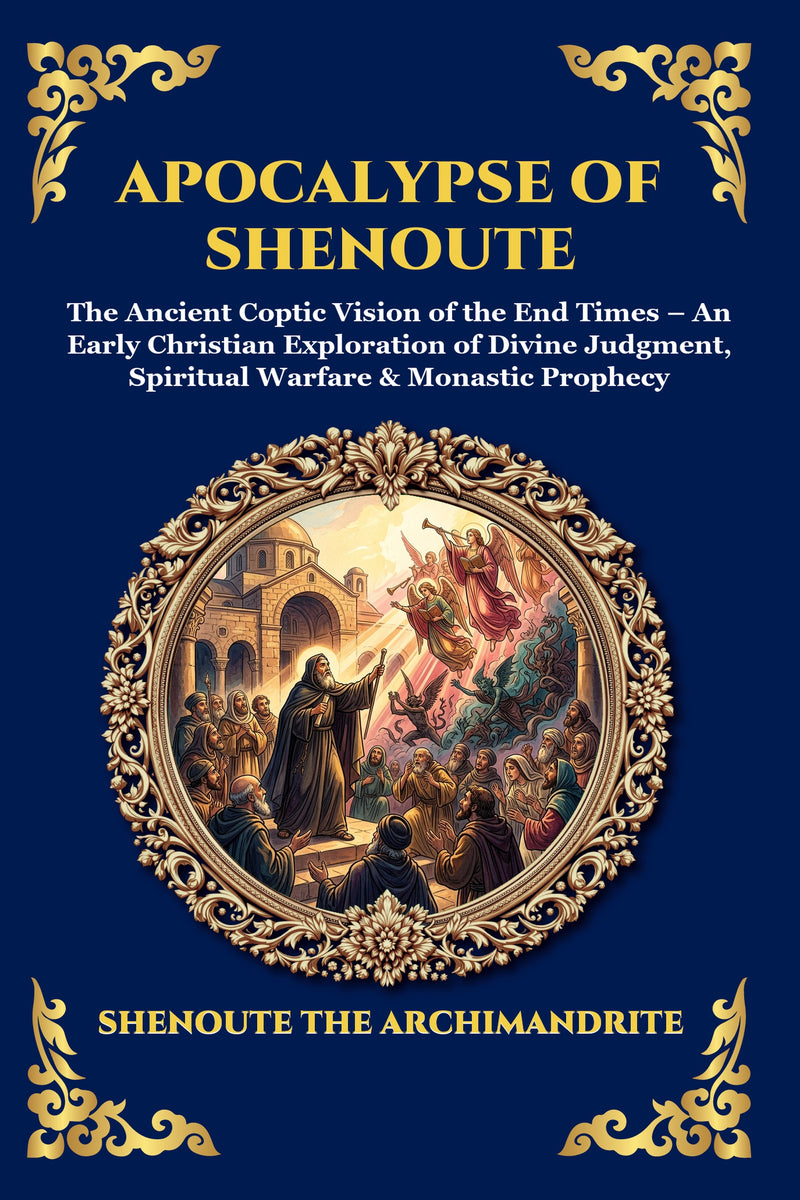
Apocalypse of Shenoute — Large Print
The Apocalypse of Shenoute reveals a vivid vision of final judgment and cosmic battles that drove early Christian monks into the desert's harsh solitude. Attributed to Shenoute the Archimandrite, this text was excluded from the Bible but shaped monastic ideals of purity and perseverance.
or free app
10,000+ hrs library
30-day guarantee
The Apocalypse of Shenoute presents the complete modern-English translation of this Coptic apocalyptic vision, readable online with audiobook narration included for Library of Alexandria Press members.
Large Print Edition. The complete, unabridged text set in a larger, easy-on-the-eyes typeface for comfortable reading.
Have you ever wondered why early Christian monks retreated to the harsh desert and what apocalyptic visions fueled their intense devotion?
The Apocalypse of Shenoute provides a compelling modern translation of one of the most fascinating and powerful works of Coptic Christian history. This ancient text, attributed to the great abbot Shenoute the Archimandrite, recounts a vivid and terrifying vision of the final judgment, the cosmic battle between angels and demons, and the strict moral expectations placed upon believers.
Far more than a simple historical chronicle, the Apocalypse of Shenoute delves into profound themes of purity, perseverance, and the ultimate sacrifices made in the pursuit of spiritual perfection. Shenoute, a towering figure in the Egyptian desert, ruled his massive monastic community with an iron will, and his writings reflect an uncompromising demand for righteousness in a fallen world. This text serves as a stark warning to sinners and a beacon of hope for the righteous, capturing the intense apocalyptic urgency that defined early monastic life.
What You Will Discover in This Modern Translation:
The Prophetic Vision of the End Times Follow the breathtaking and dramatic revelations of the final judgment, the resurrection of the dead, and the ultimate victory of God over the forces of darkness.
Spiritual Warfare in the Desert Explore stories of intense ascetic struggle, detailing how early monks battled demonic temptations and sought divine purity through fasting, prayer, and discipline.
Lessons on Divine Justice and Morality Learn timeless principles about the consequences of sin, the necessity of repentance, and the rigorous moral standards expected of true believers.
A Window into Coptic History and Culture Gain a deeper understanding of the historical and theological significance of the Egyptian monastic movement and its lasting impact on Christian asceticism.
Whether you are exploring this work for its historical value, its profound theological warnings, or its insight into the desert fathers, the Apocalypse of Shenoute offers inspiration and striking guidance for all.
Step into a story of unparalleled spiritual intensity and discover the timeless lessons of the Apocalypse of Shenoute. Begin your journey today.
| Formats | eBook (EPUB + PDF) · Audiobook · Paperback · Hardcover · Large Print |
| Language | English |
| Trim size (print) | 6 × 9 in |
| Binding | Paperback — perfect-bound · Hardcover — casewrap |
| Large Print edition | Same text in a larger, easy-read type — a larger font, not a larger trim |
| Print pricing | Every physical book at our true cost — at-cost, no profit (members) |
| Library | 873 restored titles, always growing |
| Original language | Coptic |
| Source tradition | Coptic manuscript tradition |
| Translation basis | Public-domain scholarly translation, rendered in clear modern English |
| Length | 3,553 words · ~14 min reading |
| Reading level | Grade 13 · rich, literary prose (this modern-English edition) |
| Edition | Modern English translation · 2026 |
Member reviews for this edition are collected as readers finish it — be the first. Across the library: 12,000+ books shipped, every plan covered by a 365-day print guarantee.
About this edition
The complete, unabridged text in clear modern English — faithful to the original, never simplified. Every paragraph is checked against the source, so nothing is cut, summarised, or paraphrased away. It reads cleanly for today while keeping the original meaning intact.
This text survives in Coptic manuscripts from Egyptian monastic libraries. This edition renders the standard scholarly translation into clear, accessible modern English for contemporary readers.
- Complete & unabridgedVerified paragraph by paragraph against the source — never a scan, never abridged.
- Modern English, faithfulReadable today, with the author’s meaning kept intact. Readable — not simplified.
- Every format, one membershipRead in your browser or the free app, or listen to the full audiobook.
Included free with your membership
Cancel anytime, one click · 30-day money-back guarantee
Edition last updated June 2026
What’s inside
Apocalypse of Shenoute — Large Print — complete and unabridged: all 6 sections included with membership, plus the full audiobook.
Begin reading Apocalypse of Shenoute — Large Print
In clear modern English — the complete text is included with membership.
The World That Shaped the Vision
To understand what Shenoute wrote, it is essential to understand where and when he wrote it. The Egypt of the fourth and fifth centuries CE was a world in the middle of one of the most dramatic transformations in human history. For centuries, the Nile Valley had been home to one of the world's great religious civilizations — a civilization built around the worship of gods whose names and forms had remained recognizable for three thousand years. Osiris and Isis, Horus and Thoth, Amun and Ra — these were not merely mythological figures but living presences whose temples lined the banks of the Nile and whose rituals ordered the rhythms of agricultural and civic life. By the time Shenoute was born, this world was already in the process of dissolution. Christianity had become the official religion of the Roman Empire under Constantine, and the subsequent decades saw an accelerating campaign to suppress traditional religious practice, close temples, and redirect the enormous wealth and social prestige of the old priestly classes toward the new faith.
This was not a peaceful process. The suppression of traditional Egyptian religion involved real violence, real dispossession, and real cultural trauma. Shenoute himself was directly involved in some of this violence — he is reported to have led raids on temples and the homes of people who continued to practice traditional religion, and his writings contain some of the most vehement anti-pagan rhetoric in all of late antique literature. This aspect of his legacy is genuinely troubling, and it would be dishonest to minimize it. But it is also important to understand it in context. Shenoute was not operating in a neutral environment. He was a participant in a cultural revolution of enormous scope and complexity, and his actions — however disturbing — were shaped by convictions that were deeply held and internally coherent within the framework of his theological worldview.
At the same time, the Egypt of Shenoute's era was not simply a battlefield between Christianity and paganism. It was also the birthplace of Christian monasticism — one of the most significant and enduring innovations in the history of religion. The great figures of the Egyptian desert — Anthony, Pachomius, Macarius, and their many disciples — had pioneered a way of life devoted entirely to the pursuit of God, stripped of the distractions and compromises of ordinary social existence. This movement had captured the imagination of Christians throughout the Mediterranean world, and by Shenoute's time it had produced communities of remarkable sophistication and spiritual depth. The White Monastery, which Shenoute led for decades, was one of the largest and most influential of these communities — a genuine institution with its own rules, its own economy, its own literary culture, and its own distinctive theological emphases.
The monastic context is crucial for understanding the apocalyptic and prophetic material in this volume. Monasticism was, at its core, an eschatological way of life — a way of living that was oriented toward the end, toward the ultimate reality of God's kingdom rather than the provisional realities of the present age. The monk or nun who renounced marriage, property, and social ambition was making a statement about what ultimately matters — a statement that implicitly relativized all the structures and values of ordinary society. In this sense, apocalyptic thinking and monastic practice were natural partners. Both shared a conviction that the present order of things is not final, that a different and better reality is coming, and that the appropriate response to this conviction is a radical reorientation of one's entire life.
Shenoute's community also existed within a specific social and economic context that gave his apocalyptic vision particular urgency. Upper Egypt in the fifth century was not a prosperous region. The burden of Roman taxation was heavy, and it fell disproportionately on the rural poor. Landowners — often absentee aristocrats with connections to the imperial bureaucracy — exploited their tenants with little fear of legal consequence. Famine was a recurring threat, and the monastery's charitable activities — feeding the hungry, sheltering refugees, providing medical care — put it in direct contact with the suffering of the most vulnerable members of society. When Shenoute wrote about divine judgment on the oppressors of the poor, he was not speaking in abstractions. He was speaking about people he knew, situations he had witnessed, injustices he had personally confronted.
The intellectual world that shaped Shenoute's thinking was rich and complex. He was deeply formed by the Scriptures — both the Hebrew Bible in its Greek translation and the New Testament — which he knew with extraordinary thoroughness and which he quoted constantly and often from memory. But he was also heir to a long tradition of Christian theological reflection, including the works of the great Alexandrian theologians — Clement, Origen, Athanasius — whose engagement with Greek philosophy had produced a sophisticated synthesis of biblical faith and intellectual culture. Shenoute's relationship to this tradition was complex. He was suspicious of what he saw as the excessive intellectualism of some theological approaches, and he had no patience for what he considered heretical deviation from orthodox teaching. But he was far from an anti-intellectual. His writing shows a mind that had absorbed and processed an enormous amount of theological and literary material, even when he deployed that material in the service of passionate exhortation rather than systematic argument.
The genre of apocalyptic literature that Shenoute drew upon had its own long history within both Jewish and Christian tradition. Texts like the Book of Enoch, the Apocalypse of Zephaniah, and the numerous other apocalyptic works that circulated in Egypt provided a rich reservoir of imagery, narrative conventions, and theological concepts that Shenoute could adapt for his own purposes. The vision of heavenly journeys, the enumeration of punishments for the wicked, the description of angelic hierarchies, the proclamation of imminent divine intervention — all of these were established features of the genre that Shenoute could rely on his readers to recognize and respond to. What he brought to these conventions was his own distinctive voice, his particular theological concerns, and his acute awareness of the specific situation of his community.
Understanding this background does not diminish the power or the originality of what Shenoute produced. If anything, it enhances our appreciation of his achievement. He was not working in a vacuum. He was in conversation with centuries of accumulated tradition, and the way he shaped and transformed that tradition in response to his own moment is itself a remarkable creative achievement. Great writers do not emerge from nowhere. They emerge from traditions, and their greatness consists precisely in what they do with those traditions — how they take inherited forms and fill them with new life, new urgency, and new meaning.
Reading Prophecy Across the Centuries
One of the most important questions any modern reader must confront when approaching a text like this is the question of how to read it. Apocalyptic and prophetic literature poses particular interpretive challenges, and those challenges are compounded when the text in question comes from a cultural context as remote as fifth-century Coptic Egypt. The temptation to read such a text in one of two reductive ways is strong: either to treat it as a straightforward historical document that tells us what Shenoute and his community literally believed about the end of the world, or to treat it as a kind of elaborate code in which every image and symbol stands for some specific historical referent that can be decoded with sufficient scholarly ingenuity. Both of these approaches, while not entirely without value, miss something essential about how prophetic literature actually works.
Prophetic texts are not primarily predictive in the sense that weather forecasts are predictive. They do not claim to provide a detailed schedule of future events that can be checked against subsequent history. What they claim to provide is a perspective — a way of seeing the present in light of the ultimate, a way of understanding what is really at stake in the choices and events of everyday life. The prophet speaks from a position of claimed divine insight, and what that insight reveals is not so much the specific sequence of future happenings as the underlying moral and spiritual structure of reality. When Shenoute writes about divine judgment, he is not primarily making a claim about when that judgment will occur. He is making a claim about what kind of universe we live in — a universe in which actions have ultimate consequences, in which the suffering of the innocent is seen and remembered, in which no power is final except the power of God.
This interpretive approach — sometimes called a 'theological' or 'literary' reading of apocalyptic texts — does not require the reader to share Shenoute's specific beliefs in order to engage seriously with his vision. A reader who does not believe in a literal last judgment can still find in this material a powerful articulation of the human longing for justice, a compelling critique of the complacency of the powerful, and a moving expression of hope in the face of suffering. A reader who does share something of Shenoute's faith will find additional dimensions of meaning — a vision of divine reality that speaks directly to their own experience of the world's brokenness and their own hope for its ultimate healing.
It is also worth noting that the question of how to read prophetic texts is not a modern invention. Early Christian communities debated these questions intensely, and the interpretive traditions they developed were sophisticated and varied. Origen, the great third-century Alexandrian theologian, developed an elaborate system of allegorical interpretation that found multiple layers of meaning in every biblical text. Others, like the North African Tyconius, developed rules for reading prophetic texts that distinguished between what referred to the historical church and what referred to the ultimate realities of divine judgment. Shenoute himself had views about interpretation — views that were characteristically direct and uncompromising, but that nonetheless reflected an awareness of the complexity of the task.
For readers who come to this material with a background in biblical studies or the history of Christian thought, much of what they encounter will feel familiar — recognizable themes, shared images, common concerns. But even for these readers, there will be surprises. Shenoute's particular synthesis of prophetic tradition, monastic spirituality, and Egyptian cultural context produces something genuinely distinctive — something that cannot be fully reduced to any of its sources or parallels. The specific texture of his vision, the particular way he combines urgency and tenderness, ferocity and compassion, cosmic scope and intimate personal address — these are the marks of an original mind working within a rich tradition.
For readers who come without any background in this area, the journey may feel more demanding at first, but it is no less rewarding. The editorial apparatus provided in this volume — the introductory essays, the explanatory notes, the glossary of key terms and figures — has been designed to provide the contextual information necessary to follow Shenoute's argument and appreciate his imagery without requiring prior expertise. The goal is to make this material genuinely accessible, not by simplifying or domesticating it, but by providing the scaffolding that allows readers to encounter it on its own terms.
There is something almost paradoxical about the situation of a modern reader engaging with this ancient prophetic text. The very distance that separates us from Shenoute's world — the centuries of history, the cultural transformations, the linguistic barriers — is also, in a strange way, an advantage. We come to this material without the defensive reactions it might have provoked in its original audience, without the personal stakes that made it threatening or comforting in specific ways to specific people. We can read it with a kind of freedom that Shenoute's original readers could not have had. And what we find, when we read with that freedom, is something remarkable: a human being grappling with the deepest questions that human beings face, using the resources available to him with extraordinary skill and passion, and producing a vision of reality that has lost none of its power to disturb, to challenge, and to inspire.
The spiritual warfare that Shenoute describes is not merely a historical curiosity. The struggle against forces that would diminish human dignity, corrupt human community, and extinguish human hope is as real and as urgent today as it was in fifth-century Egypt. The names and faces of those forces change across the centuries, but their essential character does not. And the resources that Shenoute drew upon in that struggle — the conviction that evil is ultimately bounded, that suffering is not the final word, that the God who created the world has not abandoned it — these are resources that remain available to anyone willing to receive them.
The monastic tradition that produced this text was, at its best, a tradition of extraordinary psychological and spiritual insight. The monks and nuns of the Egyptian desert were not naive or unsophisticated people. They had thought very carefully about the dynamics of the human heart — about the mechanisms of self-deception, the subtlety of temptation, the complexity of motivation, the long and difficult process of genuine transformation. The prophetic and apocalyptic dimensions of their thought were not separable from this psychological wisdom. They were part of the same integrated vision of what human beings are, what they are called to become, and what stands in the way of that becoming.
Cancel anytime, one click · 30-day money-back guarantee
Founding annual rate available now — your price locks for life when you join.
Not ready? Get this free chapter by email — read it anytime.
✓ Sent — check your inbox for Apocalypse of Shenoute — Large Print.
Questions about Apocalypse of Shenoute — Large Print
Who was Shenoute and did he actually write this apocalypse?
Shenoute the Archimandrite was a prominent 4th-5th century Egyptian abbot who led the White Monastery. While the Apocalypse of Shenoute is attributed to him, scholars debate whether he actually authored this particular apocalyptic text or if it was composed by later followers.
What does the Apocalypse of Shenoute contain?
The Apocalypse of Shenoute describes visions of final judgment, cosmic battles between spiritual forces, and moral teachings for Christian believers. It reflects the apocalyptic literature popular in early Egyptian monasticism, emphasizing themes of purity and divine justice.
Why isn't the Apocalypse of Shenoute in the Bible?
The Apocalypse of Shenoute was composed after the biblical canon was largely established and circulated primarily within Egyptian monastic communities. It was never considered for inclusion in the biblical canon by early church councils.
Is Apocalypse of Shenoute free to read?
The opening of the text is free to read below. Members read and listen to the complete work — and the entire Lost & Forbidden Library — free.
What is Apocalypse of Shenoute?
Have you ever wondered why early Christian monks retreated to the harsh desert and what apocalyptic visions fueled their intense devotion?
How long is Apocalypse of Shenoute?
6 chapters (~1,081 words) in this restored edition.
Shipping & returns
Billing & membership
More from the library


Explore Enoch & Pseudepigrapha
- Apocalypse of Daniel
- Apocalypse of Shenoute · Attributed to Shenoute the Arch...
- 2 Enoch · Attributed to Enoch
- Apocalypse of Pseudo-Ephraem · Attributed to Ephraem the Syrian
- Ethiopic Meqabyan I–III
- The Conflict of Adam and Eve with Satan
- Genesis Apocryphon
- Community Rule · Attributed to the Qumran community
- War Scroll · Attributed to the Qumran community
- 2 Esdras · Attributed to the prophet Ezra
- Book of Jasher
- Acts of Barnabas · Attributed to John Mark
- Acts of Paul and Thecla · Attributed to Onesiphorus
- Greek Apocalypse of Daniel
- Sibylline Oracles · Various early Christian and Jew...
- Epistle to the Alexandrians
- Apocalypse of Paul · Attributed to the Apostle Paul
- Apocalypse of Moses · Attributed to early Jewish scribes
- Testament of Solomon · Attributed to King Solomon
- Book of Giants · Attributed to Mani
- Baruch · Attributed to Baruch
- The Forgotten Books of Eden · Various early Christian and Jew...
- Fragments of a Zadokite Work · Attributed to the Zadokite comm...
- Chronicles of Jerahmeel · Attributed to Jerahmeel ben Sol...
- Biblical Antiquities of Pseudo-Philo
- Testamentum Domini · Attributed to the early Church ...
- Apocalypse of Bartholomew · Attributed to the Apostle Barth...
- Vision of Esdras · Attributed to the prophet Ezra
- Cave of Treasures · Attributed to Ephrem the Syrian
- Correspondence of Paul and Seneca · Attributed to Paul the Apostle
Apocalypse of Shenoute — Large Print
Apocalypse of Shenoute
The Ancient Coptic Vision of the End Times – An Early Christian Exploration of Divine Judgment, Spiritual Warfare & Monastic Prophecy
Library of Alexandria Press
Apocalypse of Shenoute
© Copyright 2026 Library of Alexandria Press. All rights reserved.
Published by Library of Alexandria Press
Printed in the United States of America
It is not legal to copy, share, or send any part of this document in either digital or printed form without written permission from the publisher, except short quotes in a book review.
Table of Contents
Introduction
The World That Shaped the Vision
Reading Prophecy Across the Centuries
Vision of Waters and Angels
Fate of the Presbyter and the Monk
The Testament of Shenoute
Introduction
There are texts that survive the centuries not merely because they were carefully copied and preserved, but because something in them refuses to die. They carry an urgency that transcends their moment of composition, a voice that seems to reach across the centuries and speak directly to the present. The writings attributed to Shenoute of Atripe belong to this rare and remarkable category. Among the most extraordinary of these is the visionary and prophetic material that scholars have come to gather under the designation explored in this volume — a body of Coptic literature that confronts the reader with one of the most vivid, theologically dense, and spiritually charged explorations of the end times to emerge from the early Christian world.
To encounter this text is to step into a world that is simultaneously ancient and startlingly immediate. The concerns it raises — about divine justice, about the fate of the wicked, about the suffering of the righteous, about the nature of evil and the ultimate triumph of God — are not the concerns of a distant, irrelevant past. They are the perennial concerns of human beings who look at the world around them and ask, with genuine anguish and genuine hope, whether any of it means anything. Shenoute and his community asked those questions with the same intensity that we bring to them today, and the answers they articulated — in the rich, muscular prose of the Coptic language — deserve to be heard by a new generation of readers.
The figure of Shenoute himself is one of the most commanding personalities in the entire history of early Christianity. Born around 347 CE in Upper Egypt, he rose to lead the White Monastery federation near Sohag, a community that at its height may have housed thousands of monks and nuns. He was not a gentle, contemplative figure content to withdraw from the world into quiet prayer. He was a fighter — a man of fierce convictions, volcanic rhetoric, and an almost terrifying certainty about the demands of God. He confronted corrupt landowners, challenged heretics, attended the Council of Ephesus in 431, and produced a body of writing in Coptic that is, by any measure, one of the great literary achievements of late antiquity. His letters, sermons, and canons fill volumes. His voice is unmistakable: passionate, demanding, poetic, and relentless.
Yet for all his historical prominence, Shenoute remains relatively unknown outside of specialized academic circles. This is partly a matter of language — his works were written in Coptic, a language that requires dedicated study and that has never enjoyed the broad readership of Greek or Latin. It is partly a matter of manuscript history — his texts survive in scattered fragments across dozens of collections worldwide, and the work of assembling, editing, and translating them has been ongoing for well over a century and is still not complete. And it is partly a matter of cultural bias — the rich Christian traditions of Egypt have too often been treated as peripheral footnotes to the supposedly more central developments of Rome, Constantinople, or Antioch. This volume is, among other things, a corrective to that neglect.
The prophetic and apocalyptic dimensions of Shenoute's thought represent a particularly fascinating window into his theological world. Apocalyptic literature — writing that claims to reveal hidden truths about the end of history, the judgment of the dead, and the ultimate ordering of the cosmos — was a genre with deep roots in both Jewish and Christian tradition long before Shenoute took up his pen. The Book of Daniel, the Revelation of John, the Shepherd of Hermas, the Apocalypse of Paul — these were texts that shaped the imagination of early Christians and provided them with a vocabulary for thinking about time, eternity, suffering, and salvation. Shenoute inherited this tradition and made it his own, inflecting it with the particular concerns of his monastic community, his Egyptian context, and his fierce personal spirituality.
What makes the material in this volume distinctive is not simply its apocalyptic content but the way that content is embedded in a living community's struggle to remain faithful under pressure. Shenoute was not writing theoretical theology in a comfortable library. He was addressing monks and nuns who faced real temptations, real failures, and real fears. He was leading a community that existed on the edge of a society undergoing profound transformation — the Christianization of the Roman Empire, the decline of traditional Egyptian religious practice, the social disruptions caused by taxation, drought, and political instability. When he wrote about the end times, he was not indulging in escapist fantasy. He was providing his community with a framework for understanding their present suffering and their ultimate hope.
The concept of divine judgment that runs through this material is not a comfortable one. Shenoute's God is not a vague benevolent force who smiles indulgently on human weakness. He is a God of absolute holiness who demands absolute faithfulness, and who will, in the end, hold every human being accountable for every thought, word, and deed. This can feel harsh to modern readers accustomed to more therapeutic approaches to religion. But it is worth pausing to consider what this vision offered to people who had no other recourse to justice. In a world where the powerful exploited the weak with impunity, where corrupt officials could ruin a family with a single decision, where disease and famine struck without warning and without mercy, the proclamation that God sees everything and forgets nothing was not a threat — it was a promise. It meant that the suffering of the innocent was not invisible, and that the cruelty of the wicked would not go unanswered.
Spiritual warfare is another theme that permeates the visionary material gathered here. For Shenoute and his contemporaries, the struggle against sin was not merely a psychological or moral challenge. It was a cosmic conflict, played out in the lives of individual human beings but connected to a larger battle between forces of good and evil that extended beyond the visible world. Demons were real. Temptation was not simply an internal experience but an external assault. The monk in his cell, fighting against despair or lust or pride, was engaged in the same war as the armies of heaven. This cosmological framework gave the individual monk's struggle a dignity and a significance that it might otherwise have lacked. It said, in effect, that what you do in secret matters — that the choices made in the hidden places of the heart have consequences that ripple outward through the fabric of reality.
For readers coming to this material for the first time, it may be helpful to approach it with a certain flexibility of expectation. This is not a text that yields its riches easily or immediately. It requires patience, attention, and a willingness to inhabit a worldview that differs significantly from the assumptions of modern secular culture. But the rewards of that effort are considerable. Readers who give themselves to this material will find themselves in the presence of a genuinely extraordinary mind — a mind that was simultaneously deeply traditional and fiercely original, that could draw on centuries of accumulated wisdom while speaking with a voice that was entirely its own.
The translation and presentation of this material in the pages that follow has been guided by a commitment to accessibility without superficiality. The goal has been to make the text available to general readers who may have no background in Coptic studies or early Christian history, while preserving as much as possible of the texture and force of the original. Shenoute's prose is not easy to render in modern English. It is dense, allusive, rhythmically complex, and shot through with biblical quotation and allusion. But it is also, at its best, genuinely beautiful — a prose that moves with the urgency of prophecy and the precision of a mind that has thought very carefully about very difficult things.
Vision of Waters and Angels
I saw one of the saints rise, greet them, and bless them. I heard him speaking words but could not understand them. Some of those present explained to the others seated there that he was blessing them in Hebrew. I asked who this was. They told me it was Paul the Apostle — the one who also blesses those who are first to arrive at the assembly and who meditate on the Holy Scriptures. I confess to you that I see some meditating in joy and grace. I see the one whose book it is, pouring out a multitude of blessings upon me. And I see their souls shining from the flashes of lightning that come from the words of God, as happens to iron when it is thrown into fire and air is blown into the flame: the iron glows with an intense heat.
This vision came to me in the month of Epip. I saw water below the firmament, and men on the ground mourning and grieving because they longed to drink from that water. I saw a man standing upon the water, shining like the sun, and he was unwilling to give any of it to them. I was told repeatedly that those on earth were begging, while the one over the waters held it back. I had seen the ordinance of the water many times before, but never had I seen it in this form.
When we reached the month of Mesore, I saw the man letting the water down little by little. Then I saw a great cloud of hot vapor rising up after the water. It came down upon men and animals alike. I said to those with me: What is this fire? They said to me: It is sickness and death. In those days some men came to me about their animals, saying that perhaps they had been bewitched. I said: No, it is the hand of God.
I asked, in keeping with the vision: Who are those who are grieving and asking for water? My informant told me: These are the angels who rule over the earth. The one who shines like the sun is the angel of the waters. There is no creature that exists apart from the foreknowledge of God, for everything is guided by the ordinance of God and his angels.
End of the free sample
Keep reading, free
Members read and listen to the complete book — and the entire library. Cancel anytime, one click · 30-day money-back guarantee.