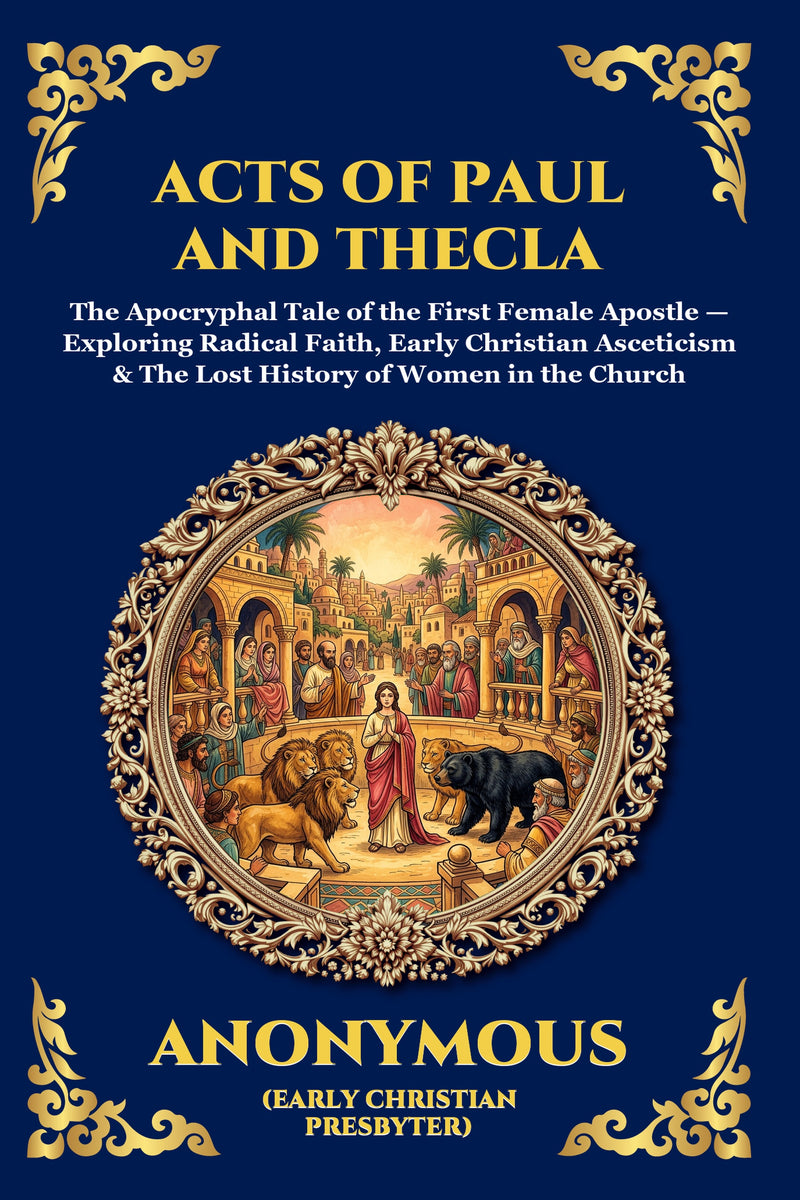
Acts of Paul and Thecla — Large Print
A second-century text, Acts of Paul and Thecla reveals the dramatic life of Thecla, a young woman who defied societal norms to follow the Apostle Paul. Excluded from the Bible, her story sheds light on early Christian women whose courage and faith reshaped their world.
or free app
10,000+ hrs library
30-day guarantee
Get the complete Acts of Paul and Thecla in readable modern English online with audiobook narration included, this 2nd-century text mentioned by Tertullian around 200 AD.
Large Print Edition. The complete, unabridged text set in a larger, easy-on-the-eyes typeface for comfortable reading.
Have you ever wondered why the powerful stories of early female Christian leaders were left out of the standard biblical canon?
The Acts of Paul and Thecla offers a breathtaking window into the lost history of women in the early church. Written in the second century, this apocryphal narrative captures the intense spiritual fervor and radical asceticism that defined the early Christian movement. It follows the dramatic life of Thecla, a young virgin from Iconium who, upon hearing the Apostle Paul preach, renounces her privileged life, her fiancé, and her family to embrace a life of chastity and devotion to God.
Her defiance sets off a chain of harrowing trials. Condemned to burn at the stake and later thrown to wild beasts in the arena, Thecla is miraculously saved by divine intervention time and time again. She ultimately baptizes herself and is commissioned by Paul to teach the gospel, becoming a legendary figure of female apostolic authority in a deeply patriarchal world.
This modern translation brings Thecla’s incredible journey to life. It explores the tension between early Christian ideals and Roman societal norms, particularly regarding women's roles, marriage, and independence. For centuries, Thecla served as an icon of female empowerment and radical faith, inspiring countless women in antiquity to pursue spiritual leadership and cast off the constraints of their time.
What You’ll Discover in This Book:
The Story of the First Female Apostle Follow Thecla’s awe-inspiring journey from a constrained noblewoman to a fiercely independent teacher of the gospel.
Radical Faith and Asceticism Explore the early Christian emphasis on chastity, spiritual purity, and the rejection of worldly expectations.
Miraculous Survival and Divine Intervention Read the gripping accounts of Thecla facing the fire and the arena, demonstrating the power of unwavering belief.
The Lost History of Women in the Church Gain a deeper understanding of the prominent roles women played in spreading the early Christian message before later institutional suppression.
Whether you are a student of early Christianity, a reader of women's history, or someone drawn to heroic tales of faith, The Acts of Paul and Thecla is an essential and inspiring read. Uncover the legendary story of a woman who defied an empire for her faith. Begin your journey today.
| Formats | eBook (EPUB + PDF) · Audiobook · Paperback · Hardcover · Large Print |
| Language | English |
| Trim size (print) | 6 × 9 in |
| Binding | Paperback — perfect-bound · Hardcover — casewrap |
| Large Print edition | Same text in a larger, easy-read type — a larger font, not a larger trim |
| Print pricing | Every physical book at our true cost — at-cost, no profit (members) |
| Library | 873 restored titles, always growing |
| Composed | 2nd century AD |
| Original language | Greek |
| Source tradition | Greek manuscript tradition with versions in Latin, Coptic, and other ancient languages |
| Translation basis | Public-domain scholarly translation, rendered in clear modern English |
| Length | 4,565 words · ~18 min reading |
| Reading level | Grade 8 · clear and comfortable (this modern-English edition) |
| Edition | Modern English translation · 2026 |
Member reviews for this edition are collected as readers finish it — be the first. Across the library: 12,000+ books shipped, every plan covered by a 365-day print guarantee.
About this edition
The complete, unabridged text in clear modern English — faithful to the original, never simplified. Every paragraph is checked against the source, so nothing is cut, summarised, or paraphrased away. It reads cleanly for today while keeping the original meaning intact.
The Acts of Paul and Thecla survives primarily through Greek manuscripts and later translations into Latin, Coptic, and other languages. This edition derives from the standard public-domain scholarly translation and renders it in clear modern English.
- Complete & unabridgedVerified paragraph by paragraph against the source — never a scan, never abridged.
- Modern English, faithfulReadable today, with the author’s meaning kept intact. Readable — not simplified.
- Every format, one membershipRead in your browser or the free app, or listen to the full audiobook.
Included free with your membership
Cancel anytime, one click · 30-day money-back guarantee
Edition last updated June 2026
What’s inside
Acts of Paul and Thecla — Large Print — complete and unabridged: all 11 sections included with membership, plus the full audiobook.
Begin reading Acts of Paul and Thecla — Large Print
In clear modern English — the complete text is included with membership.
Chapter 1
When Paul went up to Iconium after fleeing from Antioch, two men traveled with him: Demas and Hermogenes the coppersmith, both full of hypocrisy, who flattered Paul as though they loved him. But Paul, looking only to the goodness of Christ, did them no harm and loved them well, so that he tried to make sweet to them all the words of the Lord — the teaching and interpretation of the Gospel, the birth and resurrection of the Beloved — and told them word by word of the great works of Christ, how they had been revealed to him, and how Christ was born of the virgin Mary, of the seed of David.
A certain man named Onesiphorus, hearing that Paul had come to Iconium, went out with his children Simmias and Zeno and his wife Lectra to meet him, intending to receive him into his house. Titus had described to him what Paul looked like in appearance, for Onesiphorus had not seen him in the flesh, only in the spirit.
He went along the royal road that leads to Lystra and stood there waiting, watching all who came, measuring them against the description Titus had given. And he saw Paul approaching: a man small in stature, with thinning hair, bowed legs, a vigorous body, eyebrows that met in the middle, and a nose somewhat hooked — yet full of grace, for sometimes he appeared simply as a man, and sometimes his face was like the face of an angel.
When Paul saw Onesiphorus he smiled, and Onesiphorus said: Greetings, servant of the blessed God. And Paul said: Grace be with you and with your house. But Demas and Hermogenes grew envious and stirred up their hypocrisy all the more, so that Demas said: Are we not also servants of the Blessed? Why did you not greet us the same way? And Onesiphorus said: I see no fruit of righteousness in you — but if you are such men, come into my house as well and refresh yourselves.
When Paul entered the house of Onesiphorus there was great joy, and kneeling in prayer, and breaking of bread, and the word of God concerning self-restraint and continence and the resurrection. For Paul said:
Blessed are the pure in heart, for they shall see God.
Chapter 2
Blessed are they who keep the flesh chaste, for they shall become the temple of God.
Blessed are the continent, for God shall speak to them.
Blessed are they who have renounced this world, for they shall be well-pleasing to God.
Blessed are they who have wives as though they had none, for they shall inherit God.
Blessed are they who have the fear of God, for they shall become angels of God.
Blessed are they who tremble at the word of God, for they shall be comforted.
Chapter 3
Blessed are those who receive the wisdom of Jesus Christ, for they shall be called sons of the Most High.
Blessed are those who have kept their baptism pure, for they shall rest with the Father and with the Son.
Blessed are those who have come to understand Jesus Christ, for they shall dwell in light.
Blessed are those who for love of God have turned away from the ways of this world, for they shall judge angels and shall be blessed at the right hand of the Father.
Blessed are the merciful, for they shall obtain mercy and shall not see the bitter day of judgment. Blessed are the bodies of the virgins, for they shall be well-pleasing to God and shall not lose the reward of their chastity, for the word of the Father shall be their salvation in the day of his Son, and they shall have rest without end.
While Paul was saying these things in the midst of the congregation gathered in the house of Onesiphorus, a certain virgin named Thecla — whose mother was Theocleia, and who was betrothed to a man named Thamyris — sat at a nearby window and listened night and day to Paul's teaching about chastity. She did not stir from the window, but was drawn ever forward by faith, filled with great joy. And when she saw many women and virgins going in to Paul, she longed earnestly to be counted worthy to stand before him and hear the word of Christ for herself; for she had not yet seen Paul's face, but had only heard his voice.
Chapter 4
Now when Thecla still would not move from the window, her mother sent for Thamyris, and he came with great joy, as though he were already about to take her as his wife. Thamyris said to Theocleia: Where is my Thecla? And Theocleia said: I have a strange new thing to tell you, Thamyris. For three days and three nights Thecla has not stirred from the window, neither to eat nor to drink, but gazes out as though fixed upon some joyful sight, and gives all her attention to a stranger who teaches deceptive and bewildering words. I marvel that the great modesty of the girl is so sorely besieged.
O Thamyris, this man is upsetting the whole city of Iconium, and your Thecla along with it — for all the women and the young men go in to him and are taught by him. He says that there is only one God, whom all must fear, and that all must live in chastity. And my daughter too, like a spider at the window, is bound fast by his words, seized by a new longing and a fearful passion. She hangs on everything he says, and the girl is utterly captivated. Go to her and speak with her, for she is betrothed to you.
So Thamyris went to her, loving her and yet troubled by her strange, entranced state, and said: Thecla, my betrothed, why do you sit like this? What is this passion that holds you spellbound? Turn to your Thamyris and be ashamed. Her mother said the same: Thecla, why do you sit there looking down, answering nothing, like one who has been struck? And they wept bitterly — Thamyris because he was losing a wife, Theocleia because she was losing a daughter, and the maidservants because they were losing a mistress. The whole house was filled with grief and confusion. Yet through all of this Thecla did not turn away, but kept her attention fixed on the words of Paul.
Then Thamyris sprang up and went out into the street and watched those who went in to Paul and came out again. He saw two men arguing fiercely with each other and said to them: You men, tell me who you are, and who is this man inside with you who leads the souls of young men and maidens astray, persuading them that there should be no marriages and that they should remain as they are. I promise to give you a great sum of money if you will tell me about him, for I am a leading man of this city.
Demas and Hermogenes answered him: We do not know who this man is, but he robs young men of their wives and maidens of their husbands, saying: There is no resurrection for you unless you remain chaste and do not defile the flesh but keep it pure.
Thamyris said to them: Come, men, into my house and refresh yourselves with me. They went in to a lavish banquet, with abundant wine and rich food and a splendid table. Thamyris plied them with drink, for he loved Thecla and was determined to have her as his wife. And at dinner Thamyris said: Tell me, men, what exactly is his teaching, so that I too may understand it — for I am greatly distressed on account of Thecla, because she is so devoted to this stranger, and I am being cheated of my marriage.
Chapter 5
And Demas and Hermogenes said: "Bring him before Castelius the governor as one who is leading the crowds astray with this new Christian doctrine. That way he will destroy him, and you will have your wife Thecla back. And we will explain to you the resurrection he speaks of — we teach that it has already taken place in our children, and that we rise again when we come to the knowledge of the true God."
When Thamyris heard this from them, he was filled with envy and rage. He rose early and went to the house of Onesiphorus with the magistrates, officers, and a great crowd carrying staves, and said to Paul: "You have destroyed the city of the Iconians, and you have destroyed the woman who was betrothed to me, so that she will not have me. Let us go before Castelius the governor." And all the crowd cried out: "Away with the sorcerer! He has corrupted all our wives." And the whole multitude rose up against him.
Thamyris, standing before the judgment seat, cried out: "Proconsul, this man — we do not know where he comes from — forbids maidens to marry. Let him declare before you why he teaches such things." And Demas and Hermogenes said to Thamyris: "Say that he is a Christian, and that way you will destroy him." But the governor held his mind steady and summoned Paul, saying to him: "Who are you, and what do you teach? For the accusation these men bring against you is no small matter."
And Paul lifted up his voice and said: "If I am to be examined today about what I teach, then listen, Proconsul. The living God — the God of vengeance, the jealous God, the God who has need of nothing but desires the salvation of men — has sent me to turn them away from corruption and uncleanness and all pleasure that leads to death, so that they may sin no more. For this reason God sent his own Child, whom I proclaim and teach, so that men may place their hope in him who alone has had compassion on a world lost in error — so that men may no longer stand under judgment, but may have faith and the fear of God and the knowledge of self-restraint and the love of truth. If then I teach the things that have been revealed to me by God, what wrong have I done, Proconsul?" When the governor had heard this, he ordered Paul to be bound and taken away to prison until he should have time to hear him more carefully.
But Thecla, in the night, took off her bracelets and gave them to the doorkeeper, and when the door was opened for her she went to the prison and gave the jailer a silver mirror, and so made her way in to Paul and sat at his feet and listened to him speak of the wonderful works of God. And Paul had no fear at all, but walked in full confidence in God. And her own faith grew stronger as she kissed his chains.
Chapter 6
Now when Thecla was sought by her own people and by Thamyris, she was looked for through the streets as one lost. One of the fellow-servants of the doorkeeper reported that she had gone out by night. They questioned the doorkeeper, and he told them she had gone to the stranger in the prison. They went as he directed and found her there, bound to Paul as it were in affection. They left at once, gathered a crowd, and brought the matter before the governor.
The governor ordered Paul to be brought to the judgment seat. But Thecla threw herself down upon the place where Paul had taught when he sat in the prison. The governor ordered her brought to the judgment seat as well, and she went exulting with joy. When Paul was brought in a second time, the crowd cried out more fiercely: "He is a sorcerer — away with him!" But the governor listened to Paul gladly as he spoke of the holy works of Christ, and took counsel with himself. Then he called Thecla and said, "Why will you not marry Thamyris, according to the law of the Iconians?" But she stood gazing intently at Paul and made no answer. Then her mother Theocleia cried out: "Burn the lawless one! Burn her who refuses to be a bride, in the midst of the theatre, so that all the women who have been taught by this man may be struck with fear."
The governor was greatly moved. He had Paul scourged and driven out of the city, and condemned Thecla to be burned. Straightway the governor rose and went to the theatre, and all the multitude poured out to witness the dreadful spectacle. But Thecla, as a lamb in the wilderness looks about for the shepherd, so looked about for Paul. She gazed out over the crowd and saw the Lord sitting there, in the likeness of Paul, and said, "As though I could not endure it, Paul has come to look upon me." She fixed her eyes on him intently, but he departed into the heavens.
The boys and the maidens brought wood and hay to burn Thecla. When she was brought in naked, the governor wept and marveled at the power that was in her. They laid the wood, and the executioner commanded her to mount the pyre. She made the sign of the cross and climbed up upon the wood. They set it alight, and though a great fire blazed up, it took no hold on her. For God had compassion on her: a rumbling sounded beneath the earth, and a cloud heavy with rain and hail overshadowed her from above, and all its contents poured down so that many were in danger of their lives. The fire was quenched, and Thecla was saved.
Cancel anytime, one click · 30-day money-back guarantee
Founding annual rate available now — your price locks for life when you join.
Not ready? Get this free chapter by email — read it anytime.
✓ Sent — check your inbox for Acts of Paul and Thecla — Large Print.
Questions about Acts of Paul and Thecla — Large Print
Why was the Acts of Paul and Thecla excluded from the biblical canon?
The Acts of Paul and Thecla was excluded from the biblical canon partly due to concerns about its authorship and its portrayal of women in leadership roles that challenged contemporary church practices and social norms.
Who actually wrote the Acts of Paul and Thecla?
According to Tertullian, the Acts of Paul and Thecla was written by an unnamed presbyter in Asia Minor around 190 AD who composed it out of love for Paul, though he was removed from office for doing so.
What is the main story told in the Acts of Paul and Thecla?
The Acts of Paul and Thecla tells of a young woman named Thecla who converts to Christianity after hearing Paul preach, breaks her engagement, faces persecution including attempted execution, and becomes an evangelist herself.
Is Acts of Paul and Thecla free to read?
The opening of the text is free to read below. Members read and listen to the complete work — and the entire Lost & Forbidden Library — free.
What is Acts of Paul and Thecla?
Have you ever wondered why the powerful stories of early female Christian leaders were left out of the standard biblical canon? The Acts of Paul and Thecla offers a breathtaking window into the lost history of women in the early church.
How long is Acts of Paul and Thecla?
11 chapters (~4,590 words) in this restored edition.
Shipping & returns
Billing & membership
More from the library


Explore Enoch & Pseudepigrapha
- Apocalypse of Daniel
- Apocalypse of Shenoute · Attributed to Shenoute the Arch...
- 2 Enoch · Attributed to Enoch
- Apocalypse of Pseudo-Ephraem · Attributed to Ephraem the Syrian
- Ethiopic Meqabyan I–III
- The Conflict of Adam and Eve with Satan
- Genesis Apocryphon
- Community Rule · Attributed to the Qumran community
- War Scroll · Attributed to the Qumran community
- 2 Esdras · Attributed to the prophet Ezra
- Book of Jasher
- Acts of Barnabas · Attributed to John Mark
- Acts of Paul and Thecla · Attributed to Onesiphorus
- Greek Apocalypse of Daniel
- Sibylline Oracles · Various early Christian and Jew...
- Epistle to the Alexandrians
- Apocalypse of Paul · Attributed to the Apostle Paul
- Apocalypse of Moses · Attributed to early Jewish scribes
- Testament of Solomon · Attributed to King Solomon
- Book of Giants · Attributed to Mani
- Baruch · Attributed to Baruch
- The Forgotten Books of Eden · Various early Christian and Jew...
- Fragments of a Zadokite Work · Attributed to the Zadokite comm...
- Chronicles of Jerahmeel · Attributed to Jerahmeel ben Sol...
- Biblical Antiquities of Pseudo-Philo
- Testamentum Domini · Attributed to the early Church ...
- Apocalypse of Bartholomew · Attributed to the Apostle Barth...
- Vision of Esdras · Attributed to the prophet Ezra
- Cave of Treasures · Attributed to Ephrem the Syrian
- Correspondence of Paul and Seneca · Attributed to Paul the Apostle
Acts of Paul and Thecla — Large Print
The Acts of Paul and Thecla
The Virgin Who Defied the Fire and the Beasts — Thecla of Iconium Hears Paul's Gospel of Chastity, Is Condemned to the Flames and Saved by the Storm, Throws Herself into the Pool of Seals to Baptize Herself Among the Wild Beasts, and Goes Forth to Enlighten Many at Seleucia (the Famous Standalone Acts from the Acts of Paul)
Library of Alexandria Press
The Acts of Paul and Thecla
© Copyright 2026 Library of Alexandria Press. All rights reserved.
Published by Library of Alexandria Press
Printed in the United States of America
It is not legal to copy, share, or send any part of this document in either digital or printed form without written permission from the publisher, except short quotes in a book review.
Table of Contents
Introduction
Chapter 1
Chapter 2
Chapter 3
Chapter 4
Chapter 5
Chapter 6
Chapter 7
Chapter 8
Chapter 9
Chapter 10
Introduction
Somewhere in the second century of the Common Era, a story began to circulate among Christian communities scattered across Asia Minor, Egypt, Syria, and eventually the wider Mediterranean world. It was not a gospel, not an epistle, not a formal theological treatise. It was something stranger and more alive than any of those — a narrative that moved with the urgency of legend and the intimacy of biography, following a young woman named Thecla from the window of her family home in Iconium to the arenas, the wilderness, and the courts of powerful men and women who would alternately seek to destroy her and be transformed by her. For centuries this story was read aloud in churches, copied by devoted hands, translated into a dozen languages, and treasured by ordinary believers who found in its heroine something the official canon of scripture rarely offered them: a woman who acted, who chose, who suffered, who survived, and who taught.
The text you are about to read is one of the most important and most neglected documents in the entire history of Christianity. Its importance is not merely historical, though the historical dimensions are staggering. It speaks directly to questions that remain urgently alive in our own moment — questions about the authority of women in religious communities, about the relationship between bodily autonomy and spiritual calling, about what it means to follow a teacher whose demands conflict with every social obligation your culture has imposed upon you. Thecla's story is ancient, but it has never stopped being contemporary. Every generation that has encountered it has recognized something in it that feels immediate, even dangerous, even necessary.
To understand why this text matters, it helps to understand something about the world in which it emerged and the world in which it was eventually suppressed, marginalized, and finally rediscovered. The second century was a period of extraordinary ferment within the movement that would eventually call itself Christianity. The boundaries of belief, practice, and authority were not yet fixed. Communities disagreed about which texts were sacred, which leaders were legitimate, which practices were required, and which were forbidden. Women prophesied, taught, baptized, and led congregations in some communities; in others, they were already being told to be silent and to learn from their husbands at home. The question of who could speak for God, and in what contexts, was genuinely open in a way that it would not remain for long.
It was into this ferment that the story of Thecla arrived, and it arrived with a kind of theological audacity that must have taken some readers' breath away. Here was a narrative that placed a young woman at the center of the apostolic mission, that showed her receiving a calling directly from God, that depicted her performing a self-baptism in a moment of supreme crisis, and that ended — in the version most scholars consider original — with her receiving a commission to go and teach the word of God. This was not a marginal figure, not a supporting character, not a woman whose virtue was demonstrated by her silence and submission. This was an apostle.
The Greek term used in the earliest manuscripts is unambiguous: Thecla is called an apostle of God. This designation was not accidental, and it was not metaphorical. It was a direct claim about spiritual authority, about the legitimacy of women's leadership in the earliest Christian communities, and about the nature of the apostolic mission itself. That claim would prove enormously controversial. It would be celebrated in some quarters and condemned in others. It would be cited by women who sought to preach and teach, and it would be attacked by men who sought to prevent them from doing so. The history of the text's reception is, in miniature, the history of the struggle over women's roles in Christianity — a struggle that has never fully concluded.
What makes this story so enduring, however, is not only its theological significance. It is also, quite simply, a remarkable piece of storytelling. Thecla herself is one of the most vivid and fully realized characters in all of early Christian literature. She is young and beautiful, as heroines in ancient narratives typically are, but she is also courageous, resourceful, intellectually serious, and possessed of a will that bends before no human authority, however terrifying. She faces lions and bears and fire and the lust of powerful men. She leaps into a pool of water in the middle of an arena. She disguises herself as a man to travel safely through dangerous territory. She encounters the apostle Paul repeatedly, and their relationship — complex, sometimes frustrating, always spiritually charged — is one of the great relationships in early Christian literature, full of tension and tenderness and mutual misunderstanding.
Paul himself, in this narrative, is a more complicated figure than the triumphant apostle of the canonical letters. He is inspiring and transformative, but he is also sometimes hesitant, sometimes fearful, sometimes uncertain what to do with the extraordinary woman his preaching has unleashed upon the world. The dynamic between them is not one of simple discipleship. Thecla is not merely following Paul; she is, in many respects, surpassing him — enduring trials he does not face, performing acts of faith he does not perform, and ultimately receiving a commission that is in no way dependent on his approval. This complexity is part of what makes the narrative so theologically rich and so historically significant.
Before you enter the story itself, it is worth pausing to consider the circumstances of its composition and transmission, the debates it provoked in antiquity, and the long, strange journey by which it has arrived in your hands. That journey is itself a kind of story — one about the politics of canon formation, the survival of suppressed texts, and the persistent human need to find in sacred narrative a reflection of one's own experience and one's own deepest questions.
A Text Born in Controversy
The narrative of Thecla forms the central and most substantial portion of a larger collection known as the Acts of Paul, a text that also includes accounts of Paul's travels, his correspondence with the Corinthian community, and a dramatic account of his martyrdom in Rome. The Acts of Paul as a whole is generally dated to the late second century, with most scholars placing its composition somewhere between 160 and 190 CE. The earliest external reference to it comes from Tertullian, the North African theologian writing around the turn of the third century, and what Tertullian says about it is revealing in ways that go far beyond mere chronology.
Tertullian was furious. He knew the text, he knew it was widely read and widely loved, and he knew that women were using it to justify their right to teach and to baptize. In his treatise on baptism, he dismissed the Acts of Paul as a forgery, noting that a presbyter in Asia had confessed to writing it out of love for Paul. The presbyter, Tertullian reported, had been removed from his office as a consequence. This anecdote, whatever its historical accuracy, tells us several important things. First, the text was already circulating widely enough by Tertullian's time to be a matter of serious concern to church authorities. Second, it was being used by women as a theological argument for their right to perform sacramental acts. Third, the official response was not to engage with the theological argument but to discredit the text by questioning its origins.
This strategy — attacking the legitimacy of a text rather than addressing its theological content — would be repeated many times in the centuries that followed. The Acts of Paul was gradually excluded from the emerging Christian canon, though the process was neither swift nor uniform. In many communities, particularly in the East, the text continued to be read and revered long after it had been officially marginalized in the West. The story of Thecla in particular took on a life entirely independent of the larger collection in which it originally appeared, circulating as a standalone narrative, generating a rich body of commentary and hagiography, and inspiring the founding of churches, pilgrimage sites, and monastic communities across the Eastern Mediterranean.
The great church father Basil of Seleucia wrote a versified account of Thecla's life in the fifth century. A substantial shrine complex grew up at Meriamlik, near the ancient city of Seleucia in what is now southern Turkey, drawing pilgrims from across the Christian world. Gregory of Nyssa, one of the most sophisticated theologians of the fourth century, mentions Thecla in terms that suggest she was regarded as a figure of the highest spiritual authority. The pilgrim Egeria, writing her famous travel diary in the late fourth century, describes visiting the shrine at Seleucia with evident reverence. For centuries, in other words, Thecla was not a marginal or forgotten figure but a central one — a saint of the first rank, venerated across the Christian world, her story known and loved by millions.
And yet the theological implications of her story — particularly the implications for women's authority — were consistently managed, minimized, and eventually suppressed. The later hagiographical tradition tended to emphasize Thecla's virginity and her miraculous preservation from sexual violence, transforming her from an active apostolic figure into a passive icon of chastity. The commission she receives at the end of the earliest narrative — go and teach — was quietly dropped from many later versions, replaced by an account of her miraculous disappearance into a rock, safely removed from the world and its controversies. The apostle became a saint; the teacher became a symbol; the woman who acted became a woman who was acted upon.
This transformation is not incidental. It is the central interpretive event in the text's long reception history, and understanding it is essential to reading the narrative with clear eyes. What you will encounter in the pages that follow is not the domesticated Thecla of later hagiography but the original, unmanaged figure — the one who makes radical choices, who challenges every authority that claims power over her body and her vocation, and who ultimately receives a divine commission that no human institution can revoke. To read this text in its earliest form is to encounter something that the subsequent tradition worked very hard to obscure.
The question of the text's authorship and origins has occupied scholars for well over a century, and the debates remain lively and unresolved. Tertullian's claim that a single presbyter wrote the Acts of Paul out of personal devotion to the apostle is almost certainly an oversimplification, if not an outright fabrication designed to discredit a text that was causing institutional discomfort. Most contemporary scholars believe the Acts of Paul drew on earlier oral traditions and possibly written sources that were already circulating in Christian communities in Asia Minor. The Thecla narrative in particular shows signs of having roots in traditions that predate the second-century compilation — traditions that may have been maintained and transmitted by the very communities of ascetic women whose practices the narrative was later used to justify.
This possibility — that the story of Thecla was not invented by a single male author but preserved and shaped by communities of women who found in it a reflection of their own spiritual experience — has profound implications for how we read the text. It means that we may be encountering, in however mediated a form, something of the self-understanding of early Christian women who chose lives of celibacy and itinerant ministry, who understood themselves as standing in a tradition that went back to the apostolic generation, and who used narrative as a way of making theological claims that more formal genres would not have permitted them to make. The story is, on this reading, not merely about women's authority; it is itself an exercise of women's authority, a piece of theological work performed through the medium of storytelling.
The manuscript tradition of the text is complex and fascinating. The Acts of Paul as a whole survives in fragmentary form in Greek, with important witnesses in Coptic, Latin, Syriac, and other languages. The Thecla narrative has an especially rich manuscript tradition, reflecting its independent circulation and its enormous popularity across the Christian world. Scholars have worked painstakingly to reconstruct the earliest recoverable form of the text, and while certainty is impossible, the broad outlines of the original narrative are reasonably clear. The translation you are reading has been prepared with careful attention to this scholarly work, aiming to give you access to the earliest and most theologically complete version of the story — the one that made Tertullian angry, that inspired generations of women to claim apostolic authority, and that the institutional church found it necessary to contain and eventually to marginalize.
Why Thecla Still Matters
It would be a mistake to read this text as merely a historical curiosity, a window into the strange beliefs of a distant and superseded world. The questions it raises are not historical questions. They are alive questions, pressing questions, questions that anyone who has ever struggled with the relationship between institutional authority and personal calling, between social obligation and spiritual vocation, between the body and the spirit, will recognize immediately as their own.
Consider what Thecla actually does at the beginning of the narrative. She hears a voice — Paul's voice, speaking through a wall — and she is transfixed. She sits at her window for days, listening, unable to eat or sleep or attend to the ordinary business of her life. Her mother is alarmed. Her fiancé is bewildered and then furious. The social world around her — the world of family obligation, of betrothal, of the carefully managed transitions from daughter to wife to mother that constituted a respectable woman's life in the ancient Mediterranean — begins to crack and crumble beneath the force of what she is hearing. And what she is hearing is not, primarily, a set of doctrinal propositions. It is a vision of a different way of being human, a way organized around a different set of ultimate loyalties.
This experience — the experience of hearing something that reorganizes your entire sense of what your life is for, and then facing the social consequences of taking that hearing seriously — is not specific to the second century. It is one of the permanent features of religious experience, and the social pressures that Thecla faces are recognizable in any era. The family that cannot understand why you would abandon a secure future for an uncertain calling. The community that interprets your refusal of its norms as a personal insult or a dangerous example. The authorities who find your independence threatening and seek to manage or punish it. These are not ancient problems. They are perennial ones.
The text's treatment of the body is particularly striking and particularly relevant to contemporary readers. Thecla's body is, from the very beginning of the narrative, a site of contest. Her fiancé wants it as property. The men who desire her want it as an object of pleasure. The authorities who prosecute her want to use it as a site of punishment and spectacle. The narrative is brutally clear-eyed about the ways in which women's bodies are claimed, controlled, and violated by the social and political structures that surround them. But it is equally clear that Thecla's body belongs to none of these claimants. It belongs, in her own understanding, to God — and this theological claim becomes the basis for a radical refusal of every other claim upon her.
This is not a simple or untroubled position, and the narrative does not present it as such. The asceticism that Thecla embraces — the renunciation of marriage, of sexuality, of the domestic life that her culture regards as the natural destiny of women — is presented as a genuine spiritual calling, not as a neurotic flight from life or a simple rejection of the body. The body, in this text, is not evil. It is the site of Thecla's most dramatic encounters with divine power, the arena in which her faith is tested and confirmed. When she leaps into the water in the arena, performing her own baptism in the face of death, she is not escaping the body; she is using it as an instrument of the most profound spiritual act available to her. When she endures fire and wild animals and the violence of the arena, her body is not destroyed but preserved — not because it is unimportant but because it has been claimed for a purpose that transcends the purposes her society has assigned to it.
The relationship between Thecla and Paul deserves particular attention from contemporary readers, because it is easy to misread in ways that flatten its complexity. Paul is not simply a hero in this narrative, and Thecla is not simply his devoted follower. Their relationship is characterized by a genuine and sometimes painful asymmetry. Paul's preaching transforms Thecla's life, and she follows him with a devotion that is clearly modeled on the devotion of the disciples to Jesus in the canonical gospels. But Paul is also, at several crucial moments, unable or unwilling to help her. He does not intervene when she is condemned. He sends her away when she comes to him after her first ordeal. He is, in some respects, a figure of limitation as well as inspiration — a human teacher whose greatness is real but whose authority over Thecla's ultimate calling is strictly circumscribed.
This portrayal of Paul is theologically significant. The narrative is not anti-Pauline; it draws deeply on Pauline themes, particularly the themes of the new creation, the irrelevance of social distinctions before God, and the priority of the Spirit over the letter. But it refuses to make Paul the final authority over Thecla's vocation. That authority belongs to God alone, and the narrative is careful to show that Thecla's most important acts — her self-baptism, her decision to go and teach — are taken on divine authority, not on Paul's instruction or permission. In this sense, the text is making a subtle but powerful theological argument: the apostolic mission is not the exclusive property of any human institution or any class of human beings. It is given by God, and God gives it to whom God chooses.
For readers who come to this text from within a Christian tradition, this argument will resonate with debates that have never been fully resolved about the nature of ordination, the sources of ministerial authority, and the relationship between institutional structures and the movement of the Spirit. For readers who come to it from outside any religious tradition, the argument has a broader resonance: it is a claim about the irreducibility of individual conscience and vocation, about the limits of any institution's claim upon the lives of its members, about the courage required to follow a calling that your community does not recognize or sanction.
The text also has important things to say about friendship, solidarity, and the communities that form around shared values and shared risk. Thecla does not travel through her story alone. She encounters women who shelter her, protect her, and stand with her in moments of extreme danger. The queen Tryphaena, who takes Thecla into her household and mourns for her as for a daughter, is one of the most moving figures in the narrative — a powerful woman who uses her position to protect a vulnerable one, and who is herself transformed by the encounter. These relationships between women — relationships of mutual protection, spiritual solidarity, and genuine affection — are among the most historically significant aspects of the text, offering a glimpse into the networks of women that sustained the early Christian movement in ways that the canonical texts rarely acknowledge.
It is worth saying something, finally, about the experience of reading ancient texts in general and this text in particular. We are separated from the world of Thecla and Paul by nearly two thousand years, by vast differences of culture, language, social organization, and cosmological assumption. The world the narrative inhabits is not our world. Its assumptions about divine intervention, about the nature of the body, about the relationship between this life and the next, are not our assumptions — or at least, they are not the assumptions of the dominant secular culture in which most contemporary readers live. There is a real danger, in reading ancient texts, of either projecting our own concerns onto them in ways that distort their meaning, or of treating their strangeness as a barrier that makes genuine engagement impossible.
The best approach, in the editor's view, is neither of these. It is to read with a kind of double attention — attending carefully to what the text actually says in its own terms, in its own cultural and theological context, while remaining alert to the moments when it speaks across that context to something that feels immediate and recognizable. This text rewards that kind of double attention more richly than almost any other document from the early Christian period. It is strange enough to challenge every assumption you bring to it, and familiar enough to make you feel, at certain moments, that you are reading about someone you know.
Thecla herself is the best argument for reading this text. She is not a symbol or an allegory or a theological proposition in human form. She is a character — complex, courageous, sometimes frightened, sometimes exhilarated, always fully alive to the stakes of what she is doing and the cost of what she has chosen. To spend time with her is to be reminded that the questions she faced — about faith and freedom, about the body and the spirit, about the claims of community and the claims of conscience — are not questions that any generation has definitively answered. They are questions that each generation must face for itself, in its own circumstances, with whatever resources of courage and wisdom it can muster.
The story that follows is one of those resources. It has sustained and challenged and inspired readers for nearly two thousand years. It has been used to justify women's leadership and to celebrate the courage of those who follow their calling against every social pressure to conform. It has been suppressed and marginalized and rediscovered, again and again, by people who needed it. Now it is yours. Read it carefully. Read it generously. Read it with the willingness to be surprised, disturbed, and moved. And when you have finished it, consider the possibility that the woman at the window, listening to a voice that is reorganizing her entire sense of what her life is for, is not entirely unlike yourself.
The Acts of Paul and Thecla
Chapter 1
When Paul went up to Iconium after fleeing from Antioch, two men traveled with him: Demas and Hermogenes the coppersmith, both full of hypocrisy, who flattered Paul as though they loved him. But Paul, looking only to the goodness of Christ, did them no harm and loved them well, so that he tried to make sweet to them all the words of the Lord — the teaching and interpretation of the Gospel, the birth and resurrection of the Beloved — and told them word by word of the great works of Christ, how they had been revealed to him, and how Christ was born of the virgin Mary, of the seed of David.
A certain man named Onesiphorus, hearing that Paul had come to Iconium, went out with his children Simmias and Zeno and his wife Lectra to meet him, intending to receive him into his house. Titus had described to him what Paul looked like in appearance, for Onesiphorus had not seen him in the flesh, only in the spirit.
He went along the royal road that leads to Lystra and stood there waiting, watching all who came, measuring them against the description Titus had given. And he saw Paul approaching: a man small in stature, with thinning hair, bowed legs, a vigorous body, eyebrows that met in the middle, and a nose somewhat hooked — yet full of grace, for sometimes he appeared simply as a man, and sometimes his face was like the face of an angel.
When Paul saw Onesiphorus he smiled, and Onesiphorus said: Greetings, servant of the blessed God. And Paul said: Grace be with you and with your house. But Demas and Hermogenes grew envious and stirred up their hypocrisy all the more, so that Demas said: Are we not also servants of the Blessed? Why did you not greet us the same way? And Onesiphorus said: I see no fruit of righteousness in you — but if you are such men, come into my house as well and refresh yourselves.
When Paul entered the house of Onesiphorus there was great joy, and kneeling in prayer, and breaking of bread, and the word of God concerning self-restraint and continence and the resurrection. For Paul said:
Blessed are the pure in heart, for they shall see God.
End of the free sample
Keep reading, free
Members read and listen to the complete book — and the entire library. Cancel anytime, one click · 30-day money-back guarantee.