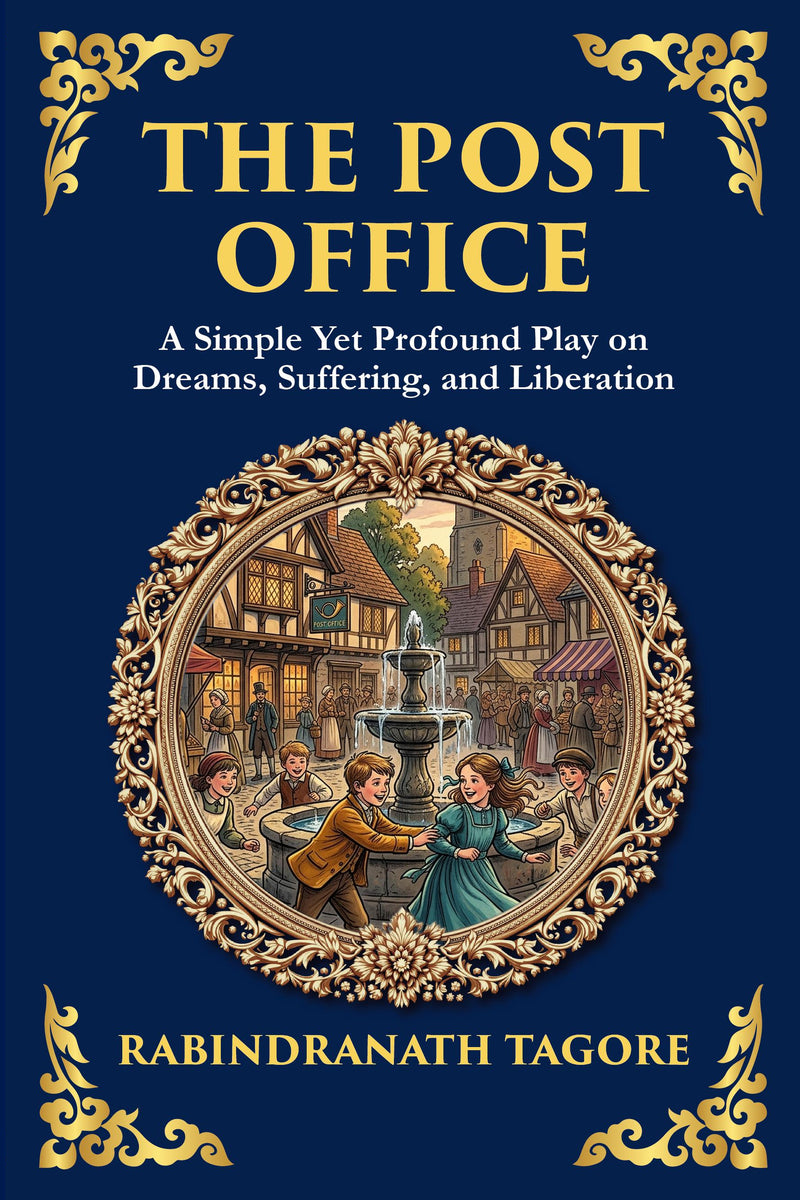
The Post Office — Large Print
In The Post Office, Nobel laureate Rabindranath Tagore crafts a moving one-act play about a sick boy confined to his room, who dreams of freedom, connection, and the mysterious arrival of a letter from the king.
or free app
10,000+ hrs library
30-day guarantee
The complete The Post Office appears in modern English through Library of Alexandria Press, available online with audiobook narration included for members.
Have you ever wondered why the longing for freedom stirs so deeply in the human heart? The Post Office by Rabindranath Tagore is one of the most moving and spiritually resonant plays of modern literature. Written with rare sensitivity and poetic grace, this one-act drama tells the story of Amal, a gravely ill child confined indoors, whose imagination soars far beyond the walls of his room.
As he watches the world from his window and listens to the voices of villagers passing by, Amal dreams of receiving a letter from the king—a symbol of the infinite, the divine, or perhaps, release from earthly suffering. Though his physical world is limited, his spirit is boundless. Through gentle interactions with villagers, a watchman, and his adoptive father, Tagore paints a world of kindness, hope, and a longing for transcendence.
What you’ll discover in this modern edition
- A Masterful Allegory of the Human Spirit Amal’s yearning reflects a universal desire for connection, meaning, and liberation from suffering.
- Poetry and Compassion Intertwined Tagore’s lyrical prose infuses each moment with spiritual warmth and philosophical depth.
- A Meditation on Mortality and Grace The play’s quiet beauty leads toward an ending that is both heart-wrenching and spiritually uplifting.
- A Story That Crosses Cultures and Generations Celebrated around the world, The Post Office has been interpreted in times of war, illness, and reflection.
- A Thought-Provoking Reading Experience Ideal for lovers of spiritual literature, minimalist drama, and symbolic storytelling.
| Formats | eBook (EPUB + PDF) · Audiobook · Paperback · Hardcover · Large Print |
| Language | English |
| Trim size (print) | 6 × 9 in |
| Binding | Paperback — perfect-bound · Hardcover — casewrap |
| Large Print edition | Same text in a larger, easy-read type — a larger font, not a larger trim |
| Print pricing | Every physical book at our true cost — at-cost, no profit (members) |
| Library | 873 restored titles, always growing |
| Length | 10,609 words · ~42 min reading |
| Reading level | Grade 6 · an easy, flowing read (this modern-English edition) |
| Edition | Modern English translation · 2026 |
Member reviews for this edition are collected as readers finish it — be the first. Across the library: 12,000+ books shipped, every plan covered by a 365-day print guarantee.
About this edition
A faithful, unabridged modern-English edition by The Library of Alexandria — carefully rendered for today's reader and verified paragraph-by-paragraph against the public-domain source. Available as eBook, audiobook, paperback, hardcover, and large print.
- Complete & unabridgedVerified paragraph by paragraph against the source — never a scan, never abridged.
- Modern English, faithfulReadable today, with the author’s meaning kept intact. Readable — not simplified.
- Every format, one membershipRead in your browser or the free app, or listen to the full audiobook.
Included free with your membership
Cancel anytime, one click · 30-day money-back guarantee
Edition last updated July 2026
What’s inside
The Post Office — Large Print — complete and unabridged: all 3 sections included with membership, plus the full audiobook.
Begin reading The Post Office — Large Print
In clear modern English — the complete text is included with membership.
Introduction
There are works of literature that announce themselves with grandeur, demanding attention through scale, complexity, or spectacle. And then there are works that arrive quietly, almost shyly, like a child standing in a doorway, and yet manage to lodge themselves permanently in the heart of anyone who encounters them. Rabindranath Tagore’s The Post Office belongs unmistakably to the second category. It is a brief play—one that can be read in a single sitting, performed in less than an hour—and yet within its modest dimensions it holds an emotional and philosophical depth that has moved audiences across continents and generations. Few short works in the history of world drama have achieved so much with so little, and fewer still have managed to be at once so simple and so profound.
This modern translation, adapted for the contemporary reader, is offered in the hope that a new generation will discover what so many before them have treasured. The language has been gently refreshed to remove the obstacles that sometimes stand between today’s readers and the literature of an earlier era, while preserving the gentle cadence, the lyrical tenderness, and the quiet wisdom that are the unmistakable signatures of Tagore’s art. What you hold is not a scholarly artifact to be studied at arm’s length, but a living thing meant to be felt. It asks very little of you in terms of time, and yet, if you allow it, it will ask a great deal of your heart.
Before you turn to the play itself, it may help to understand something of the remarkable mind that created it, the world from which it emerged, and the strange and beautiful currents of feeling that run beneath its deceptively plain surface. This introduction is intended to deepen your reading rather than replace it. It will not reveal what happens within the play—that is a journey you must take yourself, and one best taken without a map. Instead, it will prepare the ground, so that when you step into Tagore’s world, you arrive open and ready to receive what he has to offer.
To understand The Post Office, it helps to first understand the extraordinary figure who wrote it. Rabindranath Tagore was born in 1861 in Calcutta, into a family that was itself a kind of cultural institution. The Tagores were wealthy, cultivated, and intellectually restless—a household where poetry, music, philosophy, and reform mingled freely. From his earliest years, Rabindranath was steeped in an atmosphere of artistic experimentation and spiritual searching. He would grow up to become not merely a poet but a phenomenon: a writer of poems, songs, plays, novels, and essays; a painter; a composer who wrote thousands of songs that are still sung today; a philosopher of education who founded his own school and university; and a tireless thinker about the relationship between East and West, tradition and freedom, the individual and the world.
In 1913, Tagore became the first non-European to win the Nobel Prize in Literature, an honor that catapulted him to international fame and made him, for much of the early twentieth century, perhaps the most recognized voice of India in the wider world. He was a friend and correspondent of some of the great minds of his age, and his writings were translated into dozens of languages. Yet for all his fame and accomplishment, what shines most clearly through his finest work is a quality almost the opposite of grandiosity: a profound tenderness, a deep attentiveness to the small and the overlooked, and an abiding sense of wonder at the mystery of existence.
This sensibility runs through everything he wrote, but rarely with such purity as in The Post Office, which he composed in 1912, originally in Bengali under the title Dak Ghar. It belongs to a moment in his life and career when his powers were at their height, when his vision of the world had matured into something both luminous and unsparing. The play was first performed by students of his own experimental school in Santiniketan, the rural retreat where Tagore had gathered young people to learn not through rote and discipline but through immersion in nature, art, and free inquiry. There is something deeply appropriate in this origin, for The Post Office is, among many other things, a meditation on the difference between a life confined and a life set free—between the cage and the open sky.
It is worth pausing on the kind of artist Tagore was, because it shapes how we ought to read him. He was not a writer of plots in the conventional sense. His genius lay not in the engineering of suspense or the clever twist, but in atmosphere, in feeling, in the resonance of an image or a phrase. His plays are closer to poems than to the well-made dramas of the European stage. They work by suggestion rather than statement, by the gradual deepening of mood rather than the mechanics of incident. To approach The Post Office expecting the rhythms of a typical play is to risk missing its quiet magic. It asks instead to be received the way one receives music, or a landscape at dusk—with patience, with openness, and with a willingness to feel before one fully understands.
This was a deliberate artistic choice, and a courageous one. In an age increasingly obsessed with action and progress, with the visible markers of achievement and the relentless forward motion of modern life, Tagore wrote a work that values stillness, attention, and the inner life above all else. He understood that the deepest truths often cannot be argued or demonstrated but only intimated, glimpsed sideways, felt in the spaces between words. The Post Office is built almost entirely out of such spaces, and its silences are as eloquent as its speeches.
It is also important to know that Tagore wrote at a time of enormous political and cultural ferment. India was under British colonial rule, and questions of freedom, identity, and self-determination were everywhere in the air. Tagore was deeply engaged with these questions, though never in a narrowly political way. He was suspicious of nationalism even as he loved his country; he believed that true freedom was something larger and more spiritual than the mere transfer of power from one set of rulers to another. The longing for liberation that pulses through The Post Office can be read on many levels—personal, spiritual, even political—but it always remains, first and foremost, a human longing, universal and timeless. This is part of why the play has traveled so far and lasted so long: it speaks of something every reader recognizes, regardless of nation or era.
There is one further dimension of Tagore’s life that casts a particular light on this play. He knew loss intimately. Over the course of his life he endured the deaths of his wife and several of his children, including a beloved son and daughter who died young. Grief was not an abstraction to him but a familiar companion, and the tenderness with which he writes about fragility, about the vulnerability of the young and the inevitability of parting, carries the weight of genuine experience. This is not a detached intellectual exercise. It is the work of a man who had stood at the edge of the deepest human sorrows and emerged with his capacity for wonder somehow intact—indeed, deepened. That paradox, the persistence of beauty in the presence of pain, is perhaps the single most characteristic feature of Tagore’s mature vision, and it is everywhere in this play.
At the center of The Post Office is a figure of striking simplicity: a child. This in itself tells us a great deal about Tagore’s purpose. Children occupy a special place in his imagination, as they do in much of the world’s most enduring literature. They represent a way of seeing that adults have largely lost—a directness, a freshness, an openness to wonder unmediated by the calculations and compromises of grown-up life. To a child, the world is still full of mystery and possibility; the boundary between the real and the imagined is gloriously porous; the simplest things can blaze with significance. Tagore understood that this way of seeing is not naïve but, in its way, profound—that the child’s vision may be closer to the truth of things than the supposedly sophisticated vision of the adult.
The play unfolds in a domestic setting, intimate and enclosed. The world it depicts is small in physical scale, and yet through the consciousness at its center, that small world opens onto something vast. Tagore performs a kind of alchemy here, transforming the ordinary into the luminous. The figures who pass through this domestic space—neighbors, vendors, watchmen, healers, the various people who make up the texture of a village community—are sketched with economy and warmth, each one carrying their own small bundle of cares and dreams. They are recognizable types, drawn from the life Tagore knew intimately, but they are never merely types. Each is given a moment of genuine humanity, a flicker of inner life that lifts them above caricature.
What gives the play its peculiar power is the way it sets the vast longing of the human spirit against the narrow confines of physical circumstance. There is, running through the whole work, a tension between confinement and freedom, between the world as it is given to us and the world as we imagine and desire it. The play is full of windows and doorways, of glimpses of the road beyond, of the sounds and rumors of distant places. It is animated by a yearning to be elsewhere—not in any merely escapist sense, but as an expression of the soul’s irreducible hunger for something beyond the immediate, the confined, the merely practical.
This longing finds its focus in the central image from which the play takes its name: the post office, and the letters and messages it represents. Without revealing how this image unfolds in the drama, it is worth reflecting on what a post office meant in the world Tagore was writing about. In the early twentieth century, in a rural setting, the post office was a magical institution—a point of connection between the small known world and the immense unknown one beyond it. A letter could arrive from anywhere; it could carry news, summons, recognition, love. The post office was the place where the great world reached into the small one, where the distant became suddenly present. It was, in a very real sense, a window onto everything that lay beyond the horizon of one’s daily life. Tagore takes this everyday institution and infuses it with a significance that grows and deepens as the play proceeds, until it becomes something far larger than itself—a symbol whose full meaning is best discovered, not explained.
Around this central image, Tagore weaves his characteristic themes. There is the theme of imagination as a form of liberation—the idea that the mind can travel where the body cannot, that the spirit confined to a single room can still roam the wide world through the power of fancy and faith. There is the theme of waiting, of expectation, of the way hope can sustain us even when its object remains unseen. There is the theme of the relationship between the wise and the foolish, the conventional and the visionary, the people who accept the world as it is and those who sense something more behind its surface. And running beneath all of these is the great theme that gives the play its emotional depth: the meditation on freedom in its deepest and most spiritual sense, the question of what it means to be truly liberated, and the surprising places where such liberation may be found.
It would be a disservice to the reader to say more about how these themes develop, for the unfolding is the whole experience. But it may help to know what to listen for. The Post Office rewards a kind of double attention. On its surface, it is a touching and accessible story, perfectly comprehensible to a child. Beneath the surface, it is one of the most searching explorations of the human condition in modern literature, touching on the deepest questions of existence—how we find meaning in confinement, how we hold onto hope, how we make our peace with the limits of our lives and reach beyond them. The miracle of the play is that these two levels coexist without contradiction. The surface never strains under the weight of the depths beneath it; the depths never make the surface murky. The simplicity is real, and so is the profundity, and the two are one.
Cancel anytime, one click · 30-day money-back guarantee
Founding annual rate available now — your price locks for life when you join.
Not ready? Get this free chapter by email — read it anytime.
✓ Sent — check your inbox for The Post Office — Large Print.
Questions about The Post Office — Large Print
What is The Post Office about?
In The Post Office, Nobel laureate Rabindranath Tagore crafts a moving one-act play about a sick boy confined to his room, who dreams of freedom, connection, and the mysterious arrival of a letter from the king. Set within the quiet walls of a home and the wider symbolism of the world beyond, this deceptively simple drama unfolds as a luminous meditation on death, hope, and spiritual release. As the boy waits in longing for a letter he may never receive, Tagore gently explores the universal human desire for transce
Who wrote The Post Office?
The Post Office was written by Rabindranath Tagore. This edition presents the complete work in clear modern English, faithfully rendered from the public-domain original by Library of Alexandria Press.
Is The Post Office free to read?
The opening chapter is free to read on this page. Members read and listen to the complete work — and the entire library — free, and can order any physical book at our true print cost.
How long is The Post Office?
3 chapters (~10,609 words) — about 42 min of reading in this modern-English edition.
Is this an abridged version of The Post Office?
No. This is the complete, unabridged The Post Office, carefully rendered into clear modern English and verified paragraph-by-paragraph against the public-domain source — nothing is cut or summarised.
What formats does The Post Office come in?
The Post Office is available as eBook, paperback, hardcover and large print. eBook and audiobook are included with membership; printed editions ship at our true print cost.
Shipping & returns
Billing & membership
More from the library


Explore Poetry & Drama
- As You Like It · William Shakespeare
- The Raven · Edgar Allan Poe
- The Merchant of Venice · William Shakespeare
- A Midsummer Night’s Dream · William Shakespeare
- Romeo and Juliet · William Shakespeare
- The Romaunce of the Sowdone of Babylone and of Ferumbras His Sone Who Conquerede Rome
- Maha-bharata · Romesh Chunder Dutt
- The Rámáyan of Válmíki, Translated into English Verse — Large Print · Valmiki
- Idylls of the King · Alfred, Lord Tennyson
- Idylls of the King — Large Print · Alfred, Lord Tennyson
- The Bruce — Large Print · John Barbour
- The Rámáyan of Válmíki, Translated into English Verse · Valmiki
- The Bruce · John Barbour
- The Song of Hiawatha — Large Print · Henry Wadsworth Longfellow
- Orlando Furioso — Large Print · Lodovico Ariosto
- The Book of Job — Large Print
- The Song of Hiawatha · Henry Wadsworth Longfellow
- The Book of Job
- Armenian Legends and Poems — Large Print · Zabelle C. Boyajian (compiler)
- Orlando Furioso · Lodovico Ariosto
- Armenian Legends and Poems · Zabelle C. Boyajian (compiler)
- Layamon's Brut — Large Print · Layamon
- The Lusiads — Large Print · Luís de Camões
- The Aeneid — Large Print · Virgil
- The Argonautica — Large Print · Apollonius of Rhodes
- Layamon's Brut · Layamon
- The Aeneid · Virgil
- The Lusiads · Luís de Camões
- Sir Gawain and the Green Knight — Large Print · Jessie L. Weston
- Robin Hood — Large Print · Joseph Ritson (compiler)
The Post Office — Large Print
The Post Office — Large Print
A Simple but Deep Play about Dreams, Pain, and Freedom
Rabindranath Tagore
Contents
- Introduction
- Chapter 1
- Chapter 2
Introduction
There are works of literature that announce themselves with grandeur, demanding attention through scale, complexity, or spectacle. And then there are works that arrive quietly, almost shyly, like a child standing in a doorway, and yet manage to lodge themselves permanently in the heart of anyone who encounters them. Rabindranath Tagore’s The Post Office belongs unmistakably to the second category. It is a brief play—one that can be read in a single sitting, performed in less than an hour—and yet within its modest dimensions it holds an emotional and philosophical depth that has moved audiences across continents and generations. Few short works in the history of world drama have achieved so much with so little, and fewer still have managed to be at once so simple and so profound.
This modern translation, adapted for the contemporary reader, is offered in the hope that a new generation will discover what so many before them have treasured. The language has been gently refreshed to remove the obstacles that sometimes stand between today’s readers and the literature of an earlier era, while preserving the gentle cadence, the lyrical tenderness, and the quiet wisdom that are the unmistakable signatures of Tagore’s art. What you hold is not a scholarly artifact to be studied at arm’s length, but a living thing meant to be felt. It asks very little of you in terms of time, and yet, if you allow it, it will ask a great deal of your heart.
Before you turn to the play itself, it may help to understand something of the remarkable mind that created it, the world from which it emerged, and the strange and beautiful currents of feeling that run beneath its deceptively plain surface. This introduction is intended to deepen your reading rather than replace it. It will not reveal what happens within the play—that is a journey you must take yourself, and one best taken without a map. Instead, it will prepare the ground, so that when you step into Tagore’s world, you arrive open and ready to receive what he has to offer.
To understand The Post Office, it helps to first understand the extraordinary figure who wrote it. Rabindranath Tagore was born in 1861 in Calcutta, into a family that was itself a kind of cultural institution. The Tagores were wealthy, cultivated, and intellectually restless—a household where poetry, music, philosophy, and reform mingled freely. From his earliest years, Rabindranath was steeped in an atmosphere of artistic experimentation and spiritual searching. He would grow up to become not merely a poet but a phenomenon: a writer of poems, songs, plays, novels, and essays; a painter; a composer who wrote thousands of songs that are still sung today; a philosopher of education who founded his own school and university; and a tireless thinker about the relationship between East and West, tradition and freedom, the individual and the world.
In 1913, Tagore became the first non-European to win the Nobel Prize in Literature, an honor that catapulted him to international fame and made him, for much of the early twentieth century, perhaps the most recognized voice of India in the wider world. He was a friend and correspondent of some of the great minds of his age, and his writings were translated into dozens of languages. Yet for all his fame and accomplishment, what shines most clearly through his finest work is a quality almost the opposite of grandiosity: a profound tenderness, a deep attentiveness to the small and the overlooked, and an abiding sense of wonder at the mystery of existence.
This sensibility runs through everything he wrote, but rarely with such purity as in The Post Office, which he composed in 1912, originally in Bengali under the title Dak Ghar. It belongs to a moment in his life and career when his powers were at their height, when his vision of the world had matured into something both luminous and unsparing. The play was first performed by students of his own experimental school in Santiniketan, the rural retreat where Tagore had gathered young people to learn not through rote and discipline but through immersion in nature, art, and free inquiry. There is something deeply appropriate in this origin, for The Post Office is, among many other things, a meditation on the difference between a life confined and a life set free—between the cage and the open sky.
It is worth pausing on the kind of artist Tagore was, because it shapes how we ought to read him. He was not a writer of plots in the conventional sense. His genius lay not in the engineering of suspense or the clever twist, but in atmosphere, in feeling, in the resonance of an image or a phrase. His plays are closer to poems than to the well-made dramas of the European stage. They work by suggestion rather than statement, by the gradual deepening of mood rather than the mechanics of incident. To approach The Post Office expecting the rhythms of a typical play is to risk missing its quiet magic. It asks instead to be received the way one receives music, or a landscape at dusk—with patience, with openness, and with a willingness to feel before one fully understands.
This was a deliberate artistic choice, and a courageous one. In an age increasingly obsessed with action and progress, with the visible markers of achievement and the relentless forward motion of modern life, Tagore wrote a work that values stillness, attention, and the inner life above all else. He understood that the deepest truths often cannot be argued or demonstrated but only intimated, glimpsed sideways, felt in the spaces between words. The Post Office is built almost entirely out of such spaces, and its silences are as eloquent as its speeches.
It is also important to know that Tagore wrote at a time of enormous political and cultural ferment. India was under British colonial rule, and questions of freedom, identity, and self-determination were everywhere in the air. Tagore was deeply engaged with these questions, though never in a narrowly political way. He was suspicious of nationalism even as he loved his country; he believed that true freedom was something larger and more spiritual than the mere transfer of power from one set of rulers to another. The longing for liberation that pulses through The Post Office can be read on many levels—personal, spiritual, even political—but it always remains, first and foremost, a human longing, universal and timeless. This is part of why the play has traveled so far and lasted so long: it speaks of something every reader recognizes, regardless of nation or era.
There is one further dimension of Tagore’s life that casts a particular light on this play. He knew loss intimately. Over the course of his life he endured the deaths of his wife and several of his children, including a beloved son and daughter who died young. Grief was not an abstraction to him but a familiar companion, and the tenderness with which he writes about fragility, about the vulnerability of the young and the inevitability of parting, carries the weight of genuine experience. This is not a detached intellectual exercise. It is the work of a man who had stood at the edge of the deepest human sorrows and emerged with his capacity for wonder somehow intact—indeed, deepened. That paradox, the persistence of beauty in the presence of pain, is perhaps the single most characteristic feature of Tagore’s mature vision, and it is everywhere in this play.
At the center of The Post Office is a figure of striking simplicity: a child. This in itself tells us a great deal about Tagore’s purpose. Children occupy a special place in his imagination, as they do in much of the world’s most enduring literature. They represent a way of seeing that adults have largely lost—a directness, a freshness, an openness to wonder unmediated by the calculations and compromises of grown-up life. To a child, the world is still full of mystery and possibility; the boundary between the real and the imagined is gloriously porous; the simplest things can blaze with significance. Tagore understood that this way of seeing is not naïve but, in its way, profound—that the child’s vision may be closer to the truth of things than the supposedly sophisticated vision of the adult.
The play unfolds in a domestic setting, intimate and enclosed. The world it depicts is small in physical scale, and yet through the consciousness at its center, that small world opens onto something vast. Tagore performs a kind of alchemy here, transforming the ordinary into the luminous. The figures who pass through this domestic space—neighbors, vendors, watchmen, healers, the various people who make up the texture of a village community—are sketched with economy and warmth, each one carrying their own small bundle of cares and dreams. They are recognizable types, drawn from the life Tagore knew intimately, but they are never merely types. Each is given a moment of genuine humanity, a flicker of inner life that lifts them above caricature.
What gives the play its peculiar power is the way it sets the vast longing of the human spirit against the narrow confines of physical circumstance. There is, running through the whole work, a tension between confinement and freedom, between the world as it is given to us and the world as we imagine and desire it. The play is full of windows and doorways, of glimpses of the road beyond, of the sounds and rumors of distant places. It is animated by a yearning to be elsewhere—not in any merely escapist sense, but as an expression of the soul’s irreducible hunger for something beyond the immediate, the confined, the merely practical.
This longing finds its focus in the central image from which the play takes its name: the post office, and the letters and messages it represents. Without revealing how this image unfolds in the drama, it is worth reflecting on what a post office meant in the world Tagore was writing about. In the early twentieth century, in a rural setting, the post office was a magical institution—a point of connection between the small known world and the immense unknown one beyond it. A letter could arrive from anywhere; it could carry news, summons, recognition, love. The post office was the place where the great world reached into the small one, where the distant became suddenly present. It was, in a very real sense, a window onto everything that lay beyond the horizon of one’s daily life. Tagore takes this everyday institution and infuses it with a significance that grows and deepens as the play proceeds, until it becomes something far larger than itself—a symbol whose full meaning is best discovered, not explained.
Around this central image, Tagore weaves his characteristic themes. There is the theme of imagination as a form of liberation—the idea that the mind can travel where the body cannot, that the spirit confined to a single room can still roam the wide world through the power of fancy and faith. There is the theme of waiting, of expectation, of the way hope can sustain us even when its object remains unseen. There is the theme of the relationship between the wise and the foolish, the conventional and the visionary, the people who accept the world as it is and those who sense something more behind its surface. And running beneath all of these is the great theme that gives the play its emotional depth: the meditation on freedom in its deepest and most spiritual sense, the question of what it means to be truly liberated, and the surprising places where such liberation may be found.
It would be a disservice to the reader to say more about how these themes develop, for the unfolding is the whole experience. But it may help to know what to listen for. The Post Office rewards a kind of double attention. On its surface, it is a touching and accessible story, perfectly comprehensible to a child. Beneath the surface, it is one of the most searching explorations of the human condition in modern literature, touching on the deepest questions of existence—how we find meaning in confinement, how we hold onto hope, how we make our peace with the limits of our lives and reach beyond them. The miracle of the play is that these two levels coexist without contradiction. The surface never strains under the weight of the depths beneath it; the depths never make the surface murky. The simplicity is real, and so is the profundity, and the two are one.
Madhav: I’m such a mess! Before he arrived, nothing really bothered me; I felt so independent. But now that he’s here, though I have no idea where he came from, I’ve grown so fond of him that my house won’t feel like home once he’s gone. Doctor, do you think he—
Physician: If destiny allows it, he will live a long time. However, based on what the medical texts say, it seems—
Doctor. The ancient texts say: “Whether it is bile, paralysis, a cold, or gout, they all start the same way.”
Madhav. Oh, stop it! Don’t throw those scriptures at me; you’re only making me more nervous. Just tell me what I can do.
Doctor [Taking a pinch of snuff] The patient requires the most meticulous care.
Madhav. I agree; but tell me exactly how to do that.
Doctor: As I already said, he must not be allowed outside for any reason.
Madhav: Poor child; it is so difficult to keep him inside all day.
Doctor: What other choice do you have? Both the autumn sun and the damp air are dangerous for the little boy—after all, the scriptures state:
“In wheezing, swoon or in nervous fret, In jaundice or leaden eyes—“
Madhav: Please, forget about the scriptures for a moment. So, we have to lock the poor child away? Isn’t there any other way?
Physician: Not at all, because “In the wind and in the sun—“
Madhav: What good does your “this and that” do me right now? Why can’t you stop with the quotes and get straight to the point? What should be done then? Your treatment is far too harsh for the poor boy, especially since he is so patient despite all his pain and illness. It breaks my heart to see him flinch every time he takes your medicine.
End of the free sample
Keep reading, free
Members read and listen to the complete book — and the entire library. Cancel anytime, one click · 30-day money-back guarantee.