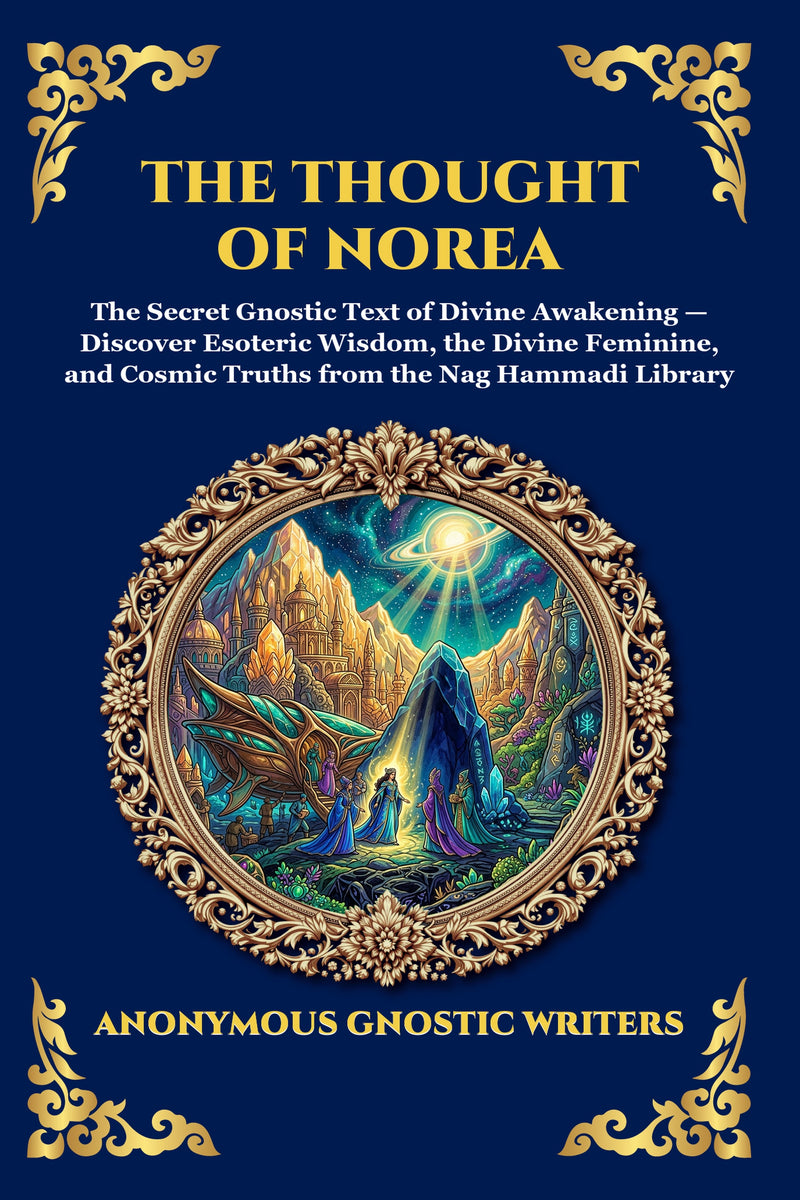
The Thought of Norea
In The Thought of Norea, a divine feminine figure finds wisdom and guidance through celestial beings in her quest for spiritual truth. Once excluded from the Christian canon, this Gnostic manuscript challenges perceptions of the divine and offers a unique glimpse into ancient spiritual beliefs.
or free app
10,000+ hrs library
30-day guarantee
The Thought of Norea is presented here as a complete modern-English translation from the Nag Hammadi Library, readable online with audiobook narration included for Library of Alexandria Press members.
A cry rises from the material world toward a realm of light: where does Norea belong?
The Thought of Norea is a brief, symbolic Gnostic hymn with no known author. It opens with a cry and gathers around Norea, a female figure of resistance and longing. According to the text, her search for divine connection brings her into contact with spiritual luminaries who offer instruction and comfort.
The hymn names the Father of All and Ennoia, a divine Thought associated with light. Scholars link it to the Sethian Gnostic tradition, which honors Seth and offers its own readings of Genesis. Its surviving Coptic text invites you into an ancient vision of spiritual belonging, rather than a long story or a simple moral lesson.
Inside this book
- A voice of longing – Meet Norea through a spiritual cry that places her yearning for divine connection at the center.
- The realm of light – Explore the Fullness, described by Gnostic teachers as the true home of the spirit.
- The divine feminine – Consider how this ancient hymn gives a female figure a central place in spiritual restoration.
- Names rich with meaning – Encounter the Father of All and Ennoia within the hymn’s compact, symbolic language.
- A different sacred vision – Read a work outside most Bibles and encounter the distinctive concerns of Gnostic thought.
Perfect for readers of early Christian and Gnostic texts, students of religion, and anyone curious about ancient visions of the divine feminine.
Open the first page now and follow Norea’s cry toward the light described in this brief hymn.
| Formats | eBook (EPUB + PDF) · Audiobook · Paperback · Hardcover · Large Print |
| Language | English |
| Trim size (print) | 6 × 9 in |
| Binding | Paperback — perfect-bound · Hardcover — casewrap |
| Large Print edition | Same text in a larger, easy-read type — a larger font, not a larger trim |
| Print pricing | Every physical book at our true cost — at-cost, no profit (members) |
| Library | 873 restored titles, always growing |
| Composed | 2nd-3rd century AD |
| Original language | Coptic |
| Source tradition | Nag Hammadi Codex IX |
| Translation basis | Public-domain scholarly translation, rendered in clear modern English. |
| Length | 2,791 words · ~11 min reading |
| Reading level | Grade 14 · rich, literary prose (this modern-English edition) |
| Edition | Modern English translation · 2026 |
Member reviews for this edition are collected as readers finish it — be the first. Across the library: 12,000+ books shipped, every plan covered by a 365-day print guarantee.
About this edition
The complete, unabridged text in clear modern English — faithful to the original, never simplified. Every paragraph is checked against the source, so nothing is cut, summarised, or paraphrased away. It reads cleanly for today while keeping the original meaning intact.
This text survives in Nag Hammadi Codex IX, discovered in Egypt in 1945. This edition renders the standard scholarly translation into clear modern English for contemporary readers.
- Complete & unabridgedVerified paragraph by paragraph against the source — never a scan, never abridged.
- Modern English, faithfulReadable today, with the author’s meaning kept intact. Readable — not simplified.
- Every format, one membershipRead in your browser or the free app, or listen to the full audiobook.
Included free with your membership
Cancel anytime, one click · 30-day money-back guarantee
Edition last updated June 2026
What’s inside
The Thought of Norea — complete and unabridged: all 4 sections included with membership, plus the full audiobook.
Begin reading The Thought of Norea
In clear modern English — the complete text is included with membership.
The World Behind the Text
To fully appreciate what you are about to read, it helps to understand the specific Gnostic tradition within which this text was composed. Scholars have identified it as belonging to the Sethian branch of Gnostic thought — one of the most sophisticated and philosophically developed streams within the broader Gnostic movement. The Sethians took their name from Seth, the third son of Adam and Eve, whom they regarded as the progenitor of a special lineage of human beings — those who carried within them the divine spark in its purest form, those who were capable of receiving gnosis and returning to the Pleroma. Seth, in Sethian mythology, was not merely a biblical patriarch. He was a cosmic figure, a divine emissary who had descended into the material world multiple times throughout history to awaken those who were spiritually ready.
Norea, in the Sethian tradition, occupies a position parallel to and in some ways even more vivid than that of Seth himself. She appears in several Sethian texts — most notably in the Hypostasis of the Archons, where she confronts the archons, the malevolent divine rulers who govern the material world, with a fierce and unyielding defiance. The archons, in Sethian cosmology, are the cosmic enforcers of ignorance. They are the powers that keep human souls trapped in the material realm, that perpetuate the illusion that the Demiurge is the highest God, that punish any attempt to see beyond the veil of material existence. And Norea, when they attempt to dominate and violate her, does not submit. She calls out to the divine, and the divine answers. She is, in this sense, the archetype of the soul that refuses to be owned by the powers of this world.
The text you are about to read is different in character from the confrontational narrative of the Hypostasis of the Archons. It is more lyrical, more interior, more meditative. It has the quality of a hymn or a prayer — a concentrated expression of spiritual longing and divine promise. But it draws on the same mythological tradition, the same cosmological framework, and the same fundamental conviction: that the divine spark within every human being is indestructible, that it cannot be permanently extinguished by the powers of ignorance and material bondage, and that the sincere cry of the awakening soul will always, ultimately, be heard.
The Sethian texts as a group represent an extraordinary achievement of religious imagination. They synthesize Jewish apocalyptic traditions, Platonic philosophy, Egyptian religious imagery, and early Christian spirituality into a coherent and internally consistent vision of cosmic reality. Their cosmology is complex — involving multiple levels of divine being, elaborate genealogies of divine figures, and intricate descriptions of the soul's journey through various cosmic realms — but the complexity is not mere obscurantism. It reflects a genuine attempt to account for the full range of human spiritual experience, including the experience of darkness, confusion, and suffering that simpler theological systems tend to explain away rather than truly address.
One of the most remarkable features of Sethian thought, and one that gives particular resonance to the figure of Norea, is its treatment of the divine feminine. The Pleroma, in Sethian cosmology, is not a realm populated exclusively by masculine divine figures. It contains within it a rich diversity of divine beings, many of them feminine, many of them representing aspects of wisdom, understanding, and spiritual power that are systematically excluded from the patriarchal structures of both mainstream Judaism and orthodox Christianity. The figure of Barbelo — the first divine emanation, the great invisible spirit's self-reflection, often understood as a kind of divine mother — occupies a central position in Sethian theology. And figures like Norea are understood as earthly or semi-earthly manifestations of these higher divine feminine principles.
This is not merely a theological abstraction. It has profound implications for how we understand the spiritual lives of the people who composed and read these texts. In a world where women were systematically excluded from positions of religious authority, where their spiritual experience was filtered through male intermediaries, where the divine was overwhelmingly imaged as masculine — the Gnostic texts offered something radically different. They offered a vision of the divine that included and honored the feminine, that recognized feminine figures as vehicles of the highest spiritual wisdom, and that treated the spiritual experiences of women as fully valid and fully significant. Whether or not the Gnostic communities were in practice more egalitarian than their orthodox counterparts — a question that scholars continue to debate — the symbolic and theological vision encoded in texts like this one represents a genuine and powerful alternative to the dominant religious imagination of the ancient world.
The discovery of the Nag Hammadi texts in 1945 did not immediately transform the scholarly landscape. The manuscripts had to be acquired, conserved, translated, and interpreted — a process that took decades and was complicated by political tensions, institutional rivalries, and the sheer difficulty of the texts themselves. It was not until the 1970s and 1980s that the full range of the Nag Hammadi library became widely available in translation, and not until the 1990s and 2000s that a broader popular audience began to engage seriously with their contents. The publication of Elaine Pagels's The Gnostic Gospels in 1979 was a watershed moment, bringing these texts to a general readership for the first time and demonstrating their relevance not just to specialist scholars but to anyone interested in the history of religion, the nature of spiritual experience, and the politics of religious authority.
Since then, interest in Gnostic texts has only grown. Scholars like Karen King, Bentley Layton, John Turner, and Marvin Meyer have produced increasingly sophisticated analyses of the Nag Hammadi corpus, illuminating its philosophical depths, its historical contexts, and its ongoing relevance. Feminist theologians and scholars of religion have found in these texts a rich resource for reimagining the divine feminine and recovering suppressed traditions of women's spiritual authority. Psychologists, particularly those working in the Jungian tradition, have found in Gnostic mythology a powerful symbolic language for describing the inner dynamics of the psyche. And spiritual seekers of all kinds have found in these texts a form of wisdom that speaks directly to the contemporary experience of alienation, longing, and the search for authentic meaning in a world that often seems governed by forces indifferent or hostile to the deepest human needs.
It is into this rich and ongoing conversation that this volume invites you. The text at its center is short — deceptively short. But as you will discover, brevity in sacred literature is not a sign of shallowness. It is often a sign of extraordinary compression, of meaning packed so densely into so few words that each reading reveals new layers, new implications, new connections to the broader tradition from which it emerges. The great mystical poems of all traditions — Rumi's ghazals, the Psalms, the Upanishadic hymns — have this quality. They are not exhausted by a single reading. They deepen with time, with reflection, with the accumulating experience of a life lived in their presence.
Reading with New Eyes
There is a particular kind of reading that sacred texts demand — a reading that is simultaneously intellectual and intuitive, analytical and receptive. It is a reading that asks you to bring your full critical intelligence to the text while also allowing the text to speak to something in you that lies beneath the critical intelligence, something older and quieter and more fundamental. This is not a contradiction. The greatest scholars of mystical literature — figures like Henry Corbin, Simone Weil, and Gershom Scholem — were people who combined rigorous intellectual discipline with a genuine openness to the transformative power of the texts they studied. They understood that to truly understand a sacred text, you must allow it to work on you, not just analyze it from a safe distance.
This volume is designed to support exactly that kind of reading. The scholarly apparatus — the introductions, the contextual essays, the explanatory notes — exists not to keep you at arm's length from the text but to bring you closer to it, to give you the background knowledge that will allow the text's imagery and ideas to resonate fully rather than remaining opaque. Think of it as preparation for an encounter rather than a substitute for one. The encounter itself is between you and the text, and no amount of scholarly commentary can replace it or predict what it will mean for you specifically.
What you will find in the text itself is a voice — a voice that is at once ancient and strangely immediate, that speaks from a specific historical and cultural context but addresses concerns that are not limited to that context. The concern with the soul's true origin and its longing for return. The concern with the powers — internal and external — that conspire to keep the soul ignorant of its own nature. The concern with the possibility of divine encounter, of a moment in which the distance between the human and the divine collapses and something essential is recognized and reclaimed. These are not concerns that belong exclusively to the second century of the Common Era. They are concerns that belong to the human condition itself, and they are concerns that you, as a reader living in the twenty-first century, are likely to recognize from your own experience.
One of the things that makes Gnostic literature particularly interesting from a contemporary perspective is its refusal of easy consolation. The Gnostic vision is not a comfortable one. It does not tell you that the world is basically fine, that the authorities who govern it are basically trustworthy, that suffering is part of a benevolent divine plan that you simply need to accept. It tells you, with unflinching honesty, that the world as it presents itself is not the whole story, that the powers that govern material existence are themselves limited and confused, and that the path to genuine spiritual freedom requires a willingness to see through the official version of reality and to trust the deeper knowing that lives within you. This is a challenging message. It is also, for many people, a profoundly liberating one.
The figure of Norea herself embodies this challenge and this liberation. She is a figure who has been targeted by the powers of ignorance — the archons who want to possess and dominate her — and who responds not with submission but with a cry of genuine spiritual need directed toward the highest divine reality. And she is heard. This is the central promise of the text: that the sincere cry of the awakening soul is heard by the divine, that the divine is not indifferent to human spiritual longing, and that the response to that longing is not silence but illumination, not abandonment but the arrival of divine messengers who bring the knowledge of the soul's true nature and its ultimate destiny.
There is something in this that speaks very directly to the contemporary spiritual situation. We live in a time of profound institutional crisis — a time when the religious authorities that once provided frameworks of meaning have, for many people, lost their credibility, when the official stories about who we are and what the world is seem increasingly inadequate to the reality of lived experience. The Gnostic response to an analogous situation in the ancient world was not despair and not simple rejection, but the cultivation of a deeper, more interior form of knowing — a gnosis that does not depend on institutional authority but arises from the direct encounter between the awakening soul and the living divine. This response has an obvious relevance to our own moment, and it is part of what makes these ancient texts feel, to so many contemporary readers, not like museum pieces but like living wisdom.
As you prepare to enter the world of this text, it is worth pausing to consider what you bring to the encounter. Every reader comes to a text with a history — a history of beliefs, experiences, questions, and longings that shapes what they are able to hear and what they are able to receive. The Gnostic texts are particularly sensitive to this dynamic, because they are explicitly addressed to those who are spiritually ready — those in whom the divine spark is, as the Gnostics would say, already beginning to stir. This does not mean that the texts are elitist in the negative sense. It means that they are alive to the reality that spiritual understanding is not simply a matter of intellectual comprehension but of interior readiness, of a willingness to be changed by what you encounter.
You do not need to be a scholar of ancient religions to benefit from reading this text. You do not need to subscribe to any particular theological position or to accept the Gnostic cosmology as literally true. What you need is curiosity — genuine curiosity about the nature of the divine, about the depth of human spiritual experience, about the traditions that have shaped and continue to shape the spiritual imagination of the West. And you need a willingness to sit with complexity, to resist the temptation to reduce rich and multilayered symbolic language to simple propositions, to allow meaning to accumulate gradually rather than demanding it all at once.
Cancel anytime, one click · 30-day money-back guarantee
Founding annual rate available now — your price locks for life when you join.
Not ready? Get this free chapter by email — read it anytime.
✓ Sent — check your inbox for The Thought of Norea.
Questions about The Thought of Norea
What is The Thought of Norea about?
It is a short hymn about Norea, a Gnostic female figure who cries out to the Father of All. Her cry is heard by the divine figures, and she is received into her place in the Fullness, the realm of light.
Who is Norea in Gnostic texts?
Norea is a female figure in Sethian Gnostic writing, tied to Adam, Seth and the age of Noah. In the Hypostasis of the Archons she resists the rulers of the world and calls for divine help.
Where was The Thought of Norea found?
It was found in Codex Nine of the Nag Hammadi library, a set of papyrus books discovered in Upper Egypt in 1945. It survives in Coptic, translated from an earlier Greek text.
What does the Fullness mean in Gnosticism?
The Fullness, often called the Pleroma, is the whole realm of divine powers and light. Gnostic writers saw it as the true home of the spirit, above the created world.
Shipping & returns
Billing & membership
More from the library


Explore The Lost & Forbidden Library
- 1 Enoch · Attributed to Enoch
- 1–4 Maccabees · Various Jewish authors
- 2 Baruch · Attributed to Baruch
- 2 Enoch · Attributed to Enoch
- 4 Baruch · Attributed to Baruch ben Neriah
- A Valentinian Exposition · Attributed to a follower of Val...
- Acts of Saturninus
- Acts of Titus · Anonymous early Christian writer
- Allogenes the Stranger · Anonymous (Early Gnostic Mystic)
- Antitheses of Marcion · Marcion
- Apocalypse of Bartholomew · Attributed to the Apostle Barth...
- Apocalypse of Daniel
- Apocalypse of Paul · Attributed to the Apostle Paul
- Apocalypse of Paul (Visio Pauli, Latin) · Attributed to the Apostle Paul
- Apocalypse of Pseudo- Ephraem · Attributed to Ephraem the Syrian
- Apocalypse of Sedrach
- Apocalypse of Shenoute · Attributed to Shenoute the Arch...
- Apocalypse of Stephen
- Apostolic Fathers · Various early Christian authors
- Apostolic Tradition · Attributed to Hippolytus of Rome
- Ars Notoria · Attributed to King Solomon
- Asclepius · Attributed to Hermes Trismegistus
- Authoritative Teaching
- Book of Giants · Attributed to Mani
- Book of the Mysteries of Heaven and Earth · Attributed to early Jewish mystics
- Cave of Treasures · Attributed to Ephrem the Syrian
- Clementine Recognitions · Attributed to Clement of Rome
- Community Rule · Attributed to the Qumran community
- Coptic Gospel of the Twelve
- Diatessaron · Attributed to Tatian
The Thought of Norea
The Thought of Norea
A Gnostic Hymn of the Divine Feminine and Her Restoration to the Fullness
Library of Alexandria Press
The Thought of Norea
© Copyright 2026 Library of Alexandria Press. All rights reserved.
Published by Library of Alexandria Press
Printed in the United States of America
It is not legal to copy, share, or send any part of this document in either digital or printed form without written permission from the publisher, except short quotes in a book review.
Table of Contents
Introduction
The World Behind the Text
Reading with New Eyes
Chapter 1
Introduction
Imagine holding in your hands a text that was buried in the Egyptian desert for nearly two thousand years, hidden deliberately, preserved against the slow erosion of time and the more violent erosion of institutional power. Imagine that the people who concealed it did so knowing that discovery meant death, that the ideas contained within its pages were considered so dangerous, so subversive to the established order of both church and state, that their very existence had to be erased. And then imagine that the earth itself refused to let that erasure happen — that a clay jar buried beneath the sands of Nag Hammadi waited patiently through the rise and fall of empires, through the Crusades and the Renaissance, through the Enlightenment and two world wars, until a pair of Egyptian farmers cracked it open in December of 1945 and changed the history of human spirituality forever.
This is not a metaphor. This is exactly what happened. The Nag Hammadi library — a collection of thirteen leather-bound codices containing fifty-two texts — was discovered by accident in Upper Egypt, and what it revealed shook the foundations of everything scholars, theologians, and spiritual seekers thought they understood about early Christianity, ancient Gnosticism, and the nature of divine knowledge itself. Among those texts, nestled within the pages of Codex IX, sits one of the most compact and yet most luminous pieces of esoteric literature ever committed to papyrus: a short, jewel-like hymn known as the Oration on the Soul, or more commonly, by the name of its central figure — Norea.
She is not a name most people recognize. She does not appear in the canonical Bible. She is not celebrated in mainstream churches, commemorated in liturgical calendars, or depicted in the stained glass windows of Gothic cathedrals. And yet, within the tradition of Gnostic spirituality, Norea occupies a position of extraordinary significance. She is the daughter of Adam and Eve, the sister of Seth, a figure who appears across multiple Gnostic texts as a symbol of the soul's defiant refusal to be dominated by ignorance, by false authority, and by the spiritual blindness that the Gnostics associated with the material world's imperfect creator. She is, in the deepest sense, a figure of awakening — and her text, though brief enough to be read in a single sitting, contains within it a depth of meaning that rewards years of contemplation.
To read this text without context is to hear music without knowing the tradition it comes from — you may appreciate its beauty, but you will miss its full resonance. This introduction exists to give you that resonance. It exists to place you inside the world that produced this remarkable document, to introduce you to the cosmological framework that makes its imagery intelligible, and to help you understand why a text this short has generated this much scholarly attention, spiritual devotion, and philosophical inquiry. By the time you turn the first page of the text itself, you will not be a stranger walking into an unfamiliar room. You will be a guest who has been properly welcomed.
Let us begin with the world into which this text was born — a world in crisis, a world in which the old certainties were dissolving and new spiritual movements were proliferating with extraordinary speed and diversity. The first and second centuries of the Common Era were among the most spiritually turbulent periods in human history. The Roman Empire had absorbed and encountered dozens of religious traditions — Egyptian, Persian, Greek, Jewish, Mesopotamian — and the resulting cultural ferment produced an explosion of new religious synthesis. Mystery religions flourished. Philosophical schools debated the nature of the divine. Jewish apocalyptic literature was generating radical new visions of cosmic history. And out of this extraordinary confluence of traditions, a loose but recognizable movement emerged that modern scholars have come to call Gnosticism.
The word itself is derived from the Greek gnosis, meaning knowledge — but not the kind of knowledge you acquire by reading a textbook or memorizing facts. Gnosis, in the Gnostic sense, is experiential, transformative, and deeply personal. It is the knowledge of one's own divine nature, the sudden recognition that the self is not merely a product of the material world but a spark of something higher, something that predates creation itself. It is the knowledge that wakes you up. And the Gnostic texts — of which the Nag Hammadi library contains the richest surviving collection — are, in their deepest intention, maps of that awakening.
What distinguished Gnostic thought from mainstream Christianity, and what made it so threatening to the emerging orthodox church, was its fundamentally different understanding of creation, of the divine, and of the human condition. Where orthodox Christianity taught that the world was created by a good and all-powerful God, Gnosticism proposed a far more complex and, in many ways, more psychologically honest cosmology. The material world, in Gnostic thought, was not the product of a perfect divine being. It was the product of an inferior, ignorant, and sometimes arrogant divine figure — the Demiurge, often identified with the God of the Hebrew Bible — who had created the material realm without fully understanding the higher divine reality from which he himself had emerged. Human beings, in this framework, were not simply fallen creatures in need of redemption through obedience and ritual. They were divine sparks trapped in material forms, longing to remember their true origin and return to the fullness of the divine — the Pleroma, the sacred totality that existed beyond and above the Demiurge's limited creation.
This is a cosmology that speaks directly to the experience of alienation, of feeling that the world as it presents itself is somehow wrong, that the authorities who claim to speak for God are themselves mistaken or corrupt, that there is something within you that knows more than the official version of reality admits. It is not difficult to understand why this vision resonated so powerfully with people living under Roman imperial rule, people who had watched the Temple in Jerusalem destroyed, people who were navigating the collapse of old certainties and the rise of new and often brutal power structures. Gnosticism offered them not just a new theology but a new anthropology — a new understanding of what a human being fundamentally is.
And it is within this context that Norea emerges as a figure of such profound importance. She is not a passive recipient of divine grace. She is not a figure who accepts her place within a hierarchy of spiritual authority. She is a figure who cries out — who raises her voice to the divine — and who receives, in response, a direct and personal revelation. Her story, even in its compressed and hymn-like form, is a story about the soul's refusal to be silenced, about the power of sincere spiritual longing to pierce through the veils of ignorance and reach the living source of divine light.
Chapter 1
Father over all, Reflection of the light, Intellect dwelling in the heights, over the realms beneath, radiance that dwells in the heights, utterance of what is true, kindly Intellect, Word that none can attain, voice too vast for any telling, past all comprehending Father!
It is to these that Norea makes her appeal.
They listened and welcomed her into the dwelling that is hers for all time.
They granted her the Father of Insight, Adamas, along with the voices belonging to the holy ones, so she could come to rest within a wisdom no description can hold and take hold of the First Insight that she has already obtained, and settle into rest in the holy one who brought himself into existence, and bring herself into existence, just as she too has taken in the living Word, and be joined to every one of the imperishable ones, and dwell in the Insight of the Father, so she may give voice to sayings of life, and remain near the one held in honor by guarding what was handed to her before the cosmos ever began.
She carries the great Insight of the ones no eye can see, and she gives glory to their Father and makes her home among those who dwell within the Fullness, and she beholds the Fullness.
Days are drawing near when she will be made whole and want for nothing ever again.
She is attended by four holy assistants, who intercede for her before the Father over all, Adamas, who dwells within all the Adams.
Though Norea's reflection belongs to him, and though she speaks of two names, both of them signify one name.
End of the free sample
Keep reading, free
Members read and listen to the complete book — and the entire library. Cancel anytime, one click · 30-day money-back guarantee.