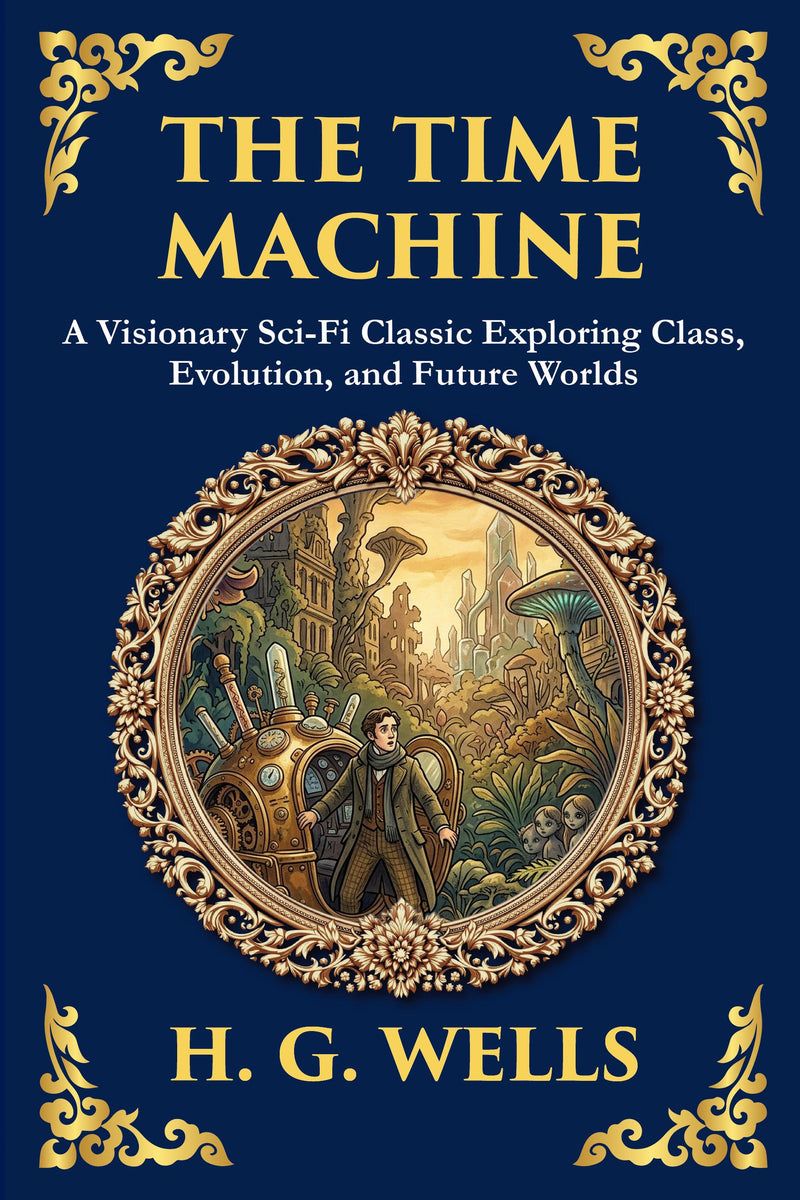
The Time Machine — Large Print
A brilliant inventor unveils a machine that can traverse time—and with it, ventures far beyond the present into the distant future.
or free app
10,000+ hrs library
30-day guarantee
The complete The Time Machine appears in modern English through Library of Alexandria Press, available online with audiobook narration included for members.
What if humanity’s distant future is not progress, but a beautiful world with something dreadful beneath it?
At a dinner party near London, an inventor makes an extraordinary claim: his machine can travel through time. In H. G. Wells’s The Time Machine, the Time Traveller tells his guests how he reaches the year 802,701 AD. There he meets the gentle, childlike Eloi, who live among fading beauty and show little curiosity about their world.
Then his machine disappears. Stranded far from home, the Time Traveller must look beyond this sunlit life and face the Morlocks, pale creatures who live underground among machines. Weena, an Eloi woman he saves from drowning, becomes his companion. As darkness threatens, his search raises unsettling questions about evolution, class division, and whether comfort makes a society stronger—or leaves it helpless.
What you'll discover
- A leap into time – Follow an inventor from a dinner-table argument into a future that overturns his expectations.
- Beauty with something missing – Meet the Eloi, whose easy days invite troubling questions about curiosity, comfort, and change.
- The world beneath – Venture toward the Morlocks’ underground machines, where the future takes a darker shape.
- Companionship far from home – Discover Weena’s gentle presence in a strange world where night brings fear.
- Class carried into evolution – Consider what happens when social divisions become differences of body and mind.
Perfect for readers who love ideas wrapped in adventure, want to explore science fiction’s roots, or seek a classic to finish in an evening.
Open the first page now, and take your place at the Time Traveller’s dinner table.
| Formats | eBook (EPUB + PDF) · Audiobook · Paperback · Hardcover · Large Print |
| Language | English |
| Trim size (print) | 6 × 9 in |
| Binding | Paperback — perfect-bound · Hardcover — casewrap |
| Large Print edition | Same text in a larger, easy-read type — a larger font, not a larger trim |
| Print pricing | Every physical book at our true cost — at-cost, no profit (members) |
| Library | 873 restored titles, always growing |
| Length | 34,318 words · ~2 hr 17 min reading |
| Reading level | Grade 9 · a comfortable read (this modern-English edition) |
| Edition | Modern English translation · 2026 |
Member reviews for this edition are collected as readers finish it — be the first. Across the library: 12,000+ books shipped, every plan covered by a 365-day print guarantee.
About this edition
A faithful, unabridged modern-English edition by The Library of Alexandria — carefully rendered for today's reader and verified paragraph-by-paragraph against the public-domain source. Available as eBook, audiobook, paperback, hardcover, and large print.
- Complete & unabridgedVerified paragraph by paragraph against the source — never a scan, never abridged.
- Modern English, faithfulReadable today, with the author’s meaning kept intact. Readable — not simplified.
- Every format, one membershipRead in your browser or the free app, or listen to the full audiobook.
Included free with your membership
Cancel anytime, one click · 30-day money-back guarantee
Edition last updated July 2026
What’s inside
The Time Machine — Large Print — complete and unabridged: all 18 sections included with membership, plus the full audiobook.
Begin reading The Time Machine — Large Print
In clear modern English — the complete text is included with membership.
Introduction
When H. G. Wells published The Time Machine in 1895, he did something that no writer before him had quite managed to do: he made the future feel like a place you could actually go. Not a dream, not a vision granted by some supernatural agency, not a Rip Van Winkle slumber from which one happens to wake in another age, but a destination reached deliberately, mechanically, by a man who builds a device and chooses to climb aboard. That single imaginative leap—the idea that time might be navigated like a river, that one could steer through the centuries the way a sailor steers through the sea—gave birth to an entire genre and reshaped the way humanity thinks about its own destiny. More than a century later, the novel remains startlingly fresh, its ideas undimmed, its anxieties uncannily relevant, and its sheer storytelling power as gripping as it was on the day it first appeared.
This edition has been prepared with the contemporary reader in mind. Wells wrote in the supple, energetic prose of late-Victorian England, a style that is wonderfully vivid but occasionally dense with the idioms, scientific assumptions, and rhetorical habits of his era. The aim of this modern adaptation is not to flatten or simplify what Wells achieved, but to clear away the small obstacles of time and language that can stand between a present-day reader and the full force of the story. The result, we hope, is a reading experience that preserves the original’s intelligence, wit, and visionary sweep while allowing it to move with the immediacy that Wells himself surely intended. What follows is a brief orientation—a way of stepping into the machine before you take your own journey through it. You will find nothing here that spoils the surprises ahead; rather, this introduction is meant to sharpen your senses, to point your attention toward the things worth watching for, and to set the stage for one of the most influential adventures in the history of literature.
To understand why The Time Machine struck its first readers like a thunderclap, it helps to understand the man who wrote it and the world he was writing in. Herbert George Wells was born in 1866 in Bromley, Kent, into a family of modest means and uncertain fortunes. His father was a shopkeeper and a part-time professional cricketer; his mother worked as a housekeeper at a country estate. The young Wells seemed destined for the kind of life that swallowed up countless bright children of the lower-middle class in Victorian England—apprenticed to a draper, set to spend his days folding fabric behind a counter, his curiosity slowly extinguished by the grinding monotony of trade. That he escaped this fate, and went on to become one of the most famous and influential writers in the English language, is a story almost as remarkable as any he ever invented.
A leg injury sustained as a boy gave Wells the unexpected gift of long hours spent reading, and reading awakened in him an appetite for ideas that no draper’s shop could satisfy. He won a scholarship to study under the great biologist Thomas Henry Huxley, the man popularly known as “Darwin’s Bulldog” for his fierce public defense of evolutionary theory. This education would prove decisive. Wells absorbed not only the mechanics of natural selection but its profound and unsettling implications: that humanity was not the fixed, divinely appointed pinnacle of creation but merely one branch of a constantly changing tree, subject like every other species to the pressures of environment, competition, and time. If life had evolved from simpler forms into its present complexity, then what was to stop it from evolving further—or, just as plausibly, from declining, degenerating, splitting into new and unrecognizable shapes? This question, planted in Wells’s mind during his student days, would become the dark, pulsing heart of his first great novel.
Wells came to maturity at a particular hinge point in human history. The Industrial Revolution had transformed Britain from a nation of farmers and craftsmen into the workshop of the world, and the transformation had come at tremendous human cost. The factories that produced unimaginable wealth were powered by the labor of men, women, and children who lived in conditions of squalor and exhaustion that the comfortable classes preferred not to see. The great cities had divided themselves, almost geographically, into separate worlds: the broad avenues and leafy squares of the prosperous, and the soot-choked warrens of the poor, who descended each day into mines, mills, and underground tunnels to keep the machinery of empire running. This division was not merely economic; it was beginning to feel almost biological, as though the rich and the poor were becoming two distinct kinds of human being, shaped by entirely different environments and destined for entirely different fates. Wells, who had climbed up from the lower rungs of this divided society through sheer intellectual force, understood its contours with painful intimacy. He had seen both worlds, and he sensed where the trends might lead if no one intervened.
It was out of this combination of influences—the evolutionary science of Huxley, the social anxieties of late-Victorian capitalism, the optimism and dread that hovered around the coming new century—that The Time Machine was born. Wells did not write it in a single confident stroke; the novel evolved through several earlier versions over the better part of a decade, beginning with a strange, rough piece called “The Chronic Argonauts” that he published as a young man. He kept returning to the idea, reshaping it, refining its central image, until at last he had distilled it into the lean and powerful narrative we know today. When the finished book appeared, it made Wells famous virtually overnight and launched a career that would see him produce, in rapid succession, The Island of Doctor Moreau, The Invisible Man, and The War of the Worlds—a quartet of “scientific romances,” as he called them, that would define an entire genre and influence writers and filmmakers for generations to come.
It is worth pausing on that phrase, “scientific romance,” because it tells us something important about what Wells thought he was doing. He was not writing fantasy, in the sense of inventing magic and asking readers simply to accept it. Nor was he writing the kind of speculative engineering that his great French contemporary Jules Verne favored, in which the emphasis fell on the plausibility of submarines and rockets and the technical details of how they worked. Verne, in fact, rather disapproved of Wells, complaining that the younger writer simply invented his marvels without grounding them in real physics. But this missed the point of what Wells was after. For Wells, the machine was never the point. The machine was a door. What mattered was where the door led, and what the journey through it could reveal about human nature, human society, and human destiny. The science gave the story its credibility and its forward momentum; but the heart of the work was always philosophical, social, moral. Wells used the tools of speculation the way a great satirist uses exaggeration or a great poet uses metaphor: to show us truths about ourselves that we might otherwise refuse to see.
This is why The Time Machine, despite its brevity, has endured where so many more elaborate works of its era have faded into obscurity. It is not merely a clever adventure, though it is certainly that. It is a thought experiment of extraordinary depth, conducted with the cool detachment of a scientist and the imaginative reach of a poet. Wells asks a question that no one had ever quite framed so starkly before: if the forces shaping human society today were allowed to run their course, unchecked, across hundreds of thousands or even millions of years, what would humanity become? The answer he offers is neither comforting nor simple, and it is precisely its refusal to comfort that gives the book its lasting power.
One of the pleasures awaiting a first-time reader of this novel is the elegance of its construction. Wells was a master of narrative economy, and The Time Machine is a model of how to build a story that grips from the first page and never relaxes its hold. The book opens not with the journey itself but with a gathering of comfortable, skeptical men in a comfortable Victorian drawing room, where the central figure—identified only as the Time Traveller—lays out his astonishing theory before an audience of doubters. This framing device is doing a great deal of quiet work. By beginning in the familiar, reassuring world of dinner parties and after-dinner cigars, Wells grounds the fantastic in the ordinary. We meet a medical man, a psychologist, a young man, a provincial mayor, and a narrator who relays the whole tale to us at a careful remove. These are recognizable types, sensible and worldly, and their initial skepticism becomes our own. When they doubt, we doubt with them; and when their doubt is shaken, ours is shaken too.
This careful management of belief is central to the novel’s effect. Wells understood that the more outlandish the premise, the more important it is to anchor it in concrete, persuasive detail. He devotes real attention to the idea of time travel before he ever lets his hero depart—offering a brisk, confident argument about the nature of dimensions that sounds, to this day, surprisingly modern. The notion that time might be regarded as a fourth dimension, comparable in some sense to the three dimensions of space, was very much in the intellectual air of the 1890s, and Wells seized upon it with a journalist’s instinct for the arresting idea. Readers familiar with later developments in physics may find something almost prophetic in these passages, though Wells was no physicist and made no claim to scientific rigor. What he was after was the feeling of plausibility, the sense that this was not mere whimsy but a genuine possibility that a rational man might pursue. He achieves it brilliantly, and the result is that when the Time Traveller finally throws his lever and hurtles into the unknown, we go with him not as spectators of a fairy tale but as participants in an experiment.
The structure of the novel also reflects Wells’s instinct for pacing and revelation. The story unfolds largely as a tale told after the fact—the Time Traveller recounting his adventures to his assembled guests—which allows Wells to control the flow of information with great precision. We learn what the traveller learned, in roughly the order he learned it, and we share his successive interpretations of the strange world he encounters: his early impressions, his confident theories, his dawning corrections, his moments of horror and wonder. This is one of the novel’s most sophisticated achievements. The traveller is an intelligent and educated man, and he approaches the future as a scientist approaches a new specimen—observing, hypothesizing, testing, revising. Watching him reason his way toward understanding, and watching that understanding deepen and darken as the truth reveals itself, is one of the central dramas of the book. The reader is invited not merely to witness a strange world but to figure it out, alongside the narrator, and the gradual unfolding of its secrets is managed with the skill of a master mystery writer.
It would be a disservice to describe the particulars of what the Time Traveller discovers; the freshness of those discoveries is part of what makes the book so rewarding, and they deserve to be encountered without forewarning. But it is fair to say that the world he finds is not the gleaming utopia of triumphant progress that many of Wells’s optimistic contemporaries imagined the future would bring. Nor is it a simple wasteland. It is something far more unsettling and far more thought-provoking: a world that bears the unmistakable marks of human history carried to a logical and terrible extreme. The deep questions Wells raises through this future world—about the consequences of inequality, the long-term effects of comfort and ease, the fragility of intelligence and culture, the relationship between labor and leisure, and the ultimate fate of all living things—are questions that have only grown more pressing in the years since he first posed them. As you read, you may find yourself thinking less about the year in which the story is set than about your own age, and the trajectories along which your own world is currently traveling.
Cancel anytime, one click · 30-day money-back guarantee
Founding annual rate available now — your price locks for life when you join.
Not ready? Get this free chapter by email — read it anytime.
✓ Sent — check your inbox for The Time Machine — Large Print.
Questions about The Time Machine — Large Print
What is The Time Machine about?
It follows a Victorian inventor who builds a machine to travel through time. He journeys to the year 802,701, where he meets two very different peoples and must find a way to recover his lost machine.
Who are the Eloi and the Morlocks?
The Eloi are small, gentle, childlike people living in the sun above ground. The Morlocks are pale creatures who live underground among machines. The Time Traveller sees them as the far descendants of the upper and working classes.
When was The Time Machine written?
H. G. Wells published it in 1895. It was his first novel. It is fiction, but it grew from real scientific ideas of his day, especially evolution and the thinking of his teacher T. H. Huxley.
Is The Time Machine hard to read?
No. It is short, with quick chapters and clear prose. Some Victorian wording and scientific talk in the opening dinner scene may feel dated, but the adventure soon takes over and keeps a steady pace.
Shipping & returns
Billing & membership
More from the library


Explore Science Fiction
- The Princess and the Goblin — Large Print · George MacDonald
- The Wonderful Wizard of Oz · L. Frank Baum
- The Island of Doctor Moreau · H. G. Wells
- The Invisible Man: A Grotesque Romance · H. G. Wells
- The War of the Worlds · H. G. Wells
- The Strange Case of Dr. Jekyll and Mr. Hyde · Robert Louis Stevenson
- The Marvelous Land of Oz — Large Print · L. Frank Baum
- The Island of Doctor Moreau — Large Print · H. G. Wells
- The Lost World — Large Print · Arthur Conan Doyle
- Limanora: The Island of Progress — Large Print · Godfrey Sweven
- The War of the Worlds — Large Print · H. G. Wells
- The Strange Case of Dr. Jekyll and Mr. Hyde — Large Print · Robert Louis Stevenson
- Red Nails — Large Print · Robert E. Howard
- R.U.R. (Rossum's Universal Robots) — Large Print · Karel Čapek
- Gulliver of Mars — Large Print · Edwin Lester Arnold
- Out of Time's Abyss — Large Print · Edgar Rice Burroughs
- Jewels of Gwahlur — Large Print · Robert E. Howard
- The Doomsman — Large Print · Van Tassel Sutphen
- Flatland: A Romance of Many Dimensions — Large Print · Edwin Abbott Abbott
- Armageddon—2419 A.D. — Large Print · Philip Francis Nowlan
- Mizora: A Prophecy — Large Print · Mary E. Bradley Lane
- A Voyage to Arcturus — Large Print · David Lindsay
- The Invisible Man: A Grotesque Romance — Large Print · H. G. Wells
- The Mummy! A Tale of the Twenty-Second Century — Large Print · Jane Loudon
- A Martian Odyssey — Large Print · Stanley G. Weinbaum
- We — Large Print · Yevgeny Zamyatin
- A Connecticut Yankee in King Arthur's Court — Large Print · Mark Twain
- The Revolt on Venus — Large Print · Carey Rockwell
- She — Large Print · H. Rider Haggard
- Dorothy and the Wizard in Oz — Large Print · L. Frank Baum
The Time Machine — Large Print
The Time Machine — Large Print
A Visionary Sci-Fi Classic Exploring Class, Evolution, and Future Worlds
H. G. Wells
Contents
- Introduction
- Chapter 1
- Chapter 2
- Chapter 3
- Chapter 4
- Chapter 5
- Chapter 6
- Chapter 7
- Chapter 8
- Chapter 9
- Chapter 10
- Chapter 11
- Chapter 12
- Chapter 13
- Chapter 14
- Chapter 15
- Chapter 16
- Epilogue
Introduction
When H. G. Wells published The Time Machine in 1895, he did something that no writer before him had quite managed to do: he made the future feel like a place you could actually go. Not a dream, not a vision granted by some supernatural agency, not a Rip Van Winkle slumber from which one happens to wake in another age, but a destination reached deliberately, mechanically, by a man who builds a device and chooses to climb aboard. That single imaginative leap—the idea that time might be navigated like a river, that one could steer through the centuries the way a sailor steers through the sea—gave birth to an entire genre and reshaped the way humanity thinks about its own destiny. More than a century later, the novel remains startlingly fresh, its ideas undimmed, its anxieties uncannily relevant, and its sheer storytelling power as gripping as it was on the day it first appeared.
This edition has been prepared with the contemporary reader in mind. Wells wrote in the supple, energetic prose of late-Victorian England, a style that is wonderfully vivid but occasionally dense with the idioms, scientific assumptions, and rhetorical habits of his era. The aim of this modern adaptation is not to flatten or simplify what Wells achieved, but to clear away the small obstacles of time and language that can stand between a present-day reader and the full force of the story. The result, we hope, is a reading experience that preserves the original’s intelligence, wit, and visionary sweep while allowing it to move with the immediacy that Wells himself surely intended. What follows is a brief orientation—a way of stepping into the machine before you take your own journey through it. You will find nothing here that spoils the surprises ahead; rather, this introduction is meant to sharpen your senses, to point your attention toward the things worth watching for, and to set the stage for one of the most influential adventures in the history of literature.
To understand why The Time Machine struck its first readers like a thunderclap, it helps to understand the man who wrote it and the world he was writing in. Herbert George Wells was born in 1866 in Bromley, Kent, into a family of modest means and uncertain fortunes. His father was a shopkeeper and a part-time professional cricketer; his mother worked as a housekeeper at a country estate. The young Wells seemed destined for the kind of life that swallowed up countless bright children of the lower-middle class in Victorian England—apprenticed to a draper, set to spend his days folding fabric behind a counter, his curiosity slowly extinguished by the grinding monotony of trade. That he escaped this fate, and went on to become one of the most famous and influential writers in the English language, is a story almost as remarkable as any he ever invented.
A leg injury sustained as a boy gave Wells the unexpected gift of long hours spent reading, and reading awakened in him an appetite for ideas that no draper’s shop could satisfy. He won a scholarship to study under the great biologist Thomas Henry Huxley, the man popularly known as “Darwin’s Bulldog” for his fierce public defense of evolutionary theory. This education would prove decisive. Wells absorbed not only the mechanics of natural selection but its profound and unsettling implications: that humanity was not the fixed, divinely appointed pinnacle of creation but merely one branch of a constantly changing tree, subject like every other species to the pressures of environment, competition, and time. If life had evolved from simpler forms into its present complexity, then what was to stop it from evolving further—or, just as plausibly, from declining, degenerating, splitting into new and unrecognizable shapes? This question, planted in Wells’s mind during his student days, would become the dark, pulsing heart of his first great novel.
Wells came to maturity at a particular hinge point in human history. The Industrial Revolution had transformed Britain from a nation of farmers and craftsmen into the workshop of the world, and the transformation had come at tremendous human cost. The factories that produced unimaginable wealth were powered by the labor of men, women, and children who lived in conditions of squalor and exhaustion that the comfortable classes preferred not to see. The great cities had divided themselves, almost geographically, into separate worlds: the broad avenues and leafy squares of the prosperous, and the soot-choked warrens of the poor, who descended each day into mines, mills, and underground tunnels to keep the machinery of empire running. This division was not merely economic; it was beginning to feel almost biological, as though the rich and the poor were becoming two distinct kinds of human being, shaped by entirely different environments and destined for entirely different fates. Wells, who had climbed up from the lower rungs of this divided society through sheer intellectual force, understood its contours with painful intimacy. He had seen both worlds, and he sensed where the trends might lead if no one intervened.
It was out of this combination of influences—the evolutionary science of Huxley, the social anxieties of late-Victorian capitalism, the optimism and dread that hovered around the coming new century—that The Time Machine was born. Wells did not write it in a single confident stroke; the novel evolved through several earlier versions over the better part of a decade, beginning with a strange, rough piece called “The Chronic Argonauts” that he published as a young man. He kept returning to the idea, reshaping it, refining its central image, until at last he had distilled it into the lean and powerful narrative we know today. When the finished book appeared, it made Wells famous virtually overnight and launched a career that would see him produce, in rapid succession, The Island of Doctor Moreau, The Invisible Man, and The War of the Worlds—a quartet of “scientific romances,” as he called them, that would define an entire genre and influence writers and filmmakers for generations to come.
It is worth pausing on that phrase, “scientific romance,” because it tells us something important about what Wells thought he was doing. He was not writing fantasy, in the sense of inventing magic and asking readers simply to accept it. Nor was he writing the kind of speculative engineering that his great French contemporary Jules Verne favored, in which the emphasis fell on the plausibility of submarines and rockets and the technical details of how they worked. Verne, in fact, rather disapproved of Wells, complaining that the younger writer simply invented his marvels without grounding them in real physics. But this missed the point of what Wells was after. For Wells, the machine was never the point. The machine was a door. What mattered was where the door led, and what the journey through it could reveal about human nature, human society, and human destiny. The science gave the story its credibility and its forward momentum; but the heart of the work was always philosophical, social, moral. Wells used the tools of speculation the way a great satirist uses exaggeration or a great poet uses metaphor: to show us truths about ourselves that we might otherwise refuse to see.
This is why The Time Machine, despite its brevity, has endured where so many more elaborate works of its era have faded into obscurity. It is not merely a clever adventure, though it is certainly that. It is a thought experiment of extraordinary depth, conducted with the cool detachment of a scientist and the imaginative reach of a poet. Wells asks a question that no one had ever quite framed so starkly before: if the forces shaping human society today were allowed to run their course, unchecked, across hundreds of thousands or even millions of years, what would humanity become? The answer he offers is neither comforting nor simple, and it is precisely its refusal to comfort that gives the book its lasting power.
One of the pleasures awaiting a first-time reader of this novel is the elegance of its construction. Wells was a master of narrative economy, and The Time Machine is a model of how to build a story that grips from the first page and never relaxes its hold. The book opens not with the journey itself but with a gathering of comfortable, skeptical men in a comfortable Victorian drawing room, where the central figure—identified only as the Time Traveller—lays out his astonishing theory before an audience of doubters. This framing device is doing a great deal of quiet work. By beginning in the familiar, reassuring world of dinner parties and after-dinner cigars, Wells grounds the fantastic in the ordinary. We meet a medical man, a psychologist, a young man, a provincial mayor, and a narrator who relays the whole tale to us at a careful remove. These are recognizable types, sensible and worldly, and their initial skepticism becomes our own. When they doubt, we doubt with them; and when their doubt is shaken, ours is shaken too.
This careful management of belief is central to the novel’s effect. Wells understood that the more outlandish the premise, the more important it is to anchor it in concrete, persuasive detail. He devotes real attention to the idea of time travel before he ever lets his hero depart—offering a brisk, confident argument about the nature of dimensions that sounds, to this day, surprisingly modern. The notion that time might be regarded as a fourth dimension, comparable in some sense to the three dimensions of space, was very much in the intellectual air of the 1890s, and Wells seized upon it with a journalist’s instinct for the arresting idea. Readers familiar with later developments in physics may find something almost prophetic in these passages, though Wells was no physicist and made no claim to scientific rigor. What he was after was the feeling of plausibility, the sense that this was not mere whimsy but a genuine possibility that a rational man might pursue. He achieves it brilliantly, and the result is that when the Time Traveller finally throws his lever and hurtles into the unknown, we go with him not as spectators of a fairy tale but as participants in an experiment.
The structure of the novel also reflects Wells’s instinct for pacing and revelation. The story unfolds largely as a tale told after the fact—the Time Traveller recounting his adventures to his assembled guests—which allows Wells to control the flow of information with great precision. We learn what the traveller learned, in roughly the order he learned it, and we share his successive interpretations of the strange world he encounters: his early impressions, his confident theories, his dawning corrections, his moments of horror and wonder. This is one of the novel’s most sophisticated achievements. The traveller is an intelligent and educated man, and he approaches the future as a scientist approaches a new specimen—observing, hypothesizing, testing, revising. Watching him reason his way toward understanding, and watching that understanding deepen and darken as the truth reveals itself, is one of the central dramas of the book. The reader is invited not merely to witness a strange world but to figure it out, alongside the narrator, and the gradual unfolding of its secrets is managed with the skill of a master mystery writer.
It would be a disservice to describe the particulars of what the Time Traveller discovers; the freshness of those discoveries is part of what makes the book so rewarding, and they deserve to be encountered without forewarning. But it is fair to say that the world he finds is not the gleaming utopia of triumphant progress that many of Wells’s optimistic contemporaries imagined the future would bring. Nor is it a simple wasteland. It is something far more unsettling and far more thought-provoking: a world that bears the unmistakable marks of human history carried to a logical and terrible extreme. The deep questions Wells raises through this future world—about the consequences of inequality, the long-term effects of comfort and ease, the fragility of intelligence and culture, the relationship between labor and leisure, and the ultimate fate of all living things—are questions that have only grown more pressing in the years since he first posed them. As you read, you may find yourself thinking less about the year in which the story is set than about your own age, and the trajectories along which your own world is currently traveling.
The Time Traveller (as we’ll call him for convenience) was explaining a complex theory to us. His pale grey eyes were sparkling, and his usually colorless face looked flushed and excited. The fire was burning brightly, and the soft glow from the silver lily-shaped lamps reflected in the bubbles dancing in our glasses. We were sitting in his specially designed chairs, which felt more like they were hugging us than just being sat on. It was that luxurious post-dinner mood where your thoughts can wander freely without needing to be precise. He laid out his argument—pointing to each key detail with a thin finger—while we sat back, lazily admiring his passion for this new paradox and his creative mind.
“Listen closely. I’m going to have to challenge a few ideas that almost everyone accepts as fact. For example, the geometry you learned in school is based on a misunderstanding.”
“Isn’t that a bit much to ask us to start with?” asked Filby, a red-haired man who loved to argue.
“I’m not asking you to believe anything without a good reason. You’ll see soon enough that I’m only asking for a little. You already know that a mathematical line—one with zero thickness—doesn’t actually exist in the real world. They taught you that, right? The same goes for a mathematical plane. These things are just abstract concepts.”
“That is all right,” said the Psychologist.
“A cube cannot actually exist if it only has length, width, and thickness.”
“I disagree,” Filby said. “Of course solid objects can exist. Everything real—”
“So most people think. But wait a moment. Can an instantaneous cube exist?”
“Can a cube that does not last for any time at all, have a real existence?”
End of the free sample
Keep reading, free
Members read and listen to the complete book — and the entire library. Cancel anytime, one click · 30-day money-back guarantee.