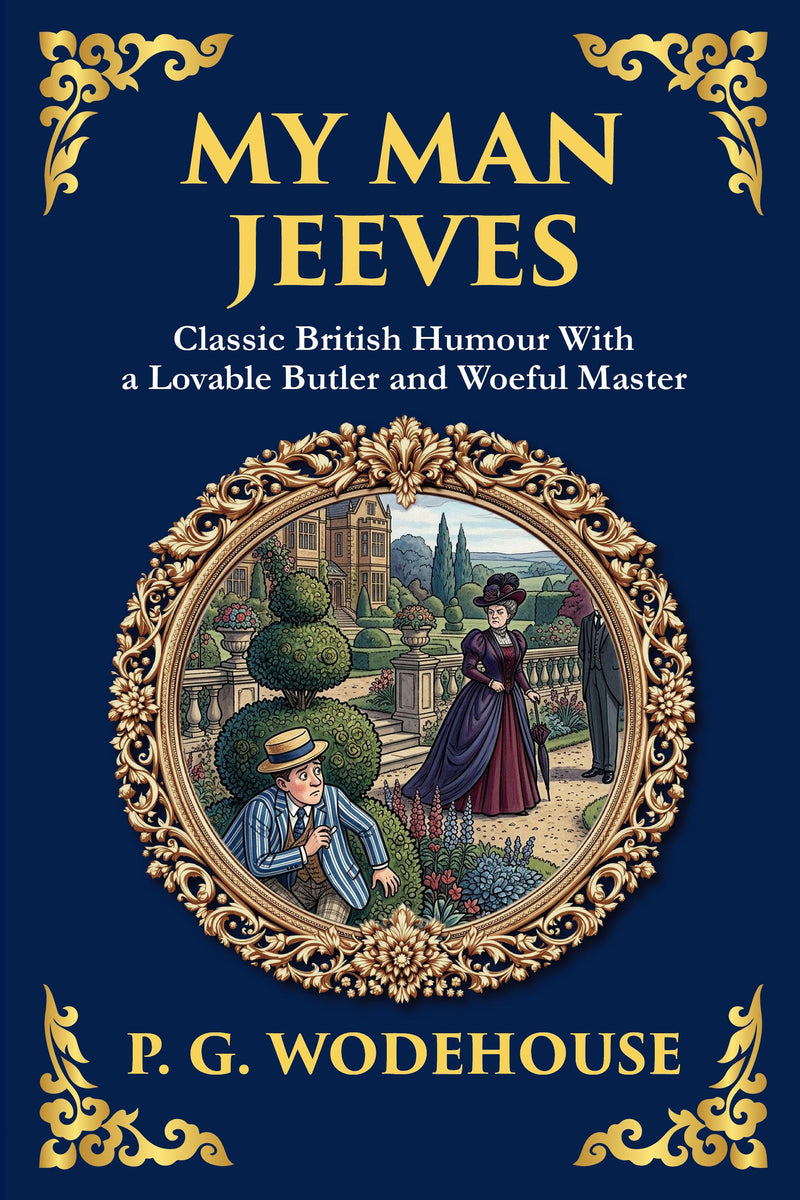
My Man Jeeves — Large Print
Enter the world of Jeeves and Wooster, where chaos meets charm and dignity is constantly under threat from well-meaning aunts, romantic entanglements, and farcical misunderstandings.
or free app
10,000+ hrs library
30-day guarantee
The complete My Man Jeeves appears in modern English through Library of Alexandria Press, available online with audiobook narration included for members.
Have you ever wondered why the cleverest person in the room is rarely the one in charge? Step into the delightfully absurd world of My Man Jeeves, where social calamities, romantic blunders, and eccentric aristocrats run wild—only to be subtly and suavely corrected by the incomparable valet, Jeeves. In this early collection of short stories, P. G. Wodehouse introduces readers to the quintessential British odd couple: the idle, affable Bertie Wooster and the ever- resourceful Jeeves.
Set in Edwardian London and New York, these sparkling comedies feature:
What you’ll discover in this modern edition
- The Debut of a Legendary Duo Meet Jeeves and Wooster for the first time in the stories that launched their iconic literary careers.
- Witty Social Satires Enjoy hilarious misadventures involving matchmaking schemes, club scandals, and upper-class tomfoolery.
- Masterclass in British Humor Discover Wodehouse's signature blend of irony, wordplay, and farce.
- Sharp Class Commentary See how a valet’s intellect repeatedly saves the day while his employer stumbles through society.
- Timeless Lighthearted Escapism Laugh your way through one of the most charming and influential comedic works in English literature.
| Formats | eBook (EPUB + PDF) · Audiobook · Paperback · Hardcover · Large Print |
| Language | English |
| Trim size (print) | 6 × 9 in |
| Binding | Paperback — perfect-bound · Hardcover — casewrap |
| Large Print edition | Same text in a larger, easy-read type — a larger font, not a larger trim |
| Print pricing | Every physical book at our true cost — at-cost, no profit (members) |
| Library | 873 restored titles, always growing |
| Length | 48,460 words · ~3 hr 14 min reading |
| Reading level | Grade 6 · an easy, flowing read (this modern-English edition) |
| Edition | Modern English translation · 2026 |
Member reviews for this edition are collected as readers finish it — be the first. Across the library: 12,000+ books shipped, every plan covered by a 365-day print guarantee.
About this edition
A faithful, unabridged modern-English edition by The Library of Alexandria — carefully rendered for today's reader and verified paragraph-by-paragraph against the public-domain source. Available as eBook, audiobook, paperback, hardcover, and large print.
- Complete & unabridgedVerified paragraph by paragraph against the source — never a scan, never abridged.
- Modern English, faithfulReadable today, with the author’s meaning kept intact. Readable — not simplified.
- Every format, one membershipRead in your browser or the free app, or listen to the full audiobook.
Included free with your membership
Cancel anytime, one click · 30-day money-back guarantee
Edition last updated July 2026
What’s inside
My Man Jeeves — Large Print — complete and unabridged: all 25 sections included with membership, plus the full audiobook.
Begin reading My Man Jeeves — Large Print
In clear modern English — the complete text is included with membership.
Introduction
The summer of 1919 was not, by most measures, a season of laughter. Europe was still sorting through the wreckage of the war that had ended the previous November, the influenza pandemic had only recently loosened its grip on the world, and the political atmosphere on both sides of the Atlantic was charged with anxiety, grievance, and the particular exhaustion that follows catastrophe. Into this atmosphere, P. G. Wodehouse released a slim collection of comic stories about a young English gentleman of spectacular uselessness and his supernaturally competent manservant. The timing, in retrospect, seems less like coincidence than like an act of mercy.
Pelham Grenville Wodehouse — who signed himself P. G. Wodehouse and was known to his friends as Plum — had been writing professionally since the turn of the century, producing school stories, comic novels, lyrics for Broadway musicals, and a steady torrent of magazine fiction on both sides of the Atlantic. By 1919 he was already a practiced entertainer, a man who understood the mechanics of comic prose the way a watchmaker understands the mechanics of springs. But the stories collected here represent something more than professional competence. They represent the moment when a gifted writer found his true subject, his true voice, and the two characters who would define his legacy for the rest of his long career. Bertram Wilberforce Wooster and his valet Reginald Jeeves had appeared in print before this collection — the first Jeeves story was published in a magazine in 1915 — but it is here, gathered together for the first time in book form, that the partnership announces itself as something genuinely new in English literature: a comic universe so internally consistent, so warmly imagined, and so perfectly pitched that readers have been returning to it for more than a century without any sign of diminishing appetite.
It is worth pausing on that word universe, because it is not an exaggeration. What Wodehouse created in these pages is not merely a set of funny situations or a pair of amusing characters. He created a world — a world with its own geography, its own social laws, its own weather, and its own moral atmosphere. It is a world in which the stakes are always low and the comedy is always high, in which aunts are forces of nature and young men are forces of chaos, in which the correct arrangement of a white waistcoat can constitute a genuine crisis and the wrong word to the wrong uncle can precipitate something very like a diplomatic incident. It is a world, crucially, in which everything comes right in the end — not through the exercise of virtue or the intervention of fate, but through the quiet, devastating intelligence of one man who happens to be employed as a personal gentleman’s gentleman.
To understand what you are about to read, it helps to understand the social world from which it springs, because Wodehouse is doing something subtler with that world than he is sometimes given credit for. The England — and, in several of these stories, the America — of the Jeeves tales is a place of inherited wealth, idle young men, and a rigid class structure that is simultaneously taken for granted and gently, persistently mocked. Bertie Wooster belongs to the class of people who have never needed to work and have consequently never developed any particular capacity for it. He is not stupid, exactly — he has moments of genuine perception and a gift for vivid, if chaotic, description — but he is magnificently, cheerfully unequipped for the practical demands of existence. He cannot dress himself to his own satisfaction, cannot navigate the emotional weather of his social circle without causing damage, and cannot conceive a plan of action that does not, within a few steps, begin to resemble a controlled demolition.
Jeeves, by contrast, is everything his employer is not. He is precise where Bertie is approximate, calm where Bertie is excitable, and possessed of a memory and an analytical intelligence that the narrative treats as essentially supernatural. He has read everything, knows everyone’s history, and can produce from the depths of his apparently inexhaustible mind the exact quotation, the exact precedent, or the exact psychological insight required to resolve whatever catastrophe Bertie has most recently stumbled into. He is, in the language of the stories themselves, the brains of the establishment — a fact that Bertie acknowledges with a cheerful lack of embarrassment that is itself one of the great comic gifts of the series.
What makes this dynamic so endlessly pleasurable is the way Wodehouse handles the power relationship between the two men. On the surface, Jeeves is the servant and Bertie is the master. In practice, the arrangement is almost precisely reversed, and both men know it, and neither man says so directly. Jeeves expresses disapproval through the most minimal of signals — a slight cough, a barely perceptible elevation of one eyebrow, a pause before the word “Indeed, sir” that somehow manages to contain an entire essay of polite disagreement. Bertie, for his part, blusters and insists and occasionally puts his foot down, and then, chapter by chapter, story by story, finds himself doing exactly what Jeeves suggested in the first place. The comedy of this arrangement never grows stale because Wodehouse never lets it become cruel. Bertie is not humiliated by his dependence on Jeeves; he is, if anything, rather proud of it, in the way that a man might be proud of owning a particularly magnificent piece of machinery. And Jeeves, for his part, serves Bertie with what appears to be genuine, if carefully modulated, affection. The relationship is a kind of marriage — a comic marriage of opposites — and like the best marriages, it is founded on a mutual recognition that each party supplies what the other lacks.
The stories in this collection are set partly in London and partly in New York, a geographical split that reflects Wodehouse’s own transatlantic life and gives the book a pleasantly cosmopolitan texture. Several of the tales follow Bertie and Jeeves through the social thickets of Manhattan, where Bertie has fetched up in a state of comfortable exile following some unspecified domestic difficulty back in England. The American stories have a slightly different flavor from the purely English ones — the characters Bertie encounters in New York tend to be a shade more eccentric, the social situations a shade more baroque — but the essential comic machinery is identical. Wherever Bertie goes, trouble follows him with the fidelity of a well-trained dog, and wherever trouble appears, Jeeves is there to resolve it with the quiet efficiency of a man who has seen everything and is surprised by nothing.
It is also worth noting, for readers coming to Wodehouse for the first time, that the eight stories collected here are not all Jeeves stories. Four of them — “Absent Treatment,” “Helping Freddie,” “Rallying Round Old George,” and “Doing Clarence a Bit of Good” — feature Bertie as narrator but replace Jeeves with a different set of supporting characters and a slightly different comic register. These stories are narrated in the same irresistible voice, and they are very funny, but they lack the particular magic of the Jeeves dynamic. Reading them alongside the Jeeves stories is instructive: you can feel, in the non-Jeeves tales, a certain something missing, a certain gravitational center that is absent, and this absence clarifies, by contrast, exactly what Jeeves contributes to the stories that do feature him. He is not merely a plot device. He is the still point around which the comic universe turns.
The question of how to read Wodehouse is one that his admirers have debated with the kind of affectionate intensity usually reserved for questions of theology, and it is worth addressing directly, because there are several wrong ways to approach these stories and one right way, and the difference between them is the difference between mild amusement and something approaching joy.
The wrong ways, briefly: do not read these stories quickly, skimming for plot. The plots are, by design, slight — they are scaffolding, not architecture — and if you race through them looking for what happens next, you will miss almost everything that matters. Do not read them with the part of your brain that is looking for depth, significance, or social commentary, at least not on a first reading. Wodehouse is doing something with the English class system, and with the relationship between intelligence and social power, that rewards reflection — but if you approach the stories as satirical documents, you will find them thinner than they are, because the satire is always subordinate to the comedy, always dissolved into it, never allowed to harden into a point. And do not, above all, read them in a hurry or in a state of stress. These stories are not medicine, exactly, though they have been prescribed as such by readers in difficult circumstances for over a century. They are more like a particular quality of afternoon light — the kind that makes everything look slightly better than it is, and makes you feel, for the duration of your exposure to it, that the world is fundamentally a manageable and even a delightful place.
The right way to read Wodehouse is slowly, attentively, and with your ear tuned to the prose. The plots, as noted, are not the point. The point is the sentence. Wodehouse is one of the great English prose stylists — a claim that sometimes surprises people who associate stylistic greatness with difficulty or solemnity — and his sentences reward the same kind of close attention that you might bring to a poet. His similes, in particular, are among the most original and consistently surprising in the language. When Bertie describes a character’s expression, or the atmosphere of a room, or the sensation of receiving bad news before breakfast, the comparison he reaches for is never the expected one, and it is never merely decorative. It illuminates. It makes you see the thing freshly, and it makes you laugh, and these two effects arrive simultaneously, which is one of the rarest achievements in comic writing.
The voice itself — Bertie’s voice, that is, since these stories are all narrated in the first person by Bertie — is a creation of extraordinary subtlety. It sounds, on the surface, like the voice of a cheerful idiot: full of slang, prone to digression, apparently incapable of completing a thought without interrupting it with a parenthetical observation about something entirely different. But listen more carefully and you will notice that the voice is doing something quite precise. The digressions are not random; they are timed. The slang is not lazy; it is chosen. The apparent incoherence of Bertie’s narration is a carefully constructed illusion, maintained by a writer who was in complete control of every word on the page. Bertie sounds like a man who cannot quite keep his thoughts in order; Wodehouse was a man who could keep his thoughts in order with the precision of a Swiss engineer. The gap between the narrator and the author is part of the joke, and once you see it, the stories become even funnier, because you are laughing at two things simultaneously: the situation Bertie is describing, and the artistry with which Wodehouse is making Bertie describe it.
A word about the edition you are holding. This Library of Alexandria Press text presents the stories in contemporary English, which means that certain period idioms have been lightly clarified and certain references that would have been immediately transparent to a 1919 reader have been gently glossed where necessary. The aim throughout has been to preserve the texture and rhythm of Wodehouse’s prose — which is, as argued above, the primary vehicle of the comedy — while removing the small obstacles that can interrupt a modern reader’s pleasure. Nothing of substance has been altered. The plots, the characters, the jokes, and above all the voice are exactly as Wodehouse left them. What has changed is purely cosmetic: the occasional piece of period slang that has drifted so far from common usage that it risks puzzling rather than charming, the occasional cultural reference that requires a footnote in standard editions and has here been briefly contextualized in the text itself. Readers who wish to encounter the stories in their original form will find excellent scholarly editions readily available; this edition is designed for readers who want to encounter the stories in the form most likely to produce uninterrupted pleasure.
Cancel anytime, one click · 30-day money-back guarantee
Founding annual rate available now — your price locks for life when you join.
Not ready? Get this free chapter by email — read it anytime.
✓ Sent — check your inbox for My Man Jeeves — Large Print.
Questions about My Man Jeeves — Large Print
What is My Man Jeeves about?
Enter the world of Jeeves and Wooster, where chaos meets charm and dignity is constantly under threat from well-meaning aunts, romantic entanglements, and farcical misunderstandings. In My Man Jeeves, P. G. Wodehouse introduces readers to the most iconic butler in literary history—Jeeves—whose impeccable logic and dry wit are the perfect antidote to the bumbling misadventures of his employer, Bertie Wooster. These timeless tales of upper-class buffoonery and lower-class brilliance are as laugh-out-loud funny today
Who wrote My Man Jeeves?
My Man Jeeves was written by P. G. Wodehouse. This edition presents the complete work in clear modern English, faithfully rendered from the public-domain original by Library of Alexandria Press.
Is My Man Jeeves free to read?
The opening chapter is free to read on this page. Members read and listen to the complete work — and the entire library — free, and can order any physical book at our true print cost.
How long is My Man Jeeves?
25 chapters (~48,460 words) — about 3 hr 14 min of reading in this modern-English edition.
Is this an abridged version of My Man Jeeves?
No. This is the complete, unabridged My Man Jeeves, carefully rendered into clear modern English and verified paragraph-by-paragraph against the public-domain source — nothing is cut or summarised.
What formats does My Man Jeeves come in?
My Man Jeeves is available as eBook, paperback, hardcover and large print. eBook and audiobook are included with membership; printed editions ship at our true print cost.
Shipping & returns
Billing & membership
More from the library


Explore Humour & Satire
- Tribulations of a Chinaman in China — Large Print · Jules Verne
- Tribulations of a Chinaman in China · Jules Verne
- The Way of the World · William Congreve
- The $30,000 Bequest, and Other Stories — Large Print · Mark Twain
- Erewhon; Or, Over the Range · Samuel Butler
- Arrowsmith — Large Print · Sinclair Lewis
- Max Havelaar; or, The Coffee Auctions of the Dutch Trading Company — Large Print · Multatuli
- Beasts and Super-Beasts · Saki
- All Things Considered — Large Print · G. K. Chesterton
- La Cintia — Large Print · Giambattista della Porta
- All Things Considered · G. K. Chesterton
- Arrowsmith · Sinclair Lewis
- The Ingoldsby Legends; or, Mirth and Marvels · Thomas Ingoldsby
- The Miser — Large Print · Molière
- Much Ado About Nothing — Large Print · William Shakespeare
- Don Juan, or the Stone Feast — Large Print · Molière
- The $30,000 Bequest, and Other Stories · Mark Twain
- The Way of All Flesh — Large Print · Samuel Butler
- La Cintia · Giambattista della Porta
- The Trimmed Lamp, and Other Stories of the Four Million — Large Print · O. Henry
- Max Havelaar; or, The Coffee Auctions of the Dutch Trading Company · Multatuli
- The Miser · Molière
- Much Ado About Nothing · William Shakespeare
- Elizabeth and Her German Garden — Large Print · Elizabeth von Arnim
- The Middle-Class Gentleman — Large Print · Molière
- The Taming of the Shrew — Large Print · William Shakespeare
- Castle Rackrent · Maria Edgeworth
- Lord Arthur Savile's Crime; The Portrait of Mr. W.H., and Other Stories — Large Print · Oscar Wilde
- The Rape of the Lock, and Other Poems — Large Print · Alexander Pope
- The Trimmed Lamp, and Other Stories of the Four Million · O. Henry
My Man Jeeves — Large Print
My Man Jeeves — Large Print
A Modern Translation
P. G. Wodehouse
Contents
- Introduction
- Chapter 1
- Chapter 2
- Chapter 3
- Chapter 4
- Chapter 5
- Chapter 6
- Chapter 7
- Chapter 8
- Chapter 9
- Chapter 10
- Chapter 11
- Chapter 12
- Chapter 13
- Chapter 14
- Chapter 15
- Chapter 16
- Chapter 17
- Chapter 18
- Chapter 19
- Chapter 20
- Chapter 21
- Chapter 22
- Chapter 23
- Chapter 24
Introduction
The summer of 1919 was not, by most measures, a season of laughter. Europe was still sorting through the wreckage of the war that had ended the previous November, the influenza pandemic had only recently loosened its grip on the world, and the political atmosphere on both sides of the Atlantic was charged with anxiety, grievance, and the particular exhaustion that follows catastrophe. Into this atmosphere, P. G. Wodehouse released a slim collection of comic stories about a young English gentleman of spectacular uselessness and his supernaturally competent manservant. The timing, in retrospect, seems less like coincidence than like an act of mercy.
Pelham Grenville Wodehouse — who signed himself P. G. Wodehouse and was known to his friends as Plum — had been writing professionally since the turn of the century, producing school stories, comic novels, lyrics for Broadway musicals, and a steady torrent of magazine fiction on both sides of the Atlantic. By 1919 he was already a practiced entertainer, a man who understood the mechanics of comic prose the way a watchmaker understands the mechanics of springs. But the stories collected here represent something more than professional competence. They represent the moment when a gifted writer found his true subject, his true voice, and the two characters who would define his legacy for the rest of his long career. Bertram Wilberforce Wooster and his valet Reginald Jeeves had appeared in print before this collection — the first Jeeves story was published in a magazine in 1915 — but it is here, gathered together for the first time in book form, that the partnership announces itself as something genuinely new in English literature: a comic universe so internally consistent, so warmly imagined, and so perfectly pitched that readers have been returning to it for more than a century without any sign of diminishing appetite.
It is worth pausing on that word universe, because it is not an exaggeration. What Wodehouse created in these pages is not merely a set of funny situations or a pair of amusing characters. He created a world — a world with its own geography, its own social laws, its own weather, and its own moral atmosphere. It is a world in which the stakes are always low and the comedy is always high, in which aunts are forces of nature and young men are forces of chaos, in which the correct arrangement of a white waistcoat can constitute a genuine crisis and the wrong word to the wrong uncle can precipitate something very like a diplomatic incident. It is a world, crucially, in which everything comes right in the end — not through the exercise of virtue or the intervention of fate, but through the quiet, devastating intelligence of one man who happens to be employed as a personal gentleman’s gentleman.
To understand what you are about to read, it helps to understand the social world from which it springs, because Wodehouse is doing something subtler with that world than he is sometimes given credit for. The England — and, in several of these stories, the America — of the Jeeves tales is a place of inherited wealth, idle young men, and a rigid class structure that is simultaneously taken for granted and gently, persistently mocked. Bertie Wooster belongs to the class of people who have never needed to work and have consequently never developed any particular capacity for it. He is not stupid, exactly — he has moments of genuine perception and a gift for vivid, if chaotic, description — but he is magnificently, cheerfully unequipped for the practical demands of existence. He cannot dress himself to his own satisfaction, cannot navigate the emotional weather of his social circle without causing damage, and cannot conceive a plan of action that does not, within a few steps, begin to resemble a controlled demolition.
Jeeves, by contrast, is everything his employer is not. He is precise where Bertie is approximate, calm where Bertie is excitable, and possessed of a memory and an analytical intelligence that the narrative treats as essentially supernatural. He has read everything, knows everyone’s history, and can produce from the depths of his apparently inexhaustible mind the exact quotation, the exact precedent, or the exact psychological insight required to resolve whatever catastrophe Bertie has most recently stumbled into. He is, in the language of the stories themselves, the brains of the establishment — a fact that Bertie acknowledges with a cheerful lack of embarrassment that is itself one of the great comic gifts of the series.
What makes this dynamic so endlessly pleasurable is the way Wodehouse handles the power relationship between the two men. On the surface, Jeeves is the servant and Bertie is the master. In practice, the arrangement is almost precisely reversed, and both men know it, and neither man says so directly. Jeeves expresses disapproval through the most minimal of signals — a slight cough, a barely perceptible elevation of one eyebrow, a pause before the word “Indeed, sir” that somehow manages to contain an entire essay of polite disagreement. Bertie, for his part, blusters and insists and occasionally puts his foot down, and then, chapter by chapter, story by story, finds himself doing exactly what Jeeves suggested in the first place. The comedy of this arrangement never grows stale because Wodehouse never lets it become cruel. Bertie is not humiliated by his dependence on Jeeves; he is, if anything, rather proud of it, in the way that a man might be proud of owning a particularly magnificent piece of machinery. And Jeeves, for his part, serves Bertie with what appears to be genuine, if carefully modulated, affection. The relationship is a kind of marriage — a comic marriage of opposites — and like the best marriages, it is founded on a mutual recognition that each party supplies what the other lacks.
The stories in this collection are set partly in London and partly in New York, a geographical split that reflects Wodehouse’s own transatlantic life and gives the book a pleasantly cosmopolitan texture. Several of the tales follow Bertie and Jeeves through the social thickets of Manhattan, where Bertie has fetched up in a state of comfortable exile following some unspecified domestic difficulty back in England. The American stories have a slightly different flavor from the purely English ones — the characters Bertie encounters in New York tend to be a shade more eccentric, the social situations a shade more baroque — but the essential comic machinery is identical. Wherever Bertie goes, trouble follows him with the fidelity of a well-trained dog, and wherever trouble appears, Jeeves is there to resolve it with the quiet efficiency of a man who has seen everything and is surprised by nothing.
It is also worth noting, for readers coming to Wodehouse for the first time, that the eight stories collected here are not all Jeeves stories. Four of them — “Absent Treatment,” “Helping Freddie,” “Rallying Round Old George,” and “Doing Clarence a Bit of Good” — feature Bertie as narrator but replace Jeeves with a different set of supporting characters and a slightly different comic register. These stories are narrated in the same irresistible voice, and they are very funny, but they lack the particular magic of the Jeeves dynamic. Reading them alongside the Jeeves stories is instructive: you can feel, in the non-Jeeves tales, a certain something missing, a certain gravitational center that is absent, and this absence clarifies, by contrast, exactly what Jeeves contributes to the stories that do feature him. He is not merely a plot device. He is the still point around which the comic universe turns.
The question of how to read Wodehouse is one that his admirers have debated with the kind of affectionate intensity usually reserved for questions of theology, and it is worth addressing directly, because there are several wrong ways to approach these stories and one right way, and the difference between them is the difference between mild amusement and something approaching joy.
The wrong ways, briefly: do not read these stories quickly, skimming for plot. The plots are, by design, slight — they are scaffolding, not architecture — and if you race through them looking for what happens next, you will miss almost everything that matters. Do not read them with the part of your brain that is looking for depth, significance, or social commentary, at least not on a first reading. Wodehouse is doing something with the English class system, and with the relationship between intelligence and social power, that rewards reflection — but if you approach the stories as satirical documents, you will find them thinner than they are, because the satire is always subordinate to the comedy, always dissolved into it, never allowed to harden into a point. And do not, above all, read them in a hurry or in a state of stress. These stories are not medicine, exactly, though they have been prescribed as such by readers in difficult circumstances for over a century. They are more like a particular quality of afternoon light — the kind that makes everything look slightly better than it is, and makes you feel, for the duration of your exposure to it, that the world is fundamentally a manageable and even a delightful place.
The right way to read Wodehouse is slowly, attentively, and with your ear tuned to the prose. The plots, as noted, are not the point. The point is the sentence. Wodehouse is one of the great English prose stylists — a claim that sometimes surprises people who associate stylistic greatness with difficulty or solemnity — and his sentences reward the same kind of close attention that you might bring to a poet. His similes, in particular, are among the most original and consistently surprising in the language. When Bertie describes a character’s expression, or the atmosphere of a room, or the sensation of receiving bad news before breakfast, the comparison he reaches for is never the expected one, and it is never merely decorative. It illuminates. It makes you see the thing freshly, and it makes you laugh, and these two effects arrive simultaneously, which is one of the rarest achievements in comic writing.
The voice itself — Bertie’s voice, that is, since these stories are all narrated in the first person by Bertie — is a creation of extraordinary subtlety. It sounds, on the surface, like the voice of a cheerful idiot: full of slang, prone to digression, apparently incapable of completing a thought without interrupting it with a parenthetical observation about something entirely different. But listen more carefully and you will notice that the voice is doing something quite precise. The digressions are not random; they are timed. The slang is not lazy; it is chosen. The apparent incoherence of Bertie’s narration is a carefully constructed illusion, maintained by a writer who was in complete control of every word on the page. Bertie sounds like a man who cannot quite keep his thoughts in order; Wodehouse was a man who could keep his thoughts in order with the precision of a Swiss engineer. The gap between the narrator and the author is part of the joke, and once you see it, the stories become even funnier, because you are laughing at two things simultaneously: the situation Bertie is describing, and the artistry with which Wodehouse is making Bertie describe it.
A word about the edition you are holding. This Library of Alexandria Press text presents the stories in contemporary English, which means that certain period idioms have been lightly clarified and certain references that would have been immediately transparent to a 1919 reader have been gently glossed where necessary. The aim throughout has been to preserve the texture and rhythm of Wodehouse’s prose — which is, as argued above, the primary vehicle of the comedy — while removing the small obstacles that can interrupt a modern reader’s pleasure. Nothing of substance has been altered. The plots, the characters, the jokes, and above all the voice are exactly as Wodehouse left them. What has changed is purely cosmetic: the occasional piece of period slang that has drifted so far from common usage that it risks puzzling rather than charming, the occasional cultural reference that requires a footnote in standard editions and has here been briefly contextualized in the text itself. Readers who wish to encounter the stories in their original form will find excellent scholarly editions readily available; this edition is designed for readers who want to encounter the stories in the form most likely to produce uninterrupted pleasure.
Leave It to Jeeves Jeeves and the Unbidden Guest Jeeves and the Hard-Boiled Egg Absent Treatment Helping Freddie Rallying Round Old George Doing Clarence a Bit of Good The Aunt and the Sluggard
Jeeves—my valet, you know—is truly an extraordinary guy. So capable. Honestly, I wouldn’t know what to do without him. In a general sense, he’s like those guys who sit looking sadly over the marble counters at the “Inquiries” desk at Pennsylvania Station. You know the types I mean. You walk up to them and ask, “When is the next train for Melonsquashville, Tennessee?” and they answer, without even pausing to think, “Two-forty-three, track ten, change at San Francisco.” And they are right every single time. Well, Jeeves gives you that same impression of knowing everything.
As an example of what I mean, I remember meeting Monty Byng on Bond Street one morning; he was wearing a grey check suit that was the height of fashion, and I felt I could never be happy until I had one just like it. I got the address of the tailors out of him and had them starting on the suit within the hour.
“Jeeves,” I said that evening. “I’m getting a check suit like the one Mr. Byng has.”
“Injudicious, sir,” he said firmly. “It will not suit you.”
“What absolute nonsense! It’s the smartest idea I’ve had in years.”
Well, the long and short of it was that the damn thing arrived, I put it on, and when I saw myself in the mirror, I nearly fainted. Jeeves was perfectly right. I looked like a cross between a vaudeville comedian and a cheap bookie. Yet Monty had looked great in the exact same fabric. These things are just life’s mysteries, and that’s all there is to it.
End of the free sample
Keep reading, free
Members read and listen to the complete book — and the entire library. Cancel anytime, one click · 30-day money-back guarantee.