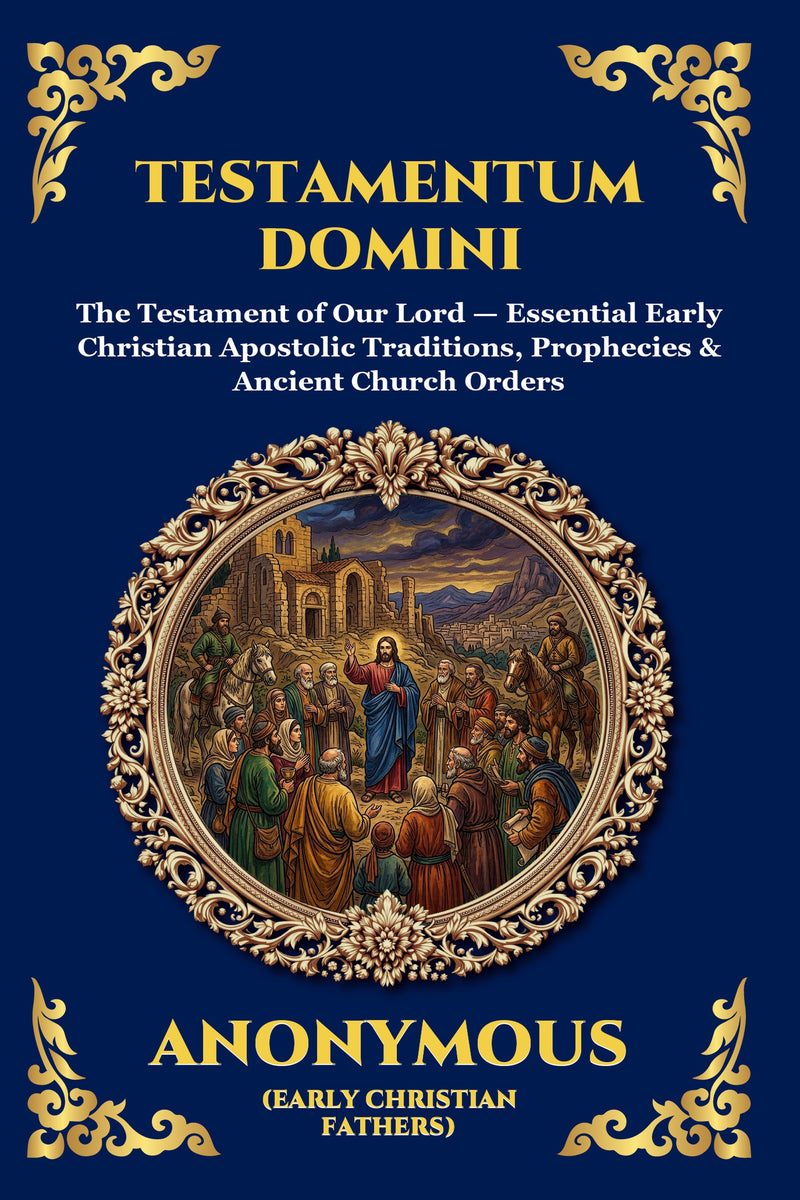
The Testament of Our Lord — Large Print
The Testamentum Domini claims to be the Lord's own instructions to the Apostles for navigating the end times. This text, omitted from the biblical canon, reveals how early Christians balanced apocalyptic urgency with the foundations of enduring Church traditions.
or free app
10,000+ hrs library
30-day guarantee
The Library of Alexandria Press presents the complete Testamentum Domini in modern English translation, readable online with audiobook narration included for members.
How does a community prepare for the last days while ordering its prayers, choosing its leaders, and building its church?
The Testament of Our Lord, also known as the Testamentum Domini, presents itself as the risen Christ's instructions to his apostles. Its opening vision describes the last days, warning of hardship, false teachers, and the coming of the Adversary. Here, the prospect of trouble frames the question of how believers should live together.
The longer second part turns from apocalypse to practical order: the arrangement of a church, the duties of ministers, and the pattern of worship. Written by an unknown author, this early Christian church order brings together prayers, rules, and rites. It remains outside the Bible and offers detailed instructions rather than a Gospel or a story.
Inside this book
- A vision of trials – Explore warnings about false teachers and the Adversary within the text's vision of the last days.
- A place for worship – Discover how instructions for arranging a church building give communal worship a concrete setting.
- The choosing of bishops – Examine ordination prayers, the people's consent, and the laying on of hands by other bishops.
- Prayer through the hours – Follow a rhythm of prayer that marks the community's life through day and night.
- Baptism and the Eucharist – Read detailed instructions for these rites alongside rules governing the lives of church ministers.
Perfect for readers of early church history, students of Christian worship, and anyone curious about how ancient communities organise their lives.
Open the first page and explore a community's rules for worship and life under the shadow of the last days.
| Formats | eBook (EPUB + PDF) · Audiobook · Paperback · Hardcover · Large Print |
| Language | English |
| Trim size (print) | 6 × 9 in |
| Binding | Paperback — perfect-bound · Hardcover — casewrap |
| Large Print edition | Same text in a larger, easy-read type — a larger font, not a larger trim |
| Print pricing | Every physical book at our true cost — at-cost, no profit (members) |
| Library | 873 restored titles, always growing |
| Composed | 4th-5th century AD |
| Original language | Syriac |
| Source tradition | Syriac and Arabic manuscript tradition |
| Translation basis | Public-domain scholarly translation, rendered in clear modern English |
| Edition | Modern English translation · 2026 |
Member reviews for this edition are collected as readers finish it — be the first. Across the library: 12,000+ books shipped, every plan covered by a 365-day print guarantee.
About this edition
The complete, unabridged text in clear modern English — faithful to the original, never simplified. Every paragraph is checked against the source, so nothing is cut, summarised, or paraphrased away. It reads cleanly for today while keeping the original meaning intact.
This edition derives from Syriac and Arabic manuscript traditions, based on standard scholarly translations, rendered here in clear modern English for contemporary readers.
- Complete & unabridgedVerified paragraph by paragraph against the source — never a scan, never abridged.
- Modern English, faithfulReadable today, with the author’s meaning kept intact. Readable — not simplified.
- Every format, one membershipRead in your browser or the free app, or listen to the full audiobook.
Included free with your membership
Cancel anytime, one click · 30-day money-back guarantee
Edition last updated June 2026
Questions about The Testament of Our Lord — Large Print
What is the Testament of Our Lord about?
It is an early Christian church order presented as Christ's teaching to his apostles after the resurrection. It describes the last days and the Adversary, then gives rules for church buildings, clergy, baptism, the Eucharist and daily prayer.
When was the Testamentum Domini written?
Scholars generally date it to the fourth or fifth century, probably in Syria or nearby lands. It was most likely written in Greek, but the Greek is lost, and the complete text survives in Syriac.
Is the Testament of Our Lord in the Bible?
No. It was never counted among the books of the New Testament. It belongs to the church order tradition, which gave practical rules for communities, and it was valued mainly in some Eastern churches.
Who is the Adversary in this text?
The Adversary is the great opponent who appears before the end of the age and deceives many. He matches the figure many Christian writers call the Antichrist, and the text warns believers to be watchful.
Shipping & returns
Billing & membership
More from the library


Explore All books
- Crime and Punishment · Fyodor Dostoyevsky
- Wuthering Heights · Emily Brontë
- Oliver Twist · Charles Dickens
- Pride and Prejudice · Jane Austen
- The Iliad · Homer
- Romeo and Juliet · William Shakespeare
- The Picture of Dorian Gray · Oscar Wilde
- Macbeth · William Shakespeare
- Alice's Adventures in Wonderland · Lewis Carroll
- Le Yi King · Anonyme
- Frankenstein · Mary Shelley
- Grimms' Fairy Tales · Jacob Grimm; Wilhelm Grimm
- Max et Moritz : une histoire de sept espiègleries · Wilhelm Busch
- A Christmas Carol · Charles Dickens
- The Odyssey · Homer
- Le Paradis perdu · John Milton
- L’Île au trésor · Robert Louis Stevenson
- Le Roman de Tristan et Iseut · Joseph Bédier
- The Prince · Niccolò Machiavelli
- Guerre et Paix · Léon Tolstoï
- L’Avare · Molière
- L’Énéide · Virgile
- Rip Van Winkle · Washington Irving
- David Copperfield · Charles Dickens
- The Brothers Karamazov · Fyodor Dostoyevsky
- Les Souffrances du jeune Werther · Johann Wolfgang von Goethe
- The Great Gatsby · F. Scott Fitzgerald
- Contes nocturnes · E. T. A. Hoffmann
- Le Comte de Monte-Cristo · Alexandre Dumas ; Auguste Maquet
- Wisdom of Jesus ben Sirach · Attributed to Joshua ben Sira