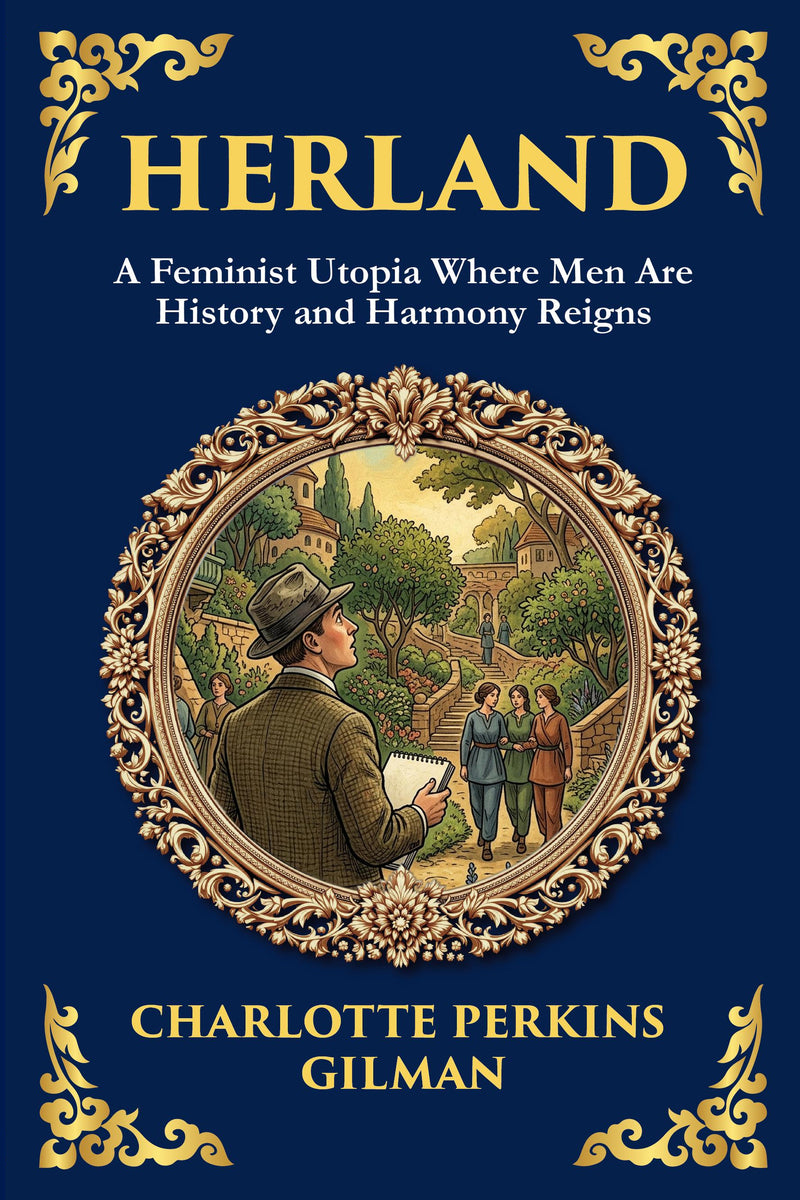
Herland
In Herland, Charlotte Perkins Gilman dares to imagine the unimaginable: a thriving utopia sustained solely by women, untouched by the influence of men.
or free app
10,000+ hrs library
30-day guarantee
The complete Herland appears in modern English through Library of Alexandria Press, available online with audiobook narration included for members.
Three men enter a country without men—and find their own ideas of civilization under examination.
In Charlotte Perkins Gilman’s Herland, three American explorers follow a rumor into an isolated country inhabited entirely by women. They expect a world they can understand on their own terms. Instead, they find neat forests, safe roads, calm cities, and people who see no reason to fear them.
Vandyck Jennings, known as Van, tells the story as a sociologist eager to study this unfamiliar society. Alongside Terry Nicholson and Jeff Margrave, he meets women whose ways of working, teaching, and raising children unsettle familiar beliefs. The adventure becomes a comic test of what the visitors think is natural—and what they have simply learned to expect.
What you'll discover
- A world built differently – Explore a peaceful country where cooperation shapes daily life, from its forests to its cities.
- Explorers out of their depth – Watch Van, Terry, and Jeff struggle when confidence proves a poor guide to understanding.
- Questions that turn inward – Meet Ellador, whose direct questions make Van look again at the world he knows.
- Motherhood as shared purpose – Discover a society that places raising the next generation at the center of public life.
- Satire with serious stakes – Follow Gilman’s challenge to assumptions about gender, family, work, and the force of custom.
Perfect for readers who enjoy ideas wrapped in adventure, early feminist writing, and utopian fiction that favors thought over thrills.
Open the first page now, and follow the explorers into a world that questions their certainties.
| Formats | eBook (EPUB + PDF) · Audiobook · Paperback · Hardcover · Large Print |
| Language | English |
| Trim size (print) | 6 × 9 in |
| Binding | Paperback — perfect-bound · Hardcover — casewrap |
| Large Print edition | Same text in a larger, easy-read type — a larger font, not a larger trim |
| Print pricing | Every physical book at our true cost — at-cost, no profit (members) |
| Library | 873 restored titles, always growing |
| Length | 54,842 words · ~3 hr 39 min reading |
| Reading level | Grade 7 · an easy, flowing read (this modern-English edition) |
| Edition | Modern English translation · 2026 |
Member reviews for this edition are collected as readers finish it — be the first. Across the library: 12,000+ books shipped, every plan covered by a 365-day print guarantee.
About this edition
A faithful, unabridged modern-English edition by The Library of Alexandria — carefully rendered for today's reader and verified paragraph-by-paragraph against the public-domain source. Available as eBook, audiobook, paperback, hardcover, and large print.
- Complete & unabridgedVerified paragraph by paragraph against the source — never a scan, never abridged.
- Modern English, faithfulReadable today, with the author’s meaning kept intact. Readable — not simplified.
- Every format, one membershipRead in your browser or the free app, or listen to the full audiobook.
Included free with your membership
Cancel anytime, one click · 30-day money-back guarantee
Edition last updated July 2026
What’s inside
Herland — complete and unabridged: all 13 sections included with membership, plus the full audiobook.
Begin reading Herland
In clear modern English — the complete text is included with membership.
Introduction
There are books that entertain, books that instruct, and a rare few that quietly rearrange the furniture of the mind so completely that the reader can never quite see the world the same way again. Herland belongs unmistakably to this third category. First serialized in 1915 in Charlotte Perkins Gilman’s own monthly magazine, The Forerunner, it lay almost forgotten for more than six decades before being rediscovered and published as a stand-alone book in 1979. Since then it has become one of the foundational texts of feminist literature and a beloved touchstone of speculative and utopian fiction. To open it today is to step into a thought experiment of extraordinary generosity and wit—an imagined country where, for two thousand years, women have built a civilization entirely without men, and where the visiting reader is invited to ask, gently but relentlessly, why our own world is arranged the way it is.
This modern edition has been carefully adapted to make Gilman’s vision as immediate and accessible as it was for her original audience. The language has been smoothed where the cadences of a century ago might trip a contemporary reader, the occasional archaic turn of phrase clarified, and the rhythm tuned for present-day ears. What has not been touched is the substance of Gilman’s argument, the buoyancy of her humor, or the deep tenderness that animates her imagined nation. The goal throughout has been fidelity to her spirit: to let a brilliant, mischievous, profoundly humane writer speak clearly across the distance of more than a hundred years, so that the questions she raised in 1915 land with full force in a world that is still, in many ways, struggling to answer them.
To understand Herland, it helps enormously to understand the woman who wrote it, because few authors have ever embodied their convictions so completely or paid so dearly for them. Charlotte Perkins Gilman was born in 1860 in Hartford, Connecticut, into a family with a formidable intellectual pedigree—she was a grandniece of Harriet Beecher Stowe, whose Uncle Tom’s Cabin had helped shake the conscience of a nation. But that distinguished lineage brought little comfort to Charlotte’s childhood. Her father abandoned the family early, leaving her mother to raise the children in genteel poverty, moving from one rented home to another, and withholding physical affection from her daughter in the mistaken belief that doing so would toughen the girl against future disappointment. It was a lonely, undernourished beginning, and it left Gilman with a lifelong hunger to understand how human beings—especially women—come to be shaped by the conditions in which they are raised.
Largely self-educated, fiercely curious, and determined to make her own way, Gilman briefly attended the Rhode Island School of Design and supported herself for a time as a commercial artist and tutor. In 1884 she married the artist Charles Walter Stetson, and within a year gave birth to a daughter. What followed has become one of the most famous and harrowing episodes in American literary history. Gilman sank into a severe postpartum depression, and the celebrated physician Silas Weir Mitchell prescribed his notorious “rest cure”—a regimen of total isolation, enforced inactivity, and the prohibition of all intellectual stimulation. She was instructed to “live as domestic a life as possible,” to keep her child with her at all times, and to “never touch pen, brush, or pencil” again. The treatment, intended to restore her, very nearly destroyed her. She would later write that she came “perilously close to losing my mind.”
Out of that experience came her stunning short story “The Yellow Wallpaper” (1892), a chilling first-person account of a woman driven to madness by exactly such a confinement. It is now regarded as a masterpiece of American Gothic and a devastating indictment of the way medicine and marriage could collude to silence women. But Gilman did more than write about her ordeal; she escaped it. She left her marriage—a scandalous act for a woman in the 1890s—moved to California, and rebuilt her life as a writer, lecturer, and social theorist. In a decision that drew enormous public condemnation, she later sent her daughter to live with her former husband and his second wife, believing the child would be better served and that she herself could do more good in the world unencumbered. Whatever one makes of that choice, it reveals a woman willing to defy nearly every expectation placed upon her sex in order to pursue her work.
And that work was prodigious. In 1898 she published Women and Economics, a sweeping analysis of the financial dependence of women upon men, which she argued was the root cause of nearly every distortion in relations between the sexes. The book was translated into seven languages and made her an international figure. She went on to write studies on the home, on motherhood, on social organization, and on the ways that culture—not nature—shapes what we assume to be eternal truths about gender. From 1909 to 1916 she single-handedly wrote, edited, and published The Forerunner, a monthly magazine in which she produced essays, poetry, reviews, and serialized novels, including Herland. She estimated that the magazine contained, over its run, the equivalent of twenty-eight books’ worth of her own writing. Few authors in history have ever been so productive or so thoroughly committed to using literature as an instrument of social change.
Gilman’s central conviction—the engine driving everything she wrote—was that the qualities we attribute to “human nature” are very often nothing more than the residue of social conditioning. The submissiveness expected of women, the aggression celebrated in men, the structure of the family, the design of the home, the very shape of the economy: all of these, she insisted, were inventions, not inevitabilities. And if they were invented, they could be reinvented. Herland is, in many ways, the warmest and most playful expression of this lifelong argument. Where “The Yellow Wallpaper” showed the nightmare of a society that crushed women, Herland dares to imagine the dream of a society that never did.
It is worth acknowledging, as modern readers should, that Gilman’s thought was not without its serious flaws. Like many progressive reformers of her era, she held views shaped by the eugenic theories then fashionable among intellectuals, and some of her writings reflect the racial and ethnic prejudices of her time. These are not to be excused or hidden, and a thoughtful reader will encounter occasional assumptions in her broader body of work that we rightly reject today. But to read Herland is to encounter Gilman at her most hopeful and her most generous, and the novel’s enduring power lies precisely in its capacity to make us examine our own unconscious assumptions—a project that, taken to its logical end, undermines the very prejudices that marred her age and our own.
Herland is the second installment in a loose trilogy of utopian novels Gilman wrote, sitting between Moving the Mountain (1911) and its own direct sequel, With Her in Ourland (1916). But it stands entirely on its own, and it remains by far the most beloved and frequently read of the three. The premise is delightfully simple, and Gilman wastes no time setting it in motion. Three young American men—adventurous, confident, and thoroughly the products of their early-twentieth-century upbringing—hear rumors of a remote, isolated land said to be inhabited entirely by women. Intrigued, skeptical, and not a little smug, they mount an expedition to find it.
What they discover upends every expectation they carry with them. Rather than tell you what they find—for half the joy of this book is the gradual unfolding of its wonders—it is enough to say that Gilman has constructed her imagined civilization with the meticulous care of a social scientist and the loving attention of an artist. Nothing in Herland is arbitrary. Every feature of this world, from its forests to its food, from its architecture to its child-rearing, has been thought through to its roots. Gilman wants us to see not merely a different society but a coherent one—a place whose every part follows logically from its founding conditions and its guiding values.
The genius of Gilman’s narrative strategy lies in her choice of narrator. The story is told to us by Vandyck Jennings—“Van”—a sociologist, and the most thoughtful and observant of the three men. Through his eyes we encounter the new land, and through his gradual, sometimes reluctant education we are educated ourselves. Van is a perfect guide precisely because he is intelligent enough to revise his views and honest enough to admit when he has been wrong. His two companions represent the poles between which he moves. There is Terry, wealthy, dashing, and utterly convinced of his irresistible appeal to women and his natural right to dominate them; and there is Jeff, romantic and chivalrous, who idealizes women so thoroughly that he can scarcely see them as real people at all. Between Terry’s contempt and Jeff’s worship stands Van, trying to understand.
This trio is one of Gilman’s sharpest inventions, for the three men embody three distinct attitudes that men of her era—and ours—commonly held toward women. By dropping all three into a world that simply does not run on their assumptions, Gilman is able to expose those assumptions with surgical precision and considerable comedy. The humor of Herland is one of its most underappreciated pleasures. Gilman could be biting, but here she is mostly genial, and a great deal of the book’s charm comes from watching her three protagonists trip over their own preconceptions. The women they meet are not impressed by Terry’s posturing, not flustered by Jeff’s gallantry, and not at all what any of the three expected. The questions the men ask reveal, again and again, far more about the world they come from than about the world they are visiting.
This is the deep structure of the book, and it is what gives Herland its peculiar and lasting force. It is not really a novel about a faraway country at all. It is a novel about us—about the readers, about the men, about the assumptions we carry so deeply that we never think to question them. Every time a character from the imagined land asks an innocent question about how things are done “back home,” we are invited to see our own arrangements from the outside, as a curious anthropologist might. Why do we organize families the way we do? Why do we raise children as we do? Why do we accept competition, ownership, and dominance as natural laws rather than as choices? Gilman never lectures; she simply lets the contrast do its work, and the result is a book that feels less like an argument than like a slow awakening.
It should be said clearly that Herland is a utopia, and utopias have their own distinctive pleasures and their own characteristic limitations. The word itself, coined by Thomas More in 1516, is a pun meaning both “good place” and “no place”—a perfect place that exists nowhere. Readers who come to Herland expecting the breathless plot machinery of a modern adventure novel may need to adjust their expectations, for Gilman is more interested in ideas than in incident, in dialogue than in derring-do. Much of the book consists of conversation: the men asking questions, the inhabitants explaining their ways, and everyone slowly coming to understand one another. But to call this “slow” would be to miss the point entirely. The drama of Herland is intellectual and emotional rather than physical, and for the reader willing to enter into its spirit, the experience is wonderfully absorbing. There is genuine suspense in watching whether the three men can change, genuine tension in the encounter between two utterly different worldviews, and genuine warmth in the relationships that develop.
What sets Herland apart from many earlier utopian writings is the particular cluster of concerns at its heart. Gilman was passionately interested in motherhood—not as a private sentimental duty but as a vast social enterprise, the foundation on which an entire civilization might be built. The society she imagines treats the raising of children as its highest collective art and its most carefully studied science. She was equally interested in cooperation as an alternative to competition, in education as the central activity of a healthy community, and in the relationship between human beings and the natural world. These themes give Herland a strikingly contemporary feel. Long before the modern environmental movement, Gilman imagined a people living in genuine harmony with their land, cultivating it with intelligence and reverence. Long before contemporary debates about work, family, and the organization of care, she was asking how a society might be structured so that nurturing and raising the next generation were honored rather than taken for granted.
Cancel anytime, one click · 30-day money-back guarantee
Founding annual rate available now — your price locks for life when you join.
Not ready? Get this free chapter by email — read it anytime.
✓ Sent — check your inbox for Herland.
Questions about Herland
What is Herland about?
Herland tells how three American men find a hidden country inhabited only by women. As they learn its language and customs, they discover a peaceful, orderly society that challenges their ideas about gender, family and work.
When was Herland written and published?
Charlotte Perkins Gilman wrote Herland in 1915 and ran it in monthly installments in her magazine, The Forerunner. It was not published as a book until 1979, long after her death.
Who are the main characters in Herland?
The three male explorers are Van, Terry and Jeff, and Van tells the story. Their partners in Herland are Ellador, Alima and Celis. Somel is one of the women who teaches them the language.
Is Herland a true story?
No, it is a work of fiction and a utopian novel. Gilman invented the hidden country to imagine how a society might work if women ran it and focused on the care of children and the land.
Shipping & returns
Billing & membership
More from the library


Explore Humour & Satire
- A Midsummer Night's Dream · William Shakespeare
- Utopia — Large Print · Thomas More
- Utopia · Thomas More
- A Woman of No Importance — Large Print · Oscar Wilde
- A Woman of No Importance · Oscar Wilde
- Barry Lyndon — Large Print · William Makepeace Thackeray
- A Midsummer Night's Dream — Large Print · William Shakespeare
- Penrod — Large Print · Booth Tarkington
- Candide — Large Print · Voltaire
- Mark Twain's Speeches · Mark Twain
- Mark Twain's Speeches — Large Print · Mark Twain
- Tartuffe; Or, The Hypocrite · Molière
- Sartor Resartus: The Life and Opinions of Herr Teufelsdröckh — Large Print · Thomas Carlyle
- Tartuffe; Or, The Hypocrite — Large Print · Molière
- The Man Who Was Thursday: A Nightmare · G. K. Chesterton
- Flatland: A Romance of Many Dimensions · Edwin Abbott Abbott
- Flatland: A Romance of Many Dimensions — Large Print · Edwin Abbott Abbott
- Pygmalion · Bernard Shaw
- Pygmalion — Large Print · Bernard Shaw
- The Man Who Was Thursday: A Nightmare — Large Print · G. K. Chesterton
- Northanger Abbey — Large Print · Jane Austen
- A Connecticut Yankee in King Arthur's Court — Large Print · Mark Twain
- The Confidence-Man: His Masquerade — Large Print · Herman Melville
- Lady Windermere's Fan — Large Print · Oscar Wilde
- Lady Windermere's Fan · Oscar Wilde
- Twelfth Night; Or, What You Will — Large Print · William Shakespeare
- Twelfth Night; Or, What You Will · William Shakespeare
- The Adventures of Ferdinand Count Fathom — Complete — Large Print · Tobias Smollett
- Lucian's True History — Large Print · Lucian of Samosata
- The Adventures of Ferdinand Count Fathom — Complete · Tobias Smollett
Herland
Herland
A Feminist Utopia Where Men Are History and Harmony Reigns
Charlotte Perkins Gilman
Contents
- Introduction
- Chapter 1
- Chapter 2
- Chapter 3
- Chapter 4
- Chapter 5
- Chapter 6
- Chapter 7
- Chapter 8
- Chapter 9
- Chapter 10
- Chapter 11
- Chapter 12
Introduction
There are books that entertain, books that instruct, and a rare few that quietly rearrange the furniture of the mind so completely that the reader can never quite see the world the same way again. Herland belongs unmistakably to this third category. First serialized in 1915 in Charlotte Perkins Gilman’s own monthly magazine, The Forerunner, it lay almost forgotten for more than six decades before being rediscovered and published as a stand-alone book in 1979. Since then it has become one of the foundational texts of feminist literature and a beloved touchstone of speculative and utopian fiction. To open it today is to step into a thought experiment of extraordinary generosity and wit—an imagined country where, for two thousand years, women have built a civilization entirely without men, and where the visiting reader is invited to ask, gently but relentlessly, why our own world is arranged the way it is.
This modern edition has been carefully adapted to make Gilman’s vision as immediate and accessible as it was for her original audience. The language has been smoothed where the cadences of a century ago might trip a contemporary reader, the occasional archaic turn of phrase clarified, and the rhythm tuned for present-day ears. What has not been touched is the substance of Gilman’s argument, the buoyancy of her humor, or the deep tenderness that animates her imagined nation. The goal throughout has been fidelity to her spirit: to let a brilliant, mischievous, profoundly humane writer speak clearly across the distance of more than a hundred years, so that the questions she raised in 1915 land with full force in a world that is still, in many ways, struggling to answer them.
To understand Herland, it helps enormously to understand the woman who wrote it, because few authors have ever embodied their convictions so completely or paid so dearly for them. Charlotte Perkins Gilman was born in 1860 in Hartford, Connecticut, into a family with a formidable intellectual pedigree—she was a grandniece of Harriet Beecher Stowe, whose Uncle Tom’s Cabin had helped shake the conscience of a nation. But that distinguished lineage brought little comfort to Charlotte’s childhood. Her father abandoned the family early, leaving her mother to raise the children in genteel poverty, moving from one rented home to another, and withholding physical affection from her daughter in the mistaken belief that doing so would toughen the girl against future disappointment. It was a lonely, undernourished beginning, and it left Gilman with a lifelong hunger to understand how human beings—especially women—come to be shaped by the conditions in which they are raised.
Largely self-educated, fiercely curious, and determined to make her own way, Gilman briefly attended the Rhode Island School of Design and supported herself for a time as a commercial artist and tutor. In 1884 she married the artist Charles Walter Stetson, and within a year gave birth to a daughter. What followed has become one of the most famous and harrowing episodes in American literary history. Gilman sank into a severe postpartum depression, and the celebrated physician Silas Weir Mitchell prescribed his notorious “rest cure”—a regimen of total isolation, enforced inactivity, and the prohibition of all intellectual stimulation. She was instructed to “live as domestic a life as possible,” to keep her child with her at all times, and to “never touch pen, brush, or pencil” again. The treatment, intended to restore her, very nearly destroyed her. She would later write that she came “perilously close to losing my mind.”
Out of that experience came her stunning short story “The Yellow Wallpaper” (1892), a chilling first-person account of a woman driven to madness by exactly such a confinement. It is now regarded as a masterpiece of American Gothic and a devastating indictment of the way medicine and marriage could collude to silence women. But Gilman did more than write about her ordeal; she escaped it. She left her marriage—a scandalous act for a woman in the 1890s—moved to California, and rebuilt her life as a writer, lecturer, and social theorist. In a decision that drew enormous public condemnation, she later sent her daughter to live with her former husband and his second wife, believing the child would be better served and that she herself could do more good in the world unencumbered. Whatever one makes of that choice, it reveals a woman willing to defy nearly every expectation placed upon her sex in order to pursue her work.
And that work was prodigious. In 1898 she published Women and Economics, a sweeping analysis of the financial dependence of women upon men, which she argued was the root cause of nearly every distortion in relations between the sexes. The book was translated into seven languages and made her an international figure. She went on to write studies on the home, on motherhood, on social organization, and on the ways that culture—not nature—shapes what we assume to be eternal truths about gender. From 1909 to 1916 she single-handedly wrote, edited, and published The Forerunner, a monthly magazine in which she produced essays, poetry, reviews, and serialized novels, including Herland. She estimated that the magazine contained, over its run, the equivalent of twenty-eight books’ worth of her own writing. Few authors in history have ever been so productive or so thoroughly committed to using literature as an instrument of social change.
Gilman’s central conviction—the engine driving everything she wrote—was that the qualities we attribute to “human nature” are very often nothing more than the residue of social conditioning. The submissiveness expected of women, the aggression celebrated in men, the structure of the family, the design of the home, the very shape of the economy: all of these, she insisted, were inventions, not inevitabilities. And if they were invented, they could be reinvented. Herland is, in many ways, the warmest and most playful expression of this lifelong argument. Where “The Yellow Wallpaper” showed the nightmare of a society that crushed women, Herland dares to imagine the dream of a society that never did.
It is worth acknowledging, as modern readers should, that Gilman’s thought was not without its serious flaws. Like many progressive reformers of her era, she held views shaped by the eugenic theories then fashionable among intellectuals, and some of her writings reflect the racial and ethnic prejudices of her time. These are not to be excused or hidden, and a thoughtful reader will encounter occasional assumptions in her broader body of work that we rightly reject today. But to read Herland is to encounter Gilman at her most hopeful and her most generous, and the novel’s enduring power lies precisely in its capacity to make us examine our own unconscious assumptions—a project that, taken to its logical end, undermines the very prejudices that marred her age and our own.
Herland is the second installment in a loose trilogy of utopian novels Gilman wrote, sitting between Moving the Mountain (1911) and its own direct sequel, With Her in Ourland (1916). But it stands entirely on its own, and it remains by far the most beloved and frequently read of the three. The premise is delightfully simple, and Gilman wastes no time setting it in motion. Three young American men—adventurous, confident, and thoroughly the products of their early-twentieth-century upbringing—hear rumors of a remote, isolated land said to be inhabited entirely by women. Intrigued, skeptical, and not a little smug, they mount an expedition to find it.
What they discover upends every expectation they carry with them. Rather than tell you what they find—for half the joy of this book is the gradual unfolding of its wonders—it is enough to say that Gilman has constructed her imagined civilization with the meticulous care of a social scientist and the loving attention of an artist. Nothing in Herland is arbitrary. Every feature of this world, from its forests to its food, from its architecture to its child-rearing, has been thought through to its roots. Gilman wants us to see not merely a different society but a coherent one—a place whose every part follows logically from its founding conditions and its guiding values.
The genius of Gilman’s narrative strategy lies in her choice of narrator. The story is told to us by Vandyck Jennings—“Van”—a sociologist, and the most thoughtful and observant of the three men. Through his eyes we encounter the new land, and through his gradual, sometimes reluctant education we are educated ourselves. Van is a perfect guide precisely because he is intelligent enough to revise his views and honest enough to admit when he has been wrong. His two companions represent the poles between which he moves. There is Terry, wealthy, dashing, and utterly convinced of his irresistible appeal to women and his natural right to dominate them; and there is Jeff, romantic and chivalrous, who idealizes women so thoroughly that he can scarcely see them as real people at all. Between Terry’s contempt and Jeff’s worship stands Van, trying to understand.
This trio is one of Gilman’s sharpest inventions, for the three men embody three distinct attitudes that men of her era—and ours—commonly held toward women. By dropping all three into a world that simply does not run on their assumptions, Gilman is able to expose those assumptions with surgical precision and considerable comedy. The humor of Herland is one of its most underappreciated pleasures. Gilman could be biting, but here she is mostly genial, and a great deal of the book’s charm comes from watching her three protagonists trip over their own preconceptions. The women they meet are not impressed by Terry’s posturing, not flustered by Jeff’s gallantry, and not at all what any of the three expected. The questions the men ask reveal, again and again, far more about the world they come from than about the world they are visiting.
This is the deep structure of the book, and it is what gives Herland its peculiar and lasting force. It is not really a novel about a faraway country at all. It is a novel about us—about the readers, about the men, about the assumptions we carry so deeply that we never think to question them. Every time a character from the imagined land asks an innocent question about how things are done “back home,” we are invited to see our own arrangements from the outside, as a curious anthropologist might. Why do we organize families the way we do? Why do we raise children as we do? Why do we accept competition, ownership, and dominance as natural laws rather than as choices? Gilman never lectures; she simply lets the contrast do its work, and the result is a book that feels less like an argument than like a slow awakening.
It should be said clearly that Herland is a utopia, and utopias have their own distinctive pleasures and their own characteristic limitations. The word itself, coined by Thomas More in 1516, is a pun meaning both “good place” and “no place”—a perfect place that exists nowhere. Readers who come to Herland expecting the breathless plot machinery of a modern adventure novel may need to adjust their expectations, for Gilman is more interested in ideas than in incident, in dialogue than in derring-do. Much of the book consists of conversation: the men asking questions, the inhabitants explaining their ways, and everyone slowly coming to understand one another. But to call this “slow” would be to miss the point entirely. The drama of Herland is intellectual and emotional rather than physical, and for the reader willing to enter into its spirit, the experience is wonderfully absorbing. There is genuine suspense in watching whether the three men can change, genuine tension in the encounter between two utterly different worldviews, and genuine warmth in the relationships that develop.
What sets Herland apart from many earlier utopian writings is the particular cluster of concerns at its heart. Gilman was passionately interested in motherhood—not as a private sentimental duty but as a vast social enterprise, the foundation on which an entire civilization might be built. The society she imagines treats the raising of children as its highest collective art and its most carefully studied science. She was equally interested in cooperation as an alternative to competition, in education as the central activity of a healthy community, and in the relationship between human beings and the natural world. These themes give Herland a strikingly contemporary feel. Long before the modern environmental movement, Gilman imagined a people living in genuine harmony with their land, cultivating it with intelligence and reverence. Long before contemporary debates about work, family, and the organization of care, she was asking how a society might be structured so that nurturing and raising the next generation were honored rather than taken for granted.
Unfortunately, I’m writing this from memory. If I could have brought the materials I prepared so carefully, this would be a very different story. I lost entire books of notes, precise records, firsthand accounts, and the pictures—which is the worst part. We had aerial views of the cities and parks, beautiful shots of the streets and buildings, both inside and out, some of those stunning gardens, and, most importantly, photos of the women themselves.
No one will ever believe what they looked like. Descriptions don’t do women justice, and I’ve never been great at describing things anyway. But I have to try; the rest of the world needs to know about that country.
I haven’t mentioned where it is because I’m afraid some self-appointed missionaries, traders, or land-hungry expansionists will try to force their way in. I can tell them now: they aren’t welcome, and if they do find it, they’ll fare even worse than we did.
It started like this. There were three of us—classmates and friends: Terry O. Nicholson (we called him “Old Nick,” and for good reason), Jeff Margrave, and me, Vandyck Jennings.
We had known each other for years, and despite our differences, we had a lot in common. We were all interested in science.
Terry was wealthy enough to do whatever he wanted, and his main goal was exploration. He used to complain that there was nothing left to discover—only small gaps to fill in, he’d say. He was good at filling those gaps, though; he was talented in many ways, especially with mechanics and electricity. He owned all sorts of boats and cars and was one of the best pilots among us.
We never could have pulled this off without Terry.
End of the free sample
Keep reading, free
Members read and listen to the complete book — and the entire library. Cancel anytime, one click · 30-day money-back guarantee.