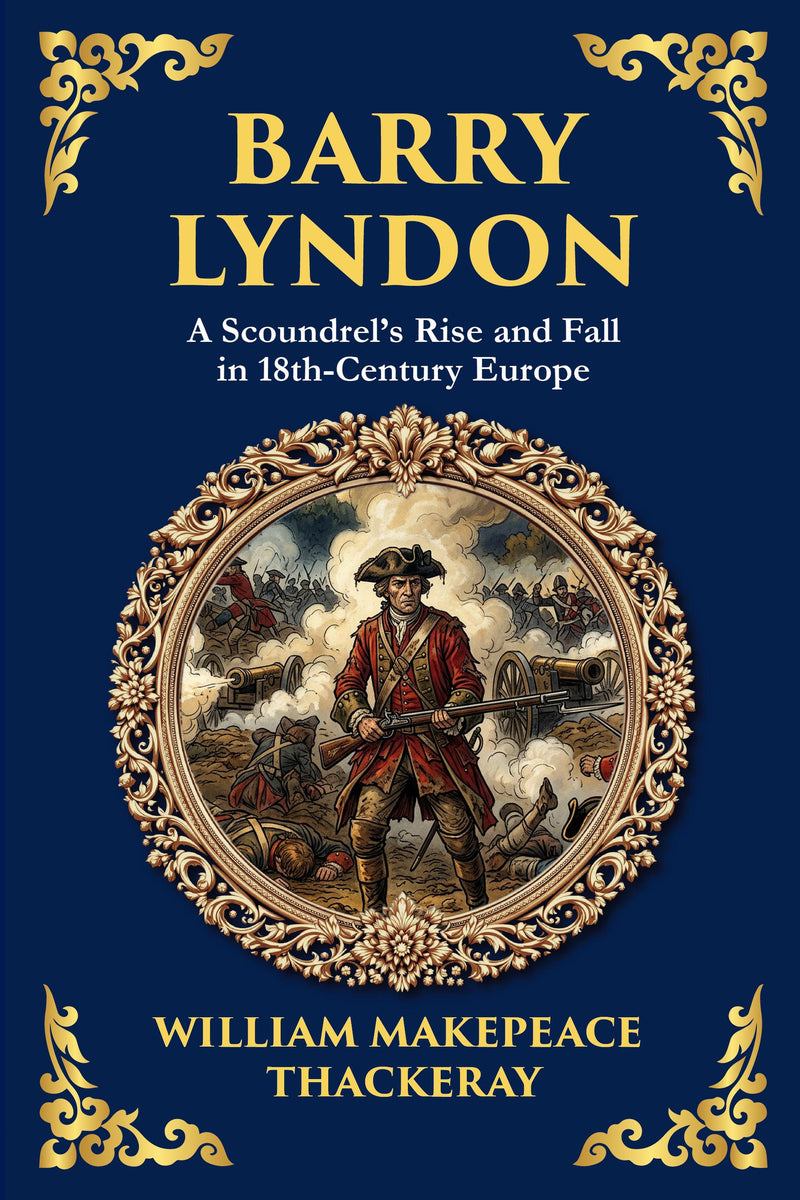
Barry Lyndon — Large Print
Meet Barry Lyndon—liar, gambler, soldier, rogue. In this darkly satirical masterpiece, William Makepeace Thackeray chronicles the extraordinary life of a man who will do anything to climb the social ladder.
or free app
10,000+ hrs library
30-day guarantee
The complete Barry Lyndon appears in modern English through Library of Alexandria Press, available online with audiobook narration included for members.
What if a man’s proudest boasts reveal every reason not to trust him?
Redmond Barry has little money and a fierce belief that he deserves a gentleman’s life. In William Makepeace Thackeray’s satirical novel, the ambitious Irishman pursues wealth and rank across eighteenth-century Europe. Soldiering, gambling, and marriage all promise a way into the world he longs to claim.
The British army offers Barry neither the glory nor the independence he expects. His uncle, the gambler Chevalier de Balibari, opens another path into fashionable society. Then wealthy Lady Lyndon becomes the focus of his ambitions. Through it all, Barry tells his own story with pride, exposing the dishonesty he means to excuse.
What you'll discover
- A rogue in full voice – Hear Barry praise his own cleverness while his excuses reveal far more than he intends.
- War without the glory – Follow an ambitious soldier into military life that refuses to match his grand expectations.
- Gambling on social rank – Meet the Chevalier de Balibari, whose profession offers Barry an entrance into fashionable European society.
- Marriage as an ambition – Watch Barry pursue Lady Lyndon’s wealth and position rather than the promise of partnership.
- Pride beneath the polish – Enjoy dry humor that exposes the vanity behind Barry’s claims to courage, charm, and distinction.
Perfect for readers who enjoy rogues, dry humor, and narrators whose eager excuses betray the faults they try to hide.
Open the first page now, and let Barry make his own revealing case for admiration.
| Formats | eBook (EPUB + PDF) · Audiobook · Paperback · Hardcover · Large Print |
| Language | English |
| Trim size (print) | 6 × 9 in |
| Binding | Paperback — perfect-bound · Hardcover — casewrap |
| Large Print edition | Same text in a larger, easy-read type — a larger font, not a larger trim |
| Print pricing | Every physical book at our true cost — at-cost, no profit (members) |
| Library | 873 restored titles, always growing |
| Length | 122,637 words · ~8 hr 11 min reading |
| Reading level | Grade 3 · an easy, flowing read (this modern-English edition) |
| Edition | Modern English translation · 2026 |
Member reviews for this edition are collected as readers finish it — be the first. Across the library: 12,000+ books shipped, every plan covered by a 365-day print guarantee.
About this edition
A faithful, unabridged modern-English edition by The Library of Alexandria — carefully rendered for today's reader and verified paragraph-by-paragraph against the public-domain source. Available as eBook, audiobook, paperback, hardcover, and large print.
- Complete & unabridgedVerified paragraph by paragraph against the source — never a scan, never abridged.
- Modern English, faithfulReadable today, with the author’s meaning kept intact. Readable — not simplified.
- Every format, one membershipRead in your browser or the free app, or listen to the full audiobook.
Included free with your membership
Cancel anytime, one click · 30-day money-back guarantee
Edition last updated July 2026
What’s inside
Barry Lyndon — Large Print — complete and unabridged: all 20 sections included with membership, plus the full audiobook.
Begin reading Barry Lyndon — Large Print
In clear modern English — the complete text is included with membership.
Introduction
There are heroes we admire, heroes we pity, and then there are those rare protagonists we cannot quite take our eyes off precisely because we know we should not trust a single word they say. The narrator at the center of this remarkable novel belongs firmly to that last category. He is charming, boastful, self-pitying, and almost entirely incapable of telling the truth about himself—and yet his voice is so vivid, so seductive, and so wonderfully alive that readers have followed him for more than a century and a half, half in horror and half in delight. To open these pages is to be taken by the arm by a man who insists, again and again, that he is a gentleman of the first rank, a brave soldier, a devoted husband, and a victim of cruel fortune. The pleasure of the book lies in the slow, dawning recognition that almost none of this is so.
William Makepeace Thackeray wrote this novel in the middle of the nineteenth century, looking back across roughly a hundred years at the glittering, brutal, and deeply hypocritical world of eighteenth-century Europe. It was an age of powdered wigs and dueling pistols, of grand estates and crushing debts, of elaborate manners that disguised naked greed. Into this world Thackeray placed one of literature’s great rogues: a man born to modest Irish circumstances who is determined, by any means necessary, to claw his way up the social ladder and live among the great. What follows is the story of that climb—and, as the very title suggests, of what comes after a climb that rises too high on too shaky a foundation.
This new edition has been carefully adapted for the contemporary reader. Thackeray wrote in a dense, ornate, and allusive style, packed with references to events, fashions, and personalities that would have been instantly familiar to a Victorian audience but that can feel like a thicket to readers today. The aim of this modern translation is not to flatten the novel’s wit or to strip away its period flavor, but to clear away the underbrush so that the brilliance of the storytelling shines through. The voice you will hear remains unmistakably that of its narrator—florid, self-justifying, frequently hilarious—but the sentences move more nimbly, and the obstacles that once stood between the modern reader and the heart of the book have been gently smoothed away. The result, we hope, is a reading experience that captures everything that has made this novel endure while inviting an entirely new generation to enjoy it.
The single most important thing to understand before you begin is that this is a story told entirely by its main character, in his own words, with no one to contradict him. This may sound like a small technical matter, but it is in fact the engine that drives the entire book, and grasping it from the outset will transform your reading.
Most novels offer us a narrator we can more or less trust—a guiding intelligence that tells us what is happening and helps us understand the characters. Here, Thackeray does something far more daring and far more entertaining. He hands the storytelling over completely to a man who is constitutionally unable to see himself clearly, who reshapes every event to flatter his own vanity, and who interprets every setback as the result of others’ treachery rather than his own folly or cruelty. The narrator presents himself as a paragon of courage, breeding, and noble feeling. The events he describes, however, frequently reveal something quite different: cowardice dressed up as valor, bullying disguised as gallantry, gambling and swindling reframed as the natural pursuits of a gentleman.
This gap—between what our narrator tells us and what we can plainly see is really going on—is where the genius of the book lives. Reading it well means learning to listen on two levels at once. On the surface, you have a man’s proud account of his own adventures, delivered with enormous confidence and considerable charm. Beneath that surface, if you pay attention, you have the true story, which the narrator gives away without ever intending to. He cannot help it. Every time he protests too much, every time he blames someone else, every time he glosses over an inconvenient detail with a flourish of wounded dignity, he is telling you the truth in spite of himself.
Thackeray was a pioneer of this technique, and he handles it with a sly comic mastery that few writers have matched. The humor of the book is rarely stated outright; it lives in the space between the narrator’s grandiose self-image and the shabby reality his words betray. When he boasts of a triumph, ask yourself what it cost the people around him. When he laments the ingratitude of those who have wronged him, ask yourself whether they had reasons. When he describes his own generosity, notice how often it seems to coincide with his own advantage. The book rewards a reader who is alert, even a little suspicious—and the rewards are considerable, because Thackeray has hidden a wealth of irony in the cracks of his narrator’s self-flattering monologue.
It would be easy to suppose that a story told by such a deceitful and self-serving man would be unpleasant to spend time with. The astonishing thing is that it is not. Our narrator is wretched in his morals and yet wonderful in his company. He has a gift for vivid description, an eye for the absurdities of the people around him, and an irrepressible energy that carries the reader along even when we are appalled by what he is describing. We come to know him with a strange intimacy. We laugh at him, we are shocked by him, and—this is the most uncomfortable part—we occasionally find ourselves rooting for him before catching ourselves and remembering exactly what sort of man he is.
This is precisely the effect Thackeray wanted. He was deeply interested in the seductiveness of charm, in the way that confidence and a smooth tongue can paper over a multitude of sins, and in society’s willingness to forgive almost anything in a person who looks the part and plays the role well. By making us complicit—by tempting us to enjoy and even admire a scoundrel—he holds up a mirror to our own susceptibility. We are flattered, manipulated, and entertained by the narrator in much the same way that the characters within the story are. The book becomes, in this sense, a sly lesson in how easily we are taken in.
So as you read, savor the voice but never quite surrender to it. Let yourself be charmed, but keep one eyebrow raised. The deepest pleasures of this novel come to the reader who can hold two thoughts at once: that this man is marvelous company, and that he is not to be believed.
To appreciate the narrator’s ambitions, it helps to understand the world in which they unfold—a world that may at first seem remote but that Thackeray renders with extraordinary richness and specificity.
The eighteenth century in Europe was an age obsessed with rank and appearance. Social position was everything, and the boundaries between classes were both rigid and, paradoxically, porous to anyone clever and bold enough to game the system. A man of the right birth could fail spectacularly and still be received in the best houses; a man of the wrong birth could possess every gift and still find every door politely closed. Into this contradiction stepped a whole class of adventurers, gamblers, fortune-hunters, and social climbers—men who understood that society judged by surfaces and who resolved to manufacture the surfaces they needed. The narrator of this novel is one of these. His entire career is an attempt to convince the world that he is something he is not, and to live off the proceeds of that deception.
The settings through which he moves are among the great pleasures of the book. We pass through the gambling rooms and drawing rooms of fashionable society, where fortunes change hands over cards and where a single rumor can make or destroy a reputation. We encounter the brutal world of eighteenth-century warfare, in which armies were raised by trickery and force, soldiers were treated as expendable, and the so-called glory of battle dissolved, on close inspection, into mud, terror, and casual cruelty. Thackeray, writing in a more comfortable age, had no patience for the romance of war, and through his narrator’s eyes—who naturally tries to make himself the hero of every skirmish—we are given a sharply unsentimental picture of what military life actually entailed for those caught up in it.
We also see the great houses and the grand families, the world of inherited wealth and ancient titles that the narrator so desperately wants to enter. Thackeray knew this world and despised much of it. He recognized that the elegance of the aristocracy was frequently built on idleness, exploitation, and a moral emptiness as profound as anything in the gutter. One of the quiet ironies of the book is that the narrator, for all his crudeness and dishonesty, is in some ways no worse than the supposedly refined people he aspires to join—he is merely more obvious about it. The polished gentleman who ruins a tenant or abandons a dependent is, in Thackeray’s clear-eyed view, no better than the brazen adventurer who cheats at cards. The difference is one of manners, not of morals.
This is why the novel, though set firmly in its own century, has lost none of its relevance. Strip away the wigs and the swords and the carriages, and you have a story about ambition, reinvention, and the pursuit of status at any cost—themes that are, if anything, more pressing today than they were when Thackeray wrote. The narrator is a master of self-promotion, a man who curates his own image, who tells a flattering story about himself and dares the world to disbelieve it. We recognize him. We have met him. We may, in our weaker moments, have been tempted to imitate him. His desire to be seen as better, grander, and more important than he really is speaks directly to a culture that prizes appearances and rewards those who perform success convincingly.
Thackeray was also fascinated by money—by where it comes from, how it is gained and lost, and what it does to the people who pursue it. The narrator’s relationship with money is a continuous, almost frenzied affair: he acquires it through gambling and scheming, spends it with reckless abandon, and is perpetually in pursuit of more. The book traces, with unflinching honesty, the connection between the desire for wealth and the corruption of character. As the narrator’s fortunes rise, so too do the stakes of his deceptions, and the human cost of his ambition becomes ever harder to ignore. Thackeray does not preach about this; he is far too skillful a writer to lecture. Instead, he simply lets the narrator’s own account accumulate, detail by detail, until the reader sees clearly what the narrator cannot or will not: that a life built on the exploitation of others must eventually come due.
The texture of this vanished world is one of the great gifts of the reading experience. Thackeray was a learned and observant writer, and he fills his pages with the sights, sounds, and customs of the period—the rituals of courtship and marriage, the codes of honor and the dueling that enforced them, the entertainments and pastimes of the rich, the desperate expedients of the poor. In this edition, these details have been kept and clarified rather than cut, because they are essential to the book’s flavor; what has been adjusted is the way they are presented, so that they illuminate the story rather than slowing it down. You will come away from the novel with a vivid sense of having traveled to another time and place, guided by a man who claims to know it intimately and who, in his own self-serving way, really does.
It is worth saying a word, too, about Thackeray’s larger purpose. He came of age as a writer in an era that loved its heroes—dashing, virtuous, romantic figures who triumphed over adversity and won the reader’s wholehearted admiration. Thackeray distrusted such figures profoundly. He suspected that they flattered the reader and disguised the messier truths of human nature. With this novel he set out to do something different and more honest: to write the life of a man who is, by any reasonable standard, a villain, and to make that life so compelling that we read on regardless. He wanted to show that the world does not, in fact, reliably reward virtue and punish vice, that charming scoundrels often prosper while better people suffer, and that the line between the respectable and the criminal is far thinner than polite society likes to pretend. This was a bold and even subversive thing to attempt, and the fact that he succeeded so brilliantly is a measure of his genius.
Cancel anytime, one click · 30-day money-back guarantee
Founding annual rate available now — your price locks for life when you join.
Not ready? Get this free chapter by email — read it anytime.
✓ Sent — check your inbox for Barry Lyndon — Large Print.
Questions about Barry Lyndon — Large Print
What is Barry Lyndon about?
Barry Lyndon follows an ambitious Irishman through military service, gambling circles, and the pursuit of a wealthy aristocratic marriage. Thackeray uses Barry’s boastful account to show how a hunger for status can turn courage and resourcefulness into tools of exploitation.
Is Barry Lyndon based on a true story?
Barry Lyndon is fiction, though Thackeray drew inspiration from the life of Andrew Robinson Stoney, an adventurer notorious for his marriage to a wealthy countess. Barry is not a direct historical portrait, and the novel shapes its material into a satire of social ambition.
Why is Barry Lyndon an unreliable narrator?
Barry describes himself as honorable, talented, and unfairly treated, but the actions he reports often contradict those claims. Readers must judge his behavior rather than accept his explanations. Much of the novel’s humor comes from how confidently he supplies evidence against himself.
How is the Barry Lyndon novel different from the film?
Stanley Kubrick’s film follows much of the novel’s broad course but changes incidents and the ending. The largest difference is perspective: Thackeray gives Barry a boastful first-person account, while the film uses an outside narrator and places greater weight on images and restrained emotion.
Shipping & returns
Billing & membership
More from the library


Explore Classic & Literary
- Resurrection · Leo Tolstoy
- Crime and Punishment · Fyodor Dostoyevsky
- Anna Karenina · Leo Tolstoy
- Moby-Dick · Herman Melville
- Great Expectations · Charles Dickens
- The Brothers Karamazov · Fyodor Dostoyevsky
- The Great Gatsby · F. Scott Fitzgerald
- McTeague: A Story of San Francisco — Large Print · Frank Norris
- McTeague: A Story of San Francisco · Frank Norris
- The Country House — Large Print · John Galsworthy
- Ethan Frome — Large Print · Edith Wharton
- Bartleby, the Scrivener: A Story of Wall-Street · Herman Melville
- Mrs. Dalloway — Large Print · Virginia Woolf
- Resurrection — Large Print · Leo Tolstoy
- Against the Grain — Large Print · Joris-Karl Huysmans
- The Red Badge of Courage: An Episode of the American Civil War · Stephen Crane
- Bartleby, the Scrivener: A Story of Wall-Street — Large Print · Herman Melville
- The Red Badge of Courage: An Episode of the American Civil War — Large Print · Stephen Crane
- North and South · Elizabeth Gaskell
- Barry Lyndon · William Makepeace Thackeray
- North and South — Large Print · Elizabeth Gaskell
- Dombey and Son — Large Print · Charles Dickens
- My Ántonia — Large Print · Willa Cather
- Jane Eyre: An Autobiography · Charlotte Brontë
- Penrod — Large Print · Booth Tarkington
- Tess of the d'Urbervilles: A Pure Woman — Large Print · Thomas Hardy
- The Belle of Bowling Green · Amelia E. Barr
- The Possessed: Or, The Devils — Large Print · Fyodor Dostoyevsky
- Penrod · Booth Tarkington
- Jane Eyre: An Autobiography — Large Print · Charlotte Brontë
Barry Lyndon — Large Print
Barry Lyndon — Large Print
A Scoundrel’s Rise and Fall in 18th-Century Europe
William Makepeace Thackeray
Contents
- Introduction
- Chapter 1
- Chapter 2
- Chapter 3
- Chapter 4
- Chapter 5
- Chapter 6
- Chapter 7
- Chapter 8
- Chapter 9
- Chapter 10
- Chapter 11
- Chapter 12
- Chapter 13
- Chapter 14
- Chapter 15
- Chapter 16
- Chapter 17
- Chapter 18
- Chapter 19
Introduction
There are heroes we admire, heroes we pity, and then there are those rare protagonists we cannot quite take our eyes off precisely because we know we should not trust a single word they say. The narrator at the center of this remarkable novel belongs firmly to that last category. He is charming, boastful, self-pitying, and almost entirely incapable of telling the truth about himself—and yet his voice is so vivid, so seductive, and so wonderfully alive that readers have followed him for more than a century and a half, half in horror and half in delight. To open these pages is to be taken by the arm by a man who insists, again and again, that he is a gentleman of the first rank, a brave soldier, a devoted husband, and a victim of cruel fortune. The pleasure of the book lies in the slow, dawning recognition that almost none of this is so.
William Makepeace Thackeray wrote this novel in the middle of the nineteenth century, looking back across roughly a hundred years at the glittering, brutal, and deeply hypocritical world of eighteenth-century Europe. It was an age of powdered wigs and dueling pistols, of grand estates and crushing debts, of elaborate manners that disguised naked greed. Into this world Thackeray placed one of literature’s great rogues: a man born to modest Irish circumstances who is determined, by any means necessary, to claw his way up the social ladder and live among the great. What follows is the story of that climb—and, as the very title suggests, of what comes after a climb that rises too high on too shaky a foundation.
This new edition has been carefully adapted for the contemporary reader. Thackeray wrote in a dense, ornate, and allusive style, packed with references to events, fashions, and personalities that would have been instantly familiar to a Victorian audience but that can feel like a thicket to readers today. The aim of this modern translation is not to flatten the novel’s wit or to strip away its period flavor, but to clear away the underbrush so that the brilliance of the storytelling shines through. The voice you will hear remains unmistakably that of its narrator—florid, self-justifying, frequently hilarious—but the sentences move more nimbly, and the obstacles that once stood between the modern reader and the heart of the book have been gently smoothed away. The result, we hope, is a reading experience that captures everything that has made this novel endure while inviting an entirely new generation to enjoy it.
The single most important thing to understand before you begin is that this is a story told entirely by its main character, in his own words, with no one to contradict him. This may sound like a small technical matter, but it is in fact the engine that drives the entire book, and grasping it from the outset will transform your reading.
Most novels offer us a narrator we can more or less trust—a guiding intelligence that tells us what is happening and helps us understand the characters. Here, Thackeray does something far more daring and far more entertaining. He hands the storytelling over completely to a man who is constitutionally unable to see himself clearly, who reshapes every event to flatter his own vanity, and who interprets every setback as the result of others’ treachery rather than his own folly or cruelty. The narrator presents himself as a paragon of courage, breeding, and noble feeling. The events he describes, however, frequently reveal something quite different: cowardice dressed up as valor, bullying disguised as gallantry, gambling and swindling reframed as the natural pursuits of a gentleman.
This gap—between what our narrator tells us and what we can plainly see is really going on—is where the genius of the book lives. Reading it well means learning to listen on two levels at once. On the surface, you have a man’s proud account of his own adventures, delivered with enormous confidence and considerable charm. Beneath that surface, if you pay attention, you have the true story, which the narrator gives away without ever intending to. He cannot help it. Every time he protests too much, every time he blames someone else, every time he glosses over an inconvenient detail with a flourish of wounded dignity, he is telling you the truth in spite of himself.
Thackeray was a pioneer of this technique, and he handles it with a sly comic mastery that few writers have matched. The humor of the book is rarely stated outright; it lives in the space between the narrator’s grandiose self-image and the shabby reality his words betray. When he boasts of a triumph, ask yourself what it cost the people around him. When he laments the ingratitude of those who have wronged him, ask yourself whether they had reasons. When he describes his own generosity, notice how often it seems to coincide with his own advantage. The book rewards a reader who is alert, even a little suspicious—and the rewards are considerable, because Thackeray has hidden a wealth of irony in the cracks of his narrator’s self-flattering monologue.
It would be easy to suppose that a story told by such a deceitful and self-serving man would be unpleasant to spend time with. The astonishing thing is that it is not. Our narrator is wretched in his morals and yet wonderful in his company. He has a gift for vivid description, an eye for the absurdities of the people around him, and an irrepressible energy that carries the reader along even when we are appalled by what he is describing. We come to know him with a strange intimacy. We laugh at him, we are shocked by him, and—this is the most uncomfortable part—we occasionally find ourselves rooting for him before catching ourselves and remembering exactly what sort of man he is.
This is precisely the effect Thackeray wanted. He was deeply interested in the seductiveness of charm, in the way that confidence and a smooth tongue can paper over a multitude of sins, and in society’s willingness to forgive almost anything in a person who looks the part and plays the role well. By making us complicit—by tempting us to enjoy and even admire a scoundrel—he holds up a mirror to our own susceptibility. We are flattered, manipulated, and entertained by the narrator in much the same way that the characters within the story are. The book becomes, in this sense, a sly lesson in how easily we are taken in.
So as you read, savor the voice but never quite surrender to it. Let yourself be charmed, but keep one eyebrow raised. The deepest pleasures of this novel come to the reader who can hold two thoughts at once: that this man is marvelous company, and that he is not to be believed.
To appreciate the narrator’s ambitions, it helps to understand the world in which they unfold—a world that may at first seem remote but that Thackeray renders with extraordinary richness and specificity.
The eighteenth century in Europe was an age obsessed with rank and appearance. Social position was everything, and the boundaries between classes were both rigid and, paradoxically, porous to anyone clever and bold enough to game the system. A man of the right birth could fail spectacularly and still be received in the best houses; a man of the wrong birth could possess every gift and still find every door politely closed. Into this contradiction stepped a whole class of adventurers, gamblers, fortune-hunters, and social climbers—men who understood that society judged by surfaces and who resolved to manufacture the surfaces they needed. The narrator of this novel is one of these. His entire career is an attempt to convince the world that he is something he is not, and to live off the proceeds of that deception.
The settings through which he moves are among the great pleasures of the book. We pass through the gambling rooms and drawing rooms of fashionable society, where fortunes change hands over cards and where a single rumor can make or destroy a reputation. We encounter the brutal world of eighteenth-century warfare, in which armies were raised by trickery and force, soldiers were treated as expendable, and the so-called glory of battle dissolved, on close inspection, into mud, terror, and casual cruelty. Thackeray, writing in a more comfortable age, had no patience for the romance of war, and through his narrator’s eyes—who naturally tries to make himself the hero of every skirmish—we are given a sharply unsentimental picture of what military life actually entailed for those caught up in it.
We also see the great houses and the grand families, the world of inherited wealth and ancient titles that the narrator so desperately wants to enter. Thackeray knew this world and despised much of it. He recognized that the elegance of the aristocracy was frequently built on idleness, exploitation, and a moral emptiness as profound as anything in the gutter. One of the quiet ironies of the book is that the narrator, for all his crudeness and dishonesty, is in some ways no worse than the supposedly refined people he aspires to join—he is merely more obvious about it. The polished gentleman who ruins a tenant or abandons a dependent is, in Thackeray’s clear-eyed view, no better than the brazen adventurer who cheats at cards. The difference is one of manners, not of morals.
This is why the novel, though set firmly in its own century, has lost none of its relevance. Strip away the wigs and the swords and the carriages, and you have a story about ambition, reinvention, and the pursuit of status at any cost—themes that are, if anything, more pressing today than they were when Thackeray wrote. The narrator is a master of self-promotion, a man who curates his own image, who tells a flattering story about himself and dares the world to disbelieve it. We recognize him. We have met him. We may, in our weaker moments, have been tempted to imitate him. His desire to be seen as better, grander, and more important than he really is speaks directly to a culture that prizes appearances and rewards those who perform success convincingly.
Thackeray was also fascinated by money—by where it comes from, how it is gained and lost, and what it does to the people who pursue it. The narrator’s relationship with money is a continuous, almost frenzied affair: he acquires it through gambling and scheming, spends it with reckless abandon, and is perpetually in pursuit of more. The book traces, with unflinching honesty, the connection between the desire for wealth and the corruption of character. As the narrator’s fortunes rise, so too do the stakes of his deceptions, and the human cost of his ambition becomes ever harder to ignore. Thackeray does not preach about this; he is far too skillful a writer to lecture. Instead, he simply lets the narrator’s own account accumulate, detail by detail, until the reader sees clearly what the narrator cannot or will not: that a life built on the exploitation of others must eventually come due.
The texture of this vanished world is one of the great gifts of the reading experience. Thackeray was a learned and observant writer, and he fills his pages with the sights, sounds, and customs of the period—the rituals of courtship and marriage, the codes of honor and the dueling that enforced them, the entertainments and pastimes of the rich, the desperate expedients of the poor. In this edition, these details have been kept and clarified rather than cut, because they are essential to the book’s flavor; what has been adjusted is the way they are presented, so that they illuminate the story rather than slowing it down. You will come away from the novel with a vivid sense of having traveled to another time and place, guided by a man who claims to know it intimately and who, in his own self-serving way, really does.
It is worth saying a word, too, about Thackeray’s larger purpose. He came of age as a writer in an era that loved its heroes—dashing, virtuous, romantic figures who triumphed over adversity and won the reader’s wholehearted admiration. Thackeray distrusted such figures profoundly. He suspected that they flattered the reader and disguised the messier truths of human nature. With this novel he set out to do something different and more honest: to write the life of a man who is, by any reasonable standard, a villain, and to make that life so compelling that we read on regardless. He wanted to show that the world does not, in fact, reliably reward virtue and punish vice, that charming scoundrels often prosper while better people suffer, and that the line between the respectable and the criminal is far thinner than polite society likes to pretend. This was a bold and even subversive thing to attempt, and the fact that he succeeded so brilliantly is a measure of his genius.
Since the time of Adam, there has been almost no trouble in this world that wasn’t caused by a woman. Ever since my family began—which must have been very close to Adam’s time, because as everyone knows, the Barrys are such an old, noble, and famous line—women have heavily influenced the fate of our bloodline.
I assume every gentleman in Europe has heard of the house of Barry of Barryogue in Ireland; you won’t find a more famous name in any genealogical record. As a sophisticated man, I have learned to truly despise people who claim to be high-born but have no more family history than the servant who polishes my boots. I also laugh with total contempt at the bragging of many of my fellow countrymen, who all claim to descend from Irish kings and talk about tiny plots of land—hardly enough to feed a pig—as if they were great principalities. However, the truth forces me to admit that my family was the most noble in the country, and perhaps in the entire world. Their estates are now small and were taken from us through war, betrayal, the passage of time, the wastefulness of my ancestors, and our loyalty to the old religion and the monarch. In the past, however, these holdings were enormous and covered many counties, back when Ireland was far wealthier than it is today. I would put the Irish crown on my family crest, but there are too many foolish people claiming that honor who already use it, making it look ordinary.
Who knows? If not for a woman’s mistake, I might be wearing it right now. You look skeptical. I ask, why not? If my people had a brave leader instead of the weak cowards who bowed to King Richard II, they might have remained free. If there had been a determined leader to face the murderous thug Oliver Cromwell, we would have gotten rid of the English forever. But there was no Barry on the battlefield to fight the usurper; in fact, my ancestor, Simon de Bary, arrived with that first king and married the daughter of the King of Munster, whose own sons he ruthlessly killed in battle.
End of the free sample
Keep reading, free
Members read and listen to the complete book — and the entire library. Cancel anytime, one click · 30-day money-back guarantee.