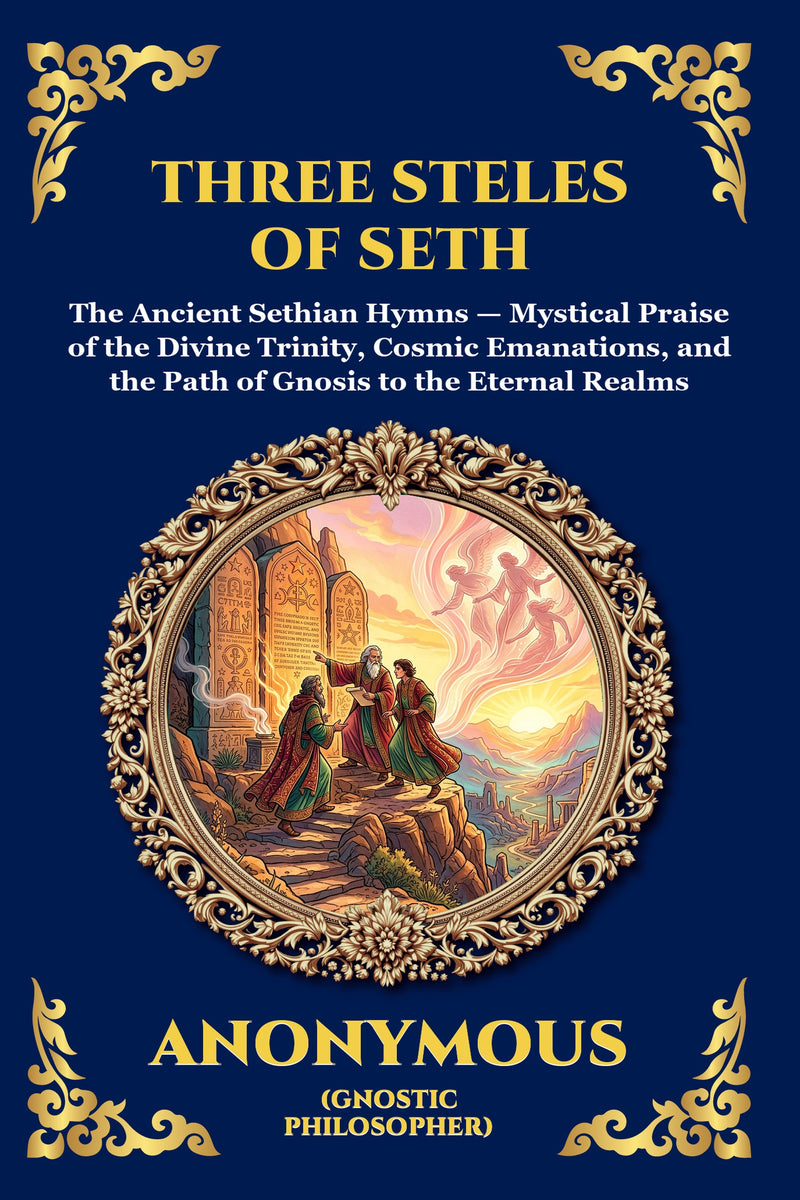
The Three Steles of Seth
The Three Steles of Seth offers a direct window into the ritualistic practices of the Sethian Gnostics, with hymns attributed to Seth himself. Excluded from the biblical canon, this text serves as a precise formula for the soul's journey back to the divine, through ecstatic prayers ascending to the Supreme, Unbegotten One.
or free app
10,000+ hrs library
30-day guarantee
The Three Steles of Seth is presented here as a complete modern-English translation of this Sethian Gnostic hymnal, readable online with audiobook narration included for Library of Alexandria Press members.
Three standing stones, three hymns of praise: how does a prayer become a path of ascent?
The Three Steles of Seth is a short Sethian Gnostic text built from prayers of thanks. Its opening names Dositheos as the receiver of a revelation about three steles, or standing stones, said to bear hymns carved by Seth. Rather than tell a story, it invites you into a rising sequence of praise.
The first hymn addresses Geradamas, the heavenly Adam and model of the perfect human in Sethian myth. The second turns to Barbelo, understood in Sethian writings as the first thought or image of the highest God. The third praises the Pre-Existent One. Together, they present remembrance and ordered prayer as a way of ascent.
Inside this book
- A revelation through Dositheos – Enter a text that frames its prayers as a revelation received and set down.
- Geradamas and heavenly humanity – Explore the figure whom Sethian myth places above the earthly Adam.
- Praise addressed to Barbelo – Encounter the divine feminine being at the heart of the second hymn.
- Toward the Pre-Existent One – Follow the hymns as their praise turns toward the highest divine being.
- Remembering as a path – Consider the closing instruction that links ordered reading and remembrance with spiritual ascent.
Perfect for readers of ancient religion, Gnostic studies, and mystical prayer, and anyone drawn to hymns that build slowly rather than a story with a plot.
Open the first page now and follow these hymns through their unfolding movement of praise.
| Formats | eBook (EPUB + PDF) · Audiobook · Paperback · Hardcover · Large Print |
| Language | English |
| Trim size (print) | 6 × 9 in |
| Binding | Paperback — perfect-bound · Hardcover — casewrap |
| Large Print edition | Same text in a larger, easy-read type — a larger font, not a larger trim |
| Print pricing | Every physical book at our true cost — at-cost, no profit (members) |
| Library | 873 restored titles, always growing |
| Composed | 2nd-3rd century AD |
| Original language | Coptic, likely translated from Greek |
| Source tradition | Nag Hammadi Codex VII |
| Translation basis | Public-domain scholarly translation, rendered in clear modern English |
| Length | 1,481 words · ~6 min reading |
| Reading level | Grade 6 · easy, accessible reading (this modern-English edition) |
| Edition | Modern English translation · 2026 |
Member reviews for this edition are collected as readers finish it — be the first. Across the library: 12,000+ books shipped, every plan covered by a 365-day print guarantee.
About this edition
The complete, unabridged text in clear modern English — faithful to the original, never simplified. Every paragraph is checked against the source, so nothing is cut, summarised, or paraphrased away. It reads cleanly for today while keeping the original meaning intact.
This text survives in Nag Hammadi Codex VII, discovered in Egypt in 1945. Our edition derives from the standard scholarly translation of the Coptic manuscript and renders it in clear modern English for contemporary readers.
- Complete & unabridgedVerified paragraph by paragraph against the source — never a scan, never abridged.
- Modern English, faithfulReadable today, with the author’s meaning kept intact. Readable — not simplified.
- Every format, one membershipRead in your browser or the free app, or listen to the full audiobook.
Included free with your membership
Cancel anytime, one click · 30-day money-back guarantee
Edition last updated June 2026
What’s inside
The Three Steles of Seth — complete and unabridged: all 4 sections included with membership, plus the full audiobook.
Begin reading The Three Steles of Seth
In clear modern English — the complete text is included with membership.
Chapter 1
I praise you, father Geradamas — I, your son Emmacha Seth, whom you brought forth without generation for the praise of our god. I am your son and you are my mind, O my father. I have sown and produced, but you have seen the majesties and have stood without end. I praise you, father. Praise me, father. Because of you I exist, because of god you exist, because of you I exist with him.
You are light and you see light. You have revealed light. You are a Mirotheas, you are my Mirotheos. I praise you as god, I praise your divinity. Great is the good one, self-conceived, who stood firm — the god who was first to stand. You came in goodness, you appeared, and you revealed goodness.
I will speak your name: you are a primary name. You are unborn, yet you have appeared to reveal the eternal. You are the one who truly is, and so you have revealed those who truly are. You are uttered by a voice, but by mind you are glorified. You are powerful everywhere, so the world of the senses also knows you — because of you and your seed. You are merciful, and you are from another race, one set above every other race.
You are from another race, and it is placed above every other race. You are from another race, you are different. You are merciful, you are eternal. You are set above a race; you caused all these to increase because of my seed, and you know that it is placed within generation. But they are from other races, they are different. They are set above other races, they are placed in life.
You are a Mirotheos. I praise the power given to me through you. You who brought forth the masculinities that truly are three times male, who were divided into five, who were given to us in triple power, who were conceived without generation, who came forth from what is above and for the sake of what is below entered into the midst — you are a parent through a parent, a word from a command. We praise you, triple male. You have unified all things through them all, you have empowered us. You came into being from the One, from the One you departed, to the One you have returned.
You have saved us, you have saved us, you have saved us — you who are crowned and who crown. We praise you eternally, we who are saved, who are perfect beings, who are made perfect because of you, who have become perfect together with you. You who are complete, who make complete, who are perfected through all these things, who are everywhere alike — triple male, you have stood firm, you were the first to stand. You have been divided everywhere and yet have remained one. Whomever you wished you have saved, and you wish that all who are worthy be saved. You are perfect, you are perfect, you are perfect.
Chapter 2
Great is the first eternal realm — male virgin Barbelo, the first glory of the invisible Father. You who are called perfect first perceived that the one who truly preexists simply is. From that one and through it you came into being first and forever, you who are nonexistent from the One, the indivisible, triple power. You are a triple power, you are a great One from a pure One. You are a superior One, the first shadow of the holy Father, light from light. We praise you, maker of perfection, giver of eternal realms.
You perceived that the eternal ones arise from a shadow. You have conferred multiplicity, yet you found and remained One, even while conferring multiplicity through division. You are a threefold replication — truly you are replicated three times. You are One, of the One, and you come from its shadow. You are hidden; you are a world of knowledge. You know that those who belong to the One arise from shadow, and they are yours, held within your heart.
For their sake you caused the eternal to exist, you made divinity live, you made knowledge good. In blessedness you caused the shadows flowing from the One to move. You made one in understanding and another in creation. You made the equal and the unequal, the similar and the different. You have empowered generation and formation — through what truly is — granting to others both being and generation. You have given them strength hidden in the heart, and you came forth both to them and from them.
You are divided among them and become a great male, the first-appearing mind. Father, God, divine child, maker of multiplicity — in dividing all those who truly are, you revealed to them all a word. You possess them all without birth, eternally, imperishably. Because of you salvation has come to us; from you comes salvation. You are wisdom, you are knowledge, you are truth. Because of you is life; from you comes life.
Because of you is mind; from you comes mind. You are mind, you are a world of truth. You are a triple power, you are a threefold replication — truly you are replicated three times — the eternal realm of eternal realms. You alone see purely the first undying, unborn ones and the first divisions, just as you yourself were divided. Unify us as you were unified. Teach us what you see.
Give us strength so that we may be saved to eternal life. We are a shadow of you, just as you are a shadow of that first preexistent one. Hear us first. We are eternal. Hear us as perfect beings.
You are the eternal realm of eternal realms, the all-perfect one who is established. You have heard, you have heard. You have saved, you have saved. We give thanks, we praise always, we shall glorify you.
Chapter 3
We rejoice, we rejoice, we rejoice. We saw, we saw, we saw what truly pre-exists — that it truly is, and is the first eternal one. You, the unborn, from you come the eternal ones and the eternal realms, the all-perfect ones who are established, and the perfect beings. We praise you, O non-being, reality before realities, first being before beings, father of divinity and life, creator of mind, giver of goodness, giver of blessedness. We all praise you — you who know, with glorifying praise — you, because of whom all these things are, who know yourself through yourself alone.
Nothing active exists prior to you. You are spirit, alone and living. You know the One, and we cannot speak of that One, which is yours everywhere. Your light enlightens us. Command us to see you, so that we may be saved. Knowledge of you is our salvation.
Command us, and we are saved. Truly we are saved. We have seen you through the mind. You are all these things and you save them all — you who will not be saved, nor have been saved, by them. You have commanded us. You are One, you are One — as one might say to you, you are One.
You are a single, living spirit. How shall we give you a name? We have none. You are their existence, you are their life, you are their mind. In you they rejoice. You ordained that they be saved through your word.
The single glory, foremost among all — O hidden one, blessed Senaon, who conceived himself, Asineus, Mephneus, Optaon, Elemaon, the great power, Emouniar, Nibareus, Kandephoros, Aphredon, Deiphaneus — you who are my Armedon, you generator of powers, Thalanatheus, Antitheus. You are in yourself, you are before yourself, and after you none have come to act. How shall we praise you? We cannot — but we thank you, we who are your inferiors. For you commanded us, you who are our superior, to glorify you as best we can. We praise you because we are saved, and we glorify you always.
Now we shall glorify you, that we may be saved to eternal salvation. We have praised you as best we can. We have been saved. You always wished us to do this, and we have done it. Whoever remembers these things and always glorifies will be perfect among the perfect, and free of suffering beyond all things.
They all praise these steles, individually and collectively, and afterward they fall silent. As appointed, they ascend. After the silence, they descend from the third. They praise the second, and afterward the first. The way of ascent is the way of descent. Understand this, then, as those who are alive, knowing that you have succeeded.
You have taught yourselves about infinite things. Marvel at the truth within them, and at the revelation.
This is the book of the fatherhood. It is the son who wrote it. Bless me, O Father. I bless you, O Father, in peace.
Amen.
Cancel anytime, one click · 30-day money-back guarantee
Founding annual rate available now — your price locks for life when you join.
Not ready? Get this free chapter by email — read it anytime.
✓ Sent — check your inbox for The Three Steles of Seth.
Questions about The Three Steles of Seth
What is the Three Steles of Seth about?
It is a set of three prayers of praise, each said to be carved on a stele by Seth. They address the heavenly Adam, the divine Mother Barbelo, and the highest God, in rising order.
Who was Dositheos in the Three Steles of Seth?
Dositheos is the visionary named at the start. He says he saw the steles, understood them and wrote them down for the elect. Scholars do not agree on whether he is the same man as other ancient teachers of that name.
Who is Barbelo?
Barbelo is a divine feminine being in Sethian Gnostic writings. She is the first image or thought of the highest God and is often called the Mother. The second stele is addressed to her.
When was the Three Steles of Seth written and where was it found?
Scholars place a Greek original in the second or third century. The Coptic copy is in Codex VII of the Nag Hammadi library, found in Egypt in 1945.
Shipping & returns
Billing & membership
More from the library


Explore The Lost & Forbidden Library
- 1 Enoch · Attributed to Enoch
- 1–4 Maccabees · Various Jewish authors
- 2 Baruch · Attributed to Baruch
- 2 Enoch · Attributed to Enoch
- 4 Baruch · Attributed to Baruch ben Neriah
- A Valentinian Exposition · Attributed to a follower of Val...
- Acts of Saturninus
- Acts of Titus · Anonymous early Christian writer
- Allogenes the Stranger · Anonymous (Early Gnostic Mystic)
- Antitheses of Marcion · Marcion
- Apocalypse of Bartholomew · Attributed to the Apostle Barth...
- Apocalypse of Daniel
- Apocalypse of Paul · Attributed to the Apostle Paul
- Apocalypse of Paul (Visio Pauli, Latin) · Attributed to the Apostle Paul
- Apocalypse of Pseudo- Ephraem · Attributed to Ephraem the Syrian
- Apocalypse of Sedrach
- Apocalypse of Shenoute · Attributed to Shenoute the Arch...
- Apocalypse of Stephen
- Apostolic Fathers · Various early Christian authors
- Apostolic Tradition · Attributed to Hippolytus of Rome
- Ars Notoria · Attributed to King Solomon
- Asclepius · Attributed to Hermes Trismegistus
- Authoritative Teaching
- Book of Giants · Attributed to Mani
- Book of the Mysteries of Heaven and Earth · Attributed to early Jewish mystics
- Cave of Treasures · Attributed to Ephrem the Syrian
- Clementine Recognitions · Attributed to Clement of Rome
- Community Rule · Attributed to the Qumran community
- Coptic Gospel of the Twelve
- Diatessaron · Attributed to Tatian
The Three Steles of Seth
The Three Steles of Seth
A Sethian Hymn of Ascent — Three Tablets of Praise to the Self-Begotten, to Barbelo, and to the Pre-Existent One
Library of Alexandria Press
The Three Steles of Seth
© Copyright 2026 Library of Alexandria Press. All rights reserved.
Published by Library of Alexandria Press
Printed in the United States of America
It is not legal to copy, share, or send any part of this document in either digital or printed form without written permission from the publisher, except short quotes in a book review.
Table of Contents
Introduction
Chapter 1
Chapter 2
Chapter 3
Introduction
Somewhere beneath the sands of Upper Egypt, in the dry cliffs above the ancient city of Chenoboskion, a collection of leather-bound codices lay hidden for nearly sixteen centuries. Sealed inside a large ceramic jar and buried in a cave, these documents survived the collapse of empires, the rise of new religions, and the long erasure of an entire spiritual tradition. When they were finally unearthed by local farmers in December 1945, the world was handed something extraordinary — a direct window into one of the most profound, complex, and misunderstood spiritual movements in human history. Among those texts, written in Coptic on papyrus leaves that had grown brittle with age, was a document that scholars would come to call the Three Steles of Seth. It is a text that defies easy categorization. It is not quite a gospel, not quite a prayer book, not quite a philosophical treatise — and yet it is somehow all of these things at once.
To hold the Three Steles of Seth in your hands, even in translation, is to feel the weight of something ancient and alive. These are hymns — three soaring, ecstatic compositions attributed to the antediluvian patriarch Seth, the third son of Adam and Eve, who in Gnostic tradition occupies a position of towering spiritual significance. They are hymns addressed to three ascending levels of divine reality: Geradamas, the heavenly archetype of humanity; Barbelo, the divine Mother and first emanation of the unknowable God; and the Invisible Spirit itself, the ultimate, ineffable source of all existence. Each stele carries the worshipper higher, deeper, further into the luminous mystery at the heart of being. Each one strips away another layer of the ordinary world and opens a doorway into something that the ancient Gnostics believed was the truest reality — a realm of pure light, pure knowledge, pure love, beyond all names and forms.
But to understand why this text matters — why it has captivated scholars, mystics, spiritual seekers, and philosophers for decades since its rediscovery — we need to understand something about the world that produced it. The Gnostic movement, broadly speaking, flourished in the first several centuries of the Common Era, overlapping with early Christianity, drawing from Jewish mysticism, Platonic philosophy, Egyptian religion, and Zoroastrian cosmology. It was never a single, unified religion. It was more like a vast and restless spiritual current, flowing through many different communities, producing dozens of distinct schools and texts, each with its own mythology, its own cosmology, its own vision of salvation. What united these communities was a shared conviction: that the material world is not the whole of reality, that human beings carry within them a spark of divine light that has become trapped in matter, and that the purpose of spiritual life is to awaken that spark, to remember one's true origin, and to return — through knowledge, through gnosis — to the source from which all things came.
The word gnosis itself is simply the Greek word for knowledge, but it refers to a very specific kind of knowing. Not intellectual knowledge, not the accumulation of facts and arguments, but direct, experiential, transformative knowledge — the kind that changes you at the root, that reorganizes your entire sense of who and what you are. The Gnostics were not primarily interested in belief. They were interested in experience. They wanted to know God, not merely believe in God. They wanted to encounter the divine directly, personally, in the depths of their own consciousness. And they developed elaborate systems of myth, ritual, meditation, and prayer to facilitate that encounter. The Three Steles of Seth stands as one of the most concentrated and beautiful expressions of this aspiration anywhere in the Gnostic literature.
The text belongs to a specific branch of Gnostic thought known as Sethian Gnosticism, named for the central role it gives to Seth as the spiritual ancestor of a chosen lineage — the seed of Seth, or the holy race — who are understood to be those souls in the world who carry the divine spark most fully and who are most capable of awakening to their true nature. Sethian texts include some of the most philosophically sophisticated documents in the entire Nag Hammadi library: the Apocryphon of John, the Gospel of the Egyptians, Zostrianos, Marsanes, Allogenes, and others. Together, they paint a picture of a cosmological system of breathtaking complexity and ambition, a vision of reality that extends from the utterly transcendent and unknowable Invisible Spirit down through cascading levels of divine emanation, through the tragic creation of the material world by ignorant or malevolent lower powers, and finally into the human situation — our forgetfulness, our longing, and our potential for return.
What makes the Three Steles of Seth distinctive within this tradition is its form. While many Sethian texts take the shape of apocalyptic revelations, mythological narratives, or philosophical dialogues, this text is pure liturgy. It is a hymn cycle — a sequence of prayers meant to be used in actual ritual practice, possibly in a communal setting where participants would ascend together through the three steles, each one representing a stage in a meditative or liturgical journey toward union with the divine. The closing lines of the text make this communal dimension explicit, describing how the congregation should return from the heights of contemplation back into the ordinary world, carrying what they have received. This is not merely a text to be read. It is a text to be performed, internalized, lived.
And this is perhaps what makes it so startling and so moving to encounter today. We are accustomed, in the modern world, to thinking of ancient religious texts as historical artifacts — interesting, perhaps even beautiful, but fundamentally remote from our contemporary experience. The Three Steles of Seth refuses that distance. Its language is immediate, urgent, and deeply personal. The worshipper who prays these hymns is not reciting a creed or affirming a doctrine. They are reaching, stretching, yearning toward something they can almost but not quite touch — and then, in moments of extraordinary grace, touching it. The hymns move through phases of praise, petition, and ecstatic recognition, and there are passages in them that read like the record of genuine mystical experience, moments where the language strains and breaks under the pressure of what it is trying to describe, where the writer seems to be grasping for words to capture something that words were never designed to hold.
The World That Gave Rise to These Hymns
To appreciate the full depth of what you are about to encounter, it helps to spend a moment with the historical and intellectual world in which these hymns were composed. The first several centuries of the Common Era were a time of extraordinary spiritual ferment in the Mediterranean world and the Near East. The old civic religions of Greece and Rome were losing their hold on the popular imagination. Mystery religions from Egypt, Persia, and the East were spreading rapidly through the Roman Empire, offering initiates a personal relationship with the divine, a promise of transformation, and the hope of a blessed afterlife. Philosophy — particularly the Platonic tradition — was undergoing a remarkable renaissance, developing into what we now call Neoplatonism, a sophisticated metaphysical system that described reality as a great chain of being emanating from a single, transcendent, utterly simple source that Plotinus and his successors called the One.
The Gnostic movement existed in intimate dialogue with all of these currents. Gnostic thinkers read Plato and were deeply influenced by him. They absorbed Jewish scripture and reinterpreted it with startling boldness, sometimes inverting its apparent meaning entirely. They engaged with early Christian communities and debated the nature of Christ, the meaning of salvation, and the character of the God of the Hebrew Bible. They drew on Egyptian religious symbolism, on Zoroastrian cosmological dualism, on the rich tradition of Jewish mysticism known as Merkabah spirituality, which involved visionary ascents through the heavenly realms. Out of all of these sources, the Gnostic thinkers fashioned something genuinely new — a vision of reality that was, in its own way, as philosophically rigorous and as spiritually ambitious as anything the ancient world produced.
The Sethians, in particular, developed a cosmological mythology of remarkable intricacy. At the apex of their system sits the Invisible Spirit — a being so utterly beyond all categories, all attributes, all descriptions, that even to call it a being is already to say too much. It is the source of everything, but it is itself nothing that can be named or grasped. From this ineffable source, through a process of contemplation and self-reflection, the divine world begins to unfold. The first great emanation is Barbelo — the divine Mother, the first thought of the Invisible Spirit, the womb of all divine life. She is the beginning of all multiplicity, the first moment in which the One becomes aware of itself and in that awareness generates something other than itself. From Barbelo and the Invisible Spirit together, further divine beings emanate: the divine Child, the self-generated Christ, and a cascading series of luminaries, aeons, and powers that together constitute the Pleroma — the fullness of the divine world.
Into this luminous fullness, tragedy enters. Through a complex mythological sequence that varies somewhat from text to text, a lower divine power — often identified with the God of the Hebrew Bible, here understood not as the supreme God but as an ignorant or arrogant demiurge — creates the material world without full knowledge of the divine realm above him. He creates human beings, but in doing so inadvertently traps within them sparks of divine light that belong to the Pleroma. The human condition, in this telling, is one of exile and amnesia. We have forgotten where we came from. We have mistaken the demiurge's world for the whole of reality. We live in a kind of spiritual sleep, dreaming that the material world is all there is, unaware of the vast luminous reality that surrounds and underlies everything we experience.
Salvation, in this framework, is not primarily about moral reformation or the forgiveness of sins. It is about awakening — about recovering the knowledge of one's true origin and nature, about recognizing the divine spark within oneself and beginning the long journey of return. This is what the Sethian texts are designed to facilitate. They are maps and vehicles for that journey. They describe the heavenly realms in such detail not merely out of speculative curiosity but because the practitioner needs to know where they are going. They provide hymns and prayers and ritual formulas because the ascent requires preparation, orientation, and a kind of spiritual technology — tools for lifting consciousness out of its ordinary, contracted state and opening it to the vastness of the divine.
The Three Steles of Seth is one of the most refined and elegant of these tools. Its three-part structure mirrors the three great levels of the Sethian divine hierarchy: the first stele addresses Geradamas, the heavenly Adam, the divine archetype of humanity who dwells in the highest reaches of the created divine world and serves as a kind of mediator between the human and the fully transcendent divine; the second addresses Barbelo, the divine Mother, the first emanation, the womb of all being; and the third reaches toward the Invisible Spirit itself, the utterly unknowable source, which can only be approached in a language of paradox and negation, a language that constantly undoes itself in order to gesture toward what cannot be said. Each stele is a step upward, a movement of the soul toward its source, and together they constitute a complete liturgical journey from the human to the divine.
It is worth pausing here to note how remarkably sophisticated this structure is from a philosophical point of view. The Sethian thinkers were grappling with one of the deepest problems in all of philosophy and theology: how does one speak about the absolute? How does one relate to a God who is, by definition, beyond all relation? How does one worship a being who transcends all the categories that worship normally assumes — personality, will, responsiveness, love? The solution they developed was not to abandon the attempt but to develop a layered approach, in which the worshipper first addresses the more accessible, more personal dimensions of the divine — the divine human, the divine Mother — before venturing into the territory of pure transcendence where language itself begins to dissolve. This is not naivety. It is a deeply considered spiritual pedagogy, one that has parallels in many of the world's great mystical traditions.
Scholars have noted striking similarities between the Sethian approach to the divine and the philosophical theology of Plotinus, the great Neoplatonist philosopher who was a contemporary of the Gnostic communities that produced these texts. Both traditions grapple with the absolute transcendence of the ultimate source, both use the language of emanation to describe how the divine world unfolds from that source, and both envision the spiritual life as a journey of return — a movement of the soul back toward its origin. There has been considerable scholarly debate about the exact relationship between Sethian Gnosticism and Neoplatonism: did the Gnostics influence the Neoplatonists, or vice versa, or were both drawing independently from a common philosophical inheritance? The question remains open, but what is clear is that these traditions were in dialogue, and that the Three Steles of Seth represents a sophisticated contribution to a conversation that was shaping the intellectual and spiritual landscape of the ancient world.
How to Read These Hymns — and Why They Still Matter
There is a question that any thoughtful reader will eventually ask when approaching a text like this: what does it mean to read it today? We live in a world almost incomprehensibly different from the one in which these hymns were composed. We do not share the mythological framework of Sethian Gnosticism. Most of us do not believe in Barbelo or Geradamas or the Invisible Spirit in the literal sense that the ancient Gnostics did. We do not participate in the ritual communities for which these hymns were written. We are separated from their authors by nearly two thousand years of history, by vast differences of culture, language, cosmology, and worldview. So what can these ancient prayers possibly offer us?
The answer, I think, is more than we might expect — and it comes from a direction that may surprise us. The great spiritual traditions of the world are not primarily valuable as historical curiosities or as windows into the past, though they are certainly that. They are valuable because they are records of human experience — of the deepest, most intense, most transformative experiences that human beings have ever had. And human experience, at its depths, is remarkably consistent across time and culture. The longing for meaning, the sense of something vast and luminous just beyond the edge of ordinary consciousness, the feeling of being somehow displaced in the world, of not quite belonging to the surface reality that everyone else seems to take for granted — these are not ancient experiences. They are perennial ones. They are experiences that countless people have in every generation, in every culture, often without any framework for understanding or articulating them.
What the Gnostic tradition offers — and what this text offers in particular — is a framework. It is a map of an interior territory that many people have glimpsed but few have been able to navigate. It is a language for experiences that often seem to resist language. And it is an invitation — perhaps the most fundamental invitation that any spiritual tradition can extend — to take seriously the possibility that the deepest reality is not the one we see with our ordinary eyes, that consciousness is not merely a byproduct of matter but is itself the fundamental substance of the universe, and that the journey inward is also a journey upward, toward something that deserves to be called divine.
Reading these hymns well requires a certain quality of attention — not the quick, skimming attention of ordinary reading, but something slower and more receptive. These are not texts designed to deliver information efficiently. They are designed to shift consciousness, to create in the reader or the singer a particular quality of awareness — open, luminous, reaching. The repetitions that might initially seem monotonous are actually carefully crafted to produce this effect. The paradoxes that seem to contradict themselves — calling the divine both existent and non-existent, both all and nothing, both the source of everything and itself nothing — are not logical errors. They are deliberate techniques, designed to exhaust the ordinary mind's habit of grasping and categorizing, to push the reader into a mode of awareness that is more receptive, more spacious, more capable of touching what the hymns are pointing toward.
This is why the text rewards slow, meditative reading. It rewards being read aloud. It rewards being returned to again and again, because it is not the kind of text that yields all of its meaning on a first encounter. Like all great mystical literature — like the poetry of Rumi, the Psalms, the Upanishads, the writings of Meister Eckhart or Julian of Norwich — it opens gradually, revealing new layers of meaning as the reader's own understanding deepens. A passage that seems opaque or even nonsensical on first reading may, after several encounters, suddenly illuminate itself, becoming a window into something genuinely profound.
It is also worth approaching this text with a degree of intellectual humility about what we do and do not know. The scholarship on Gnostic texts has advanced enormously since the Nag Hammadi discovery, but there is still much that remains uncertain. The exact date of composition of the Three Steles of Seth is debated, with estimates ranging from the second to the fourth century CE. The precise community or communities that used it are not known with certainty. The ritual context in which the hymns were performed can only be partially reconstructed from internal evidence. The Coptic text itself — which is a translation from an earlier Greek original that has not survived — contains passages that are grammatically difficult or textually corrupt, requiring scholarly judgment calls that not everyone agrees on. Different translators make different choices, and those choices can significantly affect how the text reads and what it seems to mean.
The translation and commentary presented in this volume reflect the best current scholarship while remaining committed to the goal of accessibility — of making this extraordinary text available not only to specialists but to any thoughtful reader willing to engage with it seriously. Where the text is difficult, the commentary explains the difficulty. Where scholars disagree, the disagreements are noted. Where the imagery draws on mythological or philosophical traditions that may be unfamiliar, those traditions are explained. The goal throughout is not to simplify or domesticate the text — to make it easier than it actually is — but to give the reader the tools they need to encounter it on its own terms.
Because encountering it on its own terms is, ultimately, what makes the experience worthwhile. These hymns were written by people who believed they were in contact with something real — something more real, in fact, than anything in the ordinary world. They were not writing literature for its own sake, not exercising philosophical ingenuity for the pleasure of it. They were trying to capture, in words, an experience of the divine that had broken open their ordinary consciousness and shown them something they could not unsee. Whether or not we share their metaphysical framework, whether or not we accept their cosmology, we can still feel the force of that experience in the language they used to describe it. We can still be moved by the beauty and the urgency of their reaching.
There is something else worth saying, something that goes beyond the academic and the analytical. In a world that often feels fragmented, disenchanted, and spiritually impoverished, there is a particular kind of nourishment that comes from encountering a tradition that took the inner life with absolute seriousness — that built elaborate intellectual and ritual structures in service of the conviction that consciousness can expand beyond its ordinary limits, that the human being is not merely a biological organism but a being of light temporarily dwelling in matter, and that the deepest truth about existence is not darkness or meaninglessness but a radiance so complete that it can only be described as love. You do not have to be a Gnostic to be nourished by that vision. You do not have to accept every element of the Sethian mythology to find in these hymns something that speaks to your own deepest experience and longing.
The Three Steles of Seth has waited a long time to be read. Hidden in a jar in an Egyptian cliff for sixteen centuries, it survived while the tradition that produced it was suppressed, its communities scattered, its books burned, its practitioners condemned. It survived, and now it is here, in your hands, ready to offer what it has always offered: a path of ascent, a language of the divine, and an invitation to remember what you have always, at the deepest level, already known. The journey that begins on the next page is one of the oldest journeys in human spiritual history — the journey inward and upward, toward the light that has no opposite, the silence that contains all sound, the love that is the ground of all being. There is no better time to begin.
The Three Steles of Seth
Chapter 1
I praise you, father Geradamas — I, your son Emmacha Seth, whom you brought forth without generation for the praise of our god. I am your son and you are my mind, O my father. I have sown and produced, but you have seen the majesties and have stood without end. I praise you, father. Praise me, father. Because of you I exist, because of god you exist, because of you I exist with him.
You are light and you see light. You have revealed light. You are a Mirotheas, you are my Mirotheos. I praise you as god, I praise your divinity. Great is the good one, self-conceived, who stood firm — the god who was first to stand. You came in goodness, you appeared, and you revealed goodness.
I will speak your name: you are a primary name. You are unborn, yet you have appeared to reveal the eternal. You are the one who truly is, and so you have revealed those who truly are. You are uttered by a voice, but by mind you are glorified. You are powerful everywhere, so the world of the senses also knows you — because of you and your seed. You are merciful, and you are from another race, one set above every other race.
You are from another race, and it is placed above every other race. You are from another race, you are different. You are merciful, you are eternal. You are set above a race; you caused all these to increase because of my seed, and you know that it is placed within generation. But they are from other races, they are different. They are set above other races, they are placed in life.
You are a Mirotheos. I praise the power given to me through you. You who brought forth the masculinities that truly are three times male, who were divided into five, who were given to us in triple power, who were conceived without generation, who came forth from what is above and for the sake of what is below entered into the midst — you are a parent through a parent, a word from a command. We praise you, triple male. You have unified all things through them all, you have empowered us. You came into being from the One, from the One you departed, to the One you have returned.
You have saved us, you have saved us, you have saved us — you who are crowned and who crown. We praise you eternally, we who are saved, who are perfect beings, who are made perfect because of you, who have become perfect together with you. You who are complete, who make complete, who are perfected through all these things, who are everywhere alike — triple male, you have stood firm, you were the first to stand. You have been divided everywhere and yet have remained one. Whomever you wished you have saved, and you wish that all who are worthy be saved. You are perfect, you are perfect, you are perfect.
End of the free sample
Keep reading, free
Members read and listen to the complete book — and the entire library. Cancel anytime, one click · 30-day money-back guarantee.