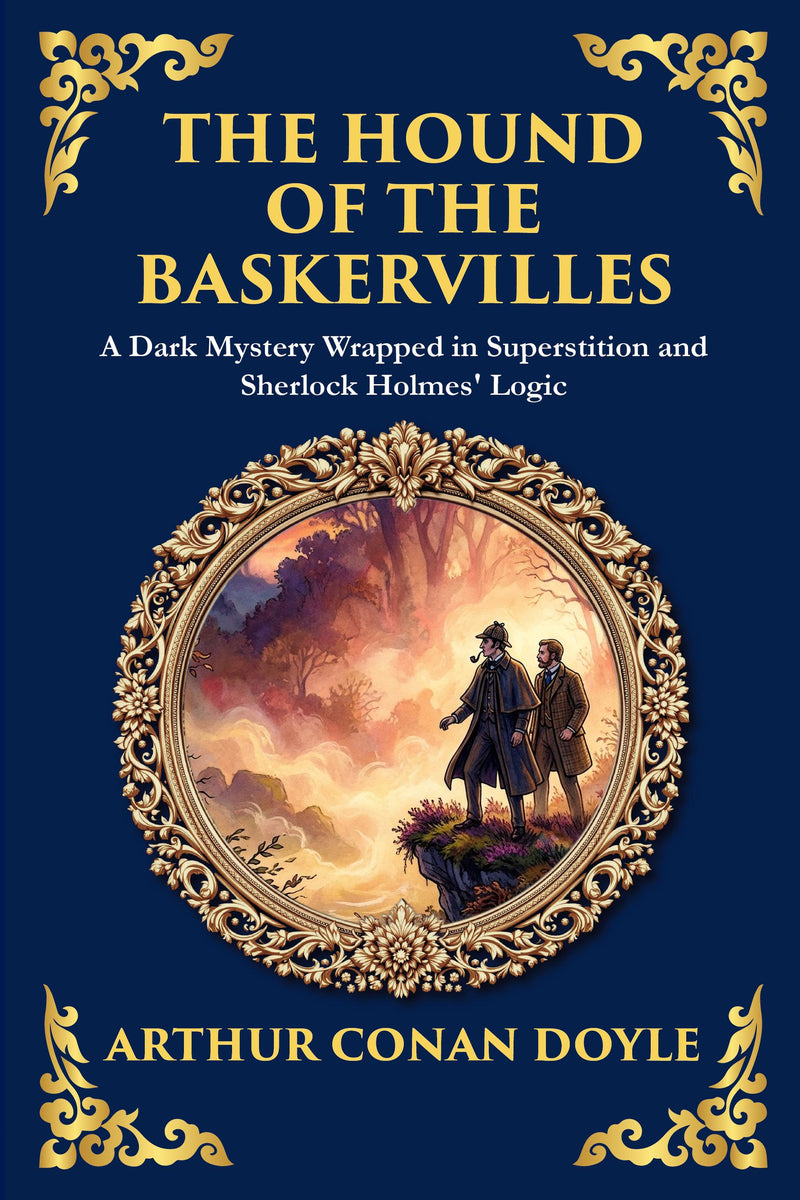
The Hound of the Baskervilles — Large Print
A mysterious death. A family curse. A terrifying hound said to haunt the moors. When Sir Charles Baskerville is found dead under suspicious circumstances, whispers of an ancient curse resurface.
or free app
10,000+ hrs library
30-day guarantee
The complete The Hound of the Baskervilles appears in modern English through Library of Alexandria Press, available online with audiobook narration included for members.
Have you ever wondered why some mysteries blur the line between the supernatural and cold, hard logic? In The Hound of the Baskervilles, Arthur Conan Doyle delivers his most chilling and suspenseful Sherlock Holmes adventure. Blending gothic terror with the brilliance of rational deduction, this timeless novel has captivated readers for over a century.
When Sir Charles Baskerville is found dead on the moors, all evidence seems to point to a legendary family curse: a monstrous spectral hound said to haunt the Baskerville lineage. Fearing for the safety of the heir, Sir Henry Baskerville, Dr. Mortimer seeks the aid of Sherlock Holmes.
But as Holmes sends Dr. Watson to investigate, strange events unfold—footprints in the night, eerie howls on the moors, and villagers gripped by fear. Holmes must unravel a tangled web of greed, deception, and superstition before the killer strikes again.
This gripping tale challenges readers to question appearances and trust only in the power of reason.
What you’ll discover in this modern edition
- Sherlock Holmes at His Finest – Witness Holmes’ legendary deductive skills as he faces one of his most complex and dangerous cases.
- A Gothic Atmosphere of Fear and Suspense – Explore the haunting moors, foggy landscapes, and eerie ruins where mystery and terror intertwine.
- Themes of Logic vs. Superstition – Dive deep into a story where the rational mind battles age-old myths and irrational fears.
- A Masterpiece of Detective Fiction – Experience why The Hound of the Baskervilles remains a cornerstone of crime and mystery literature.
- The Ultimate Holmes & Watson Dynamic – See the iconic detective duo at their most challenged and most brilliant.
| Formats | eBook (EPUB + PDF) · Audiobook · Paperback · Hardcover · Large Print |
| Language | English |
| Trim size (print) | 6 × 9 in |
| Binding | Paperback — perfect-bound · Hardcover — casewrap |
| Large Print edition | Same text in a larger, easy-read type — a larger font, not a larger trim |
| Print pricing | Every physical book at our true cost — at-cost, no profit (members) |
| Library | 873 restored titles, always growing |
| Length | 55,073 words · ~3 hr 40 min reading |
| Reading level | Grade 7 · an easy, flowing read (this modern-English edition) |
| Edition | Modern English translation · 2026 |
Member reviews for this edition are collected as readers finish it — be the first. Across the library: 12,000+ books shipped, every plan covered by a 365-day print guarantee.
About this edition
A faithful, unabridged modern-English edition by The Library of Alexandria — carefully rendered for today's reader and verified paragraph-by-paragraph against the public-domain source. Available as eBook, audiobook, paperback, hardcover, and large print.
- Complete & unabridgedVerified paragraph by paragraph against the source — never a scan, never abridged.
- Modern English, faithfulReadable today, with the author’s meaning kept intact. Readable — not simplified.
- Every format, one membershipRead in your browser or the free app, or listen to the full audiobook.
Included free with your membership
Cancel anytime, one click · 30-day money-back guarantee
Edition last updated July 2026
What’s inside
The Hound of the Baskervilles — Large Print — complete and unabridged: all 16 sections included with membership, plus the full audiobook.
Begin reading The Hound of the Baskervilles — Large Print
In clear modern English — the complete text is included with membership.
Introduction
There are stories that survive their century, and then there are stories that seem to seep into the collective imagination so completely that they no longer feel like fiction at all. They become part of the furniture of our minds—shapes glimpsed in fog, sounds heard at the edge of sleep, certainties that turn to doubt the moment we are alone with our own thoughts. This is one of those stories. Few tales in the English language have lodged themselves so deeply in our shared memory, and even readers who have never turned a single page of Arthur Conan Doyle somehow know the essential image at its heart: a great black hound, eyes ablaze, loping across a moonlit wasteland, the embodiment of a curse that has stalked a noble family for generations.
What you hold in your hands is a modern translation of that tale—an adaptation carefully prepared for the contemporary reader. Before we go any further, it is worth pausing on what that phrase means, and just as importantly, what it does not mean. This is not a summary, a simplification, or a watering-down. The bones of the story remain exactly as Conan Doyle built them more than a century ago. What has been adjusted is the surface: the occasional archaic turn of phrase, the dated idiom that might trip a modern eye, the sentence constructions that once flowed naturally but now feel like wading through treacle. The aim is to remove the small frictions that can stand between a twenty-first-century reader and the genuine pleasure of the original, while preserving every ounce of its atmosphere, its cleverness, and its dread. Think of it less as a renovation and more as a careful cleaning of an old master painting—the same image, the same brushwork, only with the grime of time gently lifted away so the colors can blaze as brightly as they did when they were new.
That distinction matters because this particular story is, above all, a triumph of atmosphere. To strip it of its mood would be to gut it. And so the modern reader will find here the same brooding wilderness, the same creeping unease, the same sense that something ancient and malevolent is watching from just beyond the reach of the lantern’s glow. What has changed is only that the path into that world has been made smoother, the door swung open a little wider. The shiver waiting on the other side is entirely undiminished.
A Detective, a Legend, and the World That Made Them
To understand why this book occupies such a singular place in literary history, it helps to know a little about the man who created it and the strange, almost reluctant relationship he had with his most famous creation. Arthur Conan Doyle was a physician by training, a Scotsman of restless energy and wide-ranging curiosity, and he came to fiction partly out of financial necessity during the long, quiet hours of a sparsely attended medical practice. It was during those idle stretches, waiting for patients who did not always come, that he first conceived of a consulting detective unlike any seen before—a man who solved crimes not through luck or intuition but through ruthless observation and remorseless logic. The character he built drew heavily on a real-life mentor from his medical training, a surgeon famous for diagnosing patients’ occupations, recent travels, and ailments from a single glance. Out of that inspiration was born one of the most recognizable figures in all of fiction.
By the time this story came to be written, however, Conan Doyle had a complicated history with his great detective. He had, in fact, grown weary of him. The author harbored serious literary ambitions—he longed to be remembered for his historical novels, his works of weight and substance—and he had come to resent the way the public clamored only for more detective stories, as though that were the limit of what he could offer. So pronounced was his frustration that he had, at one dramatic point, killed the character off entirely, sending him to an apparent doom in a thunderous waterfall and hoping to be free of him forever. The public response was something close to national mourning. Readers wore black armbands. Letters of outrage and grief poured in. The detective had escaped the page and taken on a life of his own in the minds of millions.
This book emerged from that uneasy truce between an author and his public. Crucially, when Conan Doyle returned to his detective here, he framed the story as an earlier adventure—a case from before the fateful events at the waterfall—so that he could enjoy the company of his greatest creation again without formally undoing the death he had so carefully arranged. The result is a story written by an author at the absolute peak of his powers, returning to a character he understood completely, and pouring into the work everything he had learned about suspense, structure, and the dark machinery of fear. It is no coincidence that this is so often cited as the finest of all the detective’s adventures. It was written not out of obligation but out of genuine inspiration, and that inspiration crackles on every page.
The world from which the book springs is the England of the turn of the twentieth century—a society poised uneasily between the certainties of the old order and the unsettling discoveries of the new. This was an age fascinated by science and reason, by the steady march of progress that promised to explain away every mystery. Yet it was also an age haunted by older fears, by ghost stories told around the fire, by folk legends that refused to die quietly even as the gaslights spread and the railways stretched out across the countryside. The genius of this tale lies precisely in how it sets these two worlds against one another. On one side stands cold, brilliant rationality, insisting that every effect has a knowable cause. On the other looms ancient superstition, the dread of curses and demons and forces that no microscope can detect. The drama of the story is, in large part, the drama of this collision—and the reader is never allowed to feel entirely sure which side will prevail.
It is worth saying a word, too, about the setting itself, because in this book the landscape is very nearly a character in its own right. Much of the action unfolds across a vast, desolate stretch of wild country—a place of rolling moorland, treacherous bogs, jutting granite, and ancient stone ruins left behind by peoples long vanished. Conan Doyle drew on real geography for this, on a region he had visited and whose bleak grandeur clearly seized his imagination. The setting is rendered with such vividness that the reader can almost feel the damp seeping into their clothes, hear the wind moaning across the empty spaces, sense the soft and deadly ground that can swallow a careless traveler whole. This is no mere backdrop. The wilderness presses in on the characters, isolates them, plays tricks on their senses, and amplifies every fear until the rational mind begins, despite itself, to wonder whether something supernatural might truly be at work. It is one of the great achievements of the book that a place can be made to feel so utterly menacing, and the modern reader should be prepared to find that the landscape lingers in the memory long after the final page.
What makes the partnership at the center of these stories so enduring is the contrast between its two principal figures. There is the detective himself—aloof, brilliant, occasionally insufferable, capable of leaps of reasoning that seem almost supernatural until they are explained, at which point they appear so obvious that one wonders how they were ever missed. And there is his companion and chronicler, a steady, decent, intelligent man who serves as our guide through the labyrinth. This second figure is far more than a mere sidekick or a passive narrator. He is, in many ways, the heart of the story, and the reader’s surrogate within it. We see the events largely through his eyes, share his confusion and his fears, and feel his frustration when the great detective withholds his thoughts. In this particular adventure, that narrator is given an unusually large and active role—he is called upon to act independently, to observe and report, to face danger without the reassuring presence of his more capable friend at his elbow. This structural choice deepens the suspense enormously, because it places us alongside a character who is brave and competent but, like us, often quite out of his depth, groping through the dark toward a truth he cannot yet perceive.
The Art of Dread and the Pleasure of the Puzzle
What sets this story apart from so many others in its genre is the masterful way it weaves together two very different kinds of pleasure. On one hand, it is a detective story in the purest sense—a puzzle to be solved, a chain of clues to be assembled, a mystery whose solution lies fairly within the reader’s grasp if only they are clever enough to see it. On the other hand, it is a work of genuine horror, a tale designed to make the skin crawl and the pulse quicken, a story that taps into our oldest and deepest fears of the dark and the unknown. Most authors can manage one or the other. Conan Doyle, in this book, achieves both at once, and it is the tension between them that gives the story its extraordinary power.
Consider the central dilemma the reader faces, page after page. Everything we know about the detective tells us that the world is rational, that there are no ghosts or curses, that every seemingly inexplicable event has a perfectly mundane explanation waiting to be uncovered. And yet the events of the story mount up in a way that strains this confidence to its breaking point. Strange occurrences pile upon stranger ones. Witnesses speak of things they cannot have imagined. The very atmosphere of the place seems to argue against reason. We want to believe in logic, because we have been trained by the detective himself to do so—but the book keeps planting seeds of doubt, keeps suggesting that perhaps, this time, the explanation lies beyond the natural world. This is the engine of suspense that drives the narrative forward, and it is constructed with remarkable skill. The reader is never permitted to settle comfortably into certainty. The ground beneath our feet, like the treacherous bogs of the moor itself, is always shifting.
The pacing deserves particular mention, because it is part of what makes the book so satisfying even on a second or third reading. The story opens with a quiet, almost cozy scene—an examination of an object left behind by a visitor, a display of the detective’s celebrated powers of deduction—and from there it gradually, inexorably draws the reader deeper into shadow. The tension is built not through constant action but through accumulation, through the slow gathering of unease, through small details that seem innocent at first and only later reveal their sinister significance. By the time the story reaches its climax, the reader has been so thoroughly immersed in its world, so carefully wound up by its mounting dread, that the final movements arrive with genuine force. There is a reason this book has been adapted for stage and screen more times than almost any other story of its kind. Its structure is, quite simply, a model of how to build and release tension.
For the modern reader coming to this work for the first time, a few words of guidance may enhance the experience. First, resist the temptation to rush. This is a story that rewards patience, that wants you to soak in its atmosphere rather than race toward its conclusion. The fog and the moor and the long silences are not obstacles to be hurried past; they are the very substance of the book’s pleasure. Read it slowly, ideally in the evening, and let the unease build as the author intended. Second, play the game. Pay attention to the details, to the offhand remarks and seemingly trivial observations, because the solution to the mystery is woven into them. Part of the genius of a well-made detective story is that it plays fair with the reader, scattering clues in plain sight while distracting us with red herrings and false leads. You may not solve the puzzle—few first-time readers do—but the attempt is half the fun, and the moment of revelation lands all the harder for the effort.
Cancel anytime, one click · 30-day money-back guarantee
Founding annual rate available now — your price locks for life when you join.
Not ready? Get this free chapter by email — read it anytime.
✓ Sent — check your inbox for The Hound of the Baskervilles — Large Print.
Questions about The Hound of the Baskervilles — Large Print
What is The Hound of the Baskervilles about?
A mysterious death. A family curse. A terrifying hound said to haunt the moors.
Who wrote The Hound of the Baskervilles?
The Hound of the Baskervilles was written by Arthur Conan Doyle. This edition presents the complete work in clear modern English, faithfully rendered from the public-domain original by Library of Alexandria Press.
Is The Hound of the Baskervilles free to read?
The opening chapter is free to read on this page. Members read and listen to the complete work — and the entire library — free, and can order any physical book at our true print cost.
How long is The Hound of the Baskervilles?
16 chapters (~55,073 words) — about 3 hr 40 min of reading in this modern-English edition.
Is this an abridged version of The Hound of the Baskervilles?
No. This is the complete, unabridged The Hound of the Baskervilles, carefully rendered into clear modern English and verified paragraph-by-paragraph against the public-domain source — nothing is cut or summarised.
What formats does The Hound of the Baskervilles come in?
The Hound of the Baskervilles is available as eBook, paperback, hardcover and large print. eBook and audiobook are included with membership; printed editions ship at our true print cost.
Shipping & returns
Billing & membership
More from the library


Explore Mystery & Crime
- Resurrection · Leo Tolstoy
- Crime and Punishment · Fyodor Dostoyevsky
- The Strange Case of Dr. Jekyll and Mr. Hyde · Robert Louis Stevenson
- The Riddle of the Sands · Erskine Childers
- The Wisdom of Father Brown · G. K. Chesterton
- The Cask of Amontillado · Edgar Allan Poe
- The Tomb of Ts’in · Edgar Wallace
- Ghost Stories of an Antiquary · M. R. James
- The Hunniwell Boys and the Platinum Mystery · L. P. Wyman
- The Seven Dials Mystery · Agatha Christie
- The Thirty-Nine Steps · John Buchan
- The Hand in the Dark · Arthur J. Rees
- Lady Audley’s Secret · M. E. Braddon
- The Mystery of the Blue Train · Agatha Christie
- The Secret Adversary · Agatha Christie
- The Call of Cthulhu · H. P. Lovecraft
- The Adventures of Heine · Edgar Wallace
- The Valley of Fear · Arthur Conan Doyle
- The Innocence of Father Brown · G. K. Chesterton
- McTeague: A Story of San Francisco · Frank Norris
- Tess of the d’Urbervilles: A Pure Woman · Thomas Hardy
- The Big Fix · George O. Smith
- The Ambulance Made Two Trips · Murray Leinster
- Time Crime · H. Beam Piper
- The Misplaced Battleship · Harry Harrison
- Supermind · Randall Garrett and Laurence M....
- Lone Star Planet · H. Beam Piper and John J. McGuire
- Dracula · Bram Stoker
- The Murder on the Links · Agatha Christie
- The Hound of the Baskervilles · Arthur Conan Doyle
The Hound of the Baskervilles — Large Print
The Hound of the Baskervilles — Large Print
A Dark Mystery Wrapped in Superstition and Sherlock Holmes’ Logic
Arthur Conan Doyle
Contents
- Introduction
- Chapter 1
- Chapter 2
- Chapter 3
- Chapter 4
- Chapter 5
- Chapter 6
- Chapter 7
- Chapter 8
- Chapter 9
- Chapter 10
- Chapter 11
- Chapter 12
- Chapter 13
- Chapter 14
- Chapter 15
Introduction
There are stories that survive their century, and then there are stories that seem to seep into the collective imagination so completely that they no longer feel like fiction at all. They become part of the furniture of our minds—shapes glimpsed in fog, sounds heard at the edge of sleep, certainties that turn to doubt the moment we are alone with our own thoughts. This is one of those stories. Few tales in the English language have lodged themselves so deeply in our shared memory, and even readers who have never turned a single page of Arthur Conan Doyle somehow know the essential image at its heart: a great black hound, eyes ablaze, loping across a moonlit wasteland, the embodiment of a curse that has stalked a noble family for generations.
What you hold in your hands is a modern translation of that tale—an adaptation carefully prepared for the contemporary reader. Before we go any further, it is worth pausing on what that phrase means, and just as importantly, what it does not mean. This is not a summary, a simplification, or a watering-down. The bones of the story remain exactly as Conan Doyle built them more than a century ago. What has been adjusted is the surface: the occasional archaic turn of phrase, the dated idiom that might trip a modern eye, the sentence constructions that once flowed naturally but now feel like wading through treacle. The aim is to remove the small frictions that can stand between a twenty-first-century reader and the genuine pleasure of the original, while preserving every ounce of its atmosphere, its cleverness, and its dread. Think of it less as a renovation and more as a careful cleaning of an old master painting—the same image, the same brushwork, only with the grime of time gently lifted away so the colors can blaze as brightly as they did when they were new.
That distinction matters because this particular story is, above all, a triumph of atmosphere. To strip it of its mood would be to gut it. And so the modern reader will find here the same brooding wilderness, the same creeping unease, the same sense that something ancient and malevolent is watching from just beyond the reach of the lantern’s glow. What has changed is only that the path into that world has been made smoother, the door swung open a little wider. The shiver waiting on the other side is entirely undiminished.
A Detective, a Legend, and the World That Made Them
To understand why this book occupies such a singular place in literary history, it helps to know a little about the man who created it and the strange, almost reluctant relationship he had with his most famous creation. Arthur Conan Doyle was a physician by training, a Scotsman of restless energy and wide-ranging curiosity, and he came to fiction partly out of financial necessity during the long, quiet hours of a sparsely attended medical practice. It was during those idle stretches, waiting for patients who did not always come, that he first conceived of a consulting detective unlike any seen before—a man who solved crimes not through luck or intuition but through ruthless observation and remorseless logic. The character he built drew heavily on a real-life mentor from his medical training, a surgeon famous for diagnosing patients’ occupations, recent travels, and ailments from a single glance. Out of that inspiration was born one of the most recognizable figures in all of fiction.
By the time this story came to be written, however, Conan Doyle had a complicated history with his great detective. He had, in fact, grown weary of him. The author harbored serious literary ambitions—he longed to be remembered for his historical novels, his works of weight and substance—and he had come to resent the way the public clamored only for more detective stories, as though that were the limit of what he could offer. So pronounced was his frustration that he had, at one dramatic point, killed the character off entirely, sending him to an apparent doom in a thunderous waterfall and hoping to be free of him forever. The public response was something close to national mourning. Readers wore black armbands. Letters of outrage and grief poured in. The detective had escaped the page and taken on a life of his own in the minds of millions.
This book emerged from that uneasy truce between an author and his public. Crucially, when Conan Doyle returned to his detective here, he framed the story as an earlier adventure—a case from before the fateful events at the waterfall—so that he could enjoy the company of his greatest creation again without formally undoing the death he had so carefully arranged. The result is a story written by an author at the absolute peak of his powers, returning to a character he understood completely, and pouring into the work everything he had learned about suspense, structure, and the dark machinery of fear. It is no coincidence that this is so often cited as the finest of all the detective’s adventures. It was written not out of obligation but out of genuine inspiration, and that inspiration crackles on every page.
The world from which the book springs is the England of the turn of the twentieth century—a society poised uneasily between the certainties of the old order and the unsettling discoveries of the new. This was an age fascinated by science and reason, by the steady march of progress that promised to explain away every mystery. Yet it was also an age haunted by older fears, by ghost stories told around the fire, by folk legends that refused to die quietly even as the gaslights spread and the railways stretched out across the countryside. The genius of this tale lies precisely in how it sets these two worlds against one another. On one side stands cold, brilliant rationality, insisting that every effect has a knowable cause. On the other looms ancient superstition, the dread of curses and demons and forces that no microscope can detect. The drama of the story is, in large part, the drama of this collision—and the reader is never allowed to feel entirely sure which side will prevail.
It is worth saying a word, too, about the setting itself, because in this book the landscape is very nearly a character in its own right. Much of the action unfolds across a vast, desolate stretch of wild country—a place of rolling moorland, treacherous bogs, jutting granite, and ancient stone ruins left behind by peoples long vanished. Conan Doyle drew on real geography for this, on a region he had visited and whose bleak grandeur clearly seized his imagination. The setting is rendered with such vividness that the reader can almost feel the damp seeping into their clothes, hear the wind moaning across the empty spaces, sense the soft and deadly ground that can swallow a careless traveler whole. This is no mere backdrop. The wilderness presses in on the characters, isolates them, plays tricks on their senses, and amplifies every fear until the rational mind begins, despite itself, to wonder whether something supernatural might truly be at work. It is one of the great achievements of the book that a place can be made to feel so utterly menacing, and the modern reader should be prepared to find that the landscape lingers in the memory long after the final page.
What makes the partnership at the center of these stories so enduring is the contrast between its two principal figures. There is the detective himself—aloof, brilliant, occasionally insufferable, capable of leaps of reasoning that seem almost supernatural until they are explained, at which point they appear so obvious that one wonders how they were ever missed. And there is his companion and chronicler, a steady, decent, intelligent man who serves as our guide through the labyrinth. This second figure is far more than a mere sidekick or a passive narrator. He is, in many ways, the heart of the story, and the reader’s surrogate within it. We see the events largely through his eyes, share his confusion and his fears, and feel his frustration when the great detective withholds his thoughts. In this particular adventure, that narrator is given an unusually large and active role—he is called upon to act independently, to observe and report, to face danger without the reassuring presence of his more capable friend at his elbow. This structural choice deepens the suspense enormously, because it places us alongside a character who is brave and competent but, like us, often quite out of his depth, groping through the dark toward a truth he cannot yet perceive.
The Art of Dread and the Pleasure of the Puzzle
What sets this story apart from so many others in its genre is the masterful way it weaves together two very different kinds of pleasure. On one hand, it is a detective story in the purest sense—a puzzle to be solved, a chain of clues to be assembled, a mystery whose solution lies fairly within the reader’s grasp if only they are clever enough to see it. On the other hand, it is a work of genuine horror, a tale designed to make the skin crawl and the pulse quicken, a story that taps into our oldest and deepest fears of the dark and the unknown. Most authors can manage one or the other. Conan Doyle, in this book, achieves both at once, and it is the tension between them that gives the story its extraordinary power.
Consider the central dilemma the reader faces, page after page. Everything we know about the detective tells us that the world is rational, that there are no ghosts or curses, that every seemingly inexplicable event has a perfectly mundane explanation waiting to be uncovered. And yet the events of the story mount up in a way that strains this confidence to its breaking point. Strange occurrences pile upon stranger ones. Witnesses speak of things they cannot have imagined. The very atmosphere of the place seems to argue against reason. We want to believe in logic, because we have been trained by the detective himself to do so—but the book keeps planting seeds of doubt, keeps suggesting that perhaps, this time, the explanation lies beyond the natural world. This is the engine of suspense that drives the narrative forward, and it is constructed with remarkable skill. The reader is never permitted to settle comfortably into certainty. The ground beneath our feet, like the treacherous bogs of the moor itself, is always shifting.
The pacing deserves particular mention, because it is part of what makes the book so satisfying even on a second or third reading. The story opens with a quiet, almost cozy scene—an examination of an object left behind by a visitor, a display of the detective’s celebrated powers of deduction—and from there it gradually, inexorably draws the reader deeper into shadow. The tension is built not through constant action but through accumulation, through the slow gathering of unease, through small details that seem innocent at first and only later reveal their sinister significance. By the time the story reaches its climax, the reader has been so thoroughly immersed in its world, so carefully wound up by its mounting dread, that the final movements arrive with genuine force. There is a reason this book has been adapted for stage and screen more times than almost any other story of its kind. Its structure is, quite simply, a model of how to build and release tension.
For the modern reader coming to this work for the first time, a few words of guidance may enhance the experience. First, resist the temptation to rush. This is a story that rewards patience, that wants you to soak in its atmosphere rather than race toward its conclusion. The fog and the moor and the long silences are not obstacles to be hurried past; they are the very substance of the book’s pleasure. Read it slowly, ideally in the evening, and let the unease build as the author intended. Second, play the game. Pay attention to the details, to the offhand remarks and seemingly trivial observations, because the solution to the mystery is woven into them. Part of the genius of a well-made detective story is that it plays fair with the reader, scattering clues in plain sight while distracting us with red herrings and false leads. You may not solve the puzzle—few first-time readers do—but the attempt is half the fun, and the moment of revelation lands all the harder for the effort.
Mr. Sherlock Holmes was sitting at the breakfast table. He was usually late in the mornings, unless he had been up all night, which happened quite often. I stood on the rug by the fireplace and picked up the walking stick our visitor had left behind the previous night. It was a sturdy, thick piece of wood with a rounded head, the kind known as a “Penang lawyer.” Just below the head was a wide silver band nearly an inch across. It was engraved with the date “1884” and the words, “To James Mortimer, M.R.C.S., from his friends of the C.C.H.” It was exactly the kind of stick an old-fashioned family doctor would carry—dignified, solid, and comforting.
Holmes was sitting with his back to me, and I hadn’t given him any sign that I was looking at the stick.
“How did you know what I was doing? I swear you have eyes in the back of your head.”
“At the very least, I have a polished, silver-plated coffee pot in front of me,” he replied. “But tell me, Watson, what do you think of our visitor’s stick? Since we were unlucky enough to miss him and have no idea why he came, this accidental souvenir is important. Let’s see if you can reconstruct the man’s character by examining it.”
“I think,” I said, trying my best to follow my friend’s methods, “that Dr. Mortimer is a successful, elderly doctor who is well-respected, since his acquaintances gave him this as a token of their appreciation.”
“I also think it’s likely he’s a country doctor who does a lot of his visiting on foot.”
“Because this stick, while originally very handsome, has been so beat up that I can’t imagine a city doctor carrying it. The thick iron tip is worn down, so it’s obvious he has walked a great deal with it.”
End of the free sample
Keep reading, free
Members read and listen to the complete book — and the entire library. Cancel anytime, one click · 30-day money-back guarantee.