








Riassunto
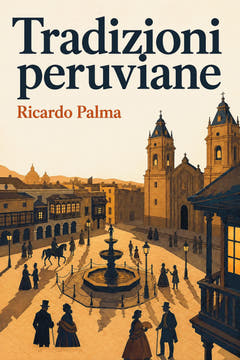
Riassunto di Tradizioni peruviane
A chi è rivolto
For readers who love short tales, colonial history told with humor, and the flavor of Latin American storytelling.
Che cos’è questo libro
Peruvian Traditions is a collection of short prose pieces by Ricardo Palma, a writer and librarian from Lima. He called each piece a tradition. A tradition mixes archive research, local legend, gossip and humor. Palma began publishing them in Lima newspapers in the 1850s and kept adding to them for decades. They were gathered into several series, and the Spanish title is Tradiciones peruanas.
Most of the tales look back to the colonial age, when Peru was ruled by Spanish viceroys from Lima, and some reach into the Inca past and the early republic. You meet viceroys, priests, nuns, smugglers, lovers, judges and rogues. Palma tells their stories with a smile and a sharp eye for pride and folly. You get a lively portrait of a society and of the way Peruvians like to tell their own past. First, we look at what a tradition actually is.
In questo riassunto
- 1A tradition blends fact and legendFree
- 2Viceroys and the theater of power
- 3Saints, priests and the colorful Church
- 4Rogues, lovers and clever tricksters
- 5Lima as a living character
- 6Humor as a way of telling history
- 7Building a national memory
- 8How the tales have lasted
Punto chiave 1 di 8
A tradition blends fact and legend
Palma invented a form that sits between history and fiction. Each tradition starts from a real document, a street name, a saying or an old story that people in Lima still repeated. He then builds a short narrative around it, often only a few pages long.
He did not claim to be a strict historian. He said, in effect, that his pieces were history told in a lighter way, with room for invention where records ran out. Readers should therefore treat the details as colorful, not as sworn evidence.
The tone is that of a man chatting with friends. He interrupts himself, teases the reader, and drops a joke where a solemn historian would put a footnote. That voice is a large part of why the pieces were loved.
For a modern reader, this means the tales work on two levels. They entertain as stories, and they show how a nation chose to remember its past.
That’s 1 of 8 key points.
The rest of the summary, written and spoken, and the whole book: free to start.
- Nothing to pay today · Renews every year
- We email you before you pay
- Cancel online in two clicks
About this edition
Every format is free to start, and print and large print are at cost.
- LengthAbout 48,000 words
- Reading timeAbout 3 h 15 min
- Listening time5 h 20 min
- FormatseBook, large-print eBook, audiobook, 15-minute summary
- LanguagesEnglish and 13 other languages
Questions about Tradizioni peruviane
What is Peruvian Traditions about?
It is a collection of short tales about Peru, mostly from the colonial period. They feature viceroys, priests, rogues and ordinary people of Lima, told with humor and based on documents, legends and local sayings.
Is Peruvian Traditions a true story?
Not strictly. Palma based many tales on real records and events but added invention and humor. They are best read as historical storytelling, not as exact history.
What is a tradition in Ricardo Palma's work?
A tradition is Palma's own form, a short prose piece that blends history, legend, gossip and wit. It is shorter than a story and lighter than a history, usually centered on one episode or saying.
When did Ricardo Palma write Peruvian Traditions?
He began publishing the traditions in newspapers in the mid nineteenth century and kept adding new ones for decades. They were gathered into several series, known in Spanish as Tradiciones peruanas.
Is Peruvian Traditions hard to read?
No. The pieces are short and conversational, and each stands alone. The humor and storytelling are easy to follow.