
 50 h 7 minAudiobook12 minSummaryRead it, hear it, the 15-minute summary, and print and large print at cost
 Audiobook edition · 50 h 7 minPaperback · 6 × 9 in · printing soonHardcover · 6 × 9 in · printing soon
About this book
What can a symbol teach you that a plain instruction cannot?
In Morals and Dogma of the Ancient and Accepted Scottish Rite of Freemasonry, Albert Pike explores the moral questions behind Masonic degrees. His lectures move from the Entered Apprentice to the Knight Kadosh and beyond, asking what duty, truth, tolerance, and labor demand of a person. Symbols become starting points for thought, rather than lessons with ready answers.
Pike gathers ideas from the Bible, Persian and Egyptian beliefs, Greek philosophy, and the Kabbalah. He reads them through questions of justice, faith, and the right use of power. This is neither a history of Freemasonry nor a record of its rituals. It is a guide to the meanings Pike finds within its ceremonies and symbols.
What you’ll discover
- Symbols that invite thought Explore Pike’s view that symbols ask you to work toward understanding for yourself.
- Truth through patient labor Follow his argument that wisdom and goodness require steady effort, not chance.
- Tolerance across different faiths Consider Pike’s account of a lodge where men of different beliefs can meet.
- Ancient ideas in conversation Encounter Zoroaster, Pythagoras, Plato, and the Kabbalah within Pike’s broad gathering of philosophies.
- Power put to service Examine the duty to defend truth and resist tyranny, fanaticism, and superstition.
Who will love it
Readers drawn to symbolism, ancient religions and myths, political philosophy, or the history of secret societies will enjoy this book. It also suits those who love moral teaching taken a little at a time.
What’s inside
The key ideas, in the 15-minute summary
- Unruled force destroys itself, so give it a rule
- A free state is a rough stone made perfect
- Symbols are the lesson and you must read them
- Masonry presents itself as heir of the Mysteries
- Seek wisdom rather than mere knowledge
- Duty, kindness and mercy are the working virtues
- Good feeling is not enough, so act on principle
- Old myths of sun and stars carry moral meaning
- God is beyond our maps, and opposites hold the world
- A borrowed book that has been read and questioned
Formats and delivery
- eBook
- On your phone, tablet or computer, once the book texts are online.
- Large-print eBook
- The same book in bigger, clearer type, once the book texts are online.
- Audiobook
- Read by Lucas Linden, complete. It opens once the recording is online.
- 15-minute summary
- The key ideas in about 12 minutes, to read today.
- Paperback
- 6 × 9 in. Printing soon: leave your email under Paperback or Hardcover above.
- Hardcover
- 6 × 9 in. Printing soon: leave your email under Paperback or Hardcover above.
- Large print paperback
- 8.5 × 11 in. Printing soon: leave your email under Paperback or Hardcover above.
- Large print hardcover
- 8.5 × 11 in. Printing soon: leave your email under Paperback or Hardcover above.
Every printed copy is made when you order it and shipped worldwide; shipping is shown at checkout. The eBook and the audiobook open when the book texts go online.
How it works
- Start free. Nothing to pay today; the eBook of this book is yours to keep.
- Read, listen and print. 200,000+ classics as eBook, large-print eBook, audiobook and 15-minute summary, and any book printed at cost as a paperback, hardcover or large print, 5 accounts for the price of one.
- We remind you first. Free for 3 months, and we email you 7 days before your first payment. Then 0,14 USD a day in your first year on the yearly plan and 0,27 USD a day after, or 0,66 USD a day on the monthly plan. Cancel online in two clicks.
Bought on its own? Every eBook, audiobook and printed book you buy without the plan carries our 30-day money-back guarantee.
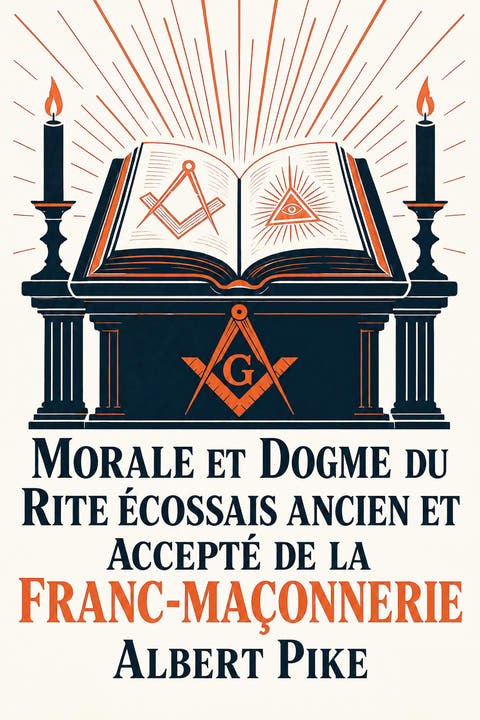
Morale et Dogme du Rite écossais ancien et accepté de la franc-maçonnerie
 by Albert Pike · 1871
Albert Pike gathers ancient symbols and moral lessons into one guide for thirty-two Masonic degrees.
ChallengingOver 20 hours to readfrançais
Excellent
Free for 3 months · starts right away, on any device
Read free3 months free · cancel anytimeFree for 3 months, then 0,14 USD a dayCancel anytimeHow it works


- Read or listen
- Print and large print at cost
- 5 accounts for the price of one
In short
What happens when raw strength has no guide? Albert Pike opens his first lecture by describing the waste and ruin caused by unregulated force.
From the 15-minute summary · Key idea 1
Unruled force destroys itself, so give it a rule
Pike heads the Apprentice lecture with two tools, the twelve-inch rule and the common gavel. The gavel stands for force, the will of the people in action. The rule stands for law and order. Without the second, he argues, the first is waste and ruin.
He pictures force in strong images. Steam shut in by science turns great wheels, while gunpowder burned in open air does nothing. The blinded giant Polyphemus strikes at random and falls among sharp rocks because of his own blows. Revolutions fail, he says, because force runs ahead of intellect and then sinks in the mud.
Free for 3 months · Cancel anytime
You looked at
Which edition is right for me
- 15-minute summary
- The key ideas of the whole book in about 12 minutes. A good first look, or a refresher.
Details
- First published
- 1871
- Language
- français
- Reading time
- 32 h 40 min
- Level
- Challenging
Cite this edition
Pike, Albert. Morals and Dogma of the Ancient and Accepted Scottish Rite of Freemasonry. Library of Alexandria, 2026, libraryofalexandria.com/products/morals-and-dogma-of-the-ancient-and-accepted-scottish-rite-of-freemasonry.
Pike, A. (2026). Morals and dogma of the Ancient and Accepted Scottish Rite of Freemasonry. Library of Alexandria. https://libraryofalexandria.com/products/morals-and-dogma-of-the-ancient-and-accepted-scottish-rite-of-freemasonry (Original work published 1871)
Pike, Albert. Morals and Dogma of the Ancient and Accepted Scottish Rite of Freemasonry. Library of Alexandria, 2026. https://libraryofalexandria.com/products/morals-and-dogma-of-the-ancient-and-accepted-scottish-rite-of-freemasonry.
@book{pike2026morals,
  author = {Pike, Albert},
  title = {Morals and Dogma of the Ancient and Accepted Scottish Rite of Freemasonry},
  publisher = {Library of Alexandria},
  year = {2026},
  url = {https://libraryofalexandria.com/products/morals-and-dogma-of-the-ancient-and-accepted-scottish-rite-of-freemasonry},
  note = {First published 1871}
}
Free gifts
580 USD in free gifts when you start
Every book in every format and in 25 languages, 5 accounts for the price of one. Nothing to pay today.
- 200,000+ classic eBooksIn 25 languages, side by side
170 USDFREE - Every audiobookIn 25 languages, any device
120 USDFREE - 15-minute summariesRead or listen, in 25 languages
60 USDFREE - Print at cost, no markupPaperback, hardcover, large print
60 USDFREE - 5 accounts for the price of oneA shelf for everyone at home
170 USDFREE - A part in rebuilding the libraryNew languages and books for all
FREE
Questions about Morale et Dogme du Rite écossais ancien et accepté de la franc-maçonnerie
Can I read it free?
Yes. The first key idea of the 15-minute summary is free with no sign-up. Start free and the whole book is yours for 3 months, with the eBook to keep, plus 200,000+ more classics and any book printed at cost as a paperback, hardcover or large print. Nothing to pay today: we email you 7 days before your first payment, and you can cancel online in two clicks.
Can I buy the printed book?
Soon. The paperback, hardcover and large print editions are being prepared. Choose Paperback or Hardcover above, leave your email, and we tell you the day you can order it, printed at cost.
How many accounts do I get?
Five, for the price of one: you and 4 more people, each with their own login, shelf and their own place in every book.
Can I cancel anytime?
Yes. Cancel online in two clicks at any time and nothing more is charged. Nothing is charged in your first 3 months, and we email you 7 days before your first payment.
What is Morals and Dogma about?
It is a set of lectures for the degrees of the Scottish Rite, using Masonic symbols to teach morality, liberty, tolerance and duty, with long surveys of ancient religion, philosophy and myth.
Did Albert Pike write all of Morals and Dogma himself?
No. His own preface says about half the book is taken from other writers, whose words he altered and mixed with his own, so he claims little of the merit of authorship.
What does dogma mean in this book?
Pike uses dogma in its original sense of teaching or doctrine. He says readers may freely reject anything that seems untrue, as long as they first weigh it fairly.

The author
Albert Pike
1809–1891 · American poet and Masonic writer
Albert Pike (1809–1891) was an American lawyer, poet, editor, and Confederate general. He was born in Boston and lived in Arkansas and later Washington, D.C., where he died. He wrote poetry and works on Freemasonry, including Morals and Dogma of the Ancient and Accepted Scottish Rite of Freemasonry, published in 1871.
More like this
Our mission
The library burned once. We are building it back.
Every great book, in every language and every format, for every family. Every plan helps pay for new languages, new audiobooks and books for readers who have never had them. Join the movement.
Read our story- Every language25 languages today, side by side, and more every year
- No wastePrinted on demand: no warehouses, no unsold stock, no pulped copies
- For everyonePaperback, hardcover and large print at the cost of printing
Popular in philosophy & ideas
See all





