


 12 h 55 minAudiobook14 minSummaryRead it, hear it, the 15-minute summary, and print and large print at costPaperback · 6 × 9 in · printing soonHardcover · 6 × 9 in · printing soon
About this book
A ruined castle divides two families, while love stirs at the manor and Napoleon’s army marches east.
Tadeusz Soplica returns from school to Soplicowo, a manor among Lithuania’s forests and farmland. His uncle, the Judge, welcomes guests and hopes for peace. But the Soplicas and Horeszkos still quarrel over a ruined castle, and the young man finds love and trouble close at hand.
In Pan Tadeusz, Adam Mickiewicz turns dinners, hunts and courtship into a portrait of a homeland remembered from exile. Set in 1811 and 1812, this verse epic follows private grudges as war draws near. Telimena, Zosia, the Count and the castle keeper Gerwazy bring different desires into a world shaped by honour and tradition.
What you’ll discover
- A home alive with detail Enter crowded dinners, gardens and farmland, where daily customs reveal a whole way of life.
- Love among old grudges Follow Tadeusz into a household where romance shares space with a stubborn family feud.
- The hunt and its quarrels Join a gathering meant to unite neighbours, where disputes over honour sharpen the divide.
- Humour beside pride Meet small nobles who farm their own plots, carrying swords, coats of arms and little money.
- The ache of homeland Discover how remembered fields and familiar rituals give shape to the poet’s longing for home.
Who will love it
For readers who love stories told with warmth, humour and rich detail of country life, and anyone curious about Polish and Lithuanian history.
What’s inside
The key ideas, in the 15-minute summary
- A lost country seen from exile
- A young man comes home
- A ruined castle and a family feud
- Dinners, mushrooms and the art of the hunt
- Telimena, the Count and the games of love
- A quarrel that splits the district
- The petty nobles gather for a council
- What the poem says about home and nation
- How the poem is told
Who’s who
- Tadeusz SoplicaA warm, hot-headed young man who comes home from school in Vilnius to his uncle's manor and finds love and trouble waiting.
- The JudgeTadeusz's uncle and master of Soplicowo, a generous host who wants peace in the district and an end to the lawsuit over the castle.
- TelimenaA lively, worldly lady staying at the manor, who enjoys the attention of the men around her and knows how to use it.
- ZosiaA fresh, quiet young girl in Telimena's care who loves her garden and her birds and whose gentle presence matters more than she knows.
- GerwazyThe old keeper of the Horeszko castle, fiercely loyal to his dead master, who carries the keys and a sword called the Penknife.
- The CountA fashionable young heir of the Horeszko line, fond of grand gestures, who wants the castle back by law or by force.
- The WojskiAn older relative and hunter, keeper of manners and old stories, who leads the hunt and blows the horn.
- The friar RobakA mysterious, solitary friar who moves through the district giving counsel and watching events with an air of hidden purpose.
Formats and delivery
- eBook
- On your phone, tablet, computer or Kindle, with the type as large as you like.
- Large-print eBook
- The same book in bigger, clearer type, from the first page.
- Audiobook
- 12 h 55 min, complete, read by Lucas Linden.
- 15-minute summary
- The key ideas in about 14 minutes, to read or to hear.
- Paperback
- 6 × 9 in. Printing soon: leave your email under Paperback or Hardcover above.
- Hardcover
- 6 × 9 in. Printing soon: leave your email under Paperback or Hardcover above.
- Large print paperback
- 8.5 × 11 in. Printing soon: leave your email under Paperback or Hardcover above.
- Large print hardcover
- 8.5 × 11 in. Printing soon: leave your email under Paperback or Hardcover above.
eBooks and audiobooks open right away. Download EPUB or PDF, or send the book to your Kindle. Every printed copy is made when you order it and shipped worldwide; shipping is shown at checkout.
How it works
- Start free. Nothing to pay today; the eBook of this book is yours to keep.
- Read, listen and print. 200,000+ classics as eBook, large-print eBook, audiobook and 15-minute summary, and any book printed at cost as a paperback, hardcover or large print, 5 accounts for the price of one.
- We remind you first. Free for 3 months, and we email you 7 days before your first payment. Then 0,14 USD a day in your first year on the yearly plan and 0,27 USD a day after, or 0,66 USD a day on the monthly plan. Cancel online in two clicks.
Bought on its own? Every eBook, audiobook and printed book you buy without the plan carries our 30-day money-back guarantee.
25 languages, side by side
Read and hear Pan Tadeusz oder Der letzte Ausfall in Litauen in 25 languages and switch at any time. Or read two side by side, paragraph by paragraph: the way to learn a language with a book you love.
Pan Tadeusz oder Der letzte Ausfall in Litauen
 by Adam Mickiewicz · 1834
Tadeusz returns to Soplicowo, where love and a feud over a ruined castle await as Napoleon's army marches east.
Medium level10–20 hours to read25 languages
Excellent
- Read or listen
- 25 languages, side by side
- Print and large print at cost
- 5 accounts for the price of one
Free for 3 months · starts right away, on any device
Read free3 months free · cancel anytimeFree for 3 months, then 0,14 USD a dayCancel anytimeHow it works


In short
Pan Tadeusz is a long poem in twelve books by Adam Mickiewicz, the national poet of Poland. He wrote it in Paris in the early 1830s, and it was published there in 1834.
From the 15-minute summary · Key idea 1
A lost country seen from exile
Pan Tadeusz begins with a longing. The poet is far from home, and he calls up the landscape of his youth as if he could walk through it again. He pictures meadows painted with many kinds of grain, wild pear trees growing on the balks between fields, and the white manor house among poplars. The first lines are an address to the homeland itself, and the tone is that of a man who has lost something he cannot get back.
The time of the story matters. It is 1811 and 1812, when the old Polish Commonwealth has already been divided up and Lithuania lives under Russian rule. Many Poles still hope that Napoleon, who has set up a small Polish state called the Duchy of Warsaw, will march east and free them. The poem is full of rumours, soldiers passing through and quiet talk of this hope. A reader feels that the peaceful countryside is waiting for something.
Free for 3 months · Cancel anytime
Free gifts
580 USD in free gifts when you start
Every book in every format and in 25 languages, 5 accounts for the price of one. Nothing to pay today.
- 200,000+ classic eBooksIn 25 languages, side by side
170 USDFREE - Every audiobookIn 25 languages, any device
120 USDFREE - 15-minute summariesRead or listen, in 25 languages
60 USDFREE - Print at cost, no markupPaperback, hardcover, large print
60 USDFREE - 5 accounts for the price of oneA shelf for everyone at home
170 USDFREE - A part in rebuilding the libraryNew languages and books for all
FREE
Questions about Pan Tadeusz oder Der letzte Ausfall in Litauen
Can I read it free?
Yes. The first key idea of the 15-minute summary is free with no sign-up. Start free and the whole book is yours for 3 months, with the eBook to keep, plus 200,000+ more classics and any book printed at cost as a paperback, hardcover or large print. Nothing to pay today: we email you 7 days before your first payment, and you can cancel online in two clicks.
Can I buy the printed book?
Soon. The paperback, hardcover and large print editions are being prepared. Choose Paperback or Hardcover above, leave your email, and we tell you the day you can order it, printed at cost.
How many accounts do I get?
Five, for the price of one: you and 4 more people, each with their own login, shelf and their own place in every book.
Can I cancel anytime?
Yes. Cancel online in two clicks at any time and nothing more is charged. Nothing is charged in your first 3 months, and we email you 7 days before your first payment.
What is Pan Tadeusz about?
It is a poem about two noble families in Lithuania in 1811 and 1812, who feud over a ruined castle while a young man, Tadeusz, returns home and falls in love. It also pictures old Polish country life.
Why is Pan Tadeusz so important to Poland?
It was written by an exile after Poland had disappeared from the map, and it preserves the customs, landscape and spirit of the old country. Many Poles learn it at school and regard it as their national epic.
When was Pan Tadeusz written and is it a true story?
Mickiewicz wrote it in Paris in the early 1830s, and it appeared in 1834. The story is invented, but the setting, customs and the political mood of 1811 and 1812 are drawn from real history.
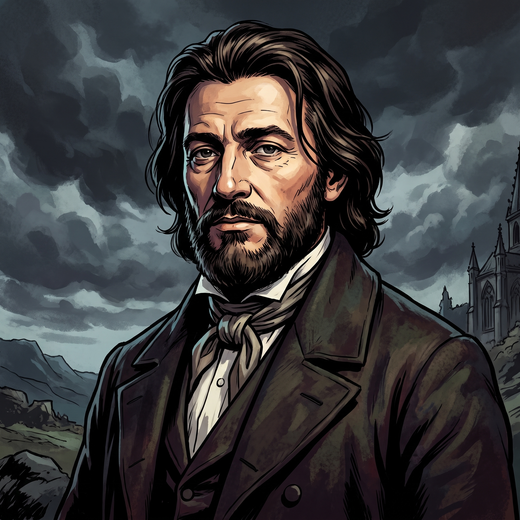
The author
Adam Mickiewicz
1798–1855 · Polish Romantic poet
Adam Mickiewicz (1798–1855) was a Polish poet, dramatist, and political activist. He was born near Nowogródek, then in the Russian Empire, and lived in Russia before settling in Paris in 1832. He wrote Pan Tadeusz, published in 1834, and the drama Dziady. He died in Constantinople.
More like this
Our mission
The library burned once. We are building it back.
Every great book, in every language and every format, for every family. Every plan helps pay for new languages, new audiobooks and books for readers who have never had them. Join the movement.
Read our story- Every language25 languages today, side by side, and more every year
- No wastePrinted on demand: no warehouses, no unsold stock, no pulped copies
- For everyonePaperback, hardcover and large print at the cost of printing

