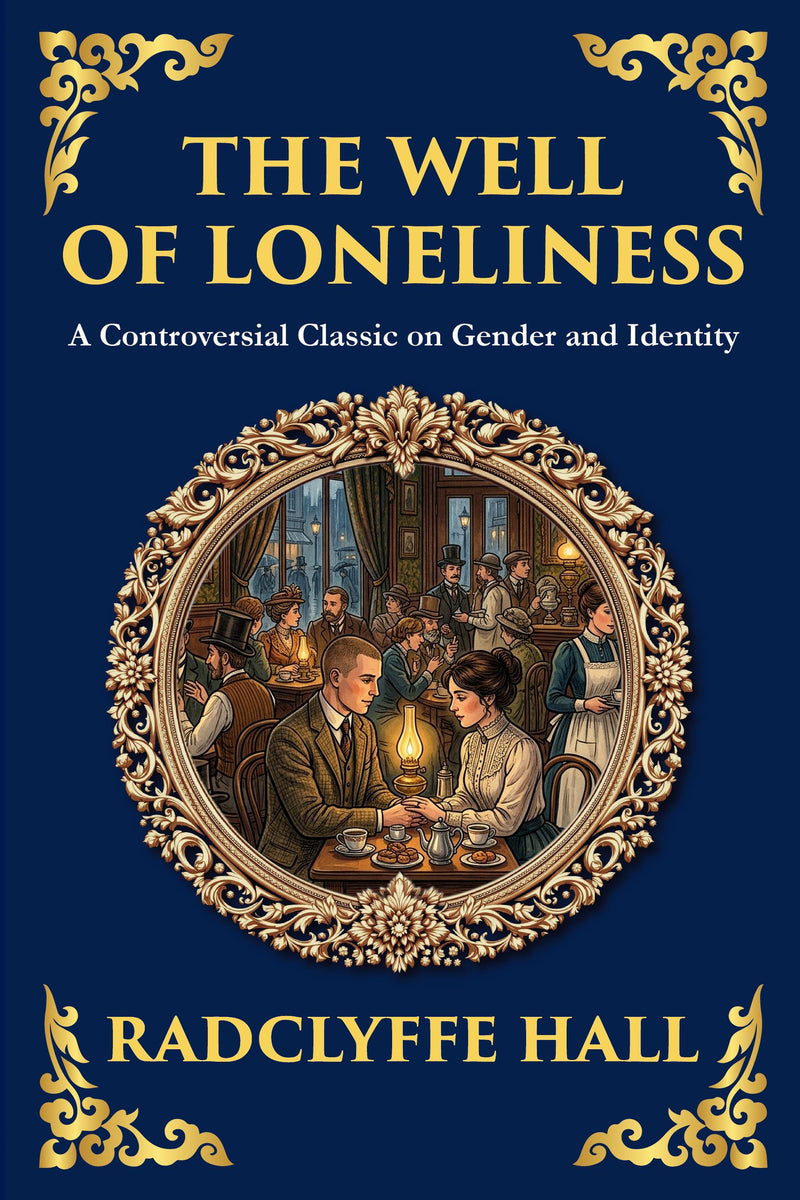
The Well of Loneliness
First banned, then embraced, The Well of Loneliness remains one of the most significant—and controversial—novels in LGBTQ+ literary history.
or free app
10,000+ hrs library
30-day guarantee
The complete The Well of Loneliness appears in modern English through Library of Alexandria Press, available online with audiobook narration included for members.
Have you ever wondered why being true to yourself can come at the cost of everything else? The Well of Loneliness by Radclyffe Hall is a trailblazing literary work that shattered boundaries and brought lesbian identity into the public discourse for the first time. Courageous, poetic, and deeply human, it tells the story of Stephen Gordon—a woman born into wealth and status, but destined to struggle against a world that cannot accept her difference.
From early childhood, Stephen is acutely aware that she is unlike other girls. Intelligent, strong- willed, and honest to a fault, she grows into a writer and soldier, seeking meaning, purpose, and love in a society that equates her identity with shame. When she falls in love with Mary Llewellyn, the happiness she finds is short-lived as external pressures and inner turmoil threaten to destroy everything.
Radclyffe Hall’s portrayal of gender nonconformity, same-sex love, and personal sacrifice was revolutionary in its time—and remains deeply resonant today. This edition presents the full, unabridged text in a modern format that honors Hall’s fearless vision while making it accessible to contemporary readers.
What you’ll discover in this modern edition
- A Groundbreaking LGBTQ+ Novel – The first major English work to sympathetically portray lesbian identity and gender nonconformity.
| Formats | eBook (EPUB + PDF) · Audiobook · Paperback · Hardcover · Large Print |
| Language | English |
| Trim size (print) | 6 × 9 in |
| Binding | Paperback — perfect-bound · Hardcover — casewrap |
| Large Print edition | Same text in a larger, easy-read type — a larger font, not a larger trim |
| Print pricing | Every physical book at our true cost — at-cost, no profit (members) |
| Library | 873 restored titles, always growing |
| Length | 156,877 words · ~10 hr 28 min reading |
| Reading level | Grade 8 · an easy, flowing read (this modern-English edition) |
| Edition | Modern English translation · 2026 |
Member reviews for this edition are collected as readers finish it — be the first. Across the library: 12,000+ books shipped, every plan covered by a 365-day print guarantee.
About this edition
A faithful, unabridged modern-English edition by The Library of Alexandria — carefully rendered for today's reader and verified paragraph-by-paragraph against the public-domain source. Available as eBook, audiobook, paperback, hardcover, and large print.
- Complete & unabridgedVerified paragraph by paragraph against the source — never a scan, never abridged.
- Modern English, faithfulReadable today, with the author’s meaning kept intact. Readable — not simplified.
- Every format, one membershipRead in your browser or the free app, or listen to the full audiobook.
Included free with your membership
Cancel anytime, one click · 30-day money-back guarantee
Edition last updated July 2026
What’s inside
The Well of Loneliness — complete and unabridged: all 60 sections included with membership, plus the full audiobook.
Begin reading The Well of Loneliness
In clear modern English — the complete text is included with membership.
Introduction
When Radclyffe Hall published her most famous novel in 1928, she could not have anticipated that it would become one of the most fiercely contested books of the twentieth century — banned, prosecuted, defended by some of the greatest literary minds of the age, and ultimately enshrined as a landmark in the history of human self-understanding. To open this book today is to step into a moment of extraordinary courage. Here was a writer who dared to speak openly about a subject that polite society had long agreed to leave unspoken, who insisted that a kind of love society wished to deny had every right to exist, to suffer, to hope, and to be named. The novel you are about to read is not merely a story. It is an act of testimony, a plea for understanding written at a time when such a plea could ruin a reputation, destroy a career, and provoke the full machinery of the law.
This modern adaptation has been prepared with a singular purpose: to bring the emotional power and historical significance of the original to readers of our own era without the barriers of dated phrasing and stylistic conventions that can sometimes obscure rather than reveal. The prose has been gently clarified, the rhythms eased, and certain passages reframed so that the contemporary reader may feel the full force of what the author intended. Yet nothing essential has been lost. The aching tenderness, the moral seriousness, the slow and devastating accumulation of feeling — all of this remains. What you hold is a bridge between two worlds, an invitation to encounter a story that changed the way an entire civilization thought about love and identity, told in a voice that the present-day reader can hear clearly.
The Woman Behind the Book and the World That Shaped Her
To understand the novel fully, it helps to know something of the remarkable figure who wrote it. Marguerite Radclyffe Hall — known to her friends as “John,” the name she preferred and lived by — was born in 1880 into a wealthy but unhappy English family. Her childhood was marked by neglect and emotional turbulence, by a father who abandoned the household and a mother who could not offer the warmth a child needs. From these difficult beginnings emerged a woman of fierce independence, considerable wealth, and absolute conviction about who she was. By the time she came to write this book, Hall had already published several volumes of poetry and a handful of novels, one of which, Adam’s Breed, had won major literary prizes and established her as a serious author. She had earned the respect of the literary establishment. She had standing. She had everything to lose.
And she chose, deliberately and with full awareness of the consequences, to risk it all. Hall lived openly in a committed relationship with Una Troubridge, a sculptor and translator who would remain her partner for the rest of her life. Hall understood that she was different from the majority of those around her, and she had come to believe that this difference was innate, a matter of nature rather than choice or vice. She wore tailored masculine clothing, cropped her hair, and carried herself with an unmistakable presence that announced her refusal to conform. In an era when such visibility could invite scorn, ostracism, and even legal danger, Hall’s life was itself a kind of declaration. The novel grew naturally out of this lived conviction. She had reached a point where she felt morally compelled to speak, not for herself alone but on behalf of all those whom society had condemned to silence and shame.
The world into which she released her book was one of profound contradiction. The 1920s are often remembered as a decade of liberation and experimentation — the jazz age, the loosening of Victorian restraints, the dawn of a more modern sensibility. Yet beneath this surface of apparent freedom, rigid moral codes remained firmly in place, and certain subjects were guarded with ferocious vigilance. The legal and social apparatus of the period treated any frank discussion of love between members of the same sex as obscene by definition, regardless of how it was handled. There was no vocabulary in common use for what Hall wished to describe, no public framework within which her characters could be understood with sympathy. She had to invent, almost from nothing, a way of presenting her subject that would be both honest and dignified. She drew on the emerging theories of sexologists of her day — writers and physicians who had begun, however imperfectly, to study human sexuality as a natural phenomenon — and she fused these ideas with the moral and religious seriousness of her own temperament.
The result was a book that pleaded for compassion rather than demanding rights, that framed its central figure as someone deserving of pity and acceptance rather than punishment. Hall was not a revolutionary in the modern political sense. She did not call for the overturning of the social order. What she asked for was recognition — the acknowledgment that her characters were human beings, capable of nobility and devotion, worthy of a place in the world. This relatively modest plea proved, in its context, explosive enough.
The reception was swift and severe. Within months of publication, the book became the subject of an obscenity trial in England that would become legendary. A prominent newspaper editor denounced it in scorching terms, declaring that he would rather give a healthy young person poison than allow them to read it. The government moved to suppress it. In the courtroom, the prosecution argued not that the book was lewd or graphic — for it contained nothing that could remotely be called explicit by any reasonable standard — but that its mere sympathetic treatment of its subject made it dangerous. The very act of presenting these lives without condemnation was deemed corrupting. A parade of distinguished writers and intellectuals, including some of the most respected figures in British letters, prepared to testify in the book’s defense, only to be told by the magistrate that their opinions on its literary merit were irrelevant. The question, the court held, was simply whether the book might tend to deprave, and on that question the judge had already made up his mind. The book was ordered destroyed.
A similar drama played out across the Atlantic, where American authorities also attempted to ban it, though there the outcome eventually favored the book and its publisher. Through it all, Hall stood firm. She had expected the storm and weathered it with the same dignity she had given her central character. The controversy, far from silencing the novel, ensured its immortality. People wanted to read the book that the authorities feared so greatly. Smuggled copies circulated. Editions printed abroad found their way into eager hands. What began as a suppressed and persecuted work became, over the decades, a cornerstone — the single most famous and influential novel of its kind in the English language, the book that, for generations, served as a first point of recognition for countless readers who had never before seen their own inner lives reflected on a printed page.
A Story of Becoming, of Longing, and of the Search for Belonging
At its heart, this is a novel about the formation of a self under pressure — about what it means to grow up sensing that one does not fit the mold the world has prepared, and about the long, painful, often beautiful process of coming to understand and accept one’s own nature. Without revealing the turns the narrative takes, it is fair to say that the book follows a life from earliest childhood through to maturity, tracing the inner development of a sensitive, intelligent, and deeply feeling individual who must reckon, again and again, with the gap between who she is and who the world expects her to be.
Hall’s method is patient and cumulative. She does not rush. She builds her portrait through accumulated detail, through the textures of an English country childhood, through the rhythms of family life and the slow awakening of consciousness. The reader is asked to live alongside the central figure, to feel the first stirrings of awareness, the confusions of adolescence, the dawning recognition of difference, and the gradual, dawning understanding of what that difference means. This is the novel’s great achievement and its enduring power: it makes the inner life of its protagonist not abstract or theoretical but intimately, achingly real. We do not observe from a distance. We are drawn inside.
The emotional landscape of the book is vast. There is the deep and complicated bond between a child and her parents, the love that protects and the failure to understand. There is the experience of being different in a world that prizes sameness, and the loneliness — the well of loneliness from which the book takes its title — that such difference can create. There is the search for love, for companionship, for a place where one might finally belong without apology. And there is the larger question that hovers over the entire narrative: what does a just and compassionate society owe to those who do not conform to its expectations? What is the cost, both to the individual and to the world, of forcing people to live in shame and concealment?
The title itself is one of the most evocative in modern literature. The image of a well — deep, dark, isolating, a place from which the sky appears only as a distant circle of light — captures with extraordinary precision the central emotional reality the book explores. Loneliness here is not merely the absence of company. It is the more profound isolation of being unknown, unrecognized, unable to share the truth of one’s heart with the world. It is the loneliness of carrying a self that one cannot fully express, of loving in ways that one cannot openly speak of, of standing always slightly apart from the warmth and ease that others take for granted. This loneliness is the antagonist of the novel, the great enemy against which its protagonist struggles. And the search for a way out of the well — for connection, for acceptance, for love that need not hide — gives the book its momentum and its emotional stakes.
What distinguishes Hall’s treatment of these themes is the absence of cynicism and the presence of an almost religious moral gravity. The protagonist is not presented as a victim to be pitied in a condescending way, nor as a rebel raging against an unjust world. She is presented as a person of conscience, of duty, of profound capacity for love and self-sacrifice — someone who longs not to overthrow the world but to find an honorable place within it. This dignity, this insistence on the moral worth of its central figure, was precisely what made the book so threatening to the authorities of its time, and it is precisely what gives it its enduring nobility. Hall asks us to see her protagonist not as a curiosity or a problem but as a full human being, with all the depth, complexity, and worth that such a being possesses.
The novel is also, importantly, a portrait of an era. It moves through the great upheavals of the early twentieth century, including the cataclysm of the First World War, an event that reshaped European society and opened, however briefly, new possibilities for women who had previously been confined to narrow roles. Hall captures the way that great historical forces can create unexpected openings, moments in which individuals who had been pushed to the margins might step forward and demonstrate their capacities. The war years in the novel are rendered with particular power, showing how the demands of an emergency could temporarily dissolve some of the rigid boundaries that ordinarily governed people’s lives, and how the return to normalcy after the war could close those openings once more.
Throughout, Hall’s prose carries a distinctive emotional weight. She writes with sincerity and feeling, unafraid of intensity, willing to dwell in moments of sorrow and yearning. Some readers in the past have found her style heavy, even melodramatic by the standards of more restrained modern fiction. But this emotional fullness is essential to the book’s purpose. Hall was not writing a cool, ironic, detached study. She was writing a heartfelt appeal, pouring her own deepest convictions into the work. The earnestness of the prose is inseparable from its moral mission. In this adaptation, care has been taken to preserve that emotional sincerity while smoothing the passages where the original phrasing might have created distance for the contemporary reader. The aim has always been to let Hall’s heart speak directly to yours.
Cancel anytime, one click · 30-day money-back guarantee
Founding annual rate available now — your price locks for life when you join.
Not ready? Get this free chapter by email — read it anytime.
✓ Sent — check your inbox for The Well of Loneliness.
Questions about The Well of Loneliness
What is The Well of Loneliness about?
First banned, then embraced, The Well of Loneliness remains one of the most significant—and controversial—novels in LGBTQ+ literary history. It follows Stephen Gordon, a woman born into privilege who defies society’s strict expectations in pursuit of truth, love, and identity. Told with unflinching emotional honesty, Radclyffe Hall’s pioneering work explores the loneliness of living authentically in a world that refuses to understand.
Who wrote The Well of Loneliness?
The Well of Loneliness was written by Radclyffe Hall. This edition presents the complete work in clear modern English, faithfully rendered from the public-domain original by Library of Alexandria Press.
Is The Well of Loneliness free to read?
The opening chapter is free to read on this page. Members read and listen to the complete work — and the entire library — free, and can order any physical book at our true print cost.
How long is The Well of Loneliness?
60 chapters (~156,877 words) — about 10 hr 28 min of reading in this modern-English edition.
Is this an abridged version of The Well of Loneliness?
No. This is the complete, unabridged The Well of Loneliness, carefully rendered into clear modern English and verified paragraph-by-paragraph against the public-domain source — nothing is cut or summarised.
What formats does The Well of Loneliness come in?
The Well of Loneliness is available as eBook, paperback and hardcover. eBook and audiobook are included with membership; printed editions ship at our true print cost.
Shipping & returns
Billing & membership
More from the library


Explore Classic & Literary
- Dream Psychology: Psychoanalysis for Beginners · Sigmund Freud
- Great Expectations · Charles Dickens
- The Brothers Karamazov · Fyodor Dostoyevsky
- The Great Gatsby · F. Scott Fitzgerald
- Wild Flowers Worth Knowing · Neltje Blanchan
- Italian Hours · Henry James
- A Popular History of France from the Earliest Times, Volume 5 · François Guizot
- A history of English literature: A practical text-book · Edward Albert
- Italian Highways and Byways from a Motor Car · M. F. Mansfield
- The Heart-Cry of Jesus · Byron J. Rees
- Castes and Tribes of Southern India. Vol. 6 of 7 · Edgar Thurston
- Against the Grain · J.-K. Huysmans
- Dombey and Son · Charles Dickens
- How to Invest Money · George Garr Henry
- The Great Controversy Between Christ and Satan · Ellen Gould Harmon White
- One Hundred Proofs That the Earth Is Not a Globe · William Carpenter
- Southern Literature From 1579–1895 · Louise Manly
- The Renaissance: Studies in Art and Poetry · Walter Pater
- Mark Twain’s Speeches · Mark Twain
- Tacitus on Germany · Cornelius Tacitus
- The Rosary · Florence L. Barclay
- Peculiarities of American Cities · Willard W. Glazier
- Tennis for Girls · Florence A. Ballin
- The World’s Greatest Books — Volume 02 — Fiction
- Shirley · Charlotte Brontë
- Daisy Miller: A Study · Henry James
- Louis Lambert · Honoré de Balzac
- Historic Jamaica · Frank Cundall
- The Gambler · Fyodor Dostoyevsky
- The Mayor of Casterbridge · Thomas Hardy
The Well of Loneliness
The Well of Loneliness
A Controversial Classic on Gender and Identity
Radclyffe Hall
Contents
- Introduction
- Book 1
- Chapter 1
- Chapter 2
- Chapter 3
- Chapter 4
- Chapter 5
- Chapter 6
- Chapter 7
- Chapter 8
- Chapter 9
- Chapter 10
- Chapter 11
- Chapter 12
- Chapter 13
- Chapter 14
- Book 2
- Chapter 15
- Chapter 16
- Chapter 17
- Chapter 18
- Chapter 19
- Chapter 20
- Chapter 21
- Chapter 22
- Chapter 23
- Chapter 24
- Chapter 25
- Chapter 26
- Chapter 27
- Book 3
- Chapter 28
- Chapter 29
- Chapter 30
- Chapter 31
- Chapter 32
- Chapter 33
- Chapter 34
- Book 4
- Chapter 35
- … and 20 more chapters
Introduction
When Radclyffe Hall published her most famous novel in 1928, she could not have anticipated that it would become one of the most fiercely contested books of the twentieth century — banned, prosecuted, defended by some of the greatest literary minds of the age, and ultimately enshrined as a landmark in the history of human self-understanding. To open this book today is to step into a moment of extraordinary courage. Here was a writer who dared to speak openly about a subject that polite society had long agreed to leave unspoken, who insisted that a kind of love society wished to deny had every right to exist, to suffer, to hope, and to be named. The novel you are about to read is not merely a story. It is an act of testimony, a plea for understanding written at a time when such a plea could ruin a reputation, destroy a career, and provoke the full machinery of the law.
This modern adaptation has been prepared with a singular purpose: to bring the emotional power and historical significance of the original to readers of our own era without the barriers of dated phrasing and stylistic conventions that can sometimes obscure rather than reveal. The prose has been gently clarified, the rhythms eased, and certain passages reframed so that the contemporary reader may feel the full force of what the author intended. Yet nothing essential has been lost. The aching tenderness, the moral seriousness, the slow and devastating accumulation of feeling — all of this remains. What you hold is a bridge between two worlds, an invitation to encounter a story that changed the way an entire civilization thought about love and identity, told in a voice that the present-day reader can hear clearly.
The Woman Behind the Book and the World That Shaped Her
To understand the novel fully, it helps to know something of the remarkable figure who wrote it. Marguerite Radclyffe Hall — known to her friends as “John,” the name she preferred and lived by — was born in 1880 into a wealthy but unhappy English family. Her childhood was marked by neglect and emotional turbulence, by a father who abandoned the household and a mother who could not offer the warmth a child needs. From these difficult beginnings emerged a woman of fierce independence, considerable wealth, and absolute conviction about who she was. By the time she came to write this book, Hall had already published several volumes of poetry and a handful of novels, one of which, Adam’s Breed, had won major literary prizes and established her as a serious author. She had earned the respect of the literary establishment. She had standing. She had everything to lose.
And she chose, deliberately and with full awareness of the consequences, to risk it all. Hall lived openly in a committed relationship with Una Troubridge, a sculptor and translator who would remain her partner for the rest of her life. Hall understood that she was different from the majority of those around her, and she had come to believe that this difference was innate, a matter of nature rather than choice or vice. She wore tailored masculine clothing, cropped her hair, and carried herself with an unmistakable presence that announced her refusal to conform. In an era when such visibility could invite scorn, ostracism, and even legal danger, Hall’s life was itself a kind of declaration. The novel grew naturally out of this lived conviction. She had reached a point where she felt morally compelled to speak, not for herself alone but on behalf of all those whom society had condemned to silence and shame.
The world into which she released her book was one of profound contradiction. The 1920s are often remembered as a decade of liberation and experimentation — the jazz age, the loosening of Victorian restraints, the dawn of a more modern sensibility. Yet beneath this surface of apparent freedom, rigid moral codes remained firmly in place, and certain subjects were guarded with ferocious vigilance. The legal and social apparatus of the period treated any frank discussion of love between members of the same sex as obscene by definition, regardless of how it was handled. There was no vocabulary in common use for what Hall wished to describe, no public framework within which her characters could be understood with sympathy. She had to invent, almost from nothing, a way of presenting her subject that would be both honest and dignified. She drew on the emerging theories of sexologists of her day — writers and physicians who had begun, however imperfectly, to study human sexuality as a natural phenomenon — and she fused these ideas with the moral and religious seriousness of her own temperament.
The result was a book that pleaded for compassion rather than demanding rights, that framed its central figure as someone deserving of pity and acceptance rather than punishment. Hall was not a revolutionary in the modern political sense. She did not call for the overturning of the social order. What she asked for was recognition — the acknowledgment that her characters were human beings, capable of nobility and devotion, worthy of a place in the world. This relatively modest plea proved, in its context, explosive enough.
The reception was swift and severe. Within months of publication, the book became the subject of an obscenity trial in England that would become legendary. A prominent newspaper editor denounced it in scorching terms, declaring that he would rather give a healthy young person poison than allow them to read it. The government moved to suppress it. In the courtroom, the prosecution argued not that the book was lewd or graphic — for it contained nothing that could remotely be called explicit by any reasonable standard — but that its mere sympathetic treatment of its subject made it dangerous. The very act of presenting these lives without condemnation was deemed corrupting. A parade of distinguished writers and intellectuals, including some of the most respected figures in British letters, prepared to testify in the book’s defense, only to be told by the magistrate that their opinions on its literary merit were irrelevant. The question, the court held, was simply whether the book might tend to deprave, and on that question the judge had already made up his mind. The book was ordered destroyed.
A similar drama played out across the Atlantic, where American authorities also attempted to ban it, though there the outcome eventually favored the book and its publisher. Through it all, Hall stood firm. She had expected the storm and weathered it with the same dignity she had given her central character. The controversy, far from silencing the novel, ensured its immortality. People wanted to read the book that the authorities feared so greatly. Smuggled copies circulated. Editions printed abroad found their way into eager hands. What began as a suppressed and persecuted work became, over the decades, a cornerstone — the single most famous and influential novel of its kind in the English language, the book that, for generations, served as a first point of recognition for countless readers who had never before seen their own inner lives reflected on a printed page.
A Story of Becoming, of Longing, and of the Search for Belonging
At its heart, this is a novel about the formation of a self under pressure — about what it means to grow up sensing that one does not fit the mold the world has prepared, and about the long, painful, often beautiful process of coming to understand and accept one’s own nature. Without revealing the turns the narrative takes, it is fair to say that the book follows a life from earliest childhood through to maturity, tracing the inner development of a sensitive, intelligent, and deeply feeling individual who must reckon, again and again, with the gap between who she is and who the world expects her to be.
Hall’s method is patient and cumulative. She does not rush. She builds her portrait through accumulated detail, through the textures of an English country childhood, through the rhythms of family life and the slow awakening of consciousness. The reader is asked to live alongside the central figure, to feel the first stirrings of awareness, the confusions of adolescence, the dawning recognition of difference, and the gradual, dawning understanding of what that difference means. This is the novel’s great achievement and its enduring power: it makes the inner life of its protagonist not abstract or theoretical but intimately, achingly real. We do not observe from a distance. We are drawn inside.
The emotional landscape of the book is vast. There is the deep and complicated bond between a child and her parents, the love that protects and the failure to understand. There is the experience of being different in a world that prizes sameness, and the loneliness — the well of loneliness from which the book takes its title — that such difference can create. There is the search for love, for companionship, for a place where one might finally belong without apology. And there is the larger question that hovers over the entire narrative: what does a just and compassionate society owe to those who do not conform to its expectations? What is the cost, both to the individual and to the world, of forcing people to live in shame and concealment?
The title itself is one of the most evocative in modern literature. The image of a well — deep, dark, isolating, a place from which the sky appears only as a distant circle of light — captures with extraordinary precision the central emotional reality the book explores. Loneliness here is not merely the absence of company. It is the more profound isolation of being unknown, unrecognized, unable to share the truth of one’s heart with the world. It is the loneliness of carrying a self that one cannot fully express, of loving in ways that one cannot openly speak of, of standing always slightly apart from the warmth and ease that others take for granted. This loneliness is the antagonist of the novel, the great enemy against which its protagonist struggles. And the search for a way out of the well — for connection, for acceptance, for love that need not hide — gives the book its momentum and its emotional stakes.
What distinguishes Hall’s treatment of these themes is the absence of cynicism and the presence of an almost religious moral gravity. The protagonist is not presented as a victim to be pitied in a condescending way, nor as a rebel raging against an unjust world. She is presented as a person of conscience, of duty, of profound capacity for love and self-sacrifice — someone who longs not to overthrow the world but to find an honorable place within it. This dignity, this insistence on the moral worth of its central figure, was precisely what made the book so threatening to the authorities of its time, and it is precisely what gives it its enduring nobility. Hall asks us to see her protagonist not as a curiosity or a problem but as a full human being, with all the depth, complexity, and worth that such a being possesses.
The novel is also, importantly, a portrait of an era. It moves through the great upheavals of the early twentieth century, including the cataclysm of the First World War, an event that reshaped European society and opened, however briefly, new possibilities for women who had previously been confined to narrow roles. Hall captures the way that great historical forces can create unexpected openings, moments in which individuals who had been pushed to the margins might step forward and demonstrate their capacities. The war years in the novel are rendered with particular power, showing how the demands of an emergency could temporarily dissolve some of the rigid boundaries that ordinarily governed people’s lives, and how the return to normalcy after the war could close those openings once more.
Throughout, Hall’s prose carries a distinctive emotional weight. She writes with sincerity and feeling, unafraid of intensity, willing to dwell in moments of sorrow and yearning. Some readers in the past have found her style heavy, even melodramatic by the standards of more restrained modern fiction. But this emotional fullness is essential to the book’s purpose. Hall was not writing a cool, ironic, detached study. She was writing a heartfelt appeal, pouring her own deepest convictions into the work. The earnestness of the prose is inseparable from its moral mission. In this adaptation, care has been taken to preserve that emotional sincerity while smoothing the passages where the original phrasing might have created distance for the contemporary reader. The aim has always been to let Hall’s heart speak directly to yours.
Not far from Upton-on-Severn—actually, between the town and the Malvern Hills—lies the country estate of the Gordons of Bramley. It is a well-managed property with plenty of timber, cozy cottages, and sturdy fences. It is also well-watered, featuring a stream that splits in exactly the right spot to feed two large lakes on the grounds.
The house is built of Georgian red brick and features charming circular windows near the roofline. It possesses a sense of dignity and pride without being flashy, a confidence that isn’t arrogant, and a stillness that isn’t lazy. It has a gentle detachment that, to those who understand its character, only makes it feel more like a home. It reminds one of those lovely women from a previous generation—women who were passionate yet poised in their youth, and who were difficult to win over but completely devoted once they were. Those women are disappearing, but their homes remain, and Morton is exactly such a place.
Lady Anna Gordon arrived at Morton Hall as a bride just over twenty years old. She possessed a beauty unique to Irish women, with a poise that suggested quiet pride, eyes that spoke of deep longing, and a physical presence that promised happiness—the very image of the perfect woman. Sir Philip had met her in County Clare. Back then, she was Anna Molloy, a slender and innocent young woman. He felt his weariness vanish in her arms, like a tired bird returning to its nest. In fact, she once told him that a real bird had once flown to her for shelter during a storm.
Sir Philip was a tall, exceptionally handsome man. However, his appeal came less from his specific features and more from his open, tolerant expression, which could almost be described as noble. There was something both sad and gallant in his deep-set hazel eyes. He had a firm, slightly cleft chin, an intellectual forehead, and hair with a hint of auburn. His wide nostrils suggested a strong temperament, but his well-shaped lips were sensitive and passionate, marking him as both a dreamer and a lover.
End of the free sample
Keep reading, free
Members read and listen to the complete book — and the entire library. Cancel anytime, one click · 30-day money-back guarantee.