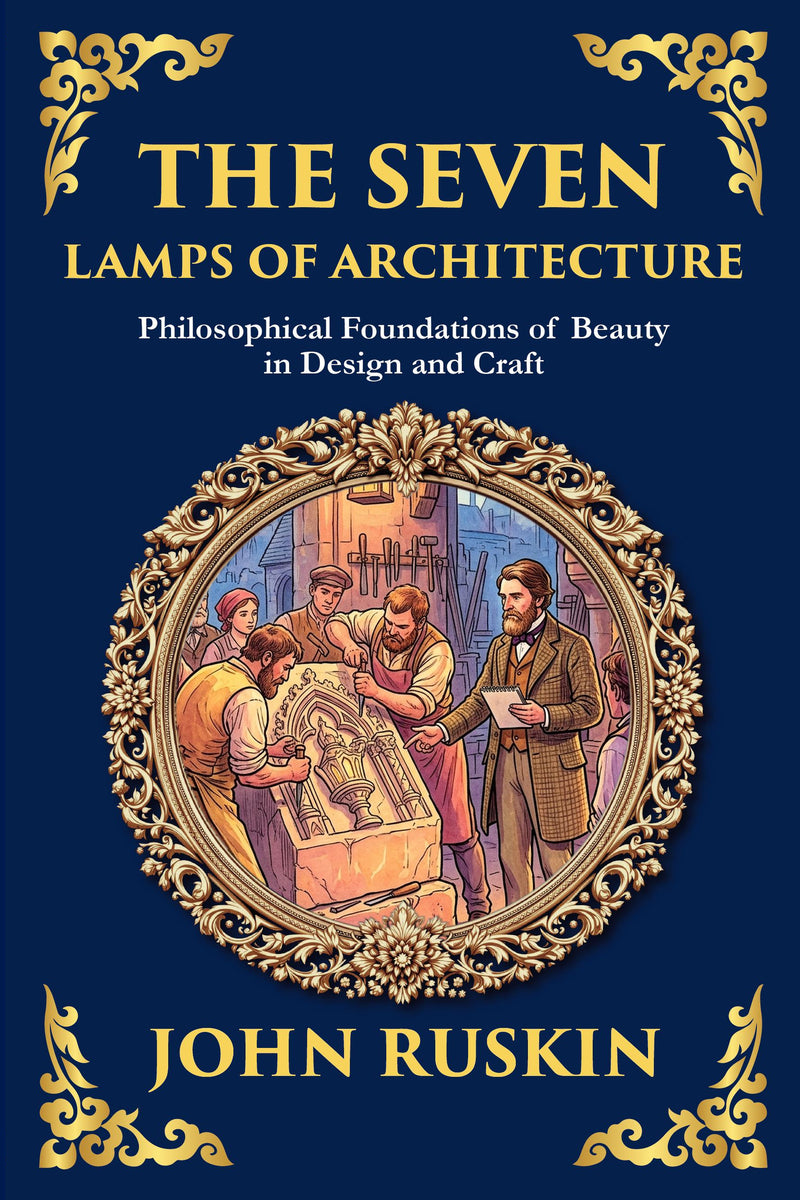
The Seven Lamps of Architecture — Large Print
In The Seven Lamps of Architecture, John Ruskin presents not just a treatise on design but a stirring call to ethical creation—where architecture is the physical manifestation of moral and spiritual principles.
or free app
10,000+ hrs library
30-day guarantee
The complete The Seven Lamps of Architecture appears in modern English through Library of Alexandria Press, available online with audiobook narration included for members.
Have you ever wondered why great architecture feels like it touches the soul? The Seven Lamps of Architecture is John Ruskin’s timeless meditation on the spiritual and ethical responsibilities embedded in design. More than a study of aesthetics or engineering, this is a visionary manifesto that connects architecture to the human condition.
Ruskin’s “lamps” are not literal—they are principles that guide the builder’s conscience. He argues that true architecture must not only serve a function but reflect sacrifice and devotion, truth in materials, strength in form, beauty through detail, life in spirit, memory of tradition, and obedience to purpose and truth. Ruskin’s writing is lyrical, impassioned, and deeply rooted in both classical and Gothic traditions.
He critiques industrialism and mass production while championing craftsmanship, integrity, and the dignity of labor. This modernized edition clarifies his ideas for the contemporary reader while retaining his profound and poetic voice.
What you’ll discover in this modern edition
- The Seven Ethical Foundations of Architecture Explore the meaning and relevance of Sacrifice, Truth, Power, Beauty, Life, Memory, and Obedience in design.
- A Philosophical Approach to Craft and Form See how architecture serves as a moral language, expressing the values of its time.
- Timeless Critique of Industrialization Understand Ruskin’s warning against dehumanized construction and loss of artistic integrity.
- Lyrical Prose and Profound Insight Encounter one of the greatest stylists in English nonfiction, whose words shaped generations of artists and thinkers.
- Essential Reading for Architects, Artists, and Philosophers A bridge between technical craft and moral reflection that still informs modern architectural thinking.
| Formats | eBook (EPUB + PDF) · Audiobook · Paperback · Hardcover · Large Print |
| Language | English |
| Trim size (print) | 6 × 9 in |
| Binding | Paperback — perfect-bound · Hardcover — casewrap |
| Large Print edition | Same text in a larger, easy-read type — a larger font, not a larger trim |
| Print pricing | Every physical book at our true cost — at-cost, no profit (members) |
| Library | 873 restored titles, always growing |
| Length | 68,046 words · ~4 hr 32 min reading |
| Reading level | Grade 13 · a demanding, literary read (this modern-English edition) |
| Edition | Modern English translation · 2026 |
Member reviews for this edition are collected as readers finish it — be the first. Across the library: 12,000+ books shipped, every plan covered by a 365-day print guarantee.
About this edition
A faithful, unabridged modern-English edition by The Library of Alexandria — carefully rendered for today's reader and verified paragraph-by-paragraph against the public-domain source. Available as eBook, audiobook, paperback, hardcover, and large print.
- Complete & unabridgedVerified paragraph by paragraph against the source — never a scan, never abridged.
- Modern English, faithfulReadable today, with the author’s meaning kept intact. Readable — not simplified.
- Every format, one membershipRead in your browser or the free app, or listen to the full audiobook.
Included free with your membership
Cancel anytime, one click · 30-day money-back guarantee
Edition last updated July 2026
What’s inside
The Seven Lamps of Architecture — Large Print — complete and unabridged: all 37 sections included with membership, plus the full audiobook.
Begin reading The Seven Lamps of Architecture — Large Print
In clear modern English — the complete text is included with membership.
Introduction
There is a particular kind of book that arrives in the world not merely as a contribution to its subject but as a reckoning with it — a book that refuses to treat its nominal topic as a technical matter and insists, sometimes uncomfortably, that it is a moral one. John Ruskin’s work on architecture, first published in 1849, is exactly such a book. It came into being at a moment when Britain was building at a pace and on a scale that had no precedent in human history, when the Industrial Revolution was not only transforming the economy but physically reshaping every city, town, and village in the land, and when the question of what all that building should look like — what it should mean, what it should say about the people who commissioned and constructed it — was being answered largely by accident, by fashion, by commercial convenience, and by a kind of collective aesthetic amnesia. Into that moment stepped a twenty-nine-year-old writer who had already made himself the most controversial and most brilliant art critic in England, and who had decided that the confusion surrounding architecture was not primarily a confusion about style or technique but a confusion about values. The result was one of the most electrifying works of cultural criticism the nineteenth century produced, and one of the most urgently relevant books you are likely to read this year.
Ruskin was born in London in 1819, the only child of a prosperous sherry merchant and a deeply religious mother whose influence on his sensibility — particularly her insistence on close, patient reading of the King James Bible — would prove decisive. He was educated largely at home before going up to Christ Church, Oxford, and from an early age he combined an extraordinary visual sensitivity with an equally extraordinary verbal facility. His first major work, the first volume of Modern Painters, appeared in 1843 when he was just twenty-four, ostensibly as a defence of the painter J. M. W. Turner against critical dismissal, but in practice as a wholesale reimagining of what it meant to see, to represent, and to judge the natural world. It announced a critic of ferocious intelligence and almost reckless confidence, someone who wrote about the experience of looking at a painting or a mountain or a Gothic cathedral with the same intensity and precision that a scientist might bring to the examination of a specimen — except that Ruskin’s conclusions were never merely descriptive. They were always, in the end, ethical.
The book you are about to read grew directly out of the research Ruskin was conducting for the third volume of Modern Painters. He had been travelling extensively in France and Italy, making detailed drawings and notes of medieval buildings — Gothic cathedrals in Normandy, Romanesque churches in Tuscany, the extraordinary layered architecture of Venice — and he found himself accumulating not just observations but convictions. He saw buildings being demolished or, almost worse, being “restored” in ways that stripped them of everything that made them alive. He saw new buildings going up that seemed to him not merely ugly but dishonest, structures that pretended to be what they were not, that used ornament as a cosmetic rather than as an expression of genuine feeling, that treated the act of building as a purely mechanical problem to be solved rather than a human act to be performed with care and intention. He felt, as he wrote in his preface, that he had “suffered too much from the destruction or neglect of the architecture I best loved” to remain cautious or diplomatic. And so he gathered his memoranda, organized them around seven governing principles, and published them with an urgency that he himself acknowledged might sacrifice polish for timeliness.
That urgency is one of the first things you will notice when you begin reading. This is not a measured, academic treatise. It is the work of a man who is genuinely agitated, who believes that something important is being lost and that most of his contemporaries either cannot see it or do not care, and who has decided that the only responsible thing to do is to say so as clearly and as forcefully as he can. The prose moves with a momentum that can feel almost overwhelming — long, elaborately constructed sentences that accumulate clause upon clause, building toward a conclusion that arrives with the force of a verdict, followed sometimes by a single short sentence that lands like a hammer. Ruskin had learned his rhythms from the King James Bible and from the great English prose stylists of the seventeenth century, and he deployed them with conscious artistry. Reading him requires a certain surrender, a willingness to be carried along rather than to skim, and the rewards of that surrender are considerable.
The most useful thing this introduction can do, perhaps, is to give you a map of the territory you are entering and some practical guidance about how to navigate it. The book is organized around seven principles, which Ruskin calls lamps — a metaphor drawn from the idea of guiding lights, principles that illuminate the path toward genuine architectural achievement. Each chapter takes one of these principles as its subject: Sacrifice, Truth, Power, Beauty, Life, Memory, and Obedience. The sequence is not arbitrary. Ruskin begins with Sacrifice because he wants to establish from the outset that architecture is not merely a practical art but an offering — that the quality of a building is inseparable from the quality of the intention behind it, from the willingness of those who made it to give something of themselves that was not strictly necessary. He ends with Obedience because he wants to argue that genuine creative freedom in architecture is not achieved by ignoring tradition but by understanding it so deeply that one can work within it with authority and conviction.
Between those two poles, the chapters on Truth and Memory are perhaps the most immediately accessible and the most directly relevant to the world we inhabit today. The chapter on Truth is a sustained argument against architectural dishonesty — against the use of materials that pretend to be other materials, against structural deceptions, against ornament that is cast or stamped rather than carved, against any building practice that involves a kind of lie. Ruskin’s argument here is not merely aesthetic. He believes that the habits of mind that produce dishonest buildings are the same habits of mind that produce dishonest societies, and that there is therefore a genuine moral stake in the question of whether the columns of a building are solid stone or hollow plaster painted to look like stone. You may find this argument extreme. You may find it persuasive. You will almost certainly find it thought-provoking in ways that extend well beyond architecture.
The chapter on Memory is the one that has perhaps had the most lasting influence, and it is the one that speaks most directly to anxieties that are, if anything, more acute now than they were in 1849. Ruskin’s argument is that buildings are not merely functional objects or aesthetic objects but historical ones — that they carry within them the accumulated evidence of the lives and labors of the people who made them, and that to destroy or falsify that evidence is to commit an act of violence against the continuity of human culture. His attack on the restoration movement of his day — the practice of stripping medieval buildings back to a conjectural original state, replacing worn stones with new ones, smoothing away the marks of time — is one of the most passionate and carefully reasoned arguments for architectural conservation ever written, and it laid the intellectual groundwork for the modern conservation movement. William Morris, who founded the Society for the Protection of Ancient Buildings in 1877, acknowledged his debt to Ruskin explicitly, and the principles that society articulated — principles that still guide conservation practice in Britain and much of the world — are recognizably Ruskinian in their origins.
The chapters on Power and Beauty are where Ruskin’s visual intelligence is most fully on display, and they are also the chapters that require the most patience from a modern reader. Ruskin is trying to do something genuinely difficult here: to explain, in words, why certain architectural forms produce certain emotional and aesthetic effects, and to ground those explanations in principles that are not merely personal preference but something more like natural law. He draws on his extraordinarily detailed observation of actual buildings — the tracery of Gothic windows, the proportions of Romanesque arches, the way light falls on carved stone — and he tries to articulate what it is about these forms that makes them beautiful or powerful or sublime. Some of his specific claims will strike you as debatable, and some of his particular enthusiasms — for the Gothic architecture of northern France and northern Italy above all other traditions — reflect the tastes and limitations of his time and background. But the underlying project, the attempt to think seriously and systematically about why some buildings move us and others leave us cold, is one that has never been more necessary than it is now, when we are surrounded by built environments that seem to have been designed with no thought for the emotional lives of the people who must inhabit them.
The chapters on Life and Obedience are the most philosophically ambitious, and in some ways the most surprising. The chapter on Life is not, as you might expect, primarily about organic forms in architecture, though Ruskin does discuss those. It is about the relationship between the quality of a building and the conditions under which it was made — about whether the people who built it were given the freedom to exercise their own judgment and creativity, or whether they were reduced to mechanical repetition of prescribed forms. Ruskin’s argument here anticipates, in remarkable ways, the critique of industrial labor that he would develop at much greater length in The Stones of Venice and later in Unto This Last. He is already beginning to see that the question of architectural quality cannot be separated from the question of how workers are treated, and that a society that degrades its craftsmen will inevitably produce degraded buildings. This is a radical argument, and it is one that Ruskin himself seems to have arrived at somewhat unexpectedly, following the logic of his aesthetic observations to conclusions that surprised him.
The chapter on Obedience is the most controversial, and it is the one most likely to provoke resistance in a modern reader. Ruskin argues that the architectural confusion of his time — the proliferation of competing styles, the inability of architects and their clients to agree on any shared principles — is itself a symptom of a deeper cultural disorder, a loss of the kind of collective conviction that had made the great architectural traditions of the past possible. His proposed remedy, the adoption of a single agreed style that would provide a common framework within which individual creativity could operate, sounds authoritarian to contemporary ears, and it is worth noting that Ruskin himself later modified and in some respects abandoned this position. But the underlying diagnosis — that genuine architectural achievement requires some degree of shared cultural purpose, and that a society fragmented into competing individualities will struggle to build anything that endures — is one that deserves serious engagement rather than dismissal.
It is impossible to overstate the influence this book has had on the way the English-speaking world thinks about architecture, cities, and the built environment. When it was published in 1849, it was immediately recognized as something extraordinary — not everyone agreed with it, and many architects found it infuriating, but no one could ignore it. It went through multiple editions in Ruskin’s lifetime and was read by an audience that extended far beyond the professional architectural community. It shaped the Gothic Revival movement, though not always in the ways Ruskin intended or approved. It influenced the Arts and Crafts movement, which drew directly on Ruskin’s arguments about the relationship between honest making and beautiful form. It shaped the thinking of architects and planners well into the twentieth century, and its arguments about memory, authenticity, and the moral dimensions of building continue to resonate in contemporary debates about heritage, conservation, and the design of public space.
Cancel anytime, one click · 30-day money-back guarantee
Founding annual rate available now — your price locks for life when you join.
Not ready? Get this free chapter by email — read it anytime.
✓ Sent — check your inbox for The Seven Lamps of Architecture — Large Print.
Questions about The Seven Lamps of Architecture — Large Print
What is The Seven Lamps of Architecture about?
In The Seven Lamps of Architecture, John Ruskin presents not just a treatise on design but a stirring call to ethical creation—where architecture is the physical manifestation of moral and spiritual principles. Originally published in 1849, this groundbreaking work identifies seven guiding "lamps"— Sacrifice, Truth, Power, Beauty, Life, Memory, and Obedience—as the essential virtues every architect must uphold. With poetic eloquence and passionate critique, Ruskin elevates architecture to a moral art form, one that
Who wrote The Seven Lamps of Architecture?
The Seven Lamps of Architecture was written by John Ruskin. This edition presents the complete work in clear modern English, faithfully rendered from the public-domain original by Library of Alexandria Press.
Is The Seven Lamps of Architecture free to read?
The opening chapter is free to read on this page. Members read and listen to the complete work — and the entire library — free, and can order any physical book at our true print cost.
How long is The Seven Lamps of Architecture?
37 chapters (~68,046 words) — about 4 hr 32 min of reading in this modern-English edition.
Is this an abridged version of The Seven Lamps of Architecture?
No. This is the complete, unabridged The Seven Lamps of Architecture, carefully rendered into clear modern English and verified paragraph-by-paragraph against the public-domain source — nothing is cut or summarised.
What formats does The Seven Lamps of Architecture come in?
The Seven Lamps of Architecture is available as eBook, paperback, hardcover and large print. eBook and audiobook are included with membership; printed editions ship at our true print cost.
Shipping & returns
Billing & membership
More from the library


Explore Free eBooks
- Kant's Prolegomena to Any Future Metaphysics · Immanuel Kant
- The Advancement of Learning · Francis Bacon
- The Dawn of Day · Friedrich Nietzsche
- Peter and Wendy · J. M. Barrie
- Meditations · Marcus Aurelius
- The Confessions of St. Augustine · Saint Augustine of Hippo
- Resurrection · Leo Tolstoy
- Dialogues Concerning Natural Religion · David Hume
- As You Like It · William Shakespeare
- Jack and Jill · Louisa May Alcott
- Dream Psychology: Psychoanalysis for Beginners · Sigmund Freud
- The Raven · Edgar Allan Poe
- Considerations on Representative Government · John Stuart Mill
- The Will to Power: An Attempted Transvaluation of All Values. Book III and IV · Friedrich Nietzsche
- Tarzan of the Apes · Edgar Rice Burroughs
- Fundamental Principles of the Metaphysic of Morals · Immanuel Kant
- The Confessions of Jean Jacques Rousseau — Complete · Jean-Jacques Rousseau
- The Merchant of Venice · William Shakespeare
- Democracy in America — Volume 2 · Alexis de Tocqueville
- Ecce Homo · Friedrich Wilhelm Nietzsche
- Second Treatise of Government · John Locke
- The Wonderful Wizard of Oz · L. Frank Baum
- The Prince · Niccolò Machiavelli
- Anne of Green Gables · L. M. Montgomery
- De Profundis · Oscar Wilde
- Thus Spake Zarathustra: A Book for All and None · Friedrich Nietzsche
- Anna Karenina · Leo Tolstoy
- Great Expectations · Charles Dickens
- The Island of Doctor Moreau · H. G. Wells
- A Midsummer Night's Dream · William Shakespeare
The Seven Lamps of Architecture — Large Print
The Seven Lamps of Architecture — Large Print
A Modern Translation
John Ruskin
Contents
- Introduction
- Chapter 1
- Preface by the Author
- Chapter 2
- Chapter 3
- Chapter 4
- Chapter 5
- Chapter 6
- Chapter 7
- Chapter 8
- Chapter 9
- Chapter 10
- Chapter 11
- Chapter 12
- Chapter 13
- Chapter 14
- Chapter 15
- Chapter 16
- Chapter 17
- Chapter 18
- Chapter 19
- Chapter 20
- Chapter 21
- Chapter 22
- Chapter 23
- Chapter 24
- Chapter 25
- Chapter 26
- Chapter 27
- Chapter 28
- Chapter 29
- Chapter 30
- Chapter 31
- Chapter 32
- Chapter 33
- Chapter 34
- Chapter 35
Introduction
There is a particular kind of book that arrives in the world not merely as a contribution to its subject but as a reckoning with it — a book that refuses to treat its nominal topic as a technical matter and insists, sometimes uncomfortably, that it is a moral one. John Ruskin’s work on architecture, first published in 1849, is exactly such a book. It came into being at a moment when Britain was building at a pace and on a scale that had no precedent in human history, when the Industrial Revolution was not only transforming the economy but physically reshaping every city, town, and village in the land, and when the question of what all that building should look like — what it should mean, what it should say about the people who commissioned and constructed it — was being answered largely by accident, by fashion, by commercial convenience, and by a kind of collective aesthetic amnesia. Into that moment stepped a twenty-nine-year-old writer who had already made himself the most controversial and most brilliant art critic in England, and who had decided that the confusion surrounding architecture was not primarily a confusion about style or technique but a confusion about values. The result was one of the most electrifying works of cultural criticism the nineteenth century produced, and one of the most urgently relevant books you are likely to read this year.
Ruskin was born in London in 1819, the only child of a prosperous sherry merchant and a deeply religious mother whose influence on his sensibility — particularly her insistence on close, patient reading of the King James Bible — would prove decisive. He was educated largely at home before going up to Christ Church, Oxford, and from an early age he combined an extraordinary visual sensitivity with an equally extraordinary verbal facility. His first major work, the first volume of Modern Painters, appeared in 1843 when he was just twenty-four, ostensibly as a defence of the painter J. M. W. Turner against critical dismissal, but in practice as a wholesale reimagining of what it meant to see, to represent, and to judge the natural world. It announced a critic of ferocious intelligence and almost reckless confidence, someone who wrote about the experience of looking at a painting or a mountain or a Gothic cathedral with the same intensity and precision that a scientist might bring to the examination of a specimen — except that Ruskin’s conclusions were never merely descriptive. They were always, in the end, ethical.
The book you are about to read grew directly out of the research Ruskin was conducting for the third volume of Modern Painters. He had been travelling extensively in France and Italy, making detailed drawings and notes of medieval buildings — Gothic cathedrals in Normandy, Romanesque churches in Tuscany, the extraordinary layered architecture of Venice — and he found himself accumulating not just observations but convictions. He saw buildings being demolished or, almost worse, being “restored” in ways that stripped them of everything that made them alive. He saw new buildings going up that seemed to him not merely ugly but dishonest, structures that pretended to be what they were not, that used ornament as a cosmetic rather than as an expression of genuine feeling, that treated the act of building as a purely mechanical problem to be solved rather than a human act to be performed with care and intention. He felt, as he wrote in his preface, that he had “suffered too much from the destruction or neglect of the architecture I best loved” to remain cautious or diplomatic. And so he gathered his memoranda, organized them around seven governing principles, and published them with an urgency that he himself acknowledged might sacrifice polish for timeliness.
That urgency is one of the first things you will notice when you begin reading. This is not a measured, academic treatise. It is the work of a man who is genuinely agitated, who believes that something important is being lost and that most of his contemporaries either cannot see it or do not care, and who has decided that the only responsible thing to do is to say so as clearly and as forcefully as he can. The prose moves with a momentum that can feel almost overwhelming — long, elaborately constructed sentences that accumulate clause upon clause, building toward a conclusion that arrives with the force of a verdict, followed sometimes by a single short sentence that lands like a hammer. Ruskin had learned his rhythms from the King James Bible and from the great English prose stylists of the seventeenth century, and he deployed them with conscious artistry. Reading him requires a certain surrender, a willingness to be carried along rather than to skim, and the rewards of that surrender are considerable.
The most useful thing this introduction can do, perhaps, is to give you a map of the territory you are entering and some practical guidance about how to navigate it. The book is organized around seven principles, which Ruskin calls lamps — a metaphor drawn from the idea of guiding lights, principles that illuminate the path toward genuine architectural achievement. Each chapter takes one of these principles as its subject: Sacrifice, Truth, Power, Beauty, Life, Memory, and Obedience. The sequence is not arbitrary. Ruskin begins with Sacrifice because he wants to establish from the outset that architecture is not merely a practical art but an offering — that the quality of a building is inseparable from the quality of the intention behind it, from the willingness of those who made it to give something of themselves that was not strictly necessary. He ends with Obedience because he wants to argue that genuine creative freedom in architecture is not achieved by ignoring tradition but by understanding it so deeply that one can work within it with authority and conviction.
Between those two poles, the chapters on Truth and Memory are perhaps the most immediately accessible and the most directly relevant to the world we inhabit today. The chapter on Truth is a sustained argument against architectural dishonesty — against the use of materials that pretend to be other materials, against structural deceptions, against ornament that is cast or stamped rather than carved, against any building practice that involves a kind of lie. Ruskin’s argument here is not merely aesthetic. He believes that the habits of mind that produce dishonest buildings are the same habits of mind that produce dishonest societies, and that there is therefore a genuine moral stake in the question of whether the columns of a building are solid stone or hollow plaster painted to look like stone. You may find this argument extreme. You may find it persuasive. You will almost certainly find it thought-provoking in ways that extend well beyond architecture.
The chapter on Memory is the one that has perhaps had the most lasting influence, and it is the one that speaks most directly to anxieties that are, if anything, more acute now than they were in 1849. Ruskin’s argument is that buildings are not merely functional objects or aesthetic objects but historical ones — that they carry within them the accumulated evidence of the lives and labors of the people who made them, and that to destroy or falsify that evidence is to commit an act of violence against the continuity of human culture. His attack on the restoration movement of his day — the practice of stripping medieval buildings back to a conjectural original state, replacing worn stones with new ones, smoothing away the marks of time — is one of the most passionate and carefully reasoned arguments for architectural conservation ever written, and it laid the intellectual groundwork for the modern conservation movement. William Morris, who founded the Society for the Protection of Ancient Buildings in 1877, acknowledged his debt to Ruskin explicitly, and the principles that society articulated — principles that still guide conservation practice in Britain and much of the world — are recognizably Ruskinian in their origins.
The chapters on Power and Beauty are where Ruskin’s visual intelligence is most fully on display, and they are also the chapters that require the most patience from a modern reader. Ruskin is trying to do something genuinely difficult here: to explain, in words, why certain architectural forms produce certain emotional and aesthetic effects, and to ground those explanations in principles that are not merely personal preference but something more like natural law. He draws on his extraordinarily detailed observation of actual buildings — the tracery of Gothic windows, the proportions of Romanesque arches, the way light falls on carved stone — and he tries to articulate what it is about these forms that makes them beautiful or powerful or sublime. Some of his specific claims will strike you as debatable, and some of his particular enthusiasms — for the Gothic architecture of northern France and northern Italy above all other traditions — reflect the tastes and limitations of his time and background. But the underlying project, the attempt to think seriously and systematically about why some buildings move us and others leave us cold, is one that has never been more necessary than it is now, when we are surrounded by built environments that seem to have been designed with no thought for the emotional lives of the people who must inhabit them.
The chapters on Life and Obedience are the most philosophically ambitious, and in some ways the most surprising. The chapter on Life is not, as you might expect, primarily about organic forms in architecture, though Ruskin does discuss those. It is about the relationship between the quality of a building and the conditions under which it was made — about whether the people who built it were given the freedom to exercise their own judgment and creativity, or whether they were reduced to mechanical repetition of prescribed forms. Ruskin’s argument here anticipates, in remarkable ways, the critique of industrial labor that he would develop at much greater length in The Stones of Venice and later in Unto This Last. He is already beginning to see that the question of architectural quality cannot be separated from the question of how workers are treated, and that a society that degrades its craftsmen will inevitably produce degraded buildings. This is a radical argument, and it is one that Ruskin himself seems to have arrived at somewhat unexpectedly, following the logic of his aesthetic observations to conclusions that surprised him.
The chapter on Obedience is the most controversial, and it is the one most likely to provoke resistance in a modern reader. Ruskin argues that the architectural confusion of his time — the proliferation of competing styles, the inability of architects and their clients to agree on any shared principles — is itself a symptom of a deeper cultural disorder, a loss of the kind of collective conviction that had made the great architectural traditions of the past possible. His proposed remedy, the adoption of a single agreed style that would provide a common framework within which individual creativity could operate, sounds authoritarian to contemporary ears, and it is worth noting that Ruskin himself later modified and in some respects abandoned this position. But the underlying diagnosis — that genuine architectural achievement requires some degree of shared cultural purpose, and that a society fragmented into competing individualities will struggle to build anything that endures — is one that deserves serious engagement rather than dismissal.
It is impossible to overstate the influence this book has had on the way the English-speaking world thinks about architecture, cities, and the built environment. When it was published in 1849, it was immediately recognized as something extraordinary — not everyone agreed with it, and many architects found it infuriating, but no one could ignore it. It went through multiple editions in Ruskin’s lifetime and was read by an audience that extended far beyond the professional architectural community. It shaped the Gothic Revival movement, though not always in the ways Ruskin intended or approved. It influenced the Arts and Crafts movement, which drew directly on Ruskin’s arguments about the relationship between honest making and beautiful form. It shaped the thinking of architects and planners well into the twentieth century, and its arguments about memory, authenticity, and the moral dimensions of building continue to resonate in contemporary debates about heritage, conservation, and the design of public space.
PREFACE 213 LECTURE I. 217 LECTURE II. 248 ADDENDA to Lectures I. and II. 270 LECTURE III. Turner and his Works 287 LECTURE IV. Pre-Raphaelitism 311 ADDENDA to Lecture IV. 334
An Inquiry into the Study of Architecture 339
PLATE PAGE I. ORNAMENTS FROM ROUEN, ST. LO, AND VENICE 33 II. PART OF THE CATHEDRAL OF ST. LO, NORMANDY 55 III. TRACERIES FROM CAEN, BAYEUX, ROUEN AND BEAVAIS 60 IV. INTERSECTIONAL MOULDINGS 66 V. CAPITAL FROM THE LOWER ARCADE OF THE DOGE’S PALACE, VENICE 88 VI. ARCH FROM THE FAÇADE OF THE CHURCH OF SAN MICHELE AT LUCCA 90 VII. PIERCED ORNAMENTS FROM LISIEUX, BAYEUX, VERONA, AND PADUA 93 VIII. WINDOW FROM THE CA’ FOSCARI, VENICE 95 IX. TRACERY FROM THE CAMPANILE OF GIOTTO, AT FLORENCE. Frontispiece. X. TRACERIES AND MOULDINGS FROM ROUEN AND SALISBURY 122 XI. BALCONY IN THE CAMPO, ST. BENEDETTO, VENICE 131 XII. FRAGMENTS FROM ABBEVILLE, LUCCA, VENICE AND PISA 149 XIII. PORTIONS OF AN ARCADE ON THE SOUTH SIDE OF THE CATHEDRAL OF FERRARA 161 XIV. SCULPTURES FROM THE CATHEDRAL OF ROUEN 165
Plate I. FIGS. 1, 3 AND 5. ILLUSTRATIVE DIAGRAMS 219 II. FIG. 2. WINDOW IN OAKHAM CASTLE 221 III. FIGS. 4 AND 6. SPRAY OF ASH-TREE, AND IMPROVEMENT OF THE SAME ON GREEK PRINCIPLES 226 IV. FIG. 7. WINDOW IN DUMBLANE CATHEDRAL 231 V. FIG. 8. MEDIEVAL TURRET 235 VI. FIGS. 9 AND 10. LOMBARDIC TOWERS 238 VII. FIGS. 11 AND 12. SPIRES AT CONTANCES AND ROUEN 240 VIII. FIGS. 13 AND 14. ILLUSTRATIVE DIAGRAMS 253 IX. FIG. 15. SCULPTURE AT LYONS 254 X. FIG. 16. NICHE AT AMIENS 255 XI. FIGS. 17 AND 18. TIGER’S HEAD, AND IMPROVEMENT OF THE SAME ON GREEK PRINCIPLES 258 XII. FIG. 19. GARRET WINDOW IN HOTEL DE BOURGTHEROUDE 265 XIII. FIGS. 20 AND 21. TREES, AS DRAWN IN THE THIRTEENTH CENTURY 294 XIV. FIG. 22. ROCKS, AS DRAWN BY THE SCHOOL OF LEONARDO DA VINCI 296 XV. FIG. 23. BOUGHS OF TREES, AFTER TITIAN 298
End of the free sample
Keep reading, free
Members read and listen to the complete book — and the entire library. Cancel anytime, one click · 30-day money-back guarantee.