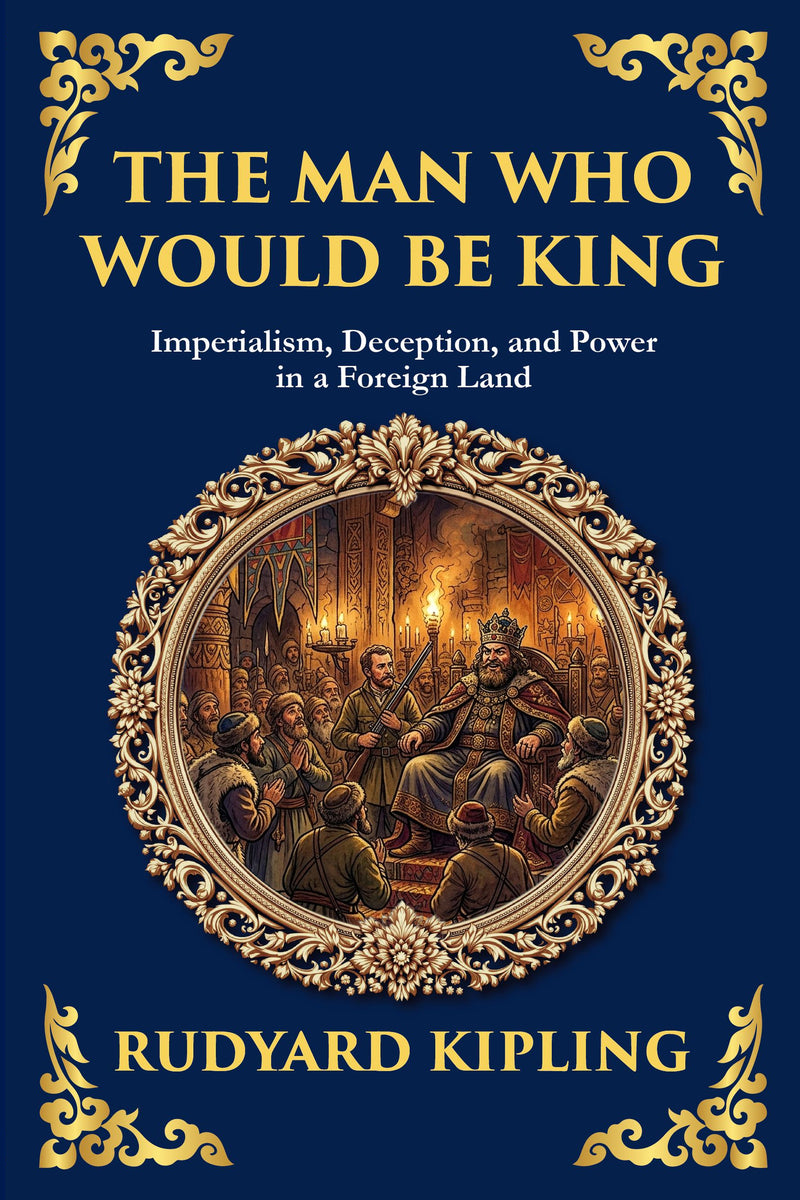
The Man Who Would Be King — Large Print
Adventure. Ambition. Betrayal. In The Man Who Would Be King, two British soldiers set out to elevate themselves beyond their humble origins by conquering a remote land—Kafiristan—and naming themselves kings.
or free app
10,000+ hrs library
30-day guarantee
The complete The Man Who Would Be King appears in modern English through Library of Alexandria Press, available online with audiobook narration included for members.
Have you ever wondered why some ambitions are born of dreams—and destroyed by their own shadows? Rudyard Kipling’s The Man Who Would Be King is a gripping tale of colonial adventure and moral complexity that follows two dynamic men—Daniel Dravot and Peachey Taliaferro Carnehan—on their journey from discontented wanderers to self-proclaimed sovereigns. Bold in vision and rich in detail, this story probes what it means to claim power, to be worshipped, and ultimately, to pay for illusions of divinity.
What you’ll discover in this modern edition
- Two Men, One Grand Scheme – Meet Dravot and Carnehan, forging a pact (“Contrack”) to become kings in a wild, ungoverned land.
- Worlds Between Worlds – From the mimicking order of British maps to the exotic, untamed terrain of Kafiristan, this is empire’s edge.
- Temptations of Authority – Dravot’s coronation, the crown, gold, and rituals. Where fantasy meets real consequences.
- Moral Hazard & Cultural Collision – The unpredictable friction between foreign ambition and local beliefs, and the thin line between godhood and downfall.
- Tragedy Born of Pride – The final downfall, betrayal, and the ruin that awaits those who assume more than they understand. This edition retains Kipling’s sharp satire, adventurous spirit, and lyrical evocations of distant lands.
| Formats | eBook (EPUB + PDF) · Audiobook · Paperback · Hardcover · Large Print |
| Language | English |
| Trim size (print) | 6 × 9 in |
| Binding | Paperback — perfect-bound · Hardcover — casewrap |
| Large Print edition | Same text in a larger, easy-read type — a larger font, not a larger trim |
| Print pricing | Every physical book at our true cost — at-cost, no profit (members) |
| Library | 873 restored titles, always growing |
| Length | 17,830 words · ~1 hr 11 min reading |
| Reading level | Grade 3 · an easy, flowing read (this modern-English edition) |
| Edition | Modern English translation · 2026 |
Member reviews for this edition are collected as readers finish it — be the first. Across the library: 12,000+ books shipped, every plan covered by a 365-day print guarantee.
About this edition
A faithful, unabridged modern-English edition by The Library of Alexandria — carefully rendered for today's reader and verified paragraph-by-paragraph against the public-domain source. Available as eBook, audiobook, paperback, hardcover, and large print.
- Complete & unabridgedVerified paragraph by paragraph against the source — never a scan, never abridged.
- Modern English, faithfulReadable today, with the author’s meaning kept intact. Readable — not simplified.
- Every format, one membershipRead in your browser or the free app, or listen to the full audiobook.
Included free with your membership
Cancel anytime, one click · 30-day money-back guarantee
Edition last updated July 2026
What’s inside
The Man Who Would Be King — Large Print — complete and unabridged, included in full with membership, plus the full audiobook.
Begin reading The Man Who Would Be King — Large Print
In clear modern English — the complete text is included with membership.
Introduction
There are stories that entertain, and there are stories that linger—tales that follow you long after the final page, raising questions you cannot quite shake. Rudyard Kipling’s masterwork belongs firmly to the second category. First published in 1888, when its author was barely into his twenties, this remarkable narrative has endured for well over a century, captivating readers across generations and continents. It has been adapted for the stage and the screen, dissected in countless academic studies, and quoted by adventurers, politicians, and dreamers alike. Yet for all its fame, it remains a work that rewards fresh attention, one whose layers reveal themselves slowly and whose meanings shift depending on the eyes that read it. This modern translation, adapted for the contemporary reader, aims to bring those layers into sharper focus, to clear away the linguistic dust of a bygone era so that the story’s astonishing power can strike you with the same force it struck its first audiences.
What you hold in your hands is a tale of ambition unbound, of two men who decide that the world as they find it is too small for their dreams. It is a story about the seductive pull of power, about the lengths to which the human heart will go to grasp at greatness, and about what happens when ordinary people convince themselves they are extraordinary. It is, too, a meditation on empire—on the strange and often terrible relationship between those who rule and those who are ruled, between the conquerors and the conquered. Kipling wrote during the high noon of the British Empire, when maps were colored pink across vast stretches of the globe and the assumption of Western superiority went largely unquestioned in the drawing rooms of London. And yet, as you will discover, this is no simple celebration of imperial glory. It is something far more complicated, far more troubling, and ultimately far more honest than that.
A Young Genius and the World That Made Him
To understand the extraordinary achievement of this short novel, it helps to understand the young man who wrote it and the world that shaped him. Rudyard Kipling was born in Bombay in 1865, the son of an artist and museum curator who had come to India to make his way in the colonial administration. India was the country of Kipling’s childhood, and he absorbed it through every sense—its heat and color, its languages and legends, the bustle of its bazaars and the murmur of its servants’ quarters, where the young boy heard stories told in Hindustani before he could properly speak English. These early years left an indelible mark. India was not, for Kipling, an abstract possession on a map; it was the landscape of his imagination, vivid and immediate and alive.
But the idyll did not last. Like many children of the British in India, the young Kipling was sent back to England at the age of five, to be lodged with a foster family in a place he would later remember as a house of misery and cruelty. The contrast between the warmth of his Indian childhood and the cold, punitive years that followed in England seems to have created in him a permanent sense of displacement—a feeling of belonging fully to neither world. This is worth keeping in mind, because the theme of the outsider, the man caught between cultures and never quite at home anywhere, runs deep through his fiction. When you read about characters who wander the margins of the empire, scheming and dreaming and chasing visions of a place where they might finally matter, you are reading the work of a man who knew intimately what it meant to be a stranger.
Kipling returned to India as a young man, taking up work as a journalist in the city of Lahore, in what is now Pakistan. Journalism proved the perfect apprenticeship for a future master of the short story. It taught him economy and observation, the art of capturing a scene in a few sharp strokes, the discipline of meeting a deadline and the necessity of holding a reader’s attention. More than that, it brought him into contact with the full sweep of colonial society—the soldiers in the barracks, the clerks and engineers, the administrators and adventurers, the drifters and chancers who washed up on the shores of empire seeking their fortune. He listened to their stories in the heat of the Punjab nights, in the railway carriages and the regimental messes, and he stored them away. Much of what gives his fiction its remarkable authenticity comes from this period: the slang, the swagger, the particular speech patterns of men far from home, the texture of a world that few of his English readers would ever see for themselves.
It was during these years that Kipling produced an astonishing burst of creative work, including the collection in which this story first appeared. By his early twenties he was already famous, his tales of Anglo-Indian life devoured by readers hungry for glimpses of the exotic frontier. When he eventually returned to England, he arrived as a literary sensation, hailed as a fresh and original voice. The accolades would continue throughout his life, culminating in 1907 when he became the first English-language writer to receive the Nobel Prize in Literature, and the youngest recipient of that honor to this day. He would go on to write beloved works for children, stirring poems that entered the national consciousness, and novels that shaped how generations of readers imagined India and the wider world.
Yet Kipling has always been a difficult figure, and it would be dishonest to introduce his work without acknowledging this. He was, by the standards of our own time and increasingly by the standards of his own, a man of the empire—a believer, at least for much of his life, in the civilizing mission of British rule and in the hierarchies of race and nation that underpinned it. Some of his writing expresses these views directly, and modern readers will rightly find much of it uncomfortable, even objectionable. To read Kipling honestly is to wrestle with this contradiction: that a writer of such tremendous gifts, such genuine sympathy for individual human beings, such ear for the music of language, could also be the voice of an imperial project that brought immense suffering to millions. We do no service to ourselves or to literature by pretending this tension does not exist. But neither should we let it blind us to the genuine complexity of his best work—a complexity that, as you will see, often runs against the grain of the very ideology its author professed.
The Heart of the Story: Ambition, Empire, and the Mirror of Power
This is precisely what makes the present narrative so endlessly fascinating, and why it has outlasted so much of the confident imperial literature of its era. On its surface, it appears to be a rousing adventure—the kind of yarn told over a glass of whiskey by men who have seen too much of the world. Two roguish characters, full of bluster and grand designs, set out on a venture so audacious that it seems almost mad. They will travel to a remote and dangerous corner of the world, far beyond the reach of any law or government, and they will carve out a kingdom of their own. They will become rulers where no European has ruled before. It is the stuff of boyhood fantasy, the colonial dream stripped to its essence: that a determined man with nerve and a rifle might bend an entire people to his will and crown himself their master.
But Kipling, even at his young age, was too shrewd and too honest a writer to leave it at that. As the tale unfolds, it becomes something deeper and darker—a study of what it actually means to seize power over others, and of the corruption, self-deception, and ultimate fragility that such an enterprise entails. The story functions, in a sense, as a parable of empire itself, compressed and intensified into the experiences of two individual men. What begins as a grand adventure slowly reveals its hollow foundations. The ambitions that seemed so glorious begin to curdle. The lines between confidence and delusion, between leadership and tyranny, between the human and the divine, grow blurred and treacherous. Kipling shows us, with extraordinary economy, how the appetite for power feeds upon itself, how those who set out to control others end by losing control of themselves, and how the very deceptions that enable conquest contain within them the seeds of its undoing.
It is a measure of the story’s sophistication that it can be read in so many ways. To some, it is a thrilling tale of derring-do in exotic lands. To others, it is a cautionary fable about hubris—a modern retelling of an ancient warning that pride goes before a fall. To still others, it is a sly and subversive critique of the imperial enterprise, exposing the absurdity and the violence at the heart of the colonial project, told by a man who was himself a product and a promoter of that project. The genius of the work lies in its refusal to resolve these readings neatly. Kipling does not lecture; he does not moralize; he simply lays out the events with the cool detachment of a journalist and the dramatic instinct of a born storyteller, and he lets you draw your own conclusions. The result is a narrative that feels alive with ambiguity, one that has continued to provoke debate for more than a hundred years and shows no sign of being exhausted.
The themes that animate the story are not relics of a vanished age. They are, if anything, more relevant than ever. We live in a world still shaped by the legacies of empire, still grappling with the consequences of the lines drawn on maps by distant powers, still witnessing the spectacle of leaders who mistake their own ambitions for destiny and their own deceptions for truth. The questions Kipling raises—about the corrupting nature of unchecked power, about the dangerous allure of treating other human beings as mere instruments of one’s will, about the stories that rulers tell to justify their rule and the moment those stories collapse—are questions that echo through our own headlines and our own history. To read this work today is not to retreat into the past but to hold up a mirror to the present, and to recognize in these long-dead characters the same drives and follies that we see playing out around us still.
There is, too, a profound psychological truth at the center of the tale. Kipling understood something essential about the human capacity for self-deception—about how we construct narratives in which we are the heroes, the chosen ones, the exceptions to the rules that bind everyone else. His two protagonists are not cartoon villains; they are recognizable human beings, with their loyalties and their codes of honor, their dreams and their vulnerabilities. We come to understand them, even to feel for them, which makes their journey all the more compelling and their fate all the more affecting. This is the mark of the truest fiction: not that it presents us with simple lessons, but that it lets us inhabit the consciousness of others and, in doing so, illuminates something about ourselves. By the time you reach the conclusion, you will feel that you have not merely watched these men but accompanied them, shared their hopes and their delusions, and arrived at the end of their road with a weight in your heart that no simple adventure story could produce.
It is worth saying a word, too, about the sheer craft of the thing. Kipling was a supreme storyteller, and the architecture of this narrative is a marvel of construction. He uses a framing device—a story within a story—that draws you in by degrees, establishing first the world from which the tale emerges before plunging you into the adventure itself. This technique creates a wonderful sense of intimacy and authenticity, as though you are being entrusted with a remarkable confidence, hearing a true account from someone who was there. The pacing is masterful, building slowly and then accelerating toward a climax of almost unbearable intensity. The dialogue crackles with the rough vitality of the men who speak it. And throughout, there is that distinctive Kipling voice—wry, knowing, alert to irony, capable of both broad comedy and genuine tragedy, often within the space of a single page. For all the weighty themes it carries, the story never forgets that its first duty is to grip and to move, and grip and move it does.
Cancel anytime, one click · 30-day money-back guarantee
Founding annual rate available now — your price locks for life when you join.
Not ready? Get this free chapter by email — read it anytime.
✓ Sent — check your inbox for The Man Who Would Be King — Large Print.
Questions about The Man Who Would Be King — Large Print
Who wrote The Man Who Would Be King?
The Man Who Would Be King was written by Rudyard Kipling. This edition presents the complete work in clear modern English, faithfully rendered from the public-domain original by Library of Alexandria Press.
Is The Man Who Would Be King free to read?
The opening chapter is free to read on this page. Members read and listen to the complete work — and the entire library — free, and can order any physical book at our true print cost.
How long is The Man Who Would Be King?
2 chapters (~17,830 words) — about 1 hr 11 min of reading in this modern-English edition.
Is this an abridged version of The Man Who Would Be King?
No. This is the complete, unabridged The Man Who Would Be King, carefully rendered into clear modern English and verified paragraph-by-paragraph against the public-domain source — nothing is cut or summarised.
What formats does The Man Who Would Be King come in?
The Man Who Would Be King is available as eBook, paperback, hardcover and large print. eBook and audiobook are included with membership; printed editions ship at our true print cost.
Shipping & returns
Billing & membership
More from the library


Explore Adventure
- Tarzan of the Apes · Edgar Rice Burroughs
- The Wonderful Wizard of Oz · L. Frank Baum
- Peter Pan · J. M. Barrie
- Moby Dick; Or, The Whale · Herman Melville
- The Riddle of the Sands · Erskine Childers
- The Loss of the Swansea: A Story of the Florida Coast · W. L. Alden
- Sky Island · L. Frank Baum
- Vikram and the Vampire: Classic Hindu Tales of Adventure, Magic, and Romance · Unknown
- Tales of Unrest · Joseph Conrad
- The Tomb of Ts’in · Edgar Wallace
- Skinny McCord · Percy Keese Fitzhugh
- The Men of the Moss-Hags · S. R. Crockett
- The Hunniwell Boys and the Platinum Mystery · L. P. Wyman
- Allan Quatermain · H. Rider Haggard
- She · H. Rider Haggard
- Medical Life in the Navy · Gordon Stables
- The Thirty-Nine Steps · John Buchan
- The Story of Doctor Dolittle · Hugh Lofting
- The Princess and the Goblin · George MacDonald
- The Man Who Would Be King · Rudyard Kipling
- Lucian’s True History · Lucian of Samosata
- The Secret Adversary · Agatha Christie
- Lord Jim · Joseph Conrad
- The Marvelous Land of Oz · L. Frank Baum
- The Virginian: A Horseman of the Plains · Owen Wister
- Mars is My Destination · Frank Belknap Long
- Anabasis · Xenophon
- The Mississippi Saucer · Frank Belknap Long
- Sabotage in Space · Carey Rockwell
- Brood of the Dark Moon · Charles Willard Diffin
The Man Who Would Be King — Large Print
The Man Who Would Be King — Large Print
Imperialism, Deception, and Power in a Foreign Land
Rudyard Kipling
Contents
- Introduction
- The Man Who Would Be King
Introduction
There are stories that entertain, and there are stories that linger—tales that follow you long after the final page, raising questions you cannot quite shake. Rudyard Kipling’s masterwork belongs firmly to the second category. First published in 1888, when its author was barely into his twenties, this remarkable narrative has endured for well over a century, captivating readers across generations and continents. It has been adapted for the stage and the screen, dissected in countless academic studies, and quoted by adventurers, politicians, and dreamers alike. Yet for all its fame, it remains a work that rewards fresh attention, one whose layers reveal themselves slowly and whose meanings shift depending on the eyes that read it. This modern translation, adapted for the contemporary reader, aims to bring those layers into sharper focus, to clear away the linguistic dust of a bygone era so that the story’s astonishing power can strike you with the same force it struck its first audiences.
What you hold in your hands is a tale of ambition unbound, of two men who decide that the world as they find it is too small for their dreams. It is a story about the seductive pull of power, about the lengths to which the human heart will go to grasp at greatness, and about what happens when ordinary people convince themselves they are extraordinary. It is, too, a meditation on empire—on the strange and often terrible relationship between those who rule and those who are ruled, between the conquerors and the conquered. Kipling wrote during the high noon of the British Empire, when maps were colored pink across vast stretches of the globe and the assumption of Western superiority went largely unquestioned in the drawing rooms of London. And yet, as you will discover, this is no simple celebration of imperial glory. It is something far more complicated, far more troubling, and ultimately far more honest than that.
A Young Genius and the World That Made Him
To understand the extraordinary achievement of this short novel, it helps to understand the young man who wrote it and the world that shaped him. Rudyard Kipling was born in Bombay in 1865, the son of an artist and museum curator who had come to India to make his way in the colonial administration. India was the country of Kipling’s childhood, and he absorbed it through every sense—its heat and color, its languages and legends, the bustle of its bazaars and the murmur of its servants’ quarters, where the young boy heard stories told in Hindustani before he could properly speak English. These early years left an indelible mark. India was not, for Kipling, an abstract possession on a map; it was the landscape of his imagination, vivid and immediate and alive.
But the idyll did not last. Like many children of the British in India, the young Kipling was sent back to England at the age of five, to be lodged with a foster family in a place he would later remember as a house of misery and cruelty. The contrast between the warmth of his Indian childhood and the cold, punitive years that followed in England seems to have created in him a permanent sense of displacement—a feeling of belonging fully to neither world. This is worth keeping in mind, because the theme of the outsider, the man caught between cultures and never quite at home anywhere, runs deep through his fiction. When you read about characters who wander the margins of the empire, scheming and dreaming and chasing visions of a place where they might finally matter, you are reading the work of a man who knew intimately what it meant to be a stranger.
Kipling returned to India as a young man, taking up work as a journalist in the city of Lahore, in what is now Pakistan. Journalism proved the perfect apprenticeship for a future master of the short story. It taught him economy and observation, the art of capturing a scene in a few sharp strokes, the discipline of meeting a deadline and the necessity of holding a reader’s attention. More than that, it brought him into contact with the full sweep of colonial society—the soldiers in the barracks, the clerks and engineers, the administrators and adventurers, the drifters and chancers who washed up on the shores of empire seeking their fortune. He listened to their stories in the heat of the Punjab nights, in the railway carriages and the regimental messes, and he stored them away. Much of what gives his fiction its remarkable authenticity comes from this period: the slang, the swagger, the particular speech patterns of men far from home, the texture of a world that few of his English readers would ever see for themselves.
It was during these years that Kipling produced an astonishing burst of creative work, including the collection in which this story first appeared. By his early twenties he was already famous, his tales of Anglo-Indian life devoured by readers hungry for glimpses of the exotic frontier. When he eventually returned to England, he arrived as a literary sensation, hailed as a fresh and original voice. The accolades would continue throughout his life, culminating in 1907 when he became the first English-language writer to receive the Nobel Prize in Literature, and the youngest recipient of that honor to this day. He would go on to write beloved works for children, stirring poems that entered the national consciousness, and novels that shaped how generations of readers imagined India and the wider world.
Yet Kipling has always been a difficult figure, and it would be dishonest to introduce his work without acknowledging this. He was, by the standards of our own time and increasingly by the standards of his own, a man of the empire—a believer, at least for much of his life, in the civilizing mission of British rule and in the hierarchies of race and nation that underpinned it. Some of his writing expresses these views directly, and modern readers will rightly find much of it uncomfortable, even objectionable. To read Kipling honestly is to wrestle with this contradiction: that a writer of such tremendous gifts, such genuine sympathy for individual human beings, such ear for the music of language, could also be the voice of an imperial project that brought immense suffering to millions. We do no service to ourselves or to literature by pretending this tension does not exist. But neither should we let it blind us to the genuine complexity of his best work—a complexity that, as you will see, often runs against the grain of the very ideology its author professed.
The Heart of the Story: Ambition, Empire, and the Mirror of Power
This is precisely what makes the present narrative so endlessly fascinating, and why it has outlasted so much of the confident imperial literature of its era. On its surface, it appears to be a rousing adventure—the kind of yarn told over a glass of whiskey by men who have seen too much of the world. Two roguish characters, full of bluster and grand designs, set out on a venture so audacious that it seems almost mad. They will travel to a remote and dangerous corner of the world, far beyond the reach of any law or government, and they will carve out a kingdom of their own. They will become rulers where no European has ruled before. It is the stuff of boyhood fantasy, the colonial dream stripped to its essence: that a determined man with nerve and a rifle might bend an entire people to his will and crown himself their master.
But Kipling, even at his young age, was too shrewd and too honest a writer to leave it at that. As the tale unfolds, it becomes something deeper and darker—a study of what it actually means to seize power over others, and of the corruption, self-deception, and ultimate fragility that such an enterprise entails. The story functions, in a sense, as a parable of empire itself, compressed and intensified into the experiences of two individual men. What begins as a grand adventure slowly reveals its hollow foundations. The ambitions that seemed so glorious begin to curdle. The lines between confidence and delusion, between leadership and tyranny, between the human and the divine, grow blurred and treacherous. Kipling shows us, with extraordinary economy, how the appetite for power feeds upon itself, how those who set out to control others end by losing control of themselves, and how the very deceptions that enable conquest contain within them the seeds of its undoing.
It is a measure of the story’s sophistication that it can be read in so many ways. To some, it is a thrilling tale of derring-do in exotic lands. To others, it is a cautionary fable about hubris—a modern retelling of an ancient warning that pride goes before a fall. To still others, it is a sly and subversive critique of the imperial enterprise, exposing the absurdity and the violence at the heart of the colonial project, told by a man who was himself a product and a promoter of that project. The genius of the work lies in its refusal to resolve these readings neatly. Kipling does not lecture; he does not moralize; he simply lays out the events with the cool detachment of a journalist and the dramatic instinct of a born storyteller, and he lets you draw your own conclusions. The result is a narrative that feels alive with ambiguity, one that has continued to provoke debate for more than a hundred years and shows no sign of being exhausted.
The themes that animate the story are not relics of a vanished age. They are, if anything, more relevant than ever. We live in a world still shaped by the legacies of empire, still grappling with the consequences of the lines drawn on maps by distant powers, still witnessing the spectacle of leaders who mistake their own ambitions for destiny and their own deceptions for truth. The questions Kipling raises—about the corrupting nature of unchecked power, about the dangerous allure of treating other human beings as mere instruments of one’s will, about the stories that rulers tell to justify their rule and the moment those stories collapse—are questions that echo through our own headlines and our own history. To read this work today is not to retreat into the past but to hold up a mirror to the present, and to recognize in these long-dead characters the same drives and follies that we see playing out around us still.
There is, too, a profound psychological truth at the center of the tale. Kipling understood something essential about the human capacity for self-deception—about how we construct narratives in which we are the heroes, the chosen ones, the exceptions to the rules that bind everyone else. His two protagonists are not cartoon villains; they are recognizable human beings, with their loyalties and their codes of honor, their dreams and their vulnerabilities. We come to understand them, even to feel for them, which makes their journey all the more compelling and their fate all the more affecting. This is the mark of the truest fiction: not that it presents us with simple lessons, but that it lets us inhabit the consciousness of others and, in doing so, illuminates something about ourselves. By the time you reach the conclusion, you will feel that you have not merely watched these men but accompanied them, shared their hopes and their delusions, and arrived at the end of their road with a weight in your heart that no simple adventure story could produce.
It is worth saying a word, too, about the sheer craft of the thing. Kipling was a supreme storyteller, and the architecture of this narrative is a marvel of construction. He uses a framing device—a story within a story—that draws you in by degrees, establishing first the world from which the tale emerges before plunging you into the adventure itself. This technique creates a wonderful sense of intimacy and authenticity, as though you are being entrusted with a remarkable confidence, hearing a true account from someone who was there. The pacing is masterful, building slowly and then accelerating toward a climax of almost unbearable intensity. The dialogue crackles with the rough vitality of the men who speak it. And throughout, there is that distinctive Kipling voice—wry, knowing, alert to irony, capable of both broad comedy and genuine tragedy, often within the space of a single page. For all the weighty themes it carries, the story never forgets that its first duty is to grip and to move, and grip and move it does.
“Brother to a Prince and fellow to a beggar if he be found worthy.”
The Law, as quoted, describes a decent way to live, though it is not an easy path to follow. I have been a companion to a beggar many times, but the circumstances always stopped us from discovering if the other was truly worthy. I have yet to be a brother to a prince, although I once almost became kin to a man who could have been a real king. He even promised me that I would inherit his kingdom—complete with its army, legal system, taxes, and government. However, I fear that my king is dead now, and if I want a crown, I will have to go out and find one for myself.
It all started on a train traveling from Ajmir to Mhow. Because of a budget deficit, I had to travel in Intermediate class. This was much worse than Second class, which is only half the price of First class, but Intermediate is truly terrible. There are no cushions in Intermediate class, and the passengers are either Eurasians, locals—which makes for an unpleasant long night journey—or drunks, who are entertaining but intoxicated. People in Intermediate class don’t use the dining cars. Instead, they carry their food in bundles and pots, buy treats from local vendors, and drink water from the side of the road. That is why, during the hot season, passengers are often carried out of the carriages dead, and regardless of the weather, they are generally looked down upon.
My specific train carriage happened to be empty until I arrived at Nasirabad. That was when a large man in his shirtsleeves stepped in and, as is common in those carriages, started a conversation. He was a drifter and a wanderer just like me, though he had a more refined taste for whiskey. He shared stories about the things he had seen and done, describing remote corners of the Empire he had explored and adventures where he risked his life just for a few days of food. “If India were full of men like us, who have no idea where their next meal is coming from, the land wouldn’t be paying seventy million in revenue—it would be seven hundred million,” he claimed; and as I looked at his face, I was inclined to agree. We discussed politics—the kind of politics shared by loafers who see the world from the bottom up, where the rough edges are still showing—and we talked about the mail because my companion wanted to send a telegram from the next station back to Ajmir, which is where you turn off the Bombay-to-Mhow line when traveling west. My friend had no money except for eight annas he wanted to save for dinner, and I had no money at all because of the budget problems I mentioned earlier. Furthermore, I was heading into a wilderness where, even if I managed to get back in touch with the Treasury, there were no telegraph offices. Therefore, I couldn’t help him in any way.
End of the free sample
Keep reading, free
Members read and listen to the complete book — and the entire library. Cancel anytime, one click · 30-day money-back guarantee.