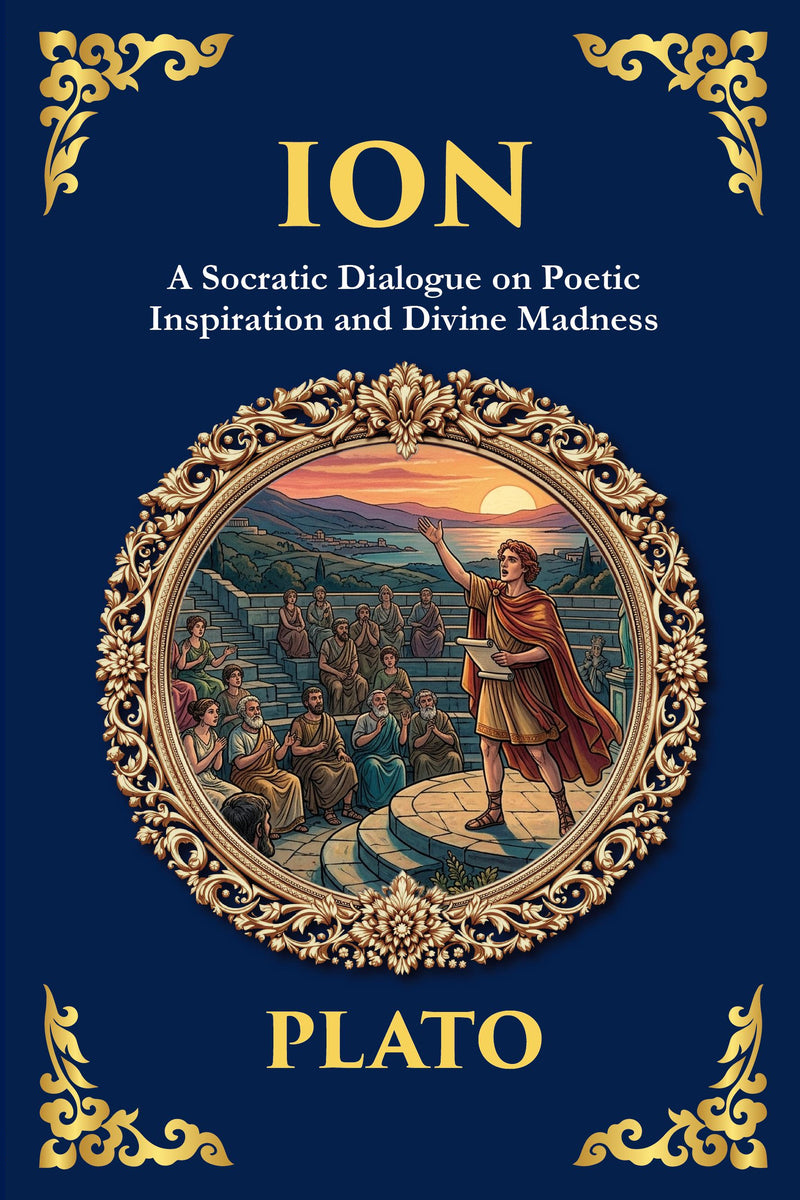
Ion — Large Print
Ion Can poets truly claim their genius—or are they simply vessels of divine madness? In this captivating Socratic dialogue, Plato explores the mysterious source of poetic inspiration.
or free app
10,000+ hrs library
30-day guarantee
The complete Ion appears in modern English through Library of Alexandria Press, available online with audiobook narration included for members.
Have you ever wondered why great poetry feels like it comes from somewhere beyond the poet? In Ion, Plato offers one of his most concise and intellectually rich dialogues—a thought- provoking conversation between Socrates and the acclaimed rhapsode Ion. At the heart of their exchange lies a deceptively simple question: Is poetic talent an art, a learned skill, or a form of divine madness?
As Ion boasts of his prowess in interpreting Homer, Socrates challenges him to explain whether his insights come from technique or a supernatural force. What unfolds is a playful yet piercing philosophical investigation into the nature of creativity, performance, and inspiration. This edition presents a crisp modern translation of Plato’s original Greek text, making its arguments accessible to contemporary readers while retaining the dialogue’s wit and rhetorical brilliance.
What you’ll discover in this modern edition
- A Dialogue on Inspiration vs. Skill – Examine whether artists create through mastery or possession by the divine.
- A Fascinating Portrait of Socratic Method – Witness Socrates’s signature irony and logic as he guides Ion toward uncomfortable truths.
- Timeless Questions on the Nature of Genius – Explore how ideas of talent, madness, and divine origin still shape our understanding of art.
- Perfect for Readers of Philosophy and the Arts – A foundational text for students, thinkers, creatives, and lovers of classical literature.
| Formats | eBook (EPUB + PDF) · Audiobook · Paperback · Hardcover · Large Print |
| Language | English |
| Trim size (print) | 6 × 9 in |
| Binding | Paperback — perfect-bound · Hardcover — casewrap |
| Large Print edition | Same text in a larger, easy-read type — a larger font, not a larger trim |
| Print pricing | Every physical book at our true cost — at-cost, no profit (members) |
| Library | 873 restored titles, always growing |
| Length | 8,118 words · ~32 min reading |
| Reading level | Grade 10 · a comfortable read (this modern-English edition) |
| Edition | Modern English translation · 2026 |
Member reviews for this edition are collected as readers finish it — be the first. Across the library: 12,000+ books shipped, every plan covered by a 365-day print guarantee.
About this edition
A faithful, unabridged modern-English edition by The Library of Alexandria — carefully rendered for today's reader and verified paragraph-by-paragraph against the public-domain source. Available as eBook, audiobook, paperback, hardcover, and large print.
- Complete & unabridgedVerified paragraph by paragraph against the source — never a scan, never abridged.
- Modern English, faithfulReadable today, with the author’s meaning kept intact. Readable — not simplified.
- Every format, one membershipRead in your browser or the free app, or listen to the full audiobook.
Included free with your membership
Cancel anytime, one click · 30-day money-back guarantee
Edition last updated July 2026
What’s inside
Ion — Large Print — complete and unabridged, included in full with membership, plus the full audiobook.
Begin reading Ion — Large Print
In clear modern English — the complete text is included with membership.
Introduction
There is a particular kind of conversation that lingers in the mind long after the words have ended—not because it settled a question, but because it cracked one open. The short, electric exchange you are about to read belongs firmly in that category. On its surface, it is a deceptively simple encounter: a renowned performer of poetry meets a famously irritating questioner, and the two of them tangle over what it means to be good at something. Yet beneath that modest framing lies one of the most enduring meditations on creativity, knowledge, and the strange forces that move human beings to make and perform art. For more than two thousand years, readers have returned to this little dialogue not for its length but for its lightning—the way it illuminates, in a few brilliant flashes, questions we still cannot answer about where inspiration comes from and what, if anything, the artist truly knows.
This work belongs to a body of writing that has shaped the entire course of Western thought. Its author needs little introduction in the broad sense, but the particular character of this piece deserves careful framing, because it is easy to misread if approached with the wrong expectations. This is not a treatise. It is not a lecture. It is a drama in miniature, a verbal duel staged between two memorable personalities, and like all good drama, it rewards the reader who pays attention not only to what is said but to how it is said, to the shifts in tone, the flattery and the flattery deflected, the moments where one speaker grows uncomfortable and the other presses harder. To read it well is to listen for the music beneath the argument.
To appreciate what unfolds in these pages, it helps to imagine the world from which it emerged. Picture a culture in which poetry was not a quiet, private pleasure consumed alone with a book, but a public, communal, and often ecstatic experience. In the ancient Greek world, the great epic poems were the foundation of education, religion, morality, and shared identity. They were the encyclopedia of a people—the place one went to learn how heroes behaved, how the gods intervened in human affairs, how to drive a chariot or arrange an army or mourn the dead. To know these poems deeply was, in a very real sense, to possess a great portion of one’s entire cultural inheritance.
And these poems were not merely read. They were performed. There existed a profession devoted entirely to the public recitation of epic verse, and the men who practiced it were celebrities of a sort difficult to translate into modern terms. They traveled from city to city, competed in festivals before enormous crowds, won prizes and prestige, and commanded the rapt attention of thousands. A great performer could make an audience weep, shudder, and gasp. He wore elaborate costume, used dramatic gesture and vocal modulation, and in the best moments seemed to become a vessel through which the ancient words poured forth with overwhelming force. The performer at the center of this dialogue is precisely such a man—a star at the height of his fame, fresh from a triumph, glowing with the confidence of a person who has just been crowned the best in his field.
Into this world steps the questioner—a figure who made it his life’s work to approach exactly such confident, successful people and ask them, with disarming politeness, to explain what they actually knew. He was famous, or infamous, for this habit. He claimed to know nothing himself, and used that claimed ignorance as a kind of lever to pry open the assumptions of those who believed they knew a great deal. He was not cruel, exactly, but he was relentless, and his conversations had a way of leaving his interlocutors more confused than they had been before they met him—though, he would insist, more honestly confused, and therefore wiser.
The collision of these two men is the engine of the entire piece. One is a master of emotional performance, accustomed to admiration and unused to being challenged on the substance of his craft. The other is a master of patient interrogation, accustomed to dismantling the comfortable certainties of his betters. When they meet, the performer expects, perhaps, a friendly admirer, a chance to bask in well-earned praise. What he gets instead is a slow, courteous, and devastating examination of whether he understands anything at all about the very art he has just performed so magnificently.
It would be a mistake, however, to read this as a simple takedown, a clever man humiliating a foolish one. The deeper one reads, the more one senses that the questioner is genuinely puzzled, genuinely searching, and that the question he raises is not merely a trap but a real mystery—one that troubles him as much as it troubles his companion. How is it that a person can be so extraordinarily, undeniably good at conveying the meaning and power of great poetry, and yet be unable to give any rational account of how he does it? What does that strange combination of obvious skill and inexplicable mystery tell us about the nature of artistic gift itself?
This question has not aged. Anyone who has ever tried to explain why a piece of music moves them, or watched a great actor inhabit a role so completely that the seams disappear, or struggled to articulate why one sentence sings and another falls flat, has brushed up against the same puzzle. We speak, even now, of artists being “inspired,” of being “in the zone,” of work that seems to “come through” them rather than from them. We use the language of possession and channeling without quite believing it literally, and yet we cannot find better words. The conversation in this dialogue is, in part, an attempt to take that language seriously—to ask what we really mean when we say that an artist is touched by something greater than ordinary skill.
The subtitle of this edition points directly to that theme: poetic inspiration and divine madness. These are not throwaway phrases. They name a genuine and ancient theory about the source of artistic power—the idea that the true poet does not compose by craft or technique alone, but is seized by a force outside himself, lifted out of his ordinary mind, and made to speak words that are not entirely his own. The performer, in turn, is presented as a link in a chain of transmission, passing that same electric force from the original poet, through himself, and out into the trembling crowd. It is a beautiful and unsettling image, and the dialogue develops it with a precision and vividness that have made it one of the most quoted passages in all of literature about the creative process.
What makes the encounter so artful is that this elevated theory of inspiration sits in delicate tension with the more deflating arc of the argument. On one hand, the questioner offers the performer an apparently flattering escape: perhaps you cannot explain your gift because it is divine, because it comes from above and not from any teachable expertise. On the other hand, that very flattery contains a sting, for if the performer’s power is not based on knowledge or skill, then in what sense does he understand anything? Is he wise, or merely a magnificent conduit through which wisdom he does not possess happens to flow? The dialogue refuses to let us rest comfortably on either side. It holds up the artist as something noble and mysterious, and at the same time gently questions whether mystery is something to be proud of.
Readers coming to this work for the first time often expect philosophy to look a certain way—dense, abstract, organized into propositions and conclusions. This piece will surprise them. It moves like a play. It has the rhythm of real speech, complete with interruptions, hesitations, sudden bursts of enthusiasm, and moments where one speaker walks happily into a trap the reader can see closing well before he can. To get the most from it, slow down and watch the dance.
Pay attention, first, to the personalities. The performer is proud, eager, a little vain, and genuinely talented. When he is praised, he expands; when he is cornered, he reaches for the most generous interpretation of his own difficulty. He is not stupid—he is, in fact, quite quick—but he is unused to having his foundations examined, and his discomfort is rendered with real psychological subtlety. Watch how he tries again and again to find a way out, and how each apparent escape leads him deeper into the maze. There is something deeply human in his predicament, and a good reader will feel sympathy for him even while smiling at his stumbles.
The questioner, for his part, is a study in controlled irony. He praises lavishly, agrees readily, and asks questions that seem innocent until their consequences arrive. He is never openly hostile; on the contrary, he maintains an almost exaggerated courtesy throughout. But that courtesy is itself a kind of weapon, because it lulls his companion into agreeing with each small step, until the small steps add up to a conclusion the performer would never have accepted if it had been stated baldly at the start. This method—building an argument out of a series of modest, hard-to-refuse admissions—is the signature technique of this entire tradition of writing, and watching it operate in such a short and self-contained example is one of the great pleasures of the piece. It is, in a sense, an ideal introduction to the method, because the argument is compact enough to hold in the mind all at once.
Second, notice the central images. The dialogue is famous for one extraordinary comparison, in which the transmission of poetic power is likened to the behavior of a particular natural force that draws objects to itself and passes its attractive power down a chain, so that each link hangs suspended from the one above. The image is so apt and so vivid that it has become one of the permanent metaphors of literary criticism. When you reach it, pause and let it work on you. It captures something true about how art moves through the world—how a creator’s energy can be transmitted, intensified, and relayed through performers and audiences across great distances of time and space. The poet of long ago still moves the crowd today, through the bodies and voices of those who carry the work forward.
Third, attend to the recurring problem of expertise. Much of the argument turns on a comparison between the performer’s art and other, more obviously technical forms of knowledge—the skills of those who actually do the things the poems describe. If a poem talks about driving a chariot, who knows better whether the description is accurate: the performer who recites it beautifully, or the person who actually drives chariots for a living? This line of questioning may seem narrow at first, even pedantic, but it opens onto a vast and enduring debate. What kind of knowledge does the artist possess? Is the maker of beautiful representations also an authority on the things represented? Can one speak truly and movingly about courage, or seamanship, or generalship, or love, without being an expert in those things oneself? These are not antique concerns. They surface every time we ask whether a novelist needs to have lived the lives they write about, whether an actor must feel what they portray, whether a song about heartbreak is more authentic if its singer has genuinely suffered.
It is worth saying clearly what this dialogue does not do, so that you are not disappointed by the wrong expectations. It does not arrive at a tidy, triumphant answer. Like many works in this tradition, it is more interested in the quality of the questioning than in the comfort of conclusions. The performer is left in a kind of suspended uncertainty, offered a choice between two unflattering self-descriptions, and the reader is left to sit with the unresolved tension. Some find this frustrating. But the frustration is the point. The dialogue wants you to feel the genuine difficulty of the question, to carry it out of the text and into your own encounters with art, and to keep turning it over long after the last line. A neat answer would close the door that the whole conversation works so hard to open.
Cancel anytime, one click · 30-day money-back guarantee
Founding annual rate available now — your price locks for life when you join.
Not ready? Get this free chapter by email — read it anytime.
✓ Sent — check your inbox for Ion — Large Print.
Questions about Ion — Large Print
What is Ion about?
Ion Can poets truly claim their genius—or are they simply vessels of divine madness? In this captivating Socratic dialogue, Plato explores the mysterious source of poetic inspiration. Through a spirited exchange between Socrates and the rhapsode Ion, this short yet profound work examines whether poetic talent is born of knowledge or of divine influence.
Who wrote Ion?
Ion was written by Plato. This edition presents the complete work in clear modern English, faithfully rendered from the public-domain original by Library of Alexandria Press.
Is Ion free to read?
The opening chapter is free to read on this page. Members read and listen to the complete work — and the entire library — free, and can order any physical book at our true print cost.
How long is Ion?
2 chapters (~8,118 words) — about 32 min of reading in this modern-English edition.
Is this an abridged version of Ion?
No. This is the complete, unabridged Ion, carefully rendered into clear modern English and verified paragraph-by-paragraph against the public-domain source — nothing is cut or summarised.
What formats does Ion come in?
Ion is available as eBook, paperback, hardcover and large print. eBook and audiobook are included with membership; printed editions ship at our true print cost.
Shipping & returns
Billing & membership
More from the library


Explore History
- The Advancement of Learning · Francis Bacon
- Democracy in America — Volume 2 · Alexis de Tocqueville
- Second Treatise of Government · John Locke
- The Prince · Niccolò Machiavelli
- The Jew, The Gypsy and El Islam — Large Print · Richard Francis Burton
- Common Sense · Thomas Paine
- Memoirs of the Courts of Louis XV and XVI — Complete · Madame du Hausset; Princesse de...
- Lucretia Borgia — Large Print · Ferdinand Gregorovius
- Lucretia Borgia · Ferdinand Gregorovius
- The Eleusinian Mysteries and Rites — Large Print · Dudley Wright
- A Vindication of the Rights of Men · Mary Wollstonecraft
- Louis XIV and La Grande Mademoiselle, 1652–1693 — Large Print · Arvède Barine
- A Record of Buddhistic Kingdoms — Large Print · Faxian
- The Jew, The Gypsy and El Islam · Richard Francis Burton
- The Story of Don John of Austria · Luis Coloma
- The Condition of the Working-Class in England in 1844 — Large Print · Friedrich Engels
- Louis XIV and La Grande Mademoiselle, 1652–1693 · Arvède Barine
- The Interesting Narrative of the Life of Olaudah Equiano — Large Print · Olaudah Equiano
- Wellington's Army, 1809–1814 — Large Print · Charles Oman
- Lives of the Early Medici — Large Print · Janet Ross (editor)
- Narrative of the Captivity and Restoration of Mrs. Mary Rowlandson · Mary White Rowlandson
- Asser's Life of King Alfred — Large Print · John Asser
- The Eleusinian Mysteries and Rites · Dudley Wright
- The Condition of the Working-Class in England in 1844 · Friedrich Engels
- Asser's Life of King Alfred · John Asser
- The Rising Tide of Color Against White World-Supremacy · Lothrop Stoddard
- A Record of Buddhistic Kingdoms · Faxian
- Andersonville Diary — Large Print · John L. Ransom
- Brief Account and Succinct Narration · Jacques Cartier
- Brief Account and Succinct Narration — Large Print · Jacques Cartier
Ion — Large Print
Ion — Large Print
A Socratic Dialogue on Poetic Inspiration and Divine Madness
Plato
Contents
- Introduction
- Ion
Introduction
There is a particular kind of conversation that lingers in the mind long after the words have ended—not because it settled a question, but because it cracked one open. The short, electric exchange you are about to read belongs firmly in that category. On its surface, it is a deceptively simple encounter: a renowned performer of poetry meets a famously irritating questioner, and the two of them tangle over what it means to be good at something. Yet beneath that modest framing lies one of the most enduring meditations on creativity, knowledge, and the strange forces that move human beings to make and perform art. For more than two thousand years, readers have returned to this little dialogue not for its length but for its lightning—the way it illuminates, in a few brilliant flashes, questions we still cannot answer about where inspiration comes from and what, if anything, the artist truly knows.
This work belongs to a body of writing that has shaped the entire course of Western thought. Its author needs little introduction in the broad sense, but the particular character of this piece deserves careful framing, because it is easy to misread if approached with the wrong expectations. This is not a treatise. It is not a lecture. It is a drama in miniature, a verbal duel staged between two memorable personalities, and like all good drama, it rewards the reader who pays attention not only to what is said but to how it is said, to the shifts in tone, the flattery and the flattery deflected, the moments where one speaker grows uncomfortable and the other presses harder. To read it well is to listen for the music beneath the argument.
To appreciate what unfolds in these pages, it helps to imagine the world from which it emerged. Picture a culture in which poetry was not a quiet, private pleasure consumed alone with a book, but a public, communal, and often ecstatic experience. In the ancient Greek world, the great epic poems were the foundation of education, religion, morality, and shared identity. They were the encyclopedia of a people—the place one went to learn how heroes behaved, how the gods intervened in human affairs, how to drive a chariot or arrange an army or mourn the dead. To know these poems deeply was, in a very real sense, to possess a great portion of one’s entire cultural inheritance.
And these poems were not merely read. They were performed. There existed a profession devoted entirely to the public recitation of epic verse, and the men who practiced it were celebrities of a sort difficult to translate into modern terms. They traveled from city to city, competed in festivals before enormous crowds, won prizes and prestige, and commanded the rapt attention of thousands. A great performer could make an audience weep, shudder, and gasp. He wore elaborate costume, used dramatic gesture and vocal modulation, and in the best moments seemed to become a vessel through which the ancient words poured forth with overwhelming force. The performer at the center of this dialogue is precisely such a man—a star at the height of his fame, fresh from a triumph, glowing with the confidence of a person who has just been crowned the best in his field.
Into this world steps the questioner—a figure who made it his life’s work to approach exactly such confident, successful people and ask them, with disarming politeness, to explain what they actually knew. He was famous, or infamous, for this habit. He claimed to know nothing himself, and used that claimed ignorance as a kind of lever to pry open the assumptions of those who believed they knew a great deal. He was not cruel, exactly, but he was relentless, and his conversations had a way of leaving his interlocutors more confused than they had been before they met him—though, he would insist, more honestly confused, and therefore wiser.
The collision of these two men is the engine of the entire piece. One is a master of emotional performance, accustomed to admiration and unused to being challenged on the substance of his craft. The other is a master of patient interrogation, accustomed to dismantling the comfortable certainties of his betters. When they meet, the performer expects, perhaps, a friendly admirer, a chance to bask in well-earned praise. What he gets instead is a slow, courteous, and devastating examination of whether he understands anything at all about the very art he has just performed so magnificently.
It would be a mistake, however, to read this as a simple takedown, a clever man humiliating a foolish one. The deeper one reads, the more one senses that the questioner is genuinely puzzled, genuinely searching, and that the question he raises is not merely a trap but a real mystery—one that troubles him as much as it troubles his companion. How is it that a person can be so extraordinarily, undeniably good at conveying the meaning and power of great poetry, and yet be unable to give any rational account of how he does it? What does that strange combination of obvious skill and inexplicable mystery tell us about the nature of artistic gift itself?
This question has not aged. Anyone who has ever tried to explain why a piece of music moves them, or watched a great actor inhabit a role so completely that the seams disappear, or struggled to articulate why one sentence sings and another falls flat, has brushed up against the same puzzle. We speak, even now, of artists being “inspired,” of being “in the zone,” of work that seems to “come through” them rather than from them. We use the language of possession and channeling without quite believing it literally, and yet we cannot find better words. The conversation in this dialogue is, in part, an attempt to take that language seriously—to ask what we really mean when we say that an artist is touched by something greater than ordinary skill.
The subtitle of this edition points directly to that theme: poetic inspiration and divine madness. These are not throwaway phrases. They name a genuine and ancient theory about the source of artistic power—the idea that the true poet does not compose by craft or technique alone, but is seized by a force outside himself, lifted out of his ordinary mind, and made to speak words that are not entirely his own. The performer, in turn, is presented as a link in a chain of transmission, passing that same electric force from the original poet, through himself, and out into the trembling crowd. It is a beautiful and unsettling image, and the dialogue develops it with a precision and vividness that have made it one of the most quoted passages in all of literature about the creative process.
What makes the encounter so artful is that this elevated theory of inspiration sits in delicate tension with the more deflating arc of the argument. On one hand, the questioner offers the performer an apparently flattering escape: perhaps you cannot explain your gift because it is divine, because it comes from above and not from any teachable expertise. On the other hand, that very flattery contains a sting, for if the performer’s power is not based on knowledge or skill, then in what sense does he understand anything? Is he wise, or merely a magnificent conduit through which wisdom he does not possess happens to flow? The dialogue refuses to let us rest comfortably on either side. It holds up the artist as something noble and mysterious, and at the same time gently questions whether mystery is something to be proud of.
Readers coming to this work for the first time often expect philosophy to look a certain way—dense, abstract, organized into propositions and conclusions. This piece will surprise them. It moves like a play. It has the rhythm of real speech, complete with interruptions, hesitations, sudden bursts of enthusiasm, and moments where one speaker walks happily into a trap the reader can see closing well before he can. To get the most from it, slow down and watch the dance.
Pay attention, first, to the personalities. The performer is proud, eager, a little vain, and genuinely talented. When he is praised, he expands; when he is cornered, he reaches for the most generous interpretation of his own difficulty. He is not stupid—he is, in fact, quite quick—but he is unused to having his foundations examined, and his discomfort is rendered with real psychological subtlety. Watch how he tries again and again to find a way out, and how each apparent escape leads him deeper into the maze. There is something deeply human in his predicament, and a good reader will feel sympathy for him even while smiling at his stumbles.
The questioner, for his part, is a study in controlled irony. He praises lavishly, agrees readily, and asks questions that seem innocent until their consequences arrive. He is never openly hostile; on the contrary, he maintains an almost exaggerated courtesy throughout. But that courtesy is itself a kind of weapon, because it lulls his companion into agreeing with each small step, until the small steps add up to a conclusion the performer would never have accepted if it had been stated baldly at the start. This method—building an argument out of a series of modest, hard-to-refuse admissions—is the signature technique of this entire tradition of writing, and watching it operate in such a short and self-contained example is one of the great pleasures of the piece. It is, in a sense, an ideal introduction to the method, because the argument is compact enough to hold in the mind all at once.
Second, notice the central images. The dialogue is famous for one extraordinary comparison, in which the transmission of poetic power is likened to the behavior of a particular natural force that draws objects to itself and passes its attractive power down a chain, so that each link hangs suspended from the one above. The image is so apt and so vivid that it has become one of the permanent metaphors of literary criticism. When you reach it, pause and let it work on you. It captures something true about how art moves through the world—how a creator’s energy can be transmitted, intensified, and relayed through performers and audiences across great distances of time and space. The poet of long ago still moves the crowd today, through the bodies and voices of those who carry the work forward.
Third, attend to the recurring problem of expertise. Much of the argument turns on a comparison between the performer’s art and other, more obviously technical forms of knowledge—the skills of those who actually do the things the poems describe. If a poem talks about driving a chariot, who knows better whether the description is accurate: the performer who recites it beautifully, or the person who actually drives chariots for a living? This line of questioning may seem narrow at first, even pedantic, but it opens onto a vast and enduring debate. What kind of knowledge does the artist possess? Is the maker of beautiful representations also an authority on the things represented? Can one speak truly and movingly about courage, or seamanship, or generalship, or love, without being an expert in those things oneself? These are not antique concerns. They surface every time we ask whether a novelist needs to have lived the lives they write about, whether an actor must feel what they portray, whether a song about heartbreak is more authentic if its singer has genuinely suffered.
It is worth saying clearly what this dialogue does not do, so that you are not disappointed by the wrong expectations. It does not arrive at a tidy, triumphant answer. Like many works in this tradition, it is more interested in the quality of the questioning than in the comfort of conclusions. The performer is left in a kind of suspended uncertainty, offered a choice between two unflattering self-descriptions, and the reader is left to sit with the unresolved tension. Some find this frustrating. But the frustration is the point. The dialogue wants you to feel the genuine difficulty of the question, to carry it out of the text and into your own encounters with art, and to keep turning it over long after the last line. A neat answer would close the door that the whole conversation works so hard to open.
SOCRATES: Welcome, Ion. Have you come from your hometown of Ephesus?
ION: No, Socrates; I’ve come from Epidaurus, where I was attending the festival for Asclepius.
SOCRATES: Do the people of Epidaurus hold poetry recitations at that festival?
ION: They certainly do, along with all kinds of musical performances.
SOCRATES: Were you one of the performers—and did you win?
ION: I won first place overall, Socrates.
SOCRATES: Great job; I hope you’ll do the same for us at the Panathenaea.
SOCRATES: I often envy your career as a rhapsode, Ion. You always get to wear elegant clothes, and looking your best is actually part of your craft. Furthermore, you are constantly surrounded by great poets—especially Homer, who is the most gifted and divine of them all. Being able to truly understand him, rather than just memorizing his words, is something anyone would envy. After all, no one can be a rhapsode without understanding the poet’s meaning. A rhapsode’s job is to explain the poet’s intent to the audience, but how can he do that effectively if he doesn’t know what the poet means? All of this is truly enviable.
ION: You’re right, Socrates; interpreting the text has definitely been the hardest part of my work. I believe I can talk about Homer better than anyone else. Neither Metrodorus of Lampsacus, Stesimbrotus of Thasos, Glaucon, nor anyone else in history has had as many or as deep insights into Homer as I do.
SOCRATES: I’m happy to hear that, Ion. I assume you won’t mind sharing those insights with me.
ION: Of course, Socrates. In fact, you really should hear how beautifully I perform Homer’s work. I believe the descendants of Homer should give me a golden crown.
End of the free sample
Keep reading, free
Members read and listen to the complete book — and the entire library. Cancel anytime, one click · 30-day money-back guarantee.