The Book of Enoch
An ancient Jewish apocalypse of visions, fallen angels, and cosmic secrets—quoted in the New Testament, lost to the West for a millennium, and preserved only by Ethiopian scribes.
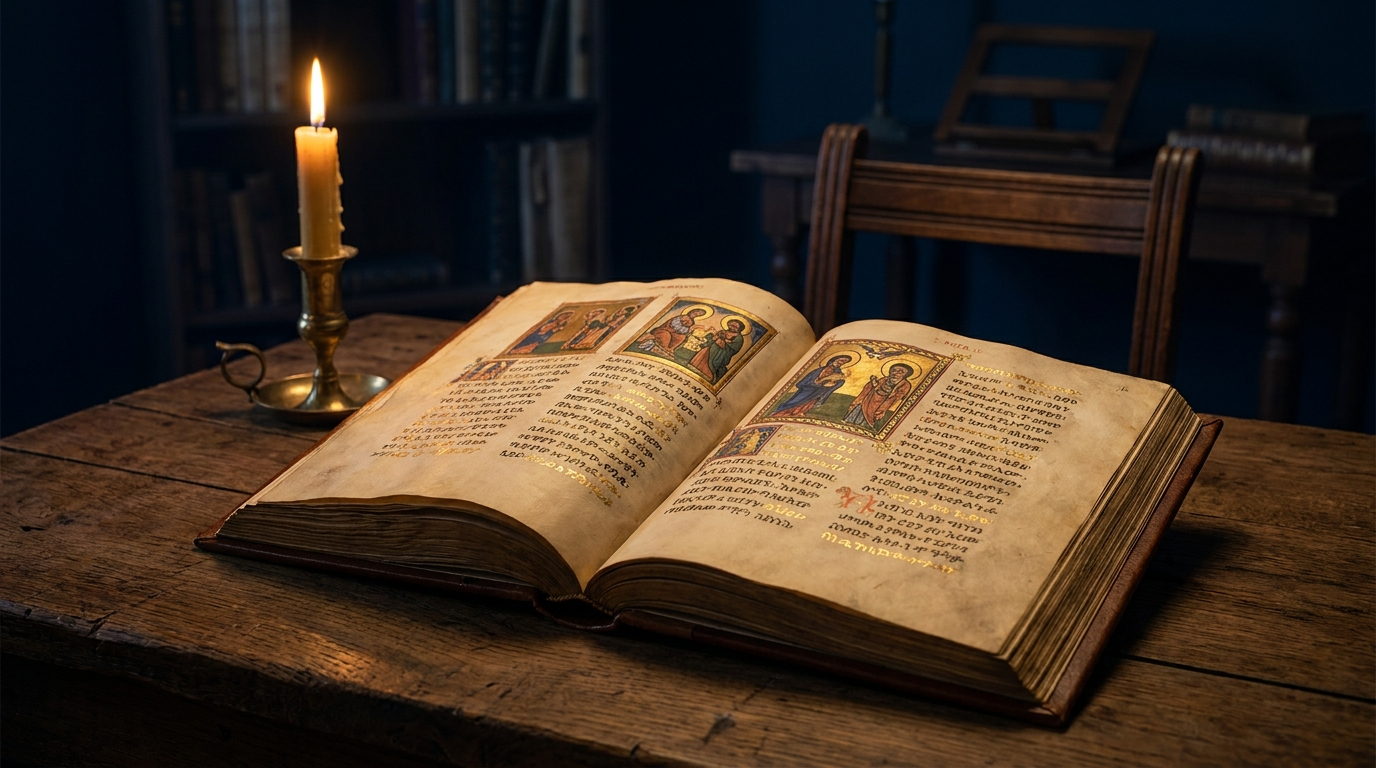
The Book of Enoch (1 Enoch) is a composite Jewish apocalyptic text (c. 300 BC–AD 100) attributed to Enoch, great-grandfather of Noah. Comprising five distinct books—Watchers, Parables, Astronomical, Dream Visions, Epistle—it recounts Enoch's heavenly journeys, the fallen angels' rebellion, the Nephilim's origins, and messianic prophecies. Excluded from most biblical canons by the fourth century, it survives complete only in Ge'ez (Ethiopic) and partially in Aramaic fragments from Qumran.
Enoch, Seventh from Adam: The Book and Its Protagonist
Enoch appears fleetingly in Genesis 5:21–24: he 'walked with God' for 365 years, then 'was not, for God took him.' That cryptic absence—no death recorded—made him the perfect vessel for Jewish apocalyptic imagination. The Book of Enoch, or 1 Enoch (distinguished from later 2 and 3 Enoch), emerged between the third century BC and the first century AD as a composite work, compiled over generations. R.H. Charles, who produced the definitive 1906 English translation from Ge'ez manuscripts, argued that the text reflects diverse authorial hands united by a common reverence for Enoch as primordial scribe and seer. The book's 108 chapters (in the Ethiopic recension) present Enoch's heavenly ascents, his intercession for fallen angels, astronomical secrets, and visions of judgment. Unlike canonical scripture, 1 Enoch's narrative is baroque, ekphrastic—Enoch traverses flaming mountains, crystal seas, and the Garden of Righteousness, recording what no mortal should see. Its influence on Second Temple Judaism and nascent Christianity was profound, shaping angelology, demonology, and messianic expectation before ecclesiastical councils deemed it too strange, too perilous, for liturgical inclusion.
Five Books in One: The Structure of 1 Enoch
1 Enoch is a library unto itself. The Book of the Watchers (chapters 1–36), the oldest stratum (c. 300 BC), narrates the angels' descent to earth, their union with human women, and Enoch's intercession; it culminates in cosmic tours where Enoch witnesses Sheol's compartments and the ends of the earth. The Parables or Similitudes (37–71), absent from Qumran and likely composed AD 40–70, introduce the 'Son of Man' enthroned in judgment—a messianic figure George Nickelsburg called 'the most explicit anticipation of New Testament Christology in Jewish literature.' The Astronomical Book (72–82), originally far longer, maps lunar and solar calendars with obsessive precision, arguing for a 364-day year against the lunar calendar. The Dream Visions (83–90), including the famous Animal Apocalypse, allegorize Israel's history as a menagerie: Abraham is a white bull, Moses a sheep, the Maccabees horned lambs battling ravens (Seleucids). The Epistle of Enoch (91–108) contains the Apocalypse of Weeks, periodizing history into ten 'weeks,' and ethical exhortations. James VanderKam notes that this fivefold structure may reflect liturgical or pedagogical use, each book answering distinct theological anxieties of its age.
The Watchers, the Nephilim, and the Origin of Evil
Chapters 6–11 revolutionize Genesis 6:1–4's terse account of the 'sons of God' cohabiting with 'daughters of men.' In 1 Enoch, two hundred Watchers, led by Shemihazah and Azazel, descend on Mount Hermon and swear an oath. Their progeny, the Nephilim—giants 'three thousand cubits' tall—devour humanity's resources and turn carnivorous, consuming flesh and drinking blood. The Watchers teach forbidden arts: Azazel imparts metallurgy and cosmetics, Baraqel astrology, Kokabel omens. This myth, as Michael Knibb observed, offers an etiology of evil external to human agency—sin's origin lies not in Adam's disobedience but in angelic transgression. God dispatches archangels: Raphael binds Azazel in the desert of Dudael under jagged rocks; Gabriel incites the giants to mutual slaughter; Michael imprisons the Watchers for seventy generations until final judgment. Enoch, summoned as scribe, delivers God's verdict: no forgiveness. The myth resonated deeply—its explanatory power for suffering, violence, and occult knowledge made it central to intertestamental Jewish thought and echoed in texts from Jubilees to the Testament of the Twelve Patriarchs.
1 Enoch is the single most important text for understanding the world into which Christianity was born, shaping angelology, messianism, and the very architecture of apocalyptic thought.Michael A. Knibb, The Ethiopic Book of Enoch (1978)
Exclusion from the Canon: Laodicea, Authorship, and Ecclesiastical Anxiety
Though revered in Second Temple Judaism and quoted by Jude, 1 Enoch faced mounting skepticism by the second century AD. The Council of Laodicea (363 AD) codified a biblical canon that excluded it; Jerome and Augustine, architects of Western Christian orthodoxy, dismissed it as pseudepigraphal—falsely attributed to the antediluvian patriarch. James Charlesworth notes that concerns were threefold: its elaborate angelology risked angel-worship; its explicit dualism (evil from fallen angels, not human free will) contradicted emerging doctrine; and its authorship was transparently post-exilic, not Mosaic-era. By the fifth century, 1 Enoch vanished from Greek and Latin Christianity. The Ethiopian Orthodox Tewahedo Church, isolated by geography and Christological controversies after Chalcedon (451 AD), preserved it as deuterocanonical, unaware of Rome's rejection. Western scholars knew 1 Enoch only through patristic citations and the Epistle of Jude's tantalizing verse—'Enoch, the seventh from Adam, prophesied...'—until the eighteenth century. The book's exclusion was not conspiratorial suppression but a calculated theological pruning: church fathers feared its vivid mythography would confuse catechumens and its pseudonymity undermined apostolic authority.

The complete Books of Enoch — all five books in clear, modern English with the original chapter divisions. The readable Library of Alexandria edition.
Read the complete text →Survival and Rediscovery: Ethiopia, James Bruce, and the Dead Sea Scrolls
In 1773, Scottish explorer James Bruce returned from Abyssinia with three Ge'ez manuscripts of 1 Enoch, retrieved from monasteries at Gondar. R.H. Charles translated Bruce's manuscripts in 1906, restoring the complete text to Western scholarship for the first time in fifteen centuries. Yet the Ge'ez raised questions: was it translated from Greek or directly from a Semitic original? Answers arrived in Qumran Cave 4 (1947–1956), where J.T. Milik identified eleven Aramaic manuscripts of 1 Enoch—fragments of the Astronomical Book, Watchers, Dream Visions, and Epistle, dated 200–50 BC. Critically, no Parables fragments appeared, suggesting its later composition. Milik's 1976 volume The Books of Enoch: Aramaic Fragments of Qumrân Cave 4 confirmed Aramaic as the original language (with Hebrew for portions of the Astronomical Book). The Qumran finds revolutionized Enochic studies: 1 Enoch was not Ethiopian fancy but a vital Second Temple document, older than most of Daniel, read at Qumran alongside Torah. George Nickelsburg concluded that the Enoch tradition rivaled the Mosaic as a lens for interpreting Genesis and cosmology among Essenes and other sectarians.
Influence on Judaism, the New Testament, and Early Christianity
1 Enoch saturates intertestamental Judaism. Jubilees recapitulates its chronology; the Testament of Levi borrows its priestly angelology; the Parables' 'Son of Man' reverberates in Daniel 7 and the Synoptic Gospels. The New Testament explicitly quotes it: Jude 14–15 cites 1 Enoch 1:9 verbatim—'Behold, the Lord comes with ten thousands of his holy ones, to execute judgment.' Jesus' self-designation as 'Son of Man' (Mark 14:62) may echo the Parables' exalted figure. James VanderKam argues that Enochic theology—fallen angels, eschatological judgment, resurrection—shaped Pharisaic and early Christian cosmology more than previously acknowledged. Church fathers Clement of Alexandria, Irenaeus, and Tertullian cited 1 Enoch as scripture. Yet by Augustine's era, its extravagance—Enoch's cosmic tours, the Watchers' lurid sins—seemed mythological, unsuitable for catechesis. Still, its legacy endures: medieval Christian cosmologies, Milton's Paradise Lost (Azazel as Satan's standard-bearer), and modern angelology all drink from Enoch's well. As Michael Knibb wrote, '1 Enoch is the single most important text for understanding the world into which Christianity was born.'
Frequently asked questions
Why is the Book of Enoch not in the Bible?
The Council of Laodicea (363 AD) and later church fathers excluded 1 Enoch due to its pseudepigraphal authorship (it was composed centuries after Enoch's supposed lifetime), its elaborate angelology that risked heterodoxy, and its mythological tone. Jerome and Augustine deemed it unsuitable for canon. Only the Ethiopian Orthodox Church retained it as deuterocanonical, unaffected by these Western conciliar decisions.
Did the New Testament quote the Book of Enoch?
Yes. Jude 14–15 directly quotes 1 Enoch 1:9: 'Behold, the Lord comes with ten thousands of his holy ones, to execute judgment on all.' This verbatim citation indicates 1 Enoch's authority in first-century Jewish-Christian circles. Additionally, Jesus' 'Son of Man' imagery and 2 Peter 2:4's reference to angels in chains likely reflect Enochic traditions, though not direct quotations.
Who were the Watchers in the Book of Enoch?
The Watchers were two hundred angels who, led by Shemihazah and Azazel, descended to earth on Mount Hermon (1 Enoch 6). They took human wives, producing the Nephilim (giants), and taught forbidden knowledge—metalworking, astrology, enchantments. God condemned them to imprisonment in darkness for seventy generations. The myth explains evil's cosmic origin outside human sin, a theology influential in Second Temple Judaism.
What are the five books within 1 Enoch?
1 Enoch comprises: (1) the Book of the Watchers (chapters 1–36), narrating angelic rebellion; (2) the Parables/Similitudes (37–71), featuring the messianic 'Son of Man'; (3) the Astronomical Book (72–82), detailing a 364-day solar calendar; (4) the Dream Visions (83–90), allegorizing Israelite history; and (5) the Epistle of Enoch (91–108), containing ethical exhortations and the Apocalypse of Weeks. Each reflects distinct periods and concerns.
How did the Book of Enoch survive?
1 Enoch survived complete only in Ge'ez (Ethiopic), preserved by the Ethiopian Orthodox Church. Scottish explorer James Bruce brought three Ge'ez manuscripts to Europe in 1773. The 1947–1956 Qumran discoveries yielded eleven Aramaic fragments (200–50 BC), confirming its antiquity and Semitic origins. These finds proved 1 Enoch was a major Second Temple text, not a late Christian invention.
What is the significance of Enoch in Genesis?
Genesis 5:21–24 states Enoch 'walked with God' for 365 years and 'was not, for God took him'—no death recorded. This enigmatic ascension made Enoch ideal for apocalyptic elaboration: if translated alive to heaven, he could reveal celestial secrets. The 365 years mirror the solar calendar in 1 Enoch's Astronomical Book, reinforcing his role as revealer of cosmic order.
Did the Dead Sea Scrolls contain the Book of Enoch?
Yes. Qumran Cave 4 yielded eleven Aramaic manuscripts of 1 Enoch (200–50 BC), covering the Watchers, Astronomical Book, Dream Visions, and Epistle. Notably absent were the Parables, suggesting later composition (AD 40–70). J.T. Milik's 1976 publication of these fragments established 1 Enoch as a core text at Qumran, read alongside Torah and prophets by Essenes or related sectarians.
Further reading
- R.H. Charles, The Book of Enoch or 1 Enoch (Clarendon Press, 1906)
- George W.E. Nickelsburg, 1 Enoch 1: A Commentary on the Book of 1 Enoch, Chapters 1–36; 81–108 (Fortress Press, 2001)
- J.T. Milik, The Books of Enoch: Aramaic Fragments of Qumrân Cave 4 (Clarendon Press, 1976)
- James C. VanderKam, Enoch and the Growth of an Apocalyptic Tradition (Catholic Biblical Association of America, 1984)
- Michael A. Knibb, The Ethiopic Book of Enoch: A New Edition in the Light of the Aramaic Dead Sea Fragments (Clarendon Press, 1978)
The complete Books of Enoch — all five books in clear, modern English with the original chapter divisions. The readable Library of Alexandria edition.
Read the complete text →