





 6 h 8 minAudiobook8 minSummaryRead it, hear it, the 15-minute summary, and print and large print at cost
 Audiobook edition · 6 h 8 minPaperback · 6 × 9 in · printing soonHardcover · 6 × 9 in · printing soon
About this book
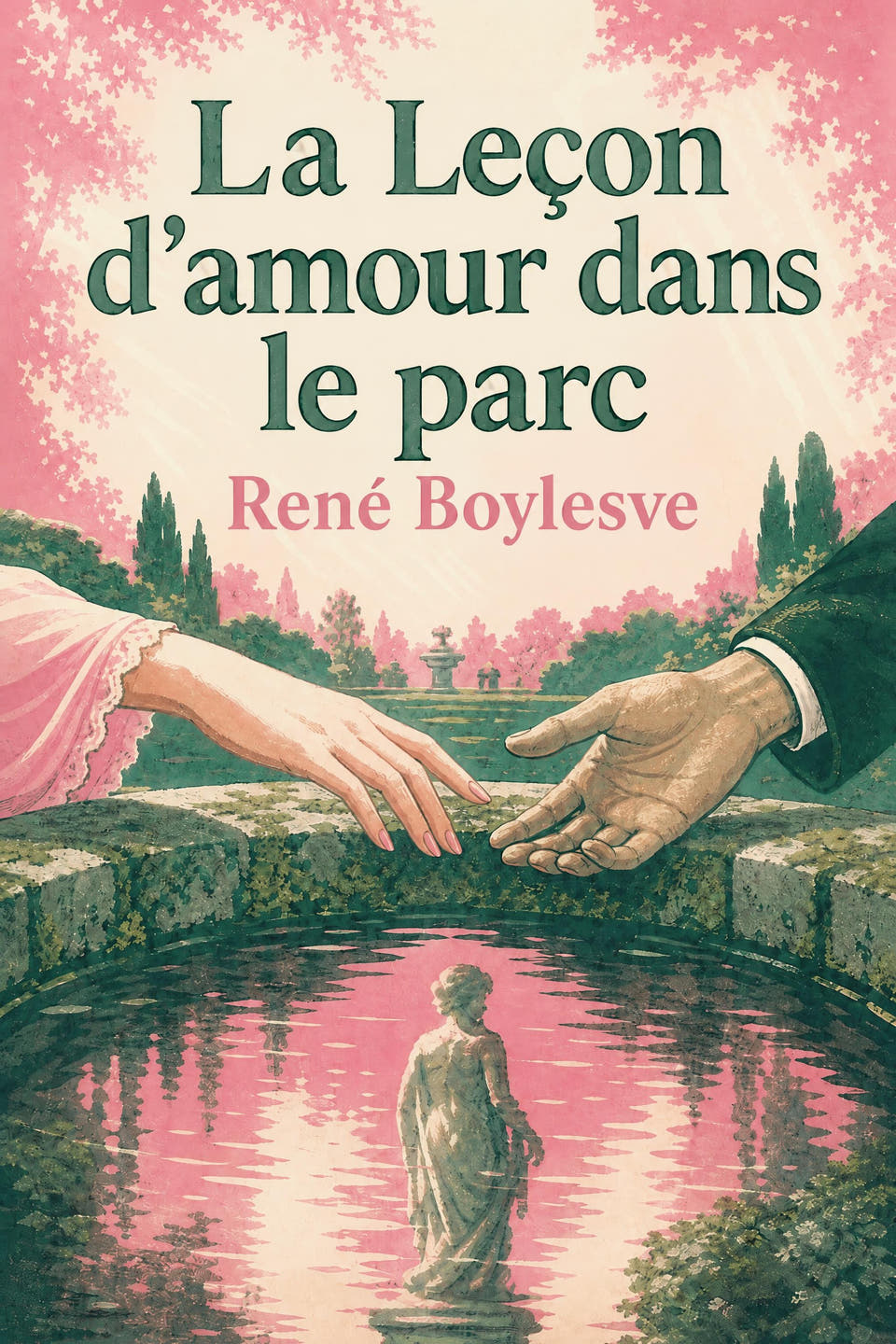
What can a hidden garden path teach you about feelings that good manners keep out of sight?
In The Love Lesson in the Park, René Boylesve looks back to an older France of country houses, formal gardens and carefully kept manners. Hidden paths and quiet corners become places where innocence meets desire. The question is intimate: how does a person begin to understand a feeling they cannot yet clearly name?
Boylesve makes this discovery a comedy of feeling, with gentle irony and a sharp eye for small gestures. The park matters as much as the people: its ordered spaces frame feelings that are harder to arrange. Rather than hurry toward action, the novel invites you to notice what lies beneath polite behaviour, and to enjoy the wit of its telling.
What you’ll discover
- A garden full of feeling Explore hidden paths and quiet corners where the setting shapes the discovery of desire.
- Innocence without easy answers Follow the delicate question of how people first learn to recognise what they feel.
- Wit beneath good manners Enjoy gentle humour that looks past polite surfaces without losing its lightness of touch.
- The weight of small gestures Notice how Boylesve's precise attention gives subtle shifts of feeling room to matter.
- A lesson beyond rules Discover a study of love that offers no simple moral to copy out.
Who will love it
For readers who love witty French stories, garden settings and sharp satire of manners. A narrator chats with you through comic mishaps and tender feeling, but the story also includes rape and brutal violence.
What’s inside
The key ideas, in the 15-minute summary
- A narrator promises a free and playful tale
- A marquise orders a statue of Love
- A private folly and a daughter's birth
- Jacquette learns by listening at doors
- A doll becomes the child's confidant
- Two women set out to damage the statue
- A page's violence throws the household into crisis
- A heartbroken chevalier vanishes into the countryside
- A governess looks for shelter from desire
Who’s who
- NinonThe warm-hearted, impulsive Marquise de Chamarante, who orders the statue of Love and struggles to raise her daughter properly.
- JacquetteNinon's clever, curious daughter, who listens at doors and tells her theories about grown-ups to her doll.
- FoulquesThe marquis, a hunting, wine-loving husband who dislikes psychological problems and loves peace and the governess's curves.
- Chevalier DieutegardA shy, poetic boy who worships Ninon and struggles to reconcile his ideal love with bodily desire.
- ChâteaubedeauA bold, boastful page whose vanity and appetite lead him into violence.
- Baron de ChemilléJacquette's godfather, a witty freethinker who believes girls should learn the truth about love instead of being kept blind.
- Madame de MatefelonThe stern, pious godmother who wants Jacquette sheltered but Dieutegard taught to move in society, and whose zeal keeps causing trouble.
- Mademoiselle de QuinsonasThe tactful governess, niece of a bishop, who dreads scandal and her own feelings.
Formats and delivery
- eBook
- On your phone, tablet, computer or Kindle, with the type as large as you like.
- Large-print eBook
- The same book in bigger, clearer type, from the first page.
- Audiobook
- 6 h 8 min, complete, read by Lucas Linden.
- 15-minute summary
- The key ideas in about 8 minutes, to read or to hear.
- Paperback
- 6 × 9 in. Printing soon: leave your email under Paperback or Hardcover above.
- Hardcover
- 6 × 9 in. Printing soon: leave your email under Paperback or Hardcover above.
- Large print paperback
- 8.5 × 11 in. Printing soon: leave your email under Paperback or Hardcover above.
- Large print hardcover
- 8.5 × 11 in. Printing soon: leave your email under Paperback or Hardcover above.
eBooks and audiobooks open right away. Download EPUB or PDF, or send the book to your Kindle. Every printed copy is made when you order it and shipped worldwide; shipping is shown at checkout.
How it works
- Start free. Nothing to pay today; the eBook of this book is yours to keep.
- Read, listen and print. 200,000+ classics as eBook, large-print eBook, audiobook and 15-minute summary, and any book printed at cost as a paperback, hardcover or large print, 5 accounts for the price of one.
- We remind you first. Free for 3 months, and we email you 7 days before your first payment. Then 0,14 USD a day in your first year on the yearly plan and 0,27 USD a day after, or 0,66 USD a day on the monthly plan. Cancel online in two clicks.
Bought on its own? Every eBook, audiobook and printed book you buy without the plan carries our 30-day money-back guarantee.
25 languages, side by side
Read and hear La Leçon d’amour dans le parc in 25 languages and switch at any time. Or read two side by side, paragraph by paragraph: the way to learn a language with a book you love.
La Leçon d’amour dans le parc
 by René Boylesve · 1902
A marble Cupid in a Loire garden puts ideas in a little girl's head, and a whole household loses its manners.
Challenging5–10 hours to read25 languages
Excellent
- Read or listen
- 25 languages, side by side
- Print and large print at cost
- 5 accounts for the price of one
Free for 3 months · starts right away, on any device
Read free3 months free · cancel anytimeFree for 3 months, then 0,14 USD a dayCancel anytimeHow it works


In short
What happens to a child raised in a château where nearly everyone is in love with someone they should not be? René Boylesve opens The Love Lesson in the Park with a wink.
From the 15-minute summary · Key idea 1
A narrator promises a free and playful tale
Boylesve starts by talking straight to you. He says he wants to write this story the way one writes a letter to a friend, telling whatever he pleases. After serious novels, he allows himself one holiday tale.
He lists his rules like a boy in a toy shop. No villains, no saints, and no gloomy slums or corrupt Paris mansions. He likes people who commit weaknesses with such good grace that God seems to watch them with only a small frown. He also warns that a delicate subject is risky when novels have grown so coarse, because excess can kill the taste for speaking of love.
Free for 3 months · Cancel anytime
Free gifts
580 USD in free gifts when you start
Every book in every format and in 25 languages, 5 accounts for the price of one. Nothing to pay today.
- 200,000+ classic eBooksIn 25 languages, side by side
170 USDFREE - Every audiobookIn 25 languages, any device
120 USDFREE - 15-minute summariesRead or listen, in 25 languages
60 USDFREE - Print at cost, no markupPaperback, hardcover, large print
60 USDFREE - 5 accounts for the price of oneA shelf for everyone at home
170 USDFREE - A part in rebuilding the libraryNew languages and books for all
FREE
Questions about La Leçon d’amour dans le parc
Can I read it free?
Yes. The first key idea of the 15-minute summary is free with no sign-up. Start free and the whole book is yours for 3 months, with the eBook to keep, plus 200,000+ more classics and any book printed at cost as a paperback, hardcover or large print. Nothing to pay today: we email you 7 days before your first payment, and you can cancel online in two clicks.
Can I buy the printed book?
Soon. The paperback, hardcover and large print editions are being prepared. Choose Paperback or Hardcover above, leave your email, and we tell you the day you can order it, printed at cost.
How many accounts do I get?
Five, for the price of one: you and 4 more people, each with their own login, shelf and their own place in every book.
Can I cancel anytime?
Yes. Cancel online in two clicks at any time and nothing more is charged. Nothing is charged in your first 3 months, and we email you 7 days before your first payment.
What is The Love Lesson in the Park about?
It follows Ninon, a marquise on the Loire, who places a statue of Cupid in her park, and her daughter Jacquette, whom the adults try to keep innocent while love affairs unfold around her.
Who is Pomme d'Api in The Love Lesson in the Park?
Pomme d'Api is the doll that Baron de Chemillé gives his goddaughter Jacquette. She treats it as her daughter and confides in it, and her speeches to it show how she understands the adults.
What does the statue of Cupid mean in the novel?
The statue stands for love shown plainly. Some characters want it hidden or damaged, others admire it, and the baron sees in it a living force that no hammer can destroy.

The author
René Boylesve
1867–1926 · French novelist
René Boylesve was a French writer born in La Haye-Descartes, France, in 1867. He wrote novels and short stories. His novel The Love Lesson in the Park was published in 1902. He was elected to the Académie française in 1918. He died in Paris in 1926.
More by René Boylesve
All 2 booksMore like this
Our mission
The library burned once. We are building it back.
Every great book, in every language and every format, for every family. Every plan helps pay for new languages, new audiobooks and books for readers who have never had them. Join the movement.
Read our story- Every language25 languages today, side by side, and more every year
- No wastePrinted on demand: no warehouses, no unsold stock, no pulped copies
- For everyonePaperback, hardcover and large print at the cost of printing

