Résumé
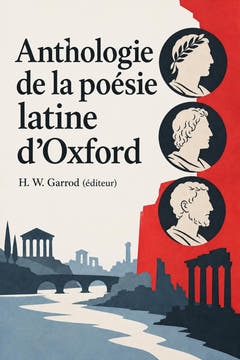
Résumé de Anthologie de la poésie latine d’Oxford
Free for 3 months
Get the full summary of Anthologie de la poésie latine d’Oxford, free
- 200,000+ classics as eBooks, audiobooks and 15-minute summaries, and print and large print at cost
- Up to 5 readers in your home on one plan

Go deeper: the whole of Anthologie de la poésie latine d’Oxford
About 10 h 30 min to read.Commencez 90 jours gratuitsÀ qui s’adresse-t-il ?
Readers who love a bright poem read aloud, and who are curious about Roman love, grief, farm life, gods, and jokes, will find a rich companion here.
De quoi parle ce livre ?
What do a prayer to the war god Mars, a love poem about a lost heart, and a letter from a man exiled to the edge of the known world have in common? They are all Latin verse, and they all sit in this book. The Oxford Book of Latin Verse, edited by H. W. Garrod, gathers poems from the earliest chants of Roman priests to the writers of about 500 A.D.
Poets appear in the order of their dates. Famous names such as Lucretius, Catullus, Vergil, Horace, Propertius, and Ovid stand beside many you may never have heard. You get a journey through a thousand years of sound, subject, and image, and the first stop is the oldest Latin of all.
Dans ce résumé
- 1Latin verse begins with prayers, charms, and tombsFree
- 2The first poets give Rome a voice
- 3Ennius gives Rome an epic and a tragic stage
- 4Roman tragedy grows bold with Pacuvius and Accius
- 5Late Republic poets write about love, scandal, and omens
- 6Lucretius argues against fear in verse
- 7Catullus turns the personal life into poetry
- 8Vergil and Horace turn the countryside and the day into art
- 9The elegists write about love as a kind of service
- 10Ovid moves from clever love poems to exile
- 11Empire and late voices end with English echoes
Point clé 1 sur 11
Latin verse begins with prayers, charms, and tombs
The book opens with scraps that Romans sang long before there was any literature. The hymns of the Salii invoke the gods. The Arval Brotherhood chant repeats its petitions three times as the singers beg Mars to keep blight and ruin away.
Short charms follow, and they are practical. One asks the earth to hold a disease, so that health may stay in the feet of a man with gout. A lullaby of a few repeated words tells a child to sleep.
Then come the epitaphs of the Scipios, carved for a family of Roman commanders. They list offices held, towns taken, and virtues shown, so that a passer-by can read a whole career in a few lines. A tomb was a public record. Latin verse begins as a tool for prayer, healing, and public memory.
That’s 1 of 11 key points.
The rest of the summary, written and spoken, and the whole book: free to start.
- Nothing to pay today · Renews every year
- We email you before you pay
- Cancel online in two clicks
Take this summary with you
Send to Kindle downloads the file and opens Amazon's page: drop the file there.
Go deeper: the whole of Anthologie de la poésie latine d’Oxford
About 10 h 30 min to read.Commencez 90 jours gratuitsPaperback, hardcover and large print, printed for you at cost, are on their way.Email me when it is printed
About this edition
Every format is free to start, and print and large print are at cost.
- LengthAbout 145,600 words
- Reading timeAbout 10 h 10 min
Questions about Anthologie de la poésie latine d’Oxford
What is The Oxford Book of Latin Verse about?
It is an anthology of Latin poetry arranged by date, from the earliest hymns and charms of Rome to poets of about 500 A.D. It includes epic, tragedy, love poems, epitaphs, and epigrams, followed by English translations.
Which poets are in The Oxford Book of Latin Verse?
It includes Ennius, Lucretius, Catullus, Vergil, Horace, Tibullus, Propertius, Sulpicia, Ovid, Seneca, Statius, Martial, Ausonius, Claudian, and many lesser-known or anonymous writers, each with a few poems or longer selections.
Is the book easy to approach for a new reader?
Yes, because the poems are short, arranged by date, and set under clear headings. You can read a single epitaph, a love poem, or a farm scene, then move on to the next.
What are the main themes in these Latin poems?
Recurring subjects include love and jealousy, grief and epitaphs, fear of death, the pleasures of country life, friendship and patrons, the gods and omens, exile, and the hope that poetry outlasts the poet.
Cite this edition
The Oxford Book of Latin Verse. Library of Alexandria, 2026, libraryofalexandria.com/products/the-oxford-book-of-latin-verse.
The Oxford book of Latin verse. (2026). Library of Alexandria. https://libraryofalexandria.com/products/the-oxford-book-of-latin-verse
The Oxford Book of Latin Verse. Library of Alexandria, 2026. https://libraryofalexandria.com/products/the-oxford-book-of-latin-verse.
@book{anonymous2026oxford,
  title = {The Oxford Book of Latin Verse},
  publisher = {Library of Alexandria},
  year = {2026},
  url = {https://libraryofalexandria.com/products/the-oxford-book-of-latin-verse}
}
Free for 3 months
Get the full summary of Anthologie de la poésie latine d’Oxford, free
- 200,000+ classics as eBooks, audiobooks and 15-minute summaries, and print and large print at cost
- Up to 5 readers in your home on one plan








