





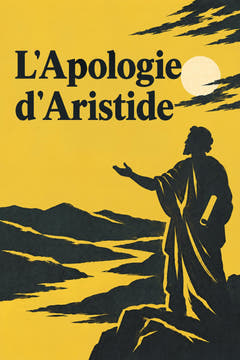
Résumé
Résumé de The Apology of Aristides
À qui s’adresse-t-il ?
For readers who love early church history, short ancient arguments, and accounts of how Christians first spoke to Roman rulers.
De quoi parle ce livre ?
The Apology of Aristides is a short defence of Christianity written in the second century by a man called Aristides, who is described as a philosopher of Athens. It is addressed to a Roman emperor. The church historian Eusebius, writing in the fourth century, says it was given to Hadrian. The Syriac version names the emperor with the name Antoninus, so scholars still debate whether it dates from about 125 or from the reign of Antoninus Pius, some years later.
For a long time the work was known only by report. Then, in the late nineteenth century, it came back into view. A fragment in Armenian was published in 1878. In 1889 the scholar Rendel Harris found a complete Syriac translation at the monastery of Saint Catherine on Mount Sinai. It was then seen that a Greek form of the text sits inside the medieval tale of Barlaam and Josaphat, and a small Greek papyrus fragment also survives. The Greek and Syriac differ in places.
The argument is simple and bold. The order of the world points to one God. Humankind falls into peoples who have understood him badly. Only the Christians, Aristides says, live as the truth requires. Let us begin with the sky and the sea.
Dans ce résumé
- 1The order of the world points to GodFree
- 2God is uncreated, unchanging and good
- 3Humankind divides into four peoples
- 4The Greek gods fail the test
- 5The Jews come closer but fall short
- 6Christians live as the truth requires
Point clé 1 sur 6
The order of the world points to God
Aristides opens with a plain observation. He looks at the heavens, the earth and the sea, and sees that everything in them is moved by something else. The sun, the stars, the seasons and the winds do not move themselves. So he concludes that there must be a mover who is greater than all that he moves.
He does not claim to understand this mover fully. He says that to search out his nature in every detail is beyond a human being. But he can say that the world is not self-made, and that whoever made it must be stronger and wiser than the things made. This is the kind of reasoning Greek thinkers used, and Aristides, as a man from Athens, uses it to open his case.
The opening also sets his tone. He does not begin by quoting scripture or by naming Jesus. He begins where an educated Roman reader might begin, with the sky, the order of nature and the question of what stands behind it. The emperor is invited to follow a line of thought, not to take a creed on trust.
The text survives in more than one form, and that matters for how we read it. The Syriac version is longer and fuller. The Greek form, found inside the story of Barlaam and Josaphat, is shorter and reworded. Scholars compare them to work out what the original read like, and they still disagree on details. The outline of the argument, however, is the same in both.
That’s 1 of 6 key points.
The rest of the summary, written and spoken, and the whole book: free to start.
- Nothing to pay today · Renews every year
- We email you before you pay
- Cancel online in two clicks
Questions about The Apology of Aristides
What is the Apology of Aristides about?
It is a short defence of Christianity addressed to a Roman emperor. It argues that one uncreated God stands behind the world, that the pagan gods and many Jewish practices fall short, and that Christians live most truly.
When was the Apology of Aristides written?
Scholars disagree. Eusebius links it to the reign of Hadrian, around 125. Others place it under Antoninus Pius, in the 140s, based on the Syriac heading. Either way, it is from the second century.
Who was Aristides of Athens?
He is known mainly from Eusebius, who calls him an Athenian philosopher and Christian. The Apology is the only work credited to him, so little else is known about his life with certainty.
How was the Apology of Aristides rediscovered?
An Armenian fragment was published in 1878. In 1889 Rendel Harris found a full Syriac version at Saint Catherine's monastery on Sinai. A Greek form was then recognised inside the tale of Barlaam and Josaphat.
What are the four peoples in the Apology of Aristides?
He divides humankind into barbarians and Greeks, Jews, and Christians in the Syriac text. The Greek text separates the Chaldeans, Greeks and Egyptians first. Each is judged by how well it knows God.