Resumen
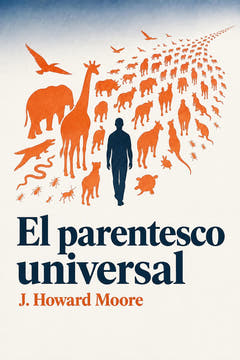
Resumen de El parentesco universal
El parentesco universal de un vistazo
Resumen: 8 min de lectura
- Tiempo de lectura
- Unas 5 h 15 min4 h 10 min fast, 6 h 15 min slow
- Duración
- 75.400 palabras
- Nivel en la biblioteca
- Exigente long sentences, a rich vocabulary
- Primera publicación
- 1906by J. Howard Moore
Reading time at 238 words a minute (fast 300, slow 200). Cuánto se tarda en leer los clásicos · Actualizado
Free for 3 months
Get the full summary of El parentesco universal, free
- 200,000+ classics as eBooks, audiobooks and 15-minute summaries, and print and large print at cost
- Up to 5 readers in your home on one plan

Para quién es
Readers who love natural history, early Darwinian thought, animal stories and moral argument will find a lot here, along with a writer who has a strong voice and a cause.
De qué trata este libro
A newborn baby can hang from a finger by its own grip for minutes. Why can an infant do what many grown adults cannot? J. Howard Moore says the answer lies in our ancestors, who clung to branches and to their mothers.
The Universal Kinship, published in Chicago in 1905, is his case that every living being is related to every other. Moore was an American zoologist and teacher. He argues that the tie is physical, mental and moral, and that if it is real, how we treat other creatures is a question of right and wrong. You will hear the whole case, from bones and embryos to dogs, ants and ethics.
En este resumen
- 1Humans are animals made of common clayFree
- 2One vertebrate plan runs from fish to philosophers
- 3Humans are mammals and primates, close to apes
- 4Similar structures point to shared descent
- 5Variation, heredity and environment shape all life
- 6Embryos and leftover organs record ancestry
- 7Fossils, maps and breeders confirm evolution
- 8Minds evolved along with bodies
- 9Animals love, grieve, reason and learn
- 10Ethics should widen to include every feeling being
Idea clave 1 de 10
Humans are animals made of common clay
Moore opens with a plain claim. A human being is an animal in the most literal sense. He is not a rock, a plant or a god, and he carries no spark of the divine that other creatures lack.
He starts with the materials. The human body is made of the same elements found in water, air and soil. Every animal begins as a single cell, and for a time a dog, a frog, a worm and a philosopher cannot be told apart as embryos. All of them take in oxygen and give off carbon dioxide, and every animal lives by burning what plants build in sunlight.
People have long pictured a chasm between themselves and every other creature, as if the rest were made for human use. Moore admits he held that view himself, and he calls it a habit taught from the cradle. You are one animal inside a vast family, built from the same stuff. Humans are animals first, made of the same clay as every living thing.
That’s 1 of 10 key points.
The rest of the summary, written and spoken, and the whole book: free to start.
- Nothing to pay today · Renews every year
- We email you before you pay
- Cancel online in two clicks
Lleva este resumen contigo
Envía a Kindle descarga el archivo y abre la página de Amazon: arrastra el archivo allí.
Profundiza: El parentesco universal al completo
Unos 5 h 30 min de lectura.Empieza 90 días gratisPronto llegará en tapa blanda, tapa dura y letra grande, impreso para ti al costo de impresión.Avísame por correo cuando esté impreso
About this edition
Every format is free to start, and print and large print are at cost.
- LengthAbout 75,400 words
- Reading timeAbout 5 h 15 min
Questions about El parentesco universal
What is The Universal Kinship about?
It argues that all living beings are related in body, mind and morals through evolution. Moore uses anatomy, embryos, fossils and animal behavior to show the family tie, then asks how humans should treat their fellow creatures.
When was The Universal Kinship written and who was J. Howard Moore?
It appeared in Chicago in 1905. Moore was an American zoologist and teacher who wrote on evolution and ethics, and who died in 1916. The book reflects the science and debates of its time.
What does universal kinship mean in the book?
It means every creature is linked by common descent. Because bodies, feelings and basic needs are shared, Moore says the same moral concern we owe people should reach other animals too.
How is the book organized?
It has three parts called the Physical Kinship, the Psychical Kinship and the Ethical Kinship. Short numbered chapters move from bones and embryos to animal minds and then to moral conduct, so each step is easy to follow.
What is the main message of The Universal Kinship?
The main message is that humans are one branch of a single family of life, and that the Golden Rule should cover every being that can feel pleasure and pain.
Cita esta edición
Moore, J. Howard. The Universal Kinship. Library of Alexandria, 2026, libraryofalexandria.com/products/the-universal-kinship.
Moore, J. H. (2026). The universal kinship. Library of Alexandria. https://libraryofalexandria.com/products/the-universal-kinship (Original work published 1906)
Moore, J. Howard. The Universal Kinship. Library of Alexandria, 2026. https://libraryofalexandria.com/products/the-universal-kinship.
@book{moore2026universal,
  author = {Moore, J. Howard},
  title = {The Universal Kinship},
  publisher = {Library of Alexandria},
  year = {2026},
  url = {https://libraryofalexandria.com/products/the-universal-kinship},
  note = {First published 1906}
}
Free for 3 months
Get the full summary of El parentesco universal, free
- 200,000+ classics as eBooks, audiobooks and 15-minute summaries, and print and large print at cost
- Up to 5 readers in your home on one plan