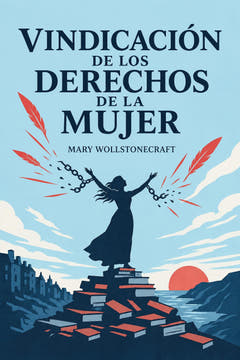
Resumen
Resumen de Vindicación de los derechos de la mujer

Go deeper: the whole of Vindicación de los derechos de la mujer
About 5 h 50 min to read.Para quién es
Readers drawn to spirited arguments about education, equality and the roots of modern feminism will love this book. It offers a bold eighteenth century voice questioning famous thinkers about women and reason.
De qué trata este libro
What would happen if half of humanity were taught to reason instead of being taught to please? That is the question Mary Wollstonecraft puts to her readers, and she puts it with a sharp pen. She wrote this book in 1792, in plain language and in a hurry, and she addressed it to a French statesman whose plans for national education gave girls fewer chances than boys.
Her target is a whole system of flattery, manners and books that trains girls to be charming and little else. She answers its authors point by point, above all Jean-Jacques Rousseau, whose ideal girl Sophia is raised to obey. You will hear each main idea in turn, with the scenes she uses to prove it, starting with her opening letter to a bishop turned politician.
En este resumen
- 1Prove women lack reason or grant them rightsFree
- 2Reason, virtue and knowledge measure every human being
- 3Inherited power and rigid ranks corrupt everyone
- 4Virtue has one standard for both sexes
- 5Training girls to please makes them weak and cunning
- 6Famous advisers teach women to flatter and to hide
- 7Habit and modesty must rest on reason, not on show
- 8Reputation and men's habits are what undermine morals
- 9Wealth, rank and dependence rob women of duty
- 10Educate boys and girls together and expect a revolution
Idea clave 1 de 10
Prove women lack reason or grant them rights
The book opens with a letter to Talleyrand, a French statesman and former bishop of Autun. He had published a pamphlet on national education, and Wollstonecraft read it with pleasure. Yet she notes that he treated women too casually.
Her challenge is simple. Talleyrand had remarked that it was hard to explain, on abstract principles, why half the human race is shut out of government. Wollstonecraft takes him at his word. If rights rest on reason, then anyone who denies them to women must first prove that women have no reason.
Custom is no argument, she adds, and slavery of any kind degrades master and servant alike. Women kept in ignorance will use cunning to win a little of the power they are denied. For a listener today, the letter shows the method of the whole book: take the principles a society already claims and ask why they stop at half its people. A cause that appeals to reason must accept reason's test.
That’s 1 of 10 key points.
The rest of the summary, written and spoken, and the whole book: free to start.
- Nothing to pay today · Renews every year
- We email you before you pay
- Cancel online in two clicks
Take this summary with you
Send to Kindle downloads the file and opens Amazon's page: drop the file there.
Go deeper: the whole of Vindicación de los derechos de la mujer
About 5 h 50 min to read.Paperback, hardcover and large print, printed for you at cost, are on their way.Email me when it is printed
About this edition
Every format is free to start, and print and large print are at cost.
- LengthAbout 87,000 words
- Reading timeAbout 5 h 50 min
- FormatseBook, large-print eBook, audiobook, 15-minute summary
- LanguagesEnglish and 12 other languages
Questions about Vindicación de los derechos de la mujer
What is A Vindication of the Rights of Woman about?
It argues that women are rational beings who have been made weak by poor education and social custom. Wollstonecraft says women should receive the same education and rights as men, so they can become independent, virtuous citizens and good mothers.
Why does Wollstonecraft criticize Rousseau?
Rousseau, in his book on education, describes an ideal girl called Sophia who is raised to please and obey. Wollstonecraft says this training denies women reason, makes them cunning and dependent, and contradicts his own praise of liberty and virtue.
When was A Vindication of the Rights of Woman written?
Wollstonecraft published it in 1792, during the years of the French Revolution. She addressed it to the French statesman Talleyrand, whose proposed national education plan offered girls more restricted schooling than boys.
Is the book approachable for modern readers?
Yes, in the sense that it is direct and organized by clear questions. Wollstonecraft speaks plainly, uses vivid examples such as the two mothers and the day school plan, and repeatedly returns to reason, virtue, independence, and education.
What is the main message of the book?
Rights and duties belong together, and reason is the same in every human being. If society wants virtuous women and good families, it must teach women to think, let them earn a living, and treat them as equal citizens.
Cite this edition
Wollstonecraft, Mary. A Vindication of the Rights of Woman. Library of Alexandria, 2026, libraryofalexandria.com/products/a-vindication-of-the-rights-of-woman.
Wollstonecraft, M. (2026). A vindication of the rights of woman. Library of Alexandria. https://libraryofalexandria.com/products/a-vindication-of-the-rights-of-woman (Original work published 1792)
Wollstonecraft, Mary. A Vindication of the Rights of Woman. Library of Alexandria, 2026. https://libraryofalexandria.com/products/a-vindication-of-the-rights-of-woman.
@book{wollstonecraft2026vindication,
  author = {Wollstonecraft, Mary},
  title = {A Vindication of the Rights of Woman},
  publisher = {Library of Alexandria},
  year = {2026},
  url = {https://libraryofalexandria.com/products/a-vindication-of-the-rights-of-woman},
  note = {First published 1792}
}





