
 11 h 32 minAudiobook8 minSummaryRead it, hear it, the 15-minute summary, and print and large print at cost
 Audiobook edition · 11 h 32 minPaperback · 6 × 9 in · printing soonHardcover · 6 × 9 in · printing soon
About this book
What did the Bible’s writers see when they looked up at the night sky?
In The Astronomy of the Bible, E. Walter Maunder follows Scripture’s sky passages with the eye of a trained observer. He explores the sun and moon, stars and constellations, asking what a shepherd or priest could see without a telescope. His starting point is simple: this is the sky of the naked eye.
Maunder brings patient attention to names such as Orion and the Pleiades, the thin crescent that marks a Hebrew month, and the long day described in Joshua. He asks what the Hebrew words most likely mean and reads the heavens of Genesis and the psalms as ancient descriptions of how the world looks.
What you’ll discover
- The sky without telescopes Look at familiar scriptural passages through the visible world their writers describe.
- A calendar in the heavens Follow the moon’s thin evening crescent into Maunder’s account of the Hebrew calendar.
- Stars with puzzling names Explore Orion, Arcturus, the Pleiades, and the difficult term Mazzaroth in Job and Amos.
- Creation as a visible world Consider how Maunder reads the vault and lights described in Genesis and the psalms.
- Unusual signs, careful questions Examine Maunder’s discussion of Joshua’s long day, when the text says the sun stands still.
Who will love it
This book suits readers who love both the night sky and the Bible, who enjoy ancient calendars, star lore and Babylonian tablets, and who like to see a scientist test old texts against observation.
What’s inside
The key ideas, in the 15-minute summary
- Genesis frees nature from the gods
- Genesis did not borrow from Babylon
- The firmament is an expanse, not a shell
- Sun and moon serve as lights and clocks
- Stars, comets and eclipses speak of order
- Astrology is the enemy of astronomy
- The constellations are older than Israel
- Job's star names point to real star groups
- The calendar rests on sun, moon and Jubilee
- Three marvels call for careful reading
Formats and delivery
- eBook
- On your phone, tablet or computer, once the book texts are online.
- Large-print eBook
- The same book in bigger, clearer type, once the book texts are online.
- Audiobook
- Read by Lucas Linden, complete. It opens once the recording is online.
- 15-minute summary
- The key ideas in about 8 minutes, to read today.
- Paperback
- 6 × 9 in. Printing soon: leave your email under Paperback or Hardcover above.
- Hardcover
- 6 × 9 in. Printing soon: leave your email under Paperback or Hardcover above.
- Large print paperback
- 8.5 × 11 in. Printing soon: leave your email under Paperback or Hardcover above.
- Large print hardcover
- 8.5 × 11 in. Printing soon: leave your email under Paperback or Hardcover above.
Every printed copy is made when you order it and shipped worldwide; shipping is shown at checkout. The eBook and the audiobook open when the book texts go online.
How it works
- Start free. Nothing to pay today; the eBook of this book is yours to keep.
- Read, listen and print. 200,000+ classics as eBook, large-print eBook, audiobook and 15-minute summary, and any book printed at cost as a paperback, hardcover or large print, 5 accounts for the price of one.
- We remind you first. Free for 3 months, and we email you 7 days before your first payment. Then 0,14 USD a day in your first year on the yearly plan and 0,27 USD a day after, or 0,66 USD a day on the monthly plan. Cancel online in two clicks.
Bought on its own? Every eBook, audiobook and printed book you buy without the plan carries our 30-day money-back guarantee.
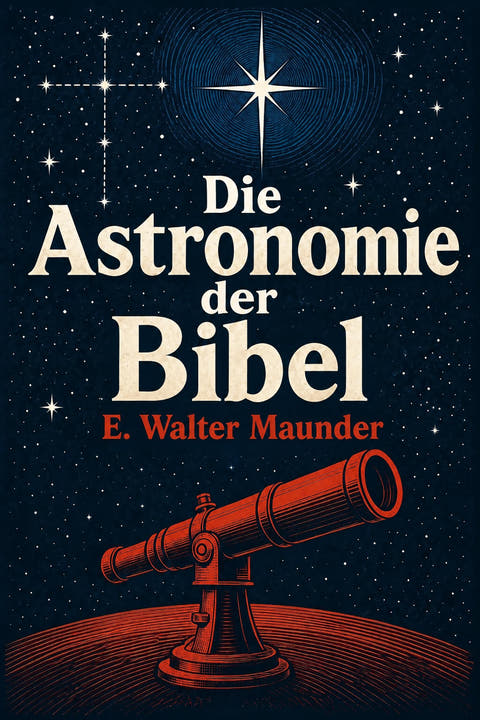
Die Astronomie der Bibel
 by E. Walter Maunder · 1908
An astronomer reads Joshua's long day, Job's star names and the Jubilee by the light of the real sky.
Medium level10–20 hours to readDeutsch
Excellent
- Read or listen
- Print and large print at cost
- 5 accounts for the price of one
Free for 3 months · starts right away, on any device
Read free3 months free · cancel anytimeFree for 3 months, then 0,14 USD a dayCancel anytimeHow it works


In short
Why would an astronomer write a commentary on the Bible? E.
From the 15-minute summary · Key idea 1
Genesis frees nature from the gods
Maunder opens with a total eclipse of the sun in India. Astronomers from England, America and Japan have two minutes under a clear sky to photograph the silver halo around the dark disc. Along the sacred river, a vast crowd weeps in terror for their suffering god. One sky is seen in two ways.
The difference, he says, is spiritual first. If the sun and moon are gods, dissecting them is profane, and many gods mean many laws. Science needs one law, the law of causality: the same causes bring the same results. Observation teaches nothing unless this law holds.
Free for 3 months · Cancel anytime
You looked at
Which edition is right for me
- 15-minute summary
- The key ideas of the whole book in about 8 minutes. A good first look, or a refresher.
Details
- First published
- 1908
- Language
- Deutsch
- Level
- Medium level
Cite this edition
Maunder, E. Walter. The Astronomy of the Bible. Library of Alexandria, 2026, libraryofalexandria.com/products/the-astronomy-of-the-bible.
Maunder, E. W. (2026). The astronomy of the Bible. Library of Alexandria. https://libraryofalexandria.com/products/the-astronomy-of-the-bible (Original work published 1908)
Maunder, E. Walter. The Astronomy of the Bible. Library of Alexandria, 2026. https://libraryofalexandria.com/products/the-astronomy-of-the-bible.
@book{maunder2026astronomy,
  author = {Maunder, E. Walter},
  title = {The Astronomy of the Bible},
  publisher = {Library of Alexandria},
  year = {2026},
  url = {https://libraryofalexandria.com/products/the-astronomy-of-the-bible},
  note = {First published 1908}
}
Free gifts
580 USD in free gifts when you start
Every book in every format and in 25 languages, 5 accounts for the price of one. Nothing to pay today.
- 200,000+ classic eBooksIn 25 languages, side by side
170 USDFREE - Every audiobookIn 25 languages, any device
120 USDFREE - 15-minute summariesRead or listen, in 25 languages
60 USDFREE - Print at cost, no markupPaperback, hardcover, large print
60 USDFREE - 5 accounts for the price of oneA shelf for everyone at home
170 USDFREE - A part in rebuilding the libraryNew languages and books for all
FREE
Questions about Die Astronomie der Bibel
Can I read it free?
Yes. The first key idea of the 15-minute summary is free with no sign-up. Start free and the whole book is yours for 3 months, with the eBook to keep, plus 200,000+ more classics and any book printed at cost as a paperback, hardcover or large print. Nothing to pay today: we email you 7 days before your first payment, and you can cancel online in two clicks.
Can I buy the printed book?
Soon. The paperback, hardcover and large print editions are being prepared. Choose Paperback or Hardcover above, leave your email, and we tell you the day you can order it, printed at cost.
How many accounts do I get?
Five, for the price of one: you and 4 more people, each with their own login, shelf and their own place in every book.
Can I cancel anytime?
Yes. Cancel online in two clicks at any time and nothing more is charged. Nothing is charged in your first 3 months, and we email you 7 days before your first payment.
What is The Astronomy of the Bible about?
It looks at every place where Scripture touches the sky: creation, clouds, sun, moon, stars, eclipses, constellations, calendars, and three miracles. Maunder explains each reference as an astronomer would, asking what the writers saw and what each verse teaches.
What does the Hebrew word raqia, firmament, mean?
Maunder says raqia means an expanse, something stretched out, not a solid dome. He backs this with Isaiah's image of the heavens stretched like a curtain and with verses that place the waters above in the clouds.
What explanation does Maunder give for Joshua's long day?
He reads the sun over Gibeon as noon, takes Joshua's cry as a prayer for relief from heat, and notes that the army covered a day's march between noon and sunset. The marched miles were its only clock.

The author
E. Walter Maunder
1851–1928 · English astronomer
Edward Walter Maunder (1851–1928) was an English astronomer who lived and worked in London. He worked at the Royal Observatory in Greenwich and studied sunspots and changes in the Sun’s activity. He also wrote books about astronomy, including The Astronomy of the Bible, which was published in 1908.
More like this
Our mission
The library burned once. We are building it back.
Every great book, in every language and every format, for every family. Every plan helps pay for new languages, new audiobooks and books for readers who have never had them. Join the movement.
Read our story- Every language25 languages today, side by side, and more every year
- No wastePrinted on demand: no warehouses, no unsold stock, no pulped copies
- For everyonePaperback, hardcover and large print at the cost of printing








