








 13 h 56 minAudiobook8 minSummaryRead it, hear it, the 15-minute summary, and print and large print at cost
 Audiobook edition · 13 h 56 minPaperback · 6 × 9 in · printing soonHardcover · 6 × 9 in · printing soon
About this book
How does a literature grow from epic songs into a world of rogues, knights, mystics and playwrights?
In A History of Spanish Literature, James Fitzmaurice-Kelly gives English readers a connected path through Spain’s writing. He begins with medieval poems and chronicles, including the Cantar de mio Cid, then follows the changes of the Renaissance. Fernando de Rojas’s Celestina helps mark a world of new forms and new rogues.
Miguel de Cervantes stands at the centre of this survey. Around him, Fitzmaurice-Kelly traces the rise of Spain’s great theatre, the weaker years of the eighteenth century and the nineteenth-century revival. He offers judgments as well as history, explaining what he values in each writer and showing how one age answers another.
What you’ll discover
- Roots in epic song Begin with the Cantar de mio Cid and the warrior at its heart.
- A Renaissance of change Explore Celestina as Spanish writers turn toward new forms and a wider world.
- Cervantes at the centre Meet the writer who anchors Fitzmaurice-Kelly’s account, guided by a scholar of his life.
- The stage comes forward Follow the rise of national drama through the theatre of Spain’s Golden Age.
- Decline and renewed colour Trace the passage from thinner literary years to Romanticism’s passion in poetry and drama.
Who will love it
For readers who love a clear map of Spanish writing before exploring Cervantes, Lope de Vega or Calderón, and students who enjoy an orderly survey of medieval epics, Renaissance writers and the Spanish stage.
What’s inside
The key ideas, in the 15-minute summary
- Spain's writing begins in song and chronicle
- The Renaissance brings new forms and new rogues
- Cervantes stands at the centre of the story
- The theatre of the Golden Age
- Decline, imitation and a slow recovery
- The nineteenth century and the critic's view
Formats and delivery
- eBook
- On your phone, tablet, computer or Kindle, with the type as large as you like.
- Large-print eBook
- The same book in bigger, clearer type, from the first page.
- Audiobook
- 13 h 56 min, complete, read by Lucas Linden.
- 15-minute summary
- The key ideas in about 8 minutes, to read or to hear.
- Paperback
- 6 × 9 in. Printing soon: leave your email under Paperback or Hardcover above.
- Hardcover
- 6 × 9 in. Printing soon: leave your email under Paperback or Hardcover above.
- Large print paperback
- 8.5 × 11 in. Printing soon: leave your email under Paperback or Hardcover above.
- Large print hardcover
- 8.5 × 11 in. Printing soon: leave your email under Paperback or Hardcover above.
eBooks and audiobooks open right away. Download EPUB or PDF, or send the book to your Kindle. Every printed copy is made when you order it and shipped worldwide; shipping is shown at checkout.
How it works
- Start free. Nothing to pay today; the eBook of this book is yours to keep.
- Read, listen and print. 200,000+ classics as eBook, large-print eBook, audiobook and 15-minute summary, and any book printed at cost as a paperback, hardcover or large print, 5 accounts for the price of one.
- We remind you first. Free for 3 months, and we email you 7 days before your first payment. Then 0,14 USD a day in your first year on the yearly plan and 0,27 USD a day after, or 0,66 USD a day on the monthly plan. Cancel online in two clicks.
Bought on its own? Every eBook, audiobook and printed book you buy without the plan carries our 30-day money-back guarantee.
25 languages, side by side
Read and hear Geschichte der spanischen Literatur in 25 languages and switch at any time. Or read two side by side, paragraph by paragraph: the way to learn a language with a book you love.
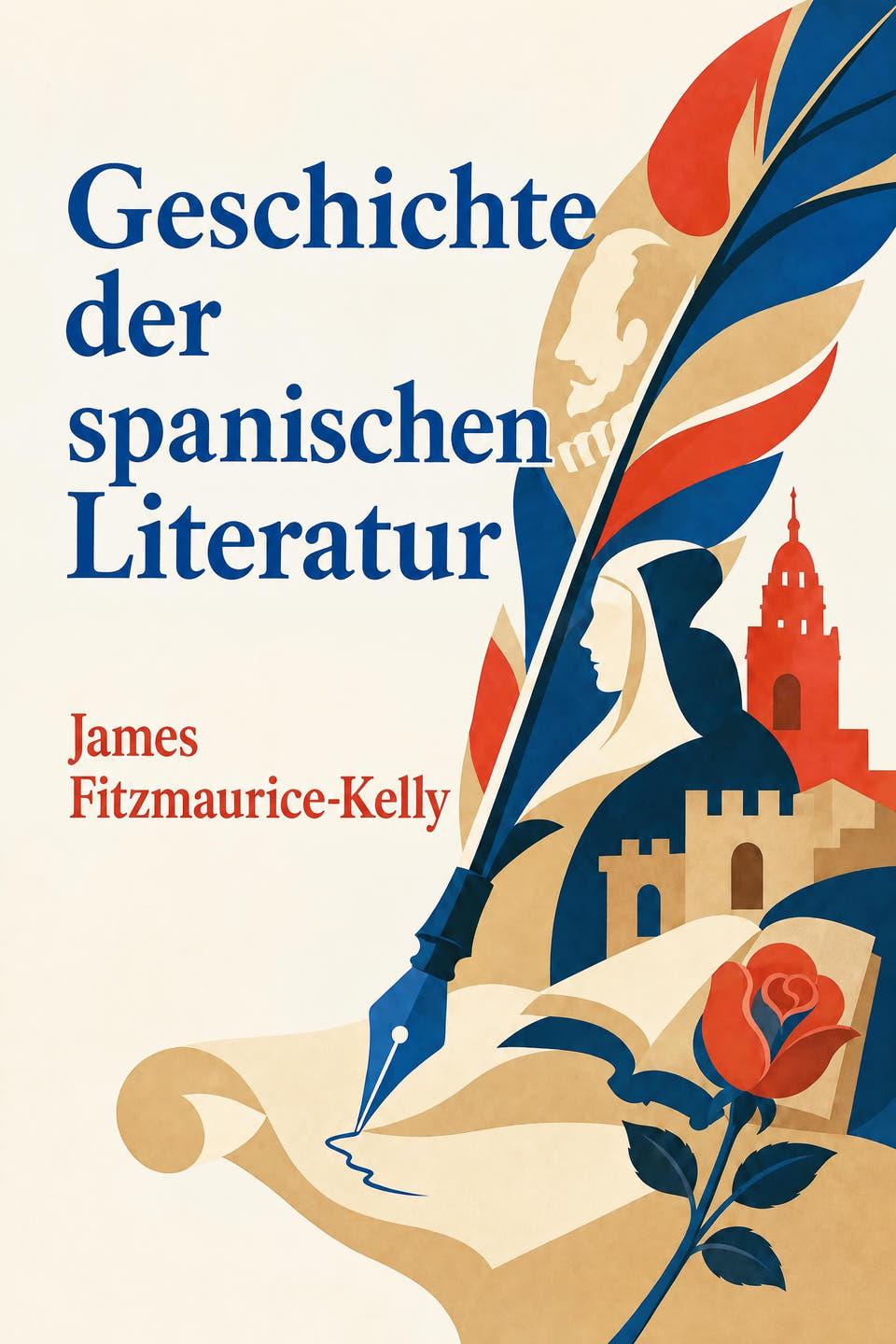
Geschichte der spanischen Literatur
 by James Fitzmaurice-Kelly · 1898
From medieval songs to Cervantes and the Spanish stage, discover how Spain's writers shape a literature.
Challenging10–20 hours to read25 languages
Excellent
- Read or listen
- 25 languages, side by side
- Print and large print at cost
- 5 accounts for the price of one
Free for 3 months · starts right away, on any device
Read free3 months free · cancel anytimeFree for 3 months, then 0,14 USD a dayCancel anytimeHow it works


In short
A History of Spanish Literature was written by James Fitzmaurice-Kelly and first published in 1898. He was a British scholar who spent his working life on Spanish books and Spanish writers.
From the 15-minute summary · Key idea 1
Spain's writing begins in song and chronicle
The oldest great poem is the Cantar de mio Cid, an epic about the Castilian warrior Rodrigo Díaz, known as the Cid. Its lines are plain, rough and direct, and the hero is a loyal vassal who is wronged by his king yet still serves him. The author treats it as the starting stone of everything that follows.
He then looks at the learned verse of the thirteenth century. Gonzalo de Berceo, a priest, wrote devout poems about saints and the Virgin Mary in simple language that ordinary listeners could follow. King Alfonso X, called the Wise, gathered scholars at his court and helped make Castilian a language fit for history, law and science. Fitzmaurice-Kelly values this moment because prose in Spanish grows up under his direction.
Free for 3 months · Cancel anytime
Free gifts
580 USD in free gifts when you start
Every book in every format and in 25 languages, 5 accounts for the price of one. Nothing to pay today.
- 200,000+ classic eBooksIn 25 languages, side by side
170 USDFREE - Every audiobookIn 25 languages, any device
120 USDFREE - 15-minute summariesRead or listen, in 25 languages
60 USDFREE - Print at cost, no markupPaperback, hardcover, large print
60 USDFREE - 5 accounts for the price of oneA shelf for everyone at home
170 USDFREE - A part in rebuilding the libraryNew languages and books for all
FREE
Questions about Geschichte der spanischen Literatur
Can I read it free?
Yes. The first key idea of the 15-minute summary is free with no sign-up. Start free and the whole book is yours for 3 months, with the eBook to keep, plus 200,000+ more classics and any book printed at cost as a paperback, hardcover or large print. Nothing to pay today: we email you 7 days before your first payment, and you can cancel online in two clicks.
Can I buy the printed book?
Soon. The paperback, hardcover and large print editions are being prepared. Choose Paperback or Hardcover above, leave your email, and we tell you the day you can order it, printed at cost.
How many accounts do I get?
Five, for the price of one: you and 4 more people, each with their own login, shelf and their own place in every book.
Can I cancel anytime?
Yes. Cancel online in two clicks at any time and nothing more is charged. Nothing is charged in your first 3 months, and we email you 7 days before your first payment.
What is A History of Spanish Literature about?
It is a survey of Spanish writing from the medieval epics and ballads through the Renaissance, the age of Cervantes and the theatre of the seventeenth century, to the novelists and poets of the nineteenth century.
Who was James Fitzmaurice-Kelly?
He was a British scholar of Spanish who taught at King's College London and died in 1923. He is best known for his work on Cervantes and for this survey, which helped introduce Spanish literature to English readers.
When was A History of Spanish Literature written?
It was first published in 1898. That means it covers writers up to the end of the nineteenth century and does not include the twentieth century.

The author
James Fitzmaurice-Kelly
1858–1923 · British scholar of Spanish literature
James Fitzmaurice-Kelly was a British scholar of Spanish language and literature. He was born in Glasgow in 1858 and died in 1923. He lived and worked in Britain, teaching Spanish at universities. He wrote A History of Spanish Literature, published in 1898, and other studies of Spanish writers.
More like this
Our mission
The library burned once. We are building it back.
Every great book, in every language and every format, for every family. Every plan helps pay for new languages, new audiobooks and books for readers who have never had them. Join the movement.
Read our story- Every language25 languages today, side by side, and more every year
- No wastePrinted on demand: no warehouses, no unsold stock, no pulped copies
- For everyonePaperback, hardcover and large print at the cost of printing

