








Zusammenfassung
Zusammenfassung von Alte Zeiten am Oberen Mississippi
Für wen es gedacht ist
This book suits readers who love river lore, steamboat machinery, frontier towns and the voices of people who did the work. It also rewards anyone curious about how trade, money and travel shaped the Midwest.
Worum es in diesem Buch geht
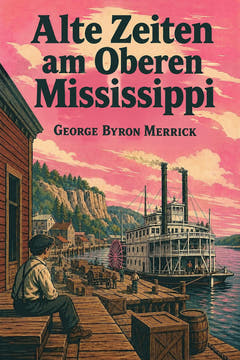
A small boy sits on a clay bank in Michigan and watches a steamboat go by. That boy is George Byron Merrick, who lives and works beside the Upper Mississippi from 1854 to 1862 and writes his recollections in 1908. He is a pantry boy, an engineer's helper, a second clerk and a pilot in training when the trade between Galena and St. Paul is at its busiest. He writes because the men and boats of that trade have vanished, and no one has set down how they lived. He can truthfully say he was a part of what he describes.
In dieser Zusammenfassung
- 1A boy from Michigan finds the riverFree
- 2The levee, the warehouse and the first job
- 3Engine room, steam and Billy Hamilton
- 4The office, the woodpile and the rulers of the boat
- 5Learning the river by heart
- 6Nerve, early pilots and the voices of old captains
- 7Menus, bars, cardsharps and races
- 8Profits, swindles and a wartime dash
- 9The river dies, and an old pilot comes back
Punkt 1 von 9
A boy from Michigan finds the river
Merrick is born in Niles, Michigan, into a family of sailors from Salem and Nantucket. At six he races to a bank of blue clay to watch steamers pass. His neighbor Kim Lyon says the man in the little house on top is pumping water into the boiler. Merrick calls this his first lesson in piloting.
In 1854 he and his brother Sam land at Prescott, Wisconsin, a rough town of settlers, Chippewa and Sioux. The boys spend summers in white pine dugouts, hunting arrowheads and camping without telling their mothers. Once a hidden branch tips Merrick under a huge raft of driftwood. He dives deeper, steers between the branches and surfaces with almost no breath left.
His one real fright comes when seven wolves chase him across the prairie. He pulls himself into a bur oak just ahead of their teeth, and the pack leaps below him for an hour. Scrapes like these teach the river boy nerve, and nerve is what the pilot house later demands.
That’s 1 of 9 key points.
The rest of the summary, written and spoken, and the whole book: free to start.
- Nothing to pay today · Renews every year
- We email you before you pay
- Cancel online in two clicks
Questions about Alte Zeiten am Oberen Mississippi
What is Old Times on the Upper Mississippi about?
It is George Byron Merrick's memoir of working on Mississippi steamboats between Galena and St. Paul in the 1850s and early 1860s. He covers boat crews, piloting, money, dangers, river towns and the end of the steamboat trade.
Who was Thomas Burns in the book?
Thomas Burns was a steady Scottish pilot on the Fanny Harris and Merrick's teacher in the pilot house. He knew every crossing from memory, drilled his cubs to back up when in doubt, and later welcomed Merrick aboard the Mary Morton.
What does mud clerk mean?
The mud clerk was the second clerk, who went out onto muddy levees in all weather to check freight in and out. Merrick explains the term in his chapter on the clerk's office, where he took the job after leaving the engine room.
Is Old Times on the Upper Mississippi a true story?
Yes, it is a first-person memoir written in 1908 about the author's own years on the river. It names real boats, captains and pilots, quotes Mark Twain's Life on the Mississippi, and adds lists of steamboats, distances and river improvements.
How does piloting a steamboat work in this book?
Merrick shows that pilots steered by memory of every bluff, bend and sandbar, even on pitch-black nights. They used leadsmen to check depths, held the wheel with delicate turns, and trained for years as cubs under experienced chiefs.